DaDaFest We believe the arts free the spirit to new - - PDF document

dadafest
SMART_READER_LITE
LIVE PREVIEW

DaDaFest We believe the arts free the spirit to new - - PDF document

22/11/2013 DaDaFest We believe the arts free the spirit to new ways of understanding, connec=ng and accep=ng DaDaFest Training 1 22/11/2013


slide-1
SLIDE 1

22/11/2013 ¡ 1 ¡

DaDaFest ¡ ¡

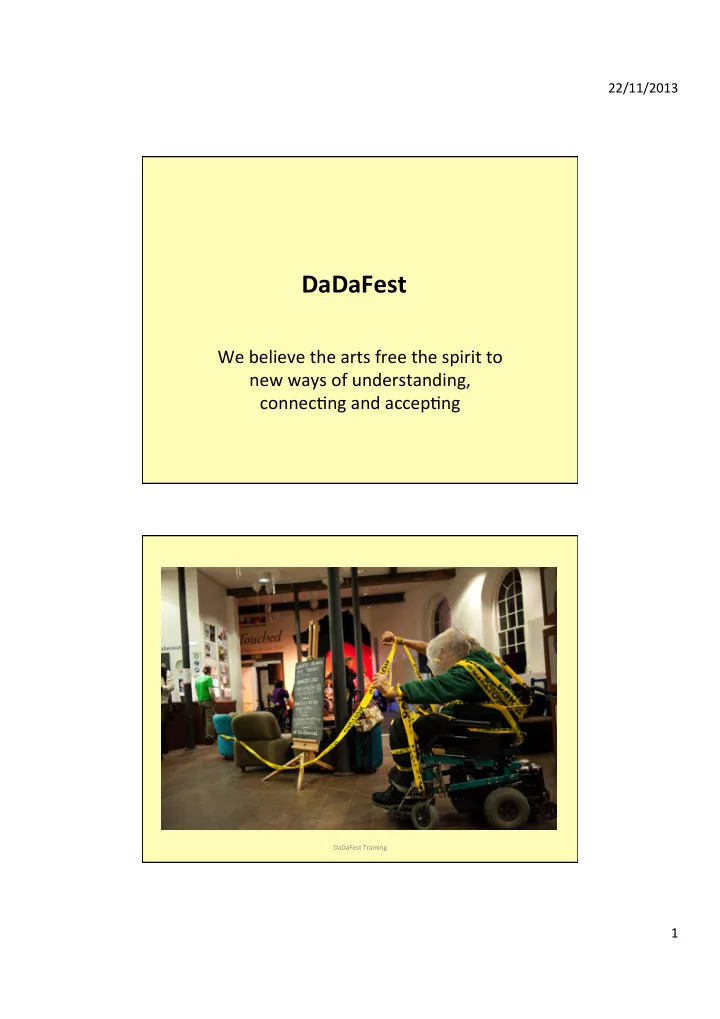
We ¡believe ¡the ¡arts ¡free ¡the ¡spirit ¡to ¡ new ¡ways ¡of ¡understanding, ¡ connec=ng ¡and ¡accep=ng ¡ ¡ ¡

DaDaFest ¡Training ¡
slide-2
SLIDE 2

22/11/2013 ¡ 2 ¡

DaDaFest ¡Training ¡

4

Historical Perspective of Disability

  • From earliest records, society has often treated Disabled

People as outcasts or cursed. Aristotle advised to get rid of ‘imperfect children’.

  • Ancient Romans would throw disabled children under horses

hooves, have blind gladiators fight each other and even had ‘dwarves’ fight woman.

  • Even Martin Luther said ‘drown the changeling child’
  • Yet, Disabled People were always prevalent in society due to

disease and lack of medical intervention and most of the time were accepted as part of the wider family unit.

  • Recent research by English Heritage shows that before the

Industrial revolution, as many as 60% of a community were thought to be disabled people .

slide-3
SLIDE 3

22/11/2013 ¡ 3 ¡

DaDaFest ¡Training ¡

6

Start of Institutionized Discrimination

  • With the industrial revolution,

Disabled People began to experience support structures disappear and for the first time, become institutionalised.

  • The Institutions were based

upon impairments i.e. blind, deaf and crippled.

  • Eugenics movement grew in

strength in the wake of Darwin’s Theory Evolution

  • Mary Dendy – an active

eugenicist in 1890 said, that children classed as ‘Mentally handicapped should be , “detained for the whole of their lives as the only way to stem the great evil of feeble- mindedness in our country”.

  • This has led to segregation,

sterilisation, stereotying to discrimination in education, work and in opportunities to participate in every day life

slide-4
SLIDE 4

22/11/2013 ¡ 4 ¡

DaDaFest ¡Training ¡

8

The Social Model of Disability

The following distinction is made:

  • Impairment or impairments is/are the

loss or limitation of function to a person’s mind, body or senses.

  • Disability is the loss or limitation of
  • pportunities to participate in society on

an equal level to others due to environmental, attitudinal, policy or communication barriers.

slide-5
SLIDE 5

22/11/2013 ¡ 5 ¡

9 ¡ 10 ¡

slide-6
SLIDE 6

22/11/2013 ¡ 6 ¡

11

Disability is a Social Construct

Society ¡is ¡the ¡ ¡ problem ¡

Inclusive Schools Accessible homes Accessible Public Transport Access to employment Identity valued Accessible toilets Political representation Access to Entertainment

12

Environmental Barriers

  • The medical model states that

this person is disabled through their inability to walk up these steps.

  • The social model states that it is

not the wheelchair user’s medical condition that disables them; it is the fact that there are steps preventing access.

slide-7
SLIDE 7

22/11/2013 ¡ 7 ¡

DaDaFest ¡Training ¡

Disability ¡Arts ¡-­‑ ¡defini=ons ¡

“Disability ¡Arts ¡was ¡fired ¡by ¡the ¡desire ¡of ¡ ¡ disabled ¡people ¡to ¡have ¡careers ¡in ¡the ¡arts. ¡ It ¡pulls ¡on ¡the ¡experiences ¡of ¡being ¡a ¡disabled ¡ person ¡in ¡a ¡disabling ¡world”. ¡

  • r ¡

“Art ¡made ¡by ¡disabled ¡people?” ¡ ¡

Allan ¡Sutherland ¡in ¡Celebra=ng ¡Disability ¡Arts ¡2003 ¡ACE ¡

¡

DaDaFest ¡Training ¡

slide-8
SLIDE 8

22/11/2013 ¡ 8 ¡

DaDaFest ¡Training ¡

Disability ¡Arts ¡is ¡Art. ¡ It ¡is ¡seriously ¡inten=oned ¡crea=ve ¡work ¡-­‑ ¡poems ¡

  • r ¡pain=ng ¡or ¡music ¡or ¡comedy ¡or ¡theatre ¡or ¡

whatever ¡-­‑ ¡made ¡with ¡some ¡sort ¡of ¡aesthe=c ¡

  • purpose. ¡

¡It ¡is ¡not ¡a ¡hobby ¡to ¡keep ¡the ¡cripples' ¡hands ¡

  • busy. ¡ ¡

And ¡it ¡is ¡not ¡therapy. ¡

DaDaFest ¡Training ¡

slide-9
SLIDE 9

22/11/2013 ¡ 9 ¡

Dance ¡and ¡Disability ¡

  • Early ¡work ¡in ¡1980’s: ¡Sarah ¡ScoT ¡and ¡Ray ¡

Harrison ¡Graham ¡– ¡Sign ¡Song ¡

  • As ¡disability ¡arts ¡developed ¡in ¡poli=cal ¡ac=vism, ¡

dance ¡didn’t ¡emerge ¡in ¡the ¡same ¡way ¡

  • ¡Past ¡work ¡based ¡in ¡therapeu=c ¡contexts ¡
  • Impairment ¡based ¡
  • ‘Integrated’ ¡
  • ‘Inclusive’ ¡– ¡a ¡them ¡and ¡us ¡culture ¡

DaDaFest ¡Training ¡ DaDaFest ¡Training ¡

slide-10
SLIDE 10

22/11/2013 ¡ 10 ¡

Dancing ¡Differently….how ¡has ¡it ¡ moved ¡on… ¡

  • More ¡exposure ¡of ¡expressive ¡physicali=es, ¡as ¡opposed ¡

to ¡bodies ¡that ¡fit ¡and ¡conform ¡

  • Choreographers ¡are ¡designing ¡work ¡from ¡the ¡

perspec=ve ¡of ¡the ¡individual ¡dancers ¡e.g. ¡Heidi ¡Laski ¡ from ¡Gimp ¡

  • Apprecia=on ¡of ¡the ¡bodies ¡uniqueness ¡as ¡opposed ¡to ¡

the ¡technical ¡conforms ¡of ¡dance ¡styles ¡or ¡methods ¡

  • Emergence ¡of ¡such ¡ar=sts ¡as ¡Claire ¡Cunningham, ¡Marc ¡

Brew ¡and ¡Caroline ¡Bowditch ¡etc ¡is ¡showing ¡a ¡lead ¡and ¡ bringing ¡in ¡a ¡‘Game ¡Change’ ¡to ¡challenge ¡who ¡actually ¡

  • wns ¡dance ¡ ¡

DaDaFest ¡Training ¡ DaDaFest ¡Training ¡

slide-11
SLIDE 11

22/11/2013 ¡ 11 ¡

"This ¡is ¡no ¡safe ¡ prearranged ¡ marriage ¡of ¡dance ¡ and ¡disability ¡[...] ¡ This ¡is ¡a ¡collision. ¡ This ¡is ¡two ¡worlds ¡ coming ¡together ¡ that ¡ain't ¡supposed ¡ to ¡co-­‑exist ¡

Lawrence Carter Long

  • n Gimp.

¡

DaDaFest ¡Training ¡

It is still just dancing….

DaDaFest ¡Training ¡