Dark matter gamma-ray line searches toward the Galactic Center halo - - PowerPoint PPT Presentation

dark matter gamma ray line searches toward the galactic
SMART_READER_LITE
LIVE PREVIEW

Dark matter gamma-ray line searches toward the Galactic Center halo - - PowerPoint PPT Presentation

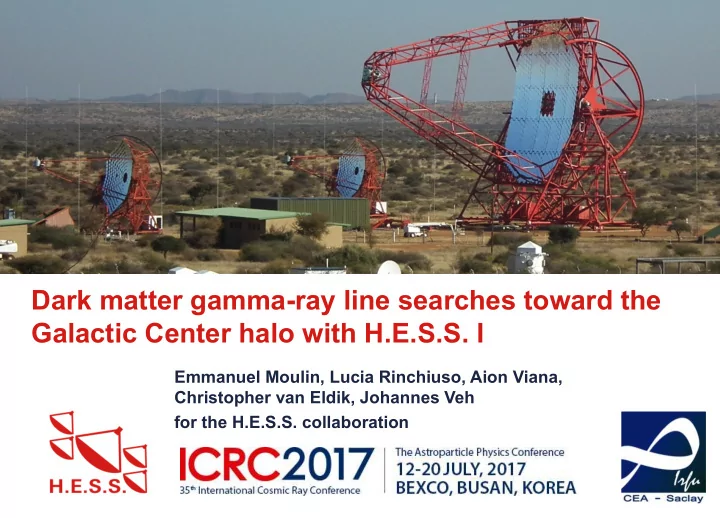
Dark matter gamma-ray line searches toward the Galactic Center halo with H.E.S.S. I Emmanuel Moulin, Lucia Rinchiuso, Aion Viana, Christopher van Eldik, Johannes Veh for the H.E.S.S. collaboration The H.E.S.S. experiment H.E.S.S. phase I


slide-1
SLIDE 1

Emmanuel Moulin, Lucia Rinchiuso, Aion Viana, Christopher van Eldik, Johannes Veh for the H.E.S.S. collaboration

Dark matter gamma-ray line searches toward the Galactic Center halo with H.E.S.S. I

slide-2
SLIDE 2

2

§ H.E.S.S. phase I

§ four 12m telescopes § FoV 5 deg § energy threshold 100 GeV § angular resolution < 0.1 deg § Operating since 2003

The H.E.S.S. experiment

§ H.E.S.S. phase II

§ four 12m telescopes § one 28m telescope (FoV 3.5 deg) § energy threshold O(30 GeV) § angular resolution from 0.4 deg to less than 0.1 deg

H.E.S.S. phase I H.E.S.S. phase II

Emmanuel Moulin . ICRC 2017, Busan, Korea

slide-3
SLIDE 3

3

Why VHE gamma-rays ?

§ Do not suffer from propagation effects at Galactic Scale : they point back to the source § Can reveal the abundance and distribution of DM § Characteristic features may be present in the spectrum at these energies

Emmanuel Moulin . ICRC 2017, Busan, Korea

slide-4
SLIDE 4

4

Why VHE gamma-rays ?

§ Do not suffer from propagation effects at Galactic scale : they point back to the source § Can reveal the abundance and distribution of DM § Characteristic features may be present in the spectrum at these energies § Identification of DM is possible

  • the gamma-ray distribution in the sky tells the DM density

distribution

  • the gamma-ray spectrum tells the reaction process and DM mass

Emmanuel Moulin . ICRC 2017, Busan, Korea

slide-5
SLIDE 5

5

Dark matter search with VHE gamma rays

Particle Physics :

  • Cross sections
  • Differential photon yield
  • DM particle mass

Astrophysics → DM distribution in the target

Emmanuel Moulin . ICRC 2017, Busan, Korea

slide-6
SLIDE 6

6

Dark matter search with VHE gamma rays

Particle Physics :

  • Cross sections
  • Differential photon yield
  • DM particle mass

Astrophysics → DM distribution in the target

Emmanuel Moulin . ICRC 2017, Busan, Korea

§ Weakly Interacting Massive Particles (WIMPs) – The weak interaction mass scale and ordinary gauge couplings give right relic DM density without fine-tuning. – Mass scale GeV-TeV, makes them Cold Dark Matter – Provides benchmark for indirect detection: thermally-produced WIMPs

slide-7
SLIDE 7

7

Spectral signatures in gamma rays

Continuum emission (“Secondary photons”) → from fragmentation of quarks/massive gauge bosons (via π0 decay) Virtual Internal Bremsstrahlung (VIB) → radiative correction to processes with charged final states → generically suppressed by O(α) Gamma-ray lines → from two-body annihilation into photons → forbidden at tree-level, generically suppressed by O(α2)

Emmanuel Moulin . ICRC 2017, Busan, Korea

slide-8
SLIDE 8

8

Energy spectrum from dark matter annihilation

cut-off of the signal at DM mass “power-law” background

The spectral information can be exploited for a better signal vs. background discrimination γ-line w/o energy resolution

not at tree level: suppressed but clear signature at DM mass !

1. Continuum: hadronization and/or decay of W/Z, quarks, leptons… 2. Line from prompt annihilation in two photons 3. Final state radiation 4. Virtual internal bremsstrahlung

Emmanuel Moulin . ICRC 2017, Busan, Korea

slide-9
SLIDE 9

9

Dark matter targets gamma-ray searches

§ DM density matters § Astrophysical background matters as well

Galactic Centre

  • Proximity (~8kpc)
  • Possibly high DM

concentration : DM profile : core? cusp?

  • High astrophysical

bck / source confusion Galaxy satellites of the Milky Way

  • Many of them within the 100 kpc from GC
  • High M/L
  • Low astrophysical background

Aquarius, Springel et al. Nature 2008

Substructures in the Galactic halo

  • Lower signal
  • Cleaner signal

(once found) Galactic halo

  • Large statistics
  • Galactic diffuse

background

Emmanuel Moulin . ICRC 2017, Busan, Korea

slide-10
SLIDE 10

10

Dark matter distribution in the Galactic Centre region (1)

We assume cusped DM density profiles, e.g. the Einasto, NFW, …

ρ$%&' r = ρ*exp −2 α r r*

2

− 1 parametrized with α = 0.17 r* = 21 𝑙𝑞𝑑 ρ* = 0.07 𝐻𝑓𝑊𝑑𝑛>? Einasto profile

as used in HESS GC 2011, 2013 papers

per bin of 0.02degx0.02deg

Emmanuel Moulin . ICRC 2017, Busan, Korea

slide-11
SLIDE 11

11

Dark matter distribution in the GC region (2)

We assume cusped DM density profiles, e.g. the Einasto, NFW, …

Einasto profile

per bin of 0.02degx0.02deg

Spatial information can be used to discriminate from the isotropic residual background

Emmanuel Moulin . ICRC 2017, Busan, Korea

slide-12
SLIDE 12

12

Dark matter distribution in the GC region (3)

We assume cusped DM density profiles, e.g. the Einasto, NFW, …

Einasto profile Example for one OFF region for a given pointing

ON region pointing position

§ Significant DM gradient between ON and OFF regions

per bin of 0.02degx0.02deg

Emmanuel Moulin . ICRC 2017, Busan, Korea

slide-13
SLIDE 13

13

Optimized background measurement

§ OFF regions are chosen symmetrically to ON regions with respect to the pointing position in the same observational field of view § Overlapping areas are discarded to maintain the dark matter gradient

→ same acceptance in ON and

OFF region (due to azimuthal symmetry) → strong dark matter gradient that improves the limits

Emmanuel Moulin . ICRC 2017, Busan, Korea

slide-14
SLIDE 14

14

The Galactic Centre region seen by H.E.S.S. I

§ Largest H.E.S.S. dataset from observations accumulated over 10 years § Most detailed view of GC @VHE : pointlike sources (PWN, SNR, Unid) and diffuse emission → GC region is a crowded environment at VHE § DM density in the central region of the Milky Way expected to be large

Emmanuel Moulin . H.E.S.S. Moriond EW 2015

Excess map, E>200 GeV

75 pc

slide-15
SLIDE 15

15

Region of interest (ROI) definition

§ 10-year observations with H.E.S.S. 1 toward the GC § Gamma-ray statistics : 254 h compared to 112 h (2011/2013 papers) § Novel analysis method : 2D likelihood analysis with spectral and spatial information of signal and background

Galactic Longitude Galactic Latitude G0.9 Sgr A*

Gamma-ray excess map

HESS J1745-303

Emmanuel Moulin . ICRC 2017, Busan, Korea

slide-16
SLIDE 16

16

§ Excluded region ±0.3° : dominated by astrophysical sources and diffuse emission § Whole region of Interest: 1° in radius § ROI divided in 7 sub-regions of 0.1°: spatial binning

Emmanuel Moulin . ICRC 2017, Busan, Korea

Region of interest (ROI) definition

slide-17
SLIDE 17

17

Gamma-ray line rate

§ Spectrum : Dirac delta function at 𝐧𝐄𝐍 § Energy resolution with

𝛕 𝐅 = 𝟐𝟏%

  • almost independent of the offset and the

azimuth angle

𝐞𝐎 𝐞𝐅′ = 𝟑𝛆 𝐅O − 𝐧𝐄𝐍 𝐒 𝐅, 𝐅O = 𝟐 𝟑𝛒

  • 𝛕

𝐟

> 𝐅>𝐅U 𝟑 𝟑𝛕𝟑

𝐎𝐣𝐤

𝛅 = 𝟐

𝟓𝛒 𝛕𝐰 𝟑𝐧𝐄𝐍

𝟑

[ 𝐞𝐎 𝐞𝐅O 𝐒 𝐅, 𝐅O 𝐔𝐩𝐜𝐭𝐁𝐟𝐠𝐠(𝐅)𝐞𝐅′

  • x 𝐊(∆𝛁)

sigma/E bias

Emmanuel Moulin . ICRC 2017, Busan, Korea

slide-18
SLIDE 18

18

2D-binned likelihood analysis

§ Likelihood function binned in energy (bin j) and space (RoI, bin i) where expected NB obtained from dL/dNB = 0 § Test statistics: likelihood-ratio test § No significant excess if found in any of the ROIs :

𝓜 = h 𝓜𝐣𝐤

𝐣,𝐤

Observed signal (ON region) Observed background (OFF region) Line signal (expected in ON) Line signal (expected in OFF) Expected background 𝐎𝐏𝐎 𝐎𝐏𝐆𝐆 𝐎𝐓 𝐎′𝐓 𝐎𝐂

𝐔𝐓 = −𝟑 𝐦𝐩𝐡 𝓜𝐗 𝓜𝐗𝐏 = −𝟑 𝐦𝐩𝐡 𝓜 𝐎𝐏𝐎, 𝐎𝐏𝐆𝐆 𝐎𝐓, 𝐎𝐓

O , 𝐎𝐂

𝓜 𝐎𝐏𝐎, 𝐎𝐏𝐆𝐆 𝐎𝐂 TS = 2.71 for a 95% CL limit

𝓜𝐣𝐤 𝐎𝐏𝐎, 𝐎𝐏𝐆𝐆 𝐎𝐓, 𝐎𝐂 = 𝐎𝐓 + 𝐎𝐂 𝐎𝐏𝐎 𝐎𝐏𝐎! 𝐟> 𝐎𝐓r𝐎𝐂 𝐎𝐓

O + 𝐎𝐂 𝐎𝐏𝐆𝐆

𝐎𝐏𝐆𝐆! 𝐟> 𝐎𝐂r𝐎𝐓U

Emmanuel Moulin . ICRC 2017, Busan, Korea

slide-19
SLIDE 19

19

95% C.L. expected limits on the annihilation flux

§ Improvement of a factor about 8 observed @ 1 TeV

  • n the mean expected

limits § Improvement from the analysis: exclusion regions, 2D binned likelihood analysis approach, improved raw data danalysis, higher statistics

Emmanuel Moulin . ICRC 2017, Busan, Korea

slide-20
SLIDE 20

20

95% C.L. expected limits on the annililation cross section σv

§ best limit 2x10-28cm3s-1 @1TeV § mass range extended down to 300 GeV and up to 70 TeV § lower energy threshold thanks to the improved raw data analysis: best limit shifted down to lower masses

Emmanuel Moulin . ICRC 2017, Busan, Korea

slide-21
SLIDE 21

21

Comparison with previous result and other experiments

§ best limit 2x10-28cm3s-1 @1TeV § lower energy threshold thanks to the improved raw data analysis: best limit shifted down to lower masses § Fermi-LAT limits surpassed

  • f a factor about 6 @300

GeV

Emmanuel Moulin . ICRC 2017, Busan, Korea

slide-22
SLIDE 22

22

Summary

§ Full H.E.S.S.-I GC dataset analysis for dark matter line searches in the inner GC halo in the DM mass range 300 GeV – 70 TeV § Improvement at 1 TeV with respect to 2013 results is about 8 on the mean expected sensitivity

  • higher photon statistics
  • higher sensitivity of the improved raw data analysis
  • 2D likelihood analyis method

§ Next steps :

  • Observed limits for publication
  • Follow-up study with H.E.S.S.-II data: more statistics and extended

pointings from inner Galaxy survey started in 2015

  • Tests of different TeV DM models can be performed

Emmanuel Moulin . ICRC 2017, Busan, Korea

slide-23
SLIDE 23

23

Constraints on DM annihilation towards the GC for the continuum with 10 years of H.E.S.S. data (3)

For the Einasto profile, strongest limits so far in the TeV mass range:

  • in the WW channel: 6×10⁻²⁶ cm3 s−1 at 1.5 TeV
  • in the ττ channel: 2×10⁻²⁶ cm3 s−1 at 800 GeV

H.E.S.S. Collaboration, Phys. Rev. Lett. 117, 111301 (2016)

Emmanuel Moulin . ICRC 2017, Busan, Korea