Gamma- Gamma -Ray Particle Ray Particle Astrophysics: - - PowerPoint PPT Presentation

gamma gamma ray particle ray particle astrophysics
SMART_READER_LITE
LIVE PREVIEW

Gamma- Gamma -Ray Particle Ray Particle Astrophysics: - - PowerPoint PPT Presentation

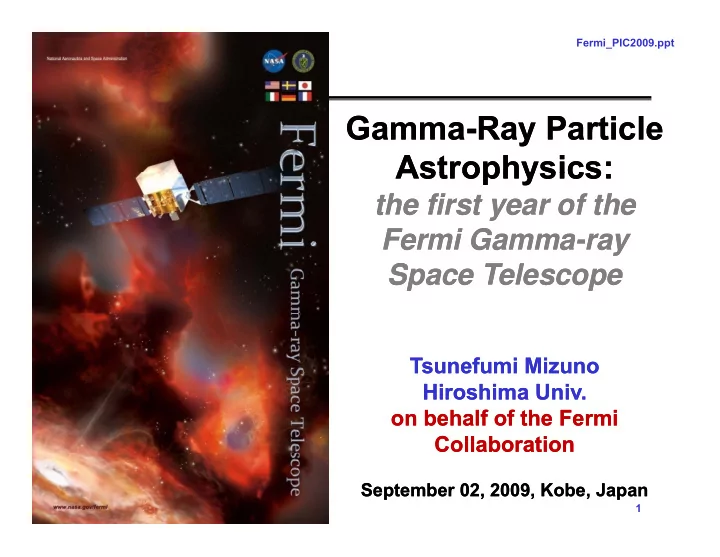
Fermi_PIC2009.ppt Gamma- Gamma -Ray Particle Ray Particle Astrophysics: Astrophysics: Astrophysics: Astrophysics: the first year of the the first year of the Fermi Gamma-ray Fermi Gamma Fermi Gamma-ray Fermi Gamma ray ray Space


slide-1
SLIDE 1

Fermi_PIC2009.ppt

Gamma Gamma-

  • Ray Particle

Ray Particle Astrophysics: Astrophysics: Astrophysics: Astrophysics:

the first year of the the first year of the Fermi Gamma Fermi Gamma-ray ray Fermi Gamma Fermi Gamma-ray ray Space Telescope Space Telescope

Tsunefumi Tsunefumi Mizuno Mizuno Hiroshima Univ. Hiroshima Univ.

  • n behalf of the Fermi
  • n behalf of the Fermi

Collaboration Collaboration

Tsunefumi Mizuno 1

September 02, 2009, Kobe, Japan September 02, 2009, Kobe, Japan

slide-2
SLIDE 2

Fermi_PIC2009.ppt

Plan of the Talk Plan of the Talk

  • Review of the high energy gamma-ray missions
  • Highlights of the Fermi’s first year results:

g g y Gamma-ray bursts

implication on fundamental physics and UHECRs

  • ti

f j t ith hi h t Γ properties of jets with highest Γ

Galactic cosmic-rays and dark matter Direct measurement of Galactic cosmic-rays Direct measurement of Galactic cosmic rays

Galactic diffuse gamma-rays as an indirect probe of Galactic CRs

Selected Galactic/extragalactic gamma-ray objects focus on the relation to Galactic CRs and UHECRs

Tsunefumi Mizuno 2

slide-3
SLIDE 3

Fermi_PIC2009.ppt

R i f Hi h R i f Hi h E G E G Review of High Review of High-Energy Gamma Energy Gamma-

  • ray

ray Astrophysics Missions Astrophysics Missions p y p y

Tsunefumi Mizuno 3

slide-4
SLIDE 4

Fermi_PIC2009.ppt

GeV Gamma-ray Astrophysics

(Eγ = a few 10s MeV to ~100 GeV)

  • 1967 to 1968 -- OSO-3 : First detection of γ-rays from the Gal. plane
  • 1972 to 1973 -- SAS-2 : Crab, Vela, and Geminga
  • 1975 to 1982 -- COS-B : >=20 γ-ray sources

EGRET:

(on the Compton Gamma Ray Observatory) 271 (>5σ) γ ray sources + detailed map of the Galaxy 271 (>5σ) γ-ray sources + detailed map of the Galaxy

1991 -- 2000

  • 2007 to present -- AGILE

Tsunefumi Mizuno 4

A new gamma-ray satellite every 10 or 15 years

  • 2008 to present -- Fermi
slide-5
SLIDE 5

Fermi_PIC2009.ppt

TeV γ-ray Astrophysics with Atmospheric Cherenkov Imager Arrays (Eγ >= 100 GeV)

HESS galactic survey Nearly 100 sources under study.

CANGAROO III, Australia H.E.S.S., Namibia MAGIC II, Canary islands, Spain

CTA (2013~)

VERITAS, Arizona, USA

Tsunefumi Mizuno 5

Very important but not covered by this talk. See, e.g., talk by Schwanke in PIC 08

slide-6
SLIDE 6

Fermi_PIC2009.ppt

Fermi Launch Fermi Launch

  • Launched from Cape Canaveral Air

Station on June 11, 2008 Science Operation on Aug 4 2009

  • Science Operation on Aug 4, 2009
  • Orbit: 565 km, 26.5o (low BG)

Tsunefumi Mizuno 6

slide-7
SLIDE 7

Fermi_PIC2009.ppt

Large Area Telescope (LAT) on Fermi Large Area Telescope (LAT) on Fermi

20 MeV to >= 300 GeV FOV: 2.4 sr

  • Tracker: Si-strip detectors & W converters

Identification and direction measurement of γ-rays

  • Calorimeter: hodoscopic CsI scintillators

Energy measurement

  • ACD: segmented plastic scintillators

BG rejection

Tsunefumi Mizuno 7

j

Technology developed through HEP experiments See Atwood et al. (ApJ 697, 1071, 2009) for detail

slide-8
SLIDE 8

Fermi_PIC2009.ppt

Gamma Gamma-

  • ray Burst Monitor (GBM) on Fermi

ray Burst Monitor (GBM) on Fermi

Views entire unocculted sky with

  • 12 NaI detectors: 8 keV - 1 MeV
  • 2 BGO detectors: 150 keV - 40 MeV

Tsunefumi Mizuno 8

LAT+GBM=> more than 7 decades of energy OK, let’s start with GRBs

slide-9
SLIDE 9

Fermi_PIC2009.ppt

Highlights from Fermi’s 1 Highlights from Fermi’s 1st

st year (1):

year (1): g g g g y ( ) y ( ) Gamma Gamma-

  • ray Bursts

ray Bursts

Tsunefumi Mizuno 9

slide-10
SLIDE 10

Fermi_PIC2009.ppt

Gamma Gamma-

  • Ray Bursts Overview (1)

Ray Bursts Overview (1)

  • Discovered in 1967
  • Cosmological origin (BeppoSAX, BATSE)

Large apparent energy release: Eiso ~ 1052 - 1054 erg

L L t f t f j t Γ > 100 ( f f QSO d 10 f AGN) Large Lorentz factor of jet: Γ >= 100 (a few for μ-QSO and ~10 for AGN) Energetics may be consistent with origin of UHECRs

  • Peak in ~ MeV gamma-rays

Band function: smoothly joins two power-laws Band function: smoothly joins two power laws

Synchrotron radiation of ultra-relativistic electrons in jet?

Tsunefumi Mizuno 10

0.01 0.1 1 10 100 MeV

slide-11
SLIDE 11

Fermi_PIC2009.ppt

Gamma Gamma-

  • Ray Bursts Overview (2)

Ray Bursts Overview (2)

2 s

  • Bimodal distribution of duration time

Short (<2 s) GRB: progenitor unknown

Merger of NSs or BHs? Long (>2 s) GRB: association with supernova Core collapse supernovae

T90 (duration) in seconds

Core-collapse supernovae

  • Gamma-ray emission mechanism not fully understood yet
  • Fermi observation of GRBs is expected to

constrain the emission mechanism constrain the bulk Lorentz factor of jet constrain the bulk Lorentz factor of jet limit on Lorentz invariance violation search for the clue of UHECRs probe the extragalactic background light (star formation in early

Tsunefumi Mizuno 11

p g g g ( y universe)

slide-12
SLIDE 12

Fermi_PIC2009.ppt

Fermi GRB Fermi GRB Skymap Skymap (as of Jun. 29, 2009) (as of Jun. 29, 2009)

  • 7 long + 2 short GRB by GBM+LAT, from 8 keV to tens of GeV
  • Short & long GRBs: similar phenomenology at high energy?

241 GBM GRBs 9 LAT GRB Abdo et al. Sci.323, 1688 (2009)

Tsunefumi Mizuno 12

9 LAT GRBs 129 In Field-of-view of LAT Abdo et al., submitted to Nature (arXiv:0908.1832)

slide-13
SLIDE 13

Fermi_PIC2009.ppt

GRB080916C Prompt Emission (<=100s) GRB080916C Prompt Emission (<=100s)

  • z=4.35 +/- 0.15 (GROND;

GCN8257)

8-260 keV

  • More than 3000 LAT photons,

145 above 100 MeV and 14 above 1 GeV

260 keV-5 MeV

  • Delayed HE onset (1st peak

not seen > 100 MeV)

Opacity effect (γγ->e+e-)? But

LAT (all)

no evidence of spectral cutoff

  • Single Band-function

dominant for 6 decades of

>100 MeV

dominant for 6 decades of energy

Lack of prominent SSC component implies high

>1 GeV

Tsunefumi Mizuno 13

magnetic field or high γe

0 20 40 60 80s

slide-14
SLIDE 14

Fermi_PIC2009.ppt

Long Long-

  • Lived HE Emission

Lived HE Emission

  • HE (>100 MeV) emission shows different temporal behavior

Temporal break in LE emission while no break in HE emission Cascades induced by ultra-relativistic ions? Cascades induced by ultra relativistic ions? Angle-dependent scattering effects?

Flux in LAT/GBM bands Flux in LAT/GBM bands

  • E>100 MeV

index = -1.2 +/- 0.2

  • E= 50 -300 keV

i d 0 6 > 3 3 index: ~-0.6 => ~-3.3 (at ~T0+55s) Photon Index (LAT only)

no significant evolution no significant evolution (Epeak gradually decreases)

Tsunefumi Mizuno 14

slide-15
SLIDE 15

Fermi_PIC2009.ppt

Constraints on Bulk Lorentz Factor Constraints on Bulk Lorentz Factor

  • Large luminosity and short variability time imply large optical depth due

to γγ -> e+e- (compactness problem)

Small emission region: R ~ cΔt τγγ(E) ~ (11/180)σTN>1/E/4πR2

τγγ(1 GeV) ~ 7x10¹¹ for a typical GRB of fluence=10-6 erg/cm2, z=1, Δt=1 s

  • Relativistic motion (Γ >> 1) can reduce optical depth
  • Relativistic motion (Γ >> 1) can reduce optical depth

Lager emission region: R ~ Γ2cΔt Reduced photon # densities: N>1/E Γ2β+2 (note: β ~ -2.2) ( β )

Blue shift of energy threshold: Eth Γ Blue shift of spectrum: N(E) = (ΓE)β+1 N(E) = (ΓE)β+1

Overall reduction of optical depth: Γ2β+2 /Γ4= Γ2β-2 ∼Γ-6.4 (<=10-12 for Γ=100)

Tsunefumi Mizuno 15

  • Limit from GRB 080916C: Γ 890±21

(Largest ever observed as of May 2009)

slide-16
SLIDE 16

Fermi_PIC2009.ppt

Limits on Lorentz Invariance Violation (LIV) Limits on Lorentz Invariance Violation (LIV)

16 5

  • Some QG models violate Lorentz
  • invariance. A high-energy photon

would arrive after a low-energy one

16.5 s

would arrive after a low energy one emitted simultaneously.

GRB080916C:

(Jacob & Piran 2008. n=1 for linear LIV)

G 0809 6C 13.2 GeV @ T0+16.5 s

MQG, 1 > (1.5±0.2) x 1018 GeV/c2, 1/10 of the Plank mass and the 1/10 of the Plank mass and the highest as of May 9, 2009.

i M

Pulsar GRB GRB AGN AGN

GRB080916C Planck mass

Tsunefumi Mizuno 16

min MQG (GeV)

Pulsar (Kaaret 99) GRB (Ellis 06) GRB (Boggs 04) AGN (Biller 98) AGN (Aharonian 08)

1015 1016 1017 1018 1019

slide-17
SLIDE 17

Fermi_PIC2009.ppt

GRB090510 (1) GRB090510 (1)

Abdo et al. 2009 Submitted to Nature (arXiv:0908.1832)

Tsunefumi Mizuno 17

slide-18
SLIDE 18

Fermi_PIC2009.ppt

GRB095010 (2) GRB095010 (2)

10 1GeV

  • Time vs. photon energy

LAT all events E>100 MeV

  • Short GRB with > 150 photons above

0.1 0.01

Short GRB with > 150 photons above 100 MeV

  • 31 GeV @ ~T0+0.83s

S lid d d tt d li LIV f 1

  • Solid and dotted line are LIV for n=1

and 2, respectively

  • Several assumptions of tstart indicated

by different colors by different colors

  • Even the conservative case (black line)

implies MQG, 1 > 1.19 MPlanck

  • Other important findings

deviation from Band function highest Epeak: 5.1 MeV (Band+PL model fit)

Tsunefumi Mizuno 18

0 0.5 1 1.5 2 (s)

model fit) delayed onset of LAT emission by 0.1- 0.2 s highest Γmin (~1200)

slide-19
SLIDE 19

Fermi_PIC2009.ppt

Highlights from Fermi’s 1 Highlights from Fermi’s 1st

st year (2):

year (2): Direct Measurements of Galactic Direct Measurements of Galactic Direct Measurements of Galactic Direct Measurements of Galactic CR Electrons CR Electrons

Tsunefumi Mizuno 19

slide-20
SLIDE 20

Fermi_PIC2009.ppt

Introduction (1): Introduction (1):

What Can We Learn from HE e What Can We Learn from HE e-/e /e+ and p/p ? and p/p ?

  • Inclusive spectra: e- + e+

Electrons, unlike protons, lose energy rapidly by Synchrotron d I C t t hi h th b th b and Inverse Compton: at very high energy they probe the nearby sources

  • Charge composition: e+/(e- + e+) and p/(p + p) ratios
  • Charge composition: e+/(e + e+) and p/(p + p) ratios

e+ and p are produced by the interactions of high-energy cosmic rays with the interstellar matter (secondary production) There might be signals from additional (astrophysical or exotic) There might be signals from additional (astrophysical or exotic) sources

  • Different measurements provide complementary information of the

p p y

  • rigin, acceleration and propagation of cosmic rays

All available data must be interpreted in a coherent scenario

Tsunefumi Mizuno 20

slide-21
SLIDE 21

Fermi_PIC2009.ppt

Introduction (2): Introduction (2):

Positron and Antiproton Fraction: 2008 Positron and Antiproton Fraction: 2008-

  • 09

09

PAMELA positron and antiproton

Nature 458, 607 (2009) PRL 102, 051101 (2009) PRL 102, 051101 (2009)

1 GeV 10 100

  • Antiproton fraction consistent with secondary production
  • Anomalous rise in the positron fraction above 10 GeV
  • Several different viable interpretations (>200 papers over the last year)

Tsunefumi Mizuno 21

See also Nature 456, 362 (2008) and PRL 101, 261104 (2008) for pre-Fermi CRE spectrum by ATIC and HESS.

slide-22
SLIDE 22

Fermi_PIC2009.ppt

Fermi-LAT Capability for CR Electrons

  • Candidate electrons pass through 12.5 X0 on average ( Tracker and

Calorimeter added together)

  • Simulated residual hadron contamination (5-21% increasing with the

( g energy) is deducted from resulting flux of electron candidates

  • Effective geometric factor (Gf) exceeds 2.5 [m2 sr] for 30 GeV to 200 GeV,

and decreases to ~1 [m2 sr] at 1 TeV. Gf times exposure has already reached [ ]

f

p y several x 107 [m2 sr s]. (very high statistics)

  • Full power of all LAT subsystems is in use: Tracker, Calorimeter and ACD

act together

Geometric Factor (Gf)

Tsunefumi Mizuno 22

Residual hadron contamination

20 GeV 100 GeV 1 TeV

slide-23
SLIDE 23

Fermi_PIC2009.ppt

Fermi-LAT Electron Spectrum

Abdo et al.

  • Phys. Rev. Let. 102,

181101 (2009) 181101 (2009) Cited 38 times within a month APS Viewpoint Harder spectrum p (spectral index: -3.04) than previously thought Total statistics collected for 6 months of Fermi LAT observations 4 5 million candidate electrons abo e 20 GeV

Tsunefumi Mizuno 23

~4.5 million candidate electrons above 20 GeV > 400 candidate electrons in last energy bin (770-1000 GeV)

slide-24
SLIDE 24

Fermi_PIC2009.ppt

Implication from Fermi-LAT CRE (1)

Old “conventional” CRE Model

γ0=2.54

for detail, see

  • D. Grasso et al. arXiv:0905.0636

(accepted by Astroparticle ) Physics) New “conventional” CRE models

γ0=2.42 γ0=2.33 Fermi CRE spectrum can be reproduced by the “conventional” Galactic cosmic-ray source model, with harder injection spectral index (-2.42) than in a pre-Fermi conventional model (-2.54). All that within our current t i ti b th t ti ti l d t ti

Tsunefumi Mizuno 24

uncertainties, both statistical and systematic.

slide-25
SLIDE 25

Fermi_PIC2009.ppt

Implication from Fermi-LAT CRE (2)

Now include recent PAMELA result on positron fraction

  • Qualitative approach: the harder primary CRE spectrum is, the steeper

secondary-to-primary e+/e- ratio should be. PAMELA shows the opposite.

New “conventional” CRE models Old “conventional” CRE Model

Precise Fermi measurement increases the discrepancy between a

Tsunefumi Mizuno 25

purely secondary origin for positrons, and the positron fraction measured by PAMELA.

slide-26
SLIDE 26

Fermi_PIC2009.ppt

Implication from Fermi-LAT CRE (3)

It is becoming clear that we are dealing with at least 3 distinct origins of HE e-/e+

Uniformly distributed distant sources, likely SNRs.

Unavoidable e+e- production by CRs and the ISM

“conventional” sources

And those that create positron excess at high energies. Nearby (d<1 kpc) and Mature (104 - 106 yr) pulsars?

An example of the fit to both Fermi and PAMELA data with Monogem and Geminga

with a nominal choice for the e+/e injection parameter (blue lines) Works well

Tsunefumi Mizuno 26

with a nominal choice for the e+/e- injection parameter (blue lines). Works well. (Discrepancy in positron fraction in low energy can be understood as the charge-sign effect of solar modulation)

slide-27
SLIDE 27

Fermi_PIC2009.ppt

Dark Matter Interpretation Dark Matter Interpretation

What said about pulsars is applicable to dark matter as sources of e- and e+.

PAMELA and Fermi data tighten the DM constraints, favoring pure e+e-, lepto- philic, or super-heavy DM models.

likely excluded preferred likely excluded preferred

10-22 σv [cm3/s] 10-19

pure e+e- Models lepto-philic Super-heavy DM

10-24 10-21 100 GeV 1 TeV DM mass 10-26 10-23

  • We need local sources (astrophysical or exotic). The origin is still unclear

but is strongly constrained by Fermi data (+ others)

Tsunefumi Mizuno 27

but is strongly constrained by Fermi data (+ others)

  • More results from Fermi-LAT are coming. Extending energy range to

5 GeV – 2 TeV and searching for the CRE anisotropy at a 1 % level.

slide-28
SLIDE 28

Fermi_PIC2009.ppt

Hi hli ht f F i’ 1 Hi hli ht f F i’ 1st

st

(3) (3) Highlights from Fermi’s 1 Highlights from Fermi’s 1st

st year (3):

year (3): Galactic Diffuse Gamma Galactic Diffuse Gamma-

  • ray

ray y Emission (Indirect Probe of Emission (Indirect Probe of Galactic CRs) Galactic CRs) Galactic CRs) Galactic CRs)

Tsunefumi Mizuno 28

slide-29
SLIDE 29

Fermi_PIC2009.ppt

Cosmic-Rays Overview

  • V. Hess, 1912
  • Discovered by V. Hess in 1912
  • Globally power-law spectrum with some structures (knee and ankle)

hint of the origin L d it ( 1 V

3)

bl t U d U

  • Large energy density (~1 eV cm-3): comparable to UB and Urad
  • UHECRs : not covered by this talk in detail

small scale anisotropy

V)-1 1 particle/m2/sec

Galactic

x (m2 sr s GeV Knee

G or EG?

Flux 1 particle /m2/yr Ankle

Auger Collaboration Sci 318 938 (2007) Extragalactic

Tsunefumi Mizuno 29

Energy (eV) 1 particle/km2/yr

Auger Collaboration, Sci. 318, 938 (2007)

18/27 events > 5.6 x 10¹⁹ eV correlate with nearby AGNs. See also arXiv:0906.2347

slide-30
SLIDE 30

Fermi_PIC2009.ppt

CRs and Galactic Diffuse Gamma CRs and Galactic Diffuse Gamma-

  • Rays

Rays

HE γ-rays are produced via interactions between Galactic cosmic-rays (CRs) and the interstellar medium (or interstellar radiation field)

(CR Accelerator) (Interstellar space) (Observer) X,γ ISM SNR SNR RX J1713 RX J1713-

  • 3946

3946

Chandra Suzaku

(CR Accelerator) (Interstellar space) (Observer) e

+

  • diffusion

diffusion HESS

B

P

Chandra, Suzaku, Radio telescopes

IC

ISRF

diffusion diffusion energy losses energy losses reacceleration reacceleration convection convection etc etc

π0 Pulsar, μ-QSO

He He CNO CNO HESS Fermi

gas e

+

  • π

+

  • etc.

etc. HESS, Fermi

gas π

Tsunefumi Mizuno 30

A powerful probe to study CRs in distant locations

slide-31
SLIDE 31

Fermi_PIC2009.ppt

Outstanding Question: Outstanding Question:

EGRET GeV Excess EGRET GeV Excess

  • EGRET observations showed

excess emission > 1 GeV everywhere in the sky when

|b|=6°-10°

everywhere in the sky when compared with models based on directly measured CR spectra Potential explanations

0.1 1 10 GeV |b| 2° 6°

  • Potential explanations

Unexpectedly large variations in cosmic-ray spectra over Galaxy Dark Matter

|b|=2°-6°

Dark Matter Unresolved sources (pulsars, SNRs, …) Instrumental

|b|<=2°

Instrumental

  • Fermi-LAT is able to confirm or

deny this phenomena

Tsunefumi Mizuno 31

deny this phenomena

Hunter et al. 1997 ~100% difference above 1 GeV

slide-32
SLIDE 32

Fermi_PIC2009.ppt

Intermediate Latitude Region seen by LAT Intermediate Latitude Region seen by LAT

|b|=10°-20°

EGRET LAT 0 1 1 10 GeV

Abdo et al. submitted to PRL Porter et al 2009 (arXiv:0907 0294)

0.1 1 10 GeV

  • |b|=10°-20°: avoid Gal. plane but still have high statistics
  • EGRET spectrum extracted for the same region

Porter et al. 2009 (arXiv:0907.0294)

EGRET spectrum extracted for the same region

  • LAT spectrum is significantly softer and does not confirm

th EGRET G V

Tsunefumi Mizuno 32

the EGRET GeV excess

  • Strongly constrains the DM interpretation
slide-33
SLIDE 33

Fermi_PIC2009.ppt

Probing CRs using Gamma Probing CRs using Gamma-

  • rays from ISM

rays from ISM

  • Correlation with gas column density reveals the CR spectrum

Method go back to SAS-2/COS-B era

  • Fermi-LAT’s high performance + CR propagation model (e.g.

GALPROP) to predict IC Sensitivity significantly improved

ISM

(e.g., LAB HI survey)

Gamma-ray intensity

(F i LAT d t ) ( g , y)

(http://www.astro.uni-bonn.de/~webaiub/english/tools_labsurvey.php)

(Fermi LAT data)

High latitude region: Detailed study of local CRs (most of the gas is close to solar system)

Tsunefumi Mizuno 33

Detailed study of local CRs (most of the gas is close to solar system) Galactic plane: CR gradient in the Galaxy (need to resolve point sources)

slide-34
SLIDE 34

Fermi_PIC2009.ppt

Accurate Measurements of Local CRs Accurate Measurements of Local CRs

Mid-high lat. region in 3rd quadrant:

  • small contamination of IC and

molecular gas

  • correlate γ-ray intensity and HI
  • correlate γ-ray intensity and HI

gas column density

Abdo et al. 2009, accepeted by ApJ (arXiv:0908.1171) contact author: TM

LAT data

  • Best quality γ-ray spectrum in

100 MeV-10 GeV (T = 1-100 GeV)

nucleon-nucleon

model from the LIS

100 MeV-10 GeV (Tp = 1-100 GeV)

  • Agree with the model prediction

from the local interstellar

electron- nucleon-nucleon

  • Prove that local CR nuclei

spectra are close to those

spectrum (LIS)

Tsunefumi Mizuno 34

bremsstrahlung p directly measured at the Earth

slide-35
SLIDE 35

Fermi_PIC2009.ppt

CR Distribution in Galaxy CR Distribution in Galaxy

SNR distribution (C & Bh tt h 1998) Pulsar distribution (Lorimer 2004)

  • CR distribution is a key to understand

their origin and propagation

  • distribution of SNRs not well measured

CR source distribution from γ-rays (Strong & Mattox 1996) (Case & Bhattacharya 1998)

  • Previous Gamma-ray data suggests a

flatter distribution than SNR/pulsar distributions (e.g., Strong et al. 2004)

0 5 10 15 kpc

sun Gal. Center

  • Fermi-LAT is able to map out

CR distributions in the Galaxy with unprecedented accuracy

Inner Galaxy

with unprecedented accuracy

  • Work in progress.

(arXiv:0907.0304 and arXiv:0907.0312)

Tsunefumi Mizuno 35

Outer Galaxy

slide-36
SLIDE 36

Fermi_PIC2009.ppt

Highlights from Fermi’s results (4): Highlights from Fermi’s results (4): Selected Galactic and Extragalactic Selected Galactic and Extragalactic Selected Galactic and Extragalactic Selected Galactic and Extragalactic Objects as a Key to Understand CRs Objects as a Key to Understand CRs

Tsunefumi Mizuno 36

slide-37
SLIDE 37

Fermi_PIC2009.ppt

Introduction: Introduction: γ-ray objects seen ray objects seen by the LAT by the LAT

Class Number FSRQ 64

  • Variety of objects in the LAT

BL Lac 46 Radio galaxy 2 Other blazar 9

bright source list (Abdo et al. ApJS 183, 46, 2009)

  • >=200 sources. More than 80%

Other blazar 9 Radio/X-ray pulsar 15 LAT γ-ray pulsar 15

are identified (EGRET:~30%)

  • Here I will pickup SNRs, LMC

and Blazars and briefly discuss

γ y p HMXB 2 Globular cluster 1

and Blazars and briefly discuss their implications for CRs.

  • Many other very important

LMC 1 Special cases (SNRs PWNe) 13

Many other very important

  • bjects and topics will not be
  • discussed. (See LAT

publications, please)

Tsunefumi Mizuno 37

(SNRs, PWNe) Unidentified 37

p , p )

slide-38
SLIDE 38

Fermi_PIC2009.ppt

Fermi LAT Study on SNRs Fermi LAT Study on SNRs

  • SNRs are the most favored explanations for the origin of Galactic CRs.

Diffusive shock acceleration in SNR shell. Sufficient to supply CRs up to knee.

  • Significant progress in recent years in keV and TeV observation of young SNRs.
  • Key issues to be addressed by Fermi-LAT:

Searching for pion signatures & measuring total energy content per SNR

  • Several possible associations to SNRs in the LAT bright source list including

Several possible associations to SNRs in the LAT bright source list including

W44: (T. Tanaka et al. proc. ICRC 2009)

Middle age (2000 yr), Mixed Morphology, 3 kpc Interactions with Molecular Cloud EGRET Fermi-LAT: (0FGL J1855.9+0126: 3 month data yield 39σ)

W51C: (Y. Uchiyama et al. proc. ICRC 2009)

Middle age (20000 yr), 6 kpc Interactions with MC

Tsunefumi Mizuno 38

HESS (Fiasson et al. 2009, no spectrum) Fermi-LAT: (0FGL J1923.0+1411: 3 month data yield 23σ)

slide-39
SLIDE 39

Fermi_PIC2009.ppt

W51C: The Fermi Source is “Extended” W51C: The Fermi Source is “Extended”

  • Mean surface brightness (2-8 GeV) as a function of distance from the

SNR center vs. Fermi-LAT PSF => Spatially extended

Bl k t ROSAT X (0 1 2 4 k V) Black contours: ROSAT X-ray (0.1-2.4 keV) Green contours: VLA 1.4 GHz Color: Fermi-LAT count map (2-8 GeV)

0 6 deg R 0.6 deg

Tsunefumi Mizuno 39

(Note) PSF of Fermi LAT depends heavily on energy. The PSF shape above is

  • btained by taking account of the energy distribution (not presented).
slide-40
SLIDE 40

Fermi_PIC2009.ppt

Spatial Extent of W44 Spatial Extent of W44

Smoothed Count Map (>1 GeV) Profile along the rectangle

Contributions form the diffuse backgrounds and nearby sources are subtracted

  • For both W44 and W51C, gamma-rays are spatially “extended” &

Black Cross: Pulsar (PSR B1853+01) location

Red: Observed Counts Black: Expected Profile for a Point Source

Tsunefumi Mizuno 40

, g y p y positionally coincident with SNRs. The luminosity is found to be very large.

  • Spectral analysis will be presented in a refereed journal
slide-41
SLIDE 41

Fermi_PIC2009.ppt

Local Group Galaxies Local Group Galaxies

  • LMC detection: CR density is inferred to be similar to MW
  • SMC non-detection: CR density is smaller than in the MW

EGRET Observation Summary:

  • M31 non-detection: has to have smaller CR density than the MW

(size M31>MW)

  • First direct evidence that CRs

(E<Eknee) are Galactic and not universal

  • Key issues not fully addressed yet

y y y

CR propagation in each Galaxy detailed comparison of CR densities among galaxies

Tsunefumi Mizuno 41

slide-42
SLIDE 42

Fermi_PIC2009.ppt

Fermi Fermi-

  • LAT Resolved the LMC

LAT Resolved the LMC

CRATES J060106-703606

30 Doradus

  • Gal. longitude
  • 161 days of survey data, ~ 1300 events

above 100 MeV

  • Gal. latitude
  • Gamma-ray is clearly extended, with the

maximum consistent with the massive star-forming region 30 Doradus Dust map (SFD)

Tsunefumi Mizuno 42 adaptively smoothed 100 MeV - 10 GeV counts map (s.n.r. = 5)

Detailed study of spatial and energy distribution is in progress

slide-43
SLIDE 43

Fermi_PIC2009.ppt

LAT Bright AGN Sample (LBAS)

  • 125 non-pulsar sources at |b|>10o
  • 106 high-confidence (P>90%) associations with AGNs

11 lower-confidence (40%<P<90%) associations ( % %) 9 unidentified (3EG: 96/181 at |b|>10o) Only ~30% of the bright Fermi AGNs were

58 FSRQ 42 BL Lac

detected by EGRET. The Sky changes!

4 of Uncertain class 2 Radio Galaxies

Tsunefumi Mizuno 43

Abdo et al. ApJ 700, 597 (2009)

slide-44
SLIDE 44

Fermi_PIC2009.ppt

Population of the LAT AGNs Population of the LAT AGNs

  • 42 BL Lacs and 58 FSRQs (EGRET: 14 and 46)
  • BL Lac has harder spectrum than FSRQ (1.99 +/- 0.22 vs. 2.40 +/- 0.17)
  • V/Vmax test (Schmidt 1968) indicates the positive evolution for FSRQ

(more sources or brighter sources at earlier time) (more sources or brighter sources at earlier time)

  • Local emissivity

ℓBL ≥ 1031 W Mpc-3, ℓFSRQ ≈ 1030 (ℓUHECR ≈ 3x1029; Waxman & Bahcall 1999) BL Lacs are favored as the origin of UHECRs (if AGNs are the sources) 3x1029 W Mpc-3

  • S. Razzaque, J. Finke

and C. Dermer

Tsunefumi Mizuno 44

p

slide-45
SLIDE 45

Fermi_PIC2009.ppt

Summary Summary

  • Presented a very biased summary of gamma-ray particle astrophysics
  • Long history of more than 40 years. Significant progresses in recent

ears b Air Cherenko Telescopes and Fermi years by Air Cherenkov Telescopes and Fermi.

  • Fermi view of GRBs:

>240 GRBs, 9 detected by LAT (as of June 2009)

  • 240 GRBs, 9 detected by LAT (as of June 2009)

GRB080916C & GRB090510 strongly constrains the bulk Lorentz factor, Lorentz invariance, etc..

  • CR electrons by Fermi + PAMELA and other data.

L l i d Local sources are required. Nearby mature pulsars. Constrains on DM scenario

  • Diffuse gamma-rays as a probe of Galactic CRs

non-GeV-excess Local CRs close to those measured at the Earch non GeV excess. Local CRs close to those measured at the Earch. Is able to map out CR distribution in the Galaxy

  • Found extended sources positionally associated with SNR. Resolved

LMC for the first time. BL Lacs are favored (than FSRQs) as the origin

Tsunefumi Mizuno 45

  • f UHECR.

Thank you for your attention!

slide-46
SLIDE 46

Fermi_PIC2009.ppt

Backup Slides Backup Slides Backup Slides Backup Slides

Tsunefumi Mizuno 46

slide-47
SLIDE 47

Fermi_PIC2009.ppt

GRB 080916C Spectrum GRB 080916C Spectrum

  • No conclusive evidence of extra HE component

Probability of no extra component is ~1%

Effect of EBL

Time bin ‘d’

  • HE absorption
  • Transparency:

0.03–1.0

Band GBM NaI LAT

0 03 (model dependent)

  • Single Band-function

dominant for 6 decades

Band function Band + power law GBM NaI GBM BGO

  • f energy band
  • Lack of prominent

SSC component implies

High magnetic field

  • εe/εB 0.1

Epeak,SSC 10 GeV (γe 100)

SSC SSC Ep,SSC

p,SSC

E Ep,syn

p,syn

γe

2 2

νFν

~ε ~ε /ε /ε

Tsunefumi Mizuno 47

peak,SSC

(γe )

synchrotron synchrotron SSC SSC ν

~ε ~εe/ε /εB

B

slide-48
SLIDE 48

Fermi_PIC2009.ppt

FOM for CRE Measurement FOM for CRE Measurement

Exposure factor (effectively) determines the # of counts

Ef(E) = Gf(E)*Tobs

L B ldi i

  • L. Baldini

Tsunefumi Mizuno 48

slide-49
SLIDE 49

Fermi_PIC2009.ppt

LAT LAT vs vs pre pre-

  • Fermi Model

Fermi Model

  • Compare with a CR propagation

model prediction based on pre- F i CR d t (St t l 2004

LAT

Fermi CR data (Strong et al. 2004, Porter et al. 2008)

π0-decay, e-Brems, Inverse Compton LAT model total

π0-decay

  • Source and isotropic (w/ residual

BG) component come from fitting the data to the sky above 30 deg IC e-Brems the data to the sky above 30 deg latitude with model fixed

  • Although there is a uniform

b th d l d t i excess above the model, data is reasonably reproduced by the model

Th d l i f l id i i i i i

Tsunefumi Mizuno 49

The model is successful considering it is a priori pre-Fermi model

slide-50
SLIDE 50

Fermi_PIC2009.ppt

Correlation with the HI Column Density Correlation with the HI Column Density

  • Mask point sources (52 total) and subtract the residual point source
  • contributions. Also subtract the IC contributions.

C l ti f 100 M V t 10 G V Th l i th

  • Correlation from 100 MeV to 10 GeV. The slope gives the γ-ray

emissivity spectrum of local HI gas produced through interactions with CRs.

(error bars are statistical only)

sity

1 6-2 3 GeV 400-560 MeV

400-566 MeV

HI column density (1020 cm-2)

ay Intens

1.6-2.3 GeV

E2 x γ-ra

Tsunefumi Mizuno 50

HI column density (1020 cm-2)

slide-51
SLIDE 51

Fermi_PIC2009.ppt

Fermi View on W51C Region Fermi View on W51C Region

Black contours: ROSAT X-ray (0.1-2.4 keV) Green contours: VLA 1.4 GHz Color: Fermi-LAT count map (2-8 GeV)

X-ray:

  • Thermal emission by shock-heated plasma

(kT=0.2 keV)

  • Central region due to cloud evapolation?

R di Radio:

  • Peaks are HII region
  • Synchrotron radiation is well matched with

thermal X-rays

G V

Tsunefumi Mizuno 51

GeV gamma-ray:

  • Origin?
  • Very high luminosity (~4 x 1035 erg/s) using 6 kpc
slide-52
SLIDE 52

Fermi_PIC2009.ppt

Fermi Fermi-

  • LAT Image of W44

LAT Image of W44

Fermi-LAT Smoothed Count Map (Front Evnets; 2-10 GeV Black cross: location of PSR B1853+01

Tsunefumi Mizuno 52

Spatially Extended??