
SLIDE 1
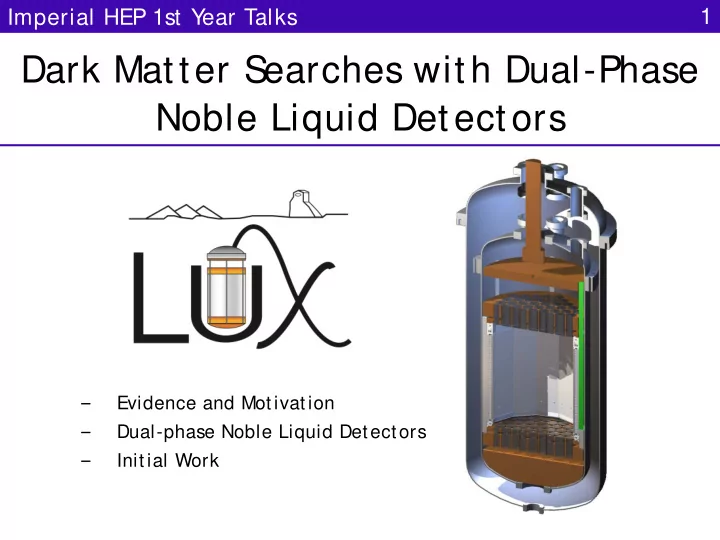
Dark Matter S earches with Dual-Phase Noble Liquid Detectors
Imperial HEP 1st Y ear Talks
‒
Evidence and Motivation
‒
Dual-phase Noble Liquid Detectors
‒
Initial Work
Dark Matter S earches with Dual-Phase Noble Liquid Detectors - - PowerPoint PPT Presentation
1 Imperial HEP 1st Y ear Talks Dark Matter S earches with Dual-Phase Noble Liquid Detectors Evidence and Motivation Dual-phase Noble Liquid Detectors Initial Work Evidence for Dark Matter 2 Astronomical Evidence
Evidence and Motivation
Dual-phase Noble Liquid Detectors
Initial Work
Astronomical Evidence
Galaxy Cluster masses
Galaxy rotation curves
Gravitational lensing
Cosmological Evidence
Cosmic Microwave Background (CMB)
Want to find direct evidence, measure local dark matter in the Galaxy
Dark Matter Baryonic Matter Dark Energy
Main properties:
Interact “ weakly” with ordinary matter
Electromagnetically neutral
Massive
S table
Candidates:
MACHOs
Massive Compact Halo Obj ects
WIMPs
Weakly Interacting Massive Particles
Other Particles
S ignal
Nuclear recoil from WIMP collision
Gives ionisation, scintillation and phonons.
Background
Other nuclear recoils
Electron recoils
Look for interaction in detector material
Discriminate electron recoils
Different amounts of ionisation and scintillation
Other recoils look like signal
Need to minimise radioactivity
Large Underground Xenon
370 kg with 100-150 kg fiducial mass (self-shielding)
Two arrays of 61 PMTs
My involvement
Data analysis
S imulation
Operations support
PMTs LXe Cryostats HV Feedthrough Recirculation and Heat Exchanger
LUX-ZEPLIN
Combination of LUX and ZEPLIN collaborations
Builds on previous LUX and ZEPLIN technology
S ame site – use previous infrastructure
Working on R & D
Use two-phase xenon chamber at Imperial
Design work for LZ
ZEPLIN-III achieved a high signal discrimination
Was this due to the high field, or an effect of the geometry?
ZEPLIN-III LUX Grid
S imulated scenarios
Count photons and find variance
Photon emissions
Propagation Liquid Gas Anode Grid
Total Variance = 5.72 %
Total Variance = 2.49%
Variance for each PMT array was similar to ZEPLIN-III
Two PMT arrays improved it
ZEPLIN-III LUX Grid
Electroluminescence studies:
Anode grid does not spoil resolution
Two PMT arrays improves resolution
LUX is filled – now turning on
LZ currently being designed
WIMP Mass [GeV/ c2] Cross-section [cm2] (normalised to nucleon)
Garfield++
Calculates electric fields
Magboltz for properties of the gas
Drifts electrons through the chamber
Drift lines for wire grid
ZEPLIN-III geometry
30% reflectivity from copper anode Variance at Production Variance after Propagation Number of Events Photons Emitted Photons at Bottom Tally
LUX geometry with wire grid
25% reflectivity from the steel wires Number of Events Variance at Production Variance after Propagation Photons Emitted Total Photon Tally
LUX geometry with wire mesh
25% reflectivity from the steel wires Number of Events Variance at Production Variance after Propagation Photons Emitted Total Photon Tally