Data Conversion Data Conversion Data Conversion Data Conversion - - PowerPoint PPT Presentation

data conversion data conversion data conversion data
SMART_READER_LITE
LIVE PREVIEW

Data Conversion Data Conversion Data Conversion Data Conversion - - PowerPoint PPT Presentation

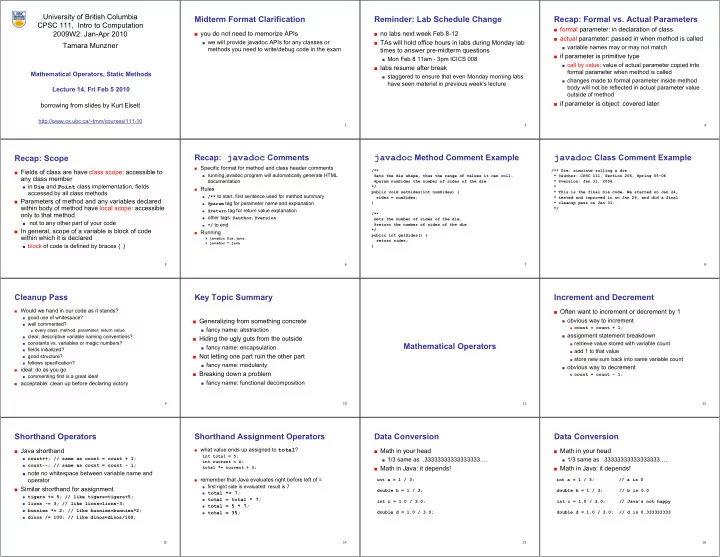
University of British Columbia Midterm Format Clarification Reminder: Lab Schedule Change Recap: Formal vs. Actual Parameters CPSC 111, Intro to Computation formal parameter: in declaration of class 2009W2: Jan-Apr 2010 you do not need


slide-1
SLIDE 1 1

University of British Columbia CPSC 111, Intro to Computation 2009W2: Jan-Apr 2010 Tamara Munzner

Mathematical Operators, Static Methods Lecture 14, Fri Feb 5 2010

http://www.cs.ubc.ca/~tmm/courses/111-10

borrowing from slides by Kurt Eiselt

2

Midterm Format Clarification

■ you do not need to memorize APIs

■ we will provide javadoc APIs for any classes or

methods you need to write/debug code in the exam

3

Reminder: Lab Schedule Change

■ no labs next week Feb 8-12 ■ TAs will hold office hours in labs during Monday lab

times to answer pre-midterm questions

■ Mon Feb 8 11am - 3pm ICICS 008

■ labs resume after break

■ staggered to ensure that even Monday morning labs

have seen material in previous week's lecture

4

Recap: Formal vs. Actual Parameters

■ formal parameter: in declaration of class ■ actual parameter: passed in when method is called

■ variable names may or may not match

■ if parameter is primitive type

■ call by value: value of actual parameter copied into

formal parameter when method is called

■ changes made to formal parameter inside method

body will not be reflected in actual parameter value

  • utside of method

■ if parameter is object: covered later

5

Recap: Scope

■ Fields of class are have class scope: accessible to

any class member

■ in Die and Point class implementation, fields

accessed by all class methods

■ Parameters of method and any variables declared

within body of method have local scope: accessible

  • nly to that method
■ not to any other part of your code

■ In general, scope of a variable is block of code

within which it is declared

■ block of code is defined by braces { } 6

Recap: javadoc Comments

■ Specific format for method and class header comments ■ running javadoc program will automatically generate HTML

documentation

■ Rules ■ /** to start, first sentence used for method summary ■ @param tag for parameter name and explanation ■ @return tag for return value explanation ■ other tags: @author, @version ■ */ to end ■ Running % javadoc Die.java % javadoc *.java 7

javadoc Method Comment Example

/** Sets the die shape, thus the range of values it can roll. @param numSides the number of sides of the die */ public void setSides(int numSides) { sides = numSides; } /** Gets the number of sides of the die. @return the number of sides of the die */ public int getSides() { return sides; }

8

javadoc Class Comment Example

/** Die: simulate rolling a die * @author: CPSC 111, Section 206, Spring 05-06 * @version: Jan 31, 2006 * * This is the final Die code. We started on Jan 24, * tested and improved in on Jan 26, and did a final * cleanup pass on Jan 31. */

9

Cleanup Pass

■ Would we hand in our code as it stands? ■ good use of whitespace? ■ well commented? ■ every class, method, parameter, return value ■ clear, descriptive variable naming conventions? ■ constants vs. variables or magic numbers? ■ fields initialized? ■ good structure? ■ follows specification? ■ ideal: do as you go ■ commenting first is a great idea! ■ acceptable: clean up before declaring victory 10

Key Topic Summary

■ Generalizing from something concrete

■ fancy name: abstraction

■ Hiding the ugly guts from the outside

■ fancy name: encapsulation

■ Not letting one part ruin the other part

■ fancy name: modularity

■ Breaking down a problem

■ fancy name: functional decomposition 11

Mathematical Operators

12

Increment and Decrement

■ Often want to increment or decrement by 1

■ obvious way to increment ■ count = count + 1; ■ assignment statement breakdown ■ retrieve value stored with variable count ■ add 1 to that value ■ store new sum back into same variable count ■ obvious way to decrement ■ count = count - 1; 13

Shorthand Operators

■ Java shorthand

■ count++; // same as count = count + 1; ■ count--; // same as count = count - 1; ■ note no whitespace between variable name and
  • perator

■ Similar shorthand for assignment

■ tigers += 5; // like tigers=tigers+5; ■ lions -= 3; // like lions=lions-3; ■ bunnies *= 2; // like bunnies=bunnies*2; ■ dinos /= 100; // like dinos=dinos/100; 14

Shorthand Assignment Operators

■ what value ends up assigned to total?

int total = 5; int current = 4; total *= current + 3;

■ remember that Java evaluates right before left of = ■ first right side is evaluated: result is 7 ■ total *= 7; ■ total = total * 7; ■ total = 5 * 7; ■ total = 35; 15

Data Conversion

■ Math in your head

■ 1/3 same as .33333333333333333….

■ Math in Java: it depends! int a = 1 / 3;

double b = 1 / 3; int c = 1.0 / 3.0; double d = 1.0 / 3.0;

16

Data Conversion

■ Math in your head

■ 1/3 same as .33333333333333333….

■ Math in Java: it depends! int a = 1 / 3; // a is 0

double b = 1 / 3; // b is 0.0 int c = 1.0 / 3.0; // Java’s not happy double d = 1.0 / 3.0; // d is 0.333333333

slide-2
SLIDE 2 17

Data Conversion

■ Consider each case int a = 1 / 3; // a is 0 ■ Literals 1 and 3 are integers ■ Arithmetic with integers results in integer

■ fractional part truncated (discarded)

■ So 0 is value assigned to a

18

Data Conversion

■ Consider each case

double b = 1 / 3; // b is 0.0

■ Literals 1 and 3 are integers ■ Arithmetic with integers results in integer

■ fractional part truncated (discarded)

■ So 0 is result on right side ■ Left side expects double

■ integer 0 is converted to floating point 0.0

■ So 0.0 is value assigned to b

19

Data Conversion

■ Consider each case

int c = 1.0 / 3.0; // Java’s not happy

■ Literals 1.0 and 3.0 are doubles ■ Arithmetic with doubles results in double ■ results is 0.333333.... ■ Left side expects int not double ■ fractional part would have to be truncated ■ Java wants to make sure you know you’d lose fractional

information

■ could be explicit with cast

int c = (int) (1.0 / 3.0); //cast placates Java

20

Data Conversion

■ Consider each case

double d = 1.0 / 3.0; // d is 0.33333333

■ Literals 1.0 and 3.0 are doubles ■ Arithmetic with doubles results in double

■ results is 0.333333....

■ Right side double can hold value

■ well... just approximation of repeating value! ■ finite number of bits to hold infinite sequence ■ roundoff errors can be major problem ■ CPSC 302, 303 cover in more detail 21

Data Conversion

■ Casting: explicit data conversion ■ Widening: conversion from one data type to another type

with equal or greater amount of space to store value

■ widening conversions safer because don’t lose information

(except for roundoff)

■ Narrowing: conversion from one type to another type with

less space to store value

■ important information may be lost ■ avoid narrowing conversions! 22

Data Conversion

■ Which of these is

■ not a conversion? ■ widening conversion? ■ narrowing conversion?

int a = 1 / 3; // a is 0 double b = 1 / 3; // b is 0.0 int c = 1.0 / 3.0; // Java’s not happy double d = 1.0 / 3.0; // d is 0.3333333333333333

23

Assignment Conversion

■ Assignment conversion: value of one type assigned

to variable of other type, so must be converted to new type

■ implicit, happens automatically ■ Java allows widening but not narrowing through

assignment

24

Promotion

■ Second kind of data conversion ■ happens when expression contains mixed data types ■ example:

int hours_worked = 40;

double pay_rate = 5.25; double total_pay = hours_worked * pay_rate;

■ To perform multiplication, Java promotes value assigned to

hours_worked to floating point value

■ produces floating point result ■ implicit, widening 25

Data Conversion

■ No such thing as automatic demoting

■ would be narrowing!

int hours_worked = 40; double pay_rate = 5.25; int total_pay = hours_worked * pay_rate; // error

■ can use casting to explicitly narrow

int total_pay = hours_worked * (int) pay_rate;

26

Modulus Operator

■ computes remainder when second operand divided into first ■ sign of result is sign of numerator ■ if both operands integer, returns integer ■ if both operands floating point, returns floating point ■ operator is %

int num1 = 8, num2 = 13; double num3 = 3.7; System.out.println( num1 % 3 ); System.out.println( num2 % -13 ); System.out.println( num3 % 3.2 ); System.out.println( -num3 % 3 );

27

Questions?

28

Static Variables

public class Giraffe { private double neckLength; public Giraffe(double neckLength) { this.necklength = necklength; } public void sayHowTall() { System.out.println(“Neck is “ + neckLength); } }

29

Static Variables

public class Giraffe { private double neckLength; public Giraffe(double neckLength) { this.necklength = necklength; } public void sayHowTall() { System.out.println(“Neck is “ + neckLength); } }

■ how would we keep track of how many giraffes we’ve

made?

■ need a way to declare variable that "belongs" to class

definition itself

■ as opposed to variable included with every instance (object)
  • f the class
30

Static Variables

public class Giraffe { private static int numGiraffes; private double neckLength; public Giraffe(double neckLength) { this.necklength = necklength; } public void sayHowTall() { System.out.println(“Neck is “ + neckLength); } }

■ static variable: variable shared among all instances of class ■ aka class variable ■ use "static" as modifier in variable declaration 31

Static Variables

public class Giraffe { private static int numGiraffes; private double neckLength; public Giraffe(double neckLength) { this.necklength = necklength; numGiraffes++; } public void sayHowTall() { System.out.println(“Neck is “ + neckLength); } }

■ updating static variable is straightforward ■ increment in constructor 32

Static Variables

■ Static variable shared among all instances of class

■ Only one copy of static variable for all objects of

class

■ Thus changing value of static variable in one object

changes it for all others objects too!

■ Memory space for a static variable established first

time containing class is referenced in program

slide-3
SLIDE 3 33

Static Methods

■ Static method "belongs" to the class itself

■ not to objects that are instances of class ■ aka class method

■ Do not have to instantiate object of class in order to

invoke static method of that class

■ Can use class name instead of object name to

invoke static method

34

Static Methods

public class Giraffe { private static int numGiraffes; private double neckLength; public Giraffe(double neckLength) { this.necklength = necklength; numGiraffes++; } public void sayHowTall() { System.out.println("Neck is " + neckLength); } public static int getGiraffeCount() { return numGiraffes; } }

■ static method example 35

Calling Static Method Example

public class UseGiraffes { public static void main (String[] args) { System.out.println("Total Giraffes: " + Giraffe.getGiraffeCount()); Giraffe fred = new Giraffe(200); Giraffe bobby = new Giraffe(220); Giraffe ethel = new Giraffe(190); Giraffe hortense = new Giraffe(250); System.out.println("Total Giraffes: " + Giraffe.getGiraffeCount()); } }

■ Note that Giraffe is class name, not object name! ■ at first line haven’t created any Giraffe objects yet 36

Static Methods

■ Static methods do not operate in context of particular object ■ cannot reference instance variables because they exist only in

an instance of a class

■ compiler will give error if static method attempts to use

nonstatic variable

■ Static method can reference static variables ■ because static variables exist independent of specific objects ■ Therefore, the main method can access only static or local

variables.

37

Static Methods

public class UseGiraffes { public static void main (String[] args) { System.out.println("Total Giraffes: " + Giraffe.getGiraffeCount()); Giraffe fred = new Giraffe(200); Giraffe bobby = new Giraffe(220); Giraffe ethel = new Giraffe(190); Giraffe hortense = new Giraffe(250); System.out.println("Total Giraffes: " + Giraffe.getGiraffeCount()); } }

Now you know what all these words mean

■ main method can access only static or local variables 38

Static Methods in java.Math

Java provides you with many pre-existing static methods

Package java.lang.Math is part of basic Java environment

■ you can use static methods provided by Math class ■ examples:

> Math.sqrt(36) 6.0 > Math.sin(90) 0.8939966636005579 > Math.sin(Math.toRadians(90)) 1.0 > Math.max(54,70) 70 > Math.round(3.14159) 3 > Math.random() 0.7843919693319797 > Math.random() 0.4253202368928023 > Math.pow(2,3) 8.0 > Math.pow(3,2) 9.0 > Math.log(1000) 6.907755278982137 > Math.log10(1000) 3.0