SLIDE 1
Davis Woodworth Physics, Santa Ana College Mentor: Yan Zheng Faculty Mentor: Larry Coldren ECE Department, UCSB
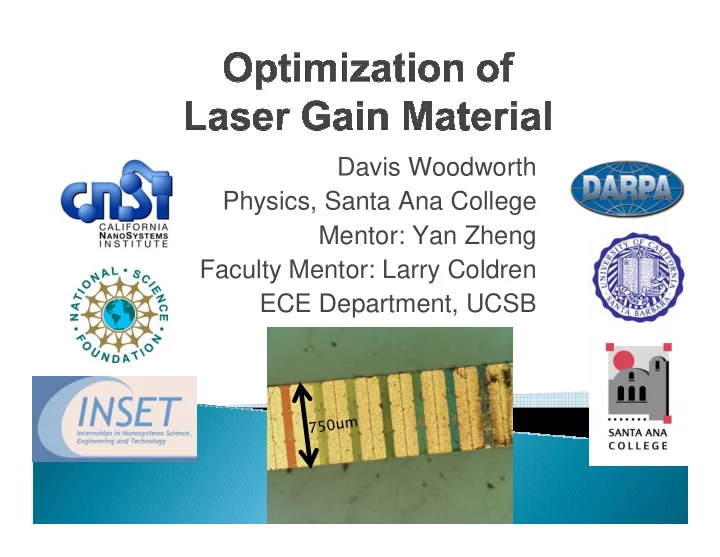
7 5 u m
SLIDE 2 Shift in electronics to faster
computing.
Problems with Copper:
- Speed limit: Parasitic loss
- Bandwidth Limit: Crosstalk
Pressing problem, servers: Copper
cables, too much heat, space, energy and not fast enough.
SLIDE 3 Replacing copper interconnects with optical
interconnects.
- Virtually no parasitic losses
- Virtually unlimited bandwidth
- No crosstalk
Current optical interconnects use Vertical Cavity Surface
Emitting Lasers (VCSELs).
- VCSELs have a higher yield.
SLIDE 4
InGaAs InGaAs GaAs InGaAs GaAs GaAs
Active Region Close-up
GaAs C Doping
Ridge Laser
Active Region Light propagation direction
SLIDE 5
250um
SLIDE 6 Light, Current (I), Voltage (LIV):
to obtain gain profile.
Relative Intensity Noise (RIN):
- Magnitude of nonlinear effects.
- Relaxation frequency.
Photodetector Photodetector Probe Probe Contact Contact
SLIDE 7 Threshold Current Slope ( )
Plot inverse slope (Differential Quantum Efficiency- DQE) versus length. Extract variables for the gain profile.
SLIDE 8 Graph Courtesy of Yan Zheng, UCSB
Y = 2261.1 ln ( J / 2792.5 )
Gain Profile Larger slope = faster
laser.
X intercept = gain
transparency.
Qualitative: comparing
- ne material next to the
- ther.
SLIDE 9 Peak (Resonant Relaxation Frequency)
Graph Courtesy of Yan Zheng, UCSB
RIN Determine effects that
hinder laser performance:
“sharpness” of peak wrt current.
Determine High speed
capabilities of Laser:
- Shift of peak wrt current.
- -maximize
SLIDE 10
Grow new lasers with differing levels of Carbon doping
and strain.
Test and compare data obtained with baseline data. Take the best material composition and use it to build a
faster Vertical Cavity Surface Emitting Laser (VCSEL).
Baseline LIV and RIN data was obtained. GEN III is finally up and running again!
SLIDE 11 Learned about laser and solid state physics. Observed and assisted in a wide range of research
activities, such as:
- MBE growth
- Photolithography
- Laser testing
- Analyzing data, sitting in on group meetings, etc.
Got a chance to observe the triumph, the defeat, the
joy and the anguish of graduate students.
SLIDE 12
Thanks to: Yan Zheng, Mentor Larry Coldren, Faculty Mentor CNSI and INSET UCSB, NSF, DARPA Fellow interns Audience Thanks to all, had a blast!
SLIDE 13
MBE diagram= http://mxp.physics.umn.edu/s07/Projects/S07_Graphene/images/MBE.gif Photolithography diagram= http://www.hitequest.com/Kiss/photolithography.gif Fiber Optic vs. Copper Cablehttp://www.visuallee.com/weblog/images/copper_fiber_compare.jpg Optical Active Cable= http://www.hitachi- cable.co.jp/ICSFiles/afieldfile/2009/03/18/oac.jpg
SLIDE 14