Day 9 Optimization of Cloud Data Centre Energy Consumption - - PDF document

day 9 optimization of cloud data centre energy consumption
SMART_READER_LITE
LIVE PREVIEW

Day 9 Optimization of Cloud Data Centre Energy Consumption - - PDF document

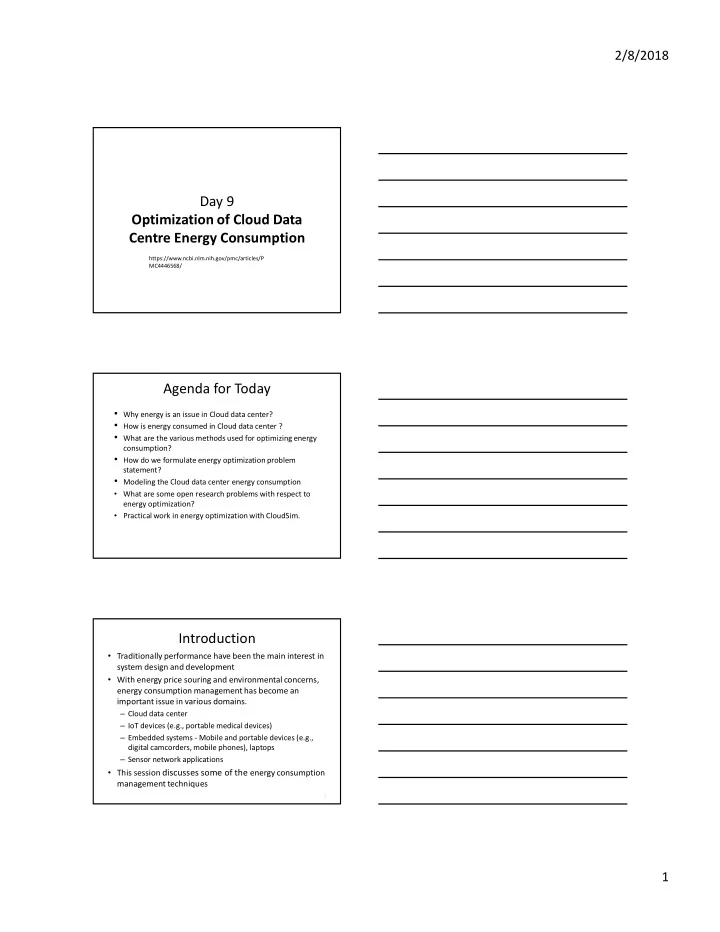
2/8/2018 Day 9 Optimization of Cloud Data Centre Energy Consumption https://www.ncbi.nlm.nih.gov/pmc/articles/P MC4446568/ Agenda for Today Why energy is an issue in Cloud data center? How is energy consumed in Cloud data center ?


slide-1
SLIDE 1

2/8/2018 1

Day 9 Optimization of Cloud Data Centre Energy Consumption

https://www.ncbi.nlm.nih.gov/pmc/articles/P MC4446568/

Agenda for Today

  • Why energy is an issue in Cloud data center?
  • How is energy consumed in Cloud data center ?
  • What are the various methods used for optimizing energy

consumption?

  • How do we formulate energy optimization problem

statement?

  • Modeling the Cloud data center energy consumption
  • What are some open research problems with respect to

energy optimization?

  • Practical work in energy optimization with CloudSim.

3

Introduction

  • Traditionally performance have been the main interest in

system design and development

  • With energy price souring and environmental concerns,

energy consumption management has become an important issue in various domains.

– Cloud data center – IoT devices (e.g., portable medical devices) – Embedded systems - Mobile and portable devices (e.g., digital camcorders, mobile phones), laptops – Sensor network applications

  • This session discusses some of the energy consumption

management techniques

slide-2
SLIDE 2

2/8/2018 2

Motivation

  • Why energy efficiency become such a significant

problem?

  • Economic issues

– Energy consumption, as illustrated by the estimated average power use across three classes of servers, is continually increasing year after year – Today, 50 cents are spent on energy for every dollar of hardware This is expected to increase by 54% over the next four years – The ever increasing energy consumption of computing systems has started to limit further performance growth due to overwhelming electricity bills

Motivation

  • Impact to end user

– Energy impacts end users in terms of resource usage costs. – Higher power consumption results in

  • Increased electricity bills, which cuts the revenue of the service

providers

  • additional requirements to a cooling system and power delivery

infrastructure (i.e. Uninterruptible Power Supplies (UPS), Power Distribution Units (PDU), etc. )

  • Environmental impact

– The rising concern of the environmental impact in terms of carbon dioxide (CO2) emissions caused by high energy consumption.

  • Therefore, the reduction of power and energy consumption

has become a first-order objective in the design of modern computing systems.

Energy Usage in Data center

  • How is energy typically used in the data center?

IT Load Power and Cooling

55% 45%

slide-3
SLIDE 3

2/8/2018 3

Energy consumption at different levels in computing systems.

  • What is the difference between power and energy?

– Power is the rate at which the system performs the work, – Energy is the total amount of work performed over a period of time. 𝑄 = 𝑋 𝑈 , 𝐹 = 𝑄𝑈 – P is power, T is a period of time, W is the total work performed in that period of time.

  • Note that reduction of the power consumption does

not always reduce the consumed energy.

Implications of Lowering Power

  • Running a task at a slower speed saves power

¼ energy savings with the

  • The problem is that it will lake longer to finish the

task thus affecting the performance

Energy Task running ‘½f’ frequency Energy Task running frequency ‘f’ Execution time Execution time double execution time

  • What if we could reduce the energy used with

minimal performance impact?

slide-4
SLIDE 4

2/8/2018 4

Dynamic Power Management

  • Dynamic Power Management (DPM) is a

design methodology for energy and power management of dynamically reconfiguring systems.

  • The goal for a DPM system is to provide the

requested services and performance with a minimum power consumption.

  • An example of DPM is the ‘Dynamic Voltage and

Frequency Scaling (DVFS).’

Dynamic voltage and frequency scaling

  • The power consumption is mainly governed by the

following equation:

𝑄 = 𝐷𝑊𝐺

– P is the power, – C is the switching capacitance, – V is the supplied voltage and – F is the working frequency.

  • From the equation, it is clearly evident that by simply

adjusting voltage–frequency pairs, it is possible to control the amount of consumed power

Dynamic voltage and frequency scaling

  • The main idea of this technique is to

– down-scale the voltage and frequency of CPU when it is not fully utilized – In ideal case, this is expected to result in cubic reduction of the dynamic power consumption.

  • Question

– How can we determine the suitable voltage- frequency setting?

slide-5
SLIDE 5

2/8/2018 5 Dynamic voltage and frequency scaling

  • Although DVFS can provide substantial energy savings,

real-world systems raise many complexities that have to be considered.

– The complex architectures of modern CPUs (i.e. pipelining, multi-level cache, etc.) make it difficult the prediction of the required CPU clock frequency that will meet application’s performance requirements. – Power consumption by a CPU may not be quadratic to its supply

  • voltage. For example, if the program is memory or I/O bounded, CPU

speed will not have a dramatic effect on the execution time. – Furthermore, slowing down the CPU may lead to changes in the order in which tasks are scheduled.

Virtualization

  • Another technology that can improve the

utilization of resources, and thus reduce the power consumption is virtualization of computer resources.

  • Virtualization technology allows one to create

several Virtual Machines (VMs) on a physical server and, therefore, reduce the amount of hardware in use and improve the utilization of resources.

Energy-Aware Consolidation for Cloud Computing

  • The power management problem becomes more

complicated when considered from the data center

  • level. In this case the system is represented by a set
  • f interconnected computing nodes that need to be

managed as a single resource in order to minimize the energy consumption.

  • Common limitations of the most of the works are

that no other system resource except for CPU are considered in the optimization

slide-6
SLIDE 6

2/8/2018 6

Cloud Datacenter Energy Consumption Modeling

  • Energy consumption model plays an important role

in Cloud datacenter energy management and control

– It is essential for guiding energy-aware algorithms such as resource provisioning policies – mechanisms such as virtual machine migration policies. – Moreover, it affects the pricing mechanism which cloud service providers charge their customers.

Energy Consumption Modeling

  • The most common approach used is the one built on the

assumption that the power consumption by a server grows

linearly with the growth of CPU utilization 𝑄 𝑣 = 𝑄 + (𝑄 − 𝑄) ∙ 𝜈

– 𝑄 is the estimated power consumption, – 𝑄is the power consumption by an idle server, – 𝑄is the power consumed by the server when it is fully utilized, and – 𝜈 is current CPU utilization.

  • Issue with this mode

– Zhang et al. [19] argue that the relationship between the energy consumption and the CPU utilization is not linear and instead it is a cubic.

Modeling the Cloud Datacenter Energy Consumption

  • Modeling the Cloud data center energy consumption

has received little attention

– Existing approaches primarily focus on CPU and memory subsystems energy consumption, – Tend to be complicated as it collects too many events leading to high overheads – The disk and network subsystems have become major contributors of data center energjy consumption – Existing approaches do not consider application characteristics when modeling Cloud datacenters energy consumption. – As application imposes different resource requirements, considering application characteristics in the development of the model also becomes a primary concern.

slide-7
SLIDE 7

2/8/2018 7

Cloud Datacenter Energy Consumption Modeling

  • We proposed an approach for Cloud datacenter

energy consumption model

– the proposed approach takes into account the energy consumption of the

  • processing unit,
  • memory,
  • disk
  • NIC (Network Interface Card)
  • the application characteristics.

Zhou Zhou; Jemal H. Abawajy; Fangmin Li; Zhigang Hu; Morshed Chowdhury; Abdulhameed Alelaiwi; Keqin Li, Fine-grained Energy Consumption Model of Servers Based on Task Characteristics in Cloud Data Center, IEEE Access, Year: 2018, Volume: PP, Issue: 99

Cloud Datacenter Energy Consumption Modeling

  • Cloud datacenter energy consumption model

framework

Zhou Zhou; Jemal H. Abawajy; Fangmin Li; Zhigang Hu; Morshed Chowdhury; Abdulhameed Alelaiwi; Keqin Li, Fine-grained Energy Consumption Model of Servers Based on Task Characteristics in Cloud Data Center, IEEE Access, Year: 2018, Volume: PP, Issue: 99

Energy Consumption Modeling

  • The feature extraction step is responsible for collecting features
  • f the resources and applications relevant to the energy

consumption modeling.

Zhou Zhou; Jemal H. Abawajy; Fangmin Li; Zhigang Hu; Morshed Chowdhury; Abdulhameed Alelaiwi; Keqin Li, Fine-grained Energy Consumption Model of Servers Based on Task Characteristics in Cloud Data Center, IEEE Access, Year: 2018, Volume: PP, Issue: 99

  • This step can be performed by using either resource utilization

based method or performance-monitor-counter (PMC) based

  • models. We used the latter with some modification
slide-8
SLIDE 8

2/8/2018 8

Energy Consumption Modeling

  • We used the PMC-based approach have three main

steps.

– Collection of data:

  • events related to hardware units such as CPU, memory, disk, and

NIC are monitored.

– Screening

  • the events are analysis and those events that are

related to the PMC set are screened out. – Modeling

  • the energy consumption model is built based on the relationship

between the PMC events and energy consumption by the system components.

Energy Consumption Modeling

  • The feature selection step is responsible for finding good feature

representation is very domain specific and related to available measurements.

Zhou Zhou; Jemal H. Abawajy; Fangmin Li; Zhigang Hu; Morshed Chowdhury; Abdulhameed Alelaiwi; Keqin Li, Fine-grained Energy Consumption Model of Servers Based on Task Characteristics in Cloud Data Center, IEEE Access, Year: 2018, Volume: PP, Issue: 99

  • This step can be accomplished by deploying approaches such as

Correlation Matrix (CM) or Principal Component Analysis (PCA).

Principal Component Analysis

  • PCA is a simple yet popular and useful linear

transformation technique

  • The main goal of a PCA analysis is to

– identify patterns in data; – detect the correlation between variables. – If a strong correlation between variables exists, reduce the dimensionality.

slide-9
SLIDE 9

2/8/2018 9

Energy Consumption Modeling

  • We compute the system power consumption as

follows: 𝑄 = 𝜍 + 𝑄

– 𝑆 = {𝐷𝑄𝑉, 𝑆𝐵𝑁, 𝐸𝐽𝑇𝐿, 𝑂𝐽𝐷} – 𝜍 : represents the power of other subcomponents of a system excluding CPU, memory, disk, and NIC. It can be considered constant

Energy Consumption Modeling

  • The parameter PCPU can be modeled with the

following equation:

𝑄 𝑣 = 𝑄 + (𝑄 − 𝑄) ∙ 𝜈

– 𝑄 is the estimated power consumption, – 𝑄is the power consumption by an idle server, – 𝑄is the power consumed by the server when it is fully utilized, and – 𝜈 is current CPU utilization.

Energy Consumption Modeling

  • In the equation below, the value of PCPU is related to

𝜈

𝑄 𝑣 = 𝑄 + (𝑄 − 𝑄) ∙ 𝜈

  • Therefore

– We choose parameter “Processor Time” as energy- consumption representative of the CPU. – “Processor Time” refers to the percentage of an elapsed time that the processor spends executing a non-idle thread. – We can monitor the value of “Processor Time” to get the CPU utilization.

slide-10
SLIDE 10

2/8/2018 10

Energy Consumption Modeling

  • As for the parameter Pmemory , we used the following

formula:

  • the power of pre-charge (PPRE),
  • activate (PACT),
  • read (PRD),
  • write (PWR)
  • refresh (PREF).
  • We used the following memory subsystem.

– “Memory Used” - the memory utilization – “Page Fault/Sec” - an average number of error pages per second.

m em ory P R E R D W R R E F A C T

P P P P P P     

Energy Consumption Modeling

  • We captured the parameter Pdisk with the following

equation:

  • where ,

– Pread represent the power needed for reading, – Pwrite represent the power needed for writing Pidle represent the power needed for remaining idle

disk READ WRITE IDLE

P P P P   

Energy Consumption Modeling

  • As for the parameter of Pnetwork, we captured it with

the following equation:

– C0 and C1 can be considered as constants, – S is the file size in MB; – B is the bandwidth in MB/s

  • As energy-consumption representative of the NIC,

we choose parameters

– “Bytes Total/Sec” - the rate at which the network adapter is processing data bytes – “Current Bandwidth” - the bandwidth.

1 network

S P C C B   

slide-11
SLIDE 11

2/8/2018 11

Energy Consumption Modeling

  • The parameter values and energy

consumption under different workload

Processor Time Memory Used Page Fault/Sec Disk Time Disk Bytes/Sec Bytes Total/Sec Current Bandwi dth Energy Consumpt ion CPU Intensive Application 4.23 4.47 512.78 0.66 4102.28 562.00 9.22E+1 8 122.49 5.92 2.85 24808.87 0.38 4102.59 1785.00 9.22E+1 8 122.05 6.64 4.48 8374.42 5.26 235386.71 396.00 9.22E+1 8 124.19 8.21 4.48 278.10 3.71 213078.94 4526.00 9.22E+1 8 127.46 5.60 3.80 50.08 1.20 16410.60 2574.00 9.22E+1 8 123.32 3.65 … 2.75 … 41652.42 … 11.93 … 1292362.83 … 567.00 … 9.22E+1 8 … 99.81 …

Energy Consumption Modeling

  • The parameter values and energy

consumption under different workload

Transactional Web Application 6.90 4.29 28192.0 4 2.86 689229.2 2 64.13 9.22E+18 107.00 13.48 4.36 61633.7 2.86 645129.1 5 63.58 9.22E+18 115.18 18.42 4.50 77579.1 2 0.90 49230.76 170.23 9.22E+18 116.05 30.53 4.50 114919. 69 5.26 80508.48 352.14 9.22E+18 119.46 10.81 4.31 42296.9 3 2.86 109744.2 5 469.58 9.22E+18 113.23 1.89 4.21 53.09 0.88 3589.75 64.10 9.22E+18 105.05 1.28 … 4.11 … 2047.26 … 0.99 … 4039.30 … 63.12 … 9.22E+18 … 97.77 …

Energy Consumption Modeling

  • The parameter values and energy

consumption under different workload

Transactional Web Application 6.90 4.29 28192.0 4 2.86 689229.2 2 64.13 9.22E+18 107.00 13.48 4.36 61633.7 2.86 645129.1 5 63.58 9.22E+18 115.18 18.42 4.50 77579.1 2 0.90 49230.76 170.23 9.22E+18 116.05 30.53 4.50 114919. 69 5.26 80508.48 352.14 9.22E+18 119.46 10.81 4.31 42296.9 3 2.86 109744.2 5 469.58 9.22E+18 113.23 1.89 4.21 53.09 0.88 3589.75 64.10 9.22E+18 105.05 1.28 … 4.11 … 2047.26 … 0.99 … 4039.30 … 63.12 … 9.22E+18 … 97.77 …

slide-12
SLIDE 12

2/8/2018 12

Energy Consumption Modeling

  • The parameter values and energy

consumption under different workload

I/O Intensive Application 1.43 3.15 6820.57 33.50 12965503.46 96.15 9.22E+18 106.82 2.18 3.15 3568.04 37.17 23877620.48 1013.53 9.22E+18 107.17 4.88 3.11 65473.4 51.19 23920602.25 1057.64 9.22E+18 112.85 5.53 2.90 32459.7 6 37.59 24110357.36 1125.20 9.22E+18 120.78 6.51 2.83 38.06 15.72 17867756.48 12834.7 9 9.22E+18 121.28 7.10 … 2.95 … 13.02 … 4.32 … 1932221.31 … 105.00 … 9.22E+18 … 125.13 …

Feature Selection

  • We selected a subset of relevant features from

those extracted in the preceding section for use in power model building

Component name Parameter CPU architecture 2 × (intel)Xeon E5-2620 Six-Core CPU frequency 12×2.0 GHZ Level 1 cache 6 × 32 KB Level 2 cache 6 × 256 KB Level 3 cache 15 MB Memory size 20 GB DDR3 Disk size 2×1TB NIC Intel quad-port Gigabit network adapter

Feature Selection

  • Analysis of the selected features contributions

Parameter Application Contribution (%) CPU Intensive Transactional Web I/O Intensive Processor Time 63 62 53 Disk Bytes/Sec 21 19 27 Disk Time 11 14 15 Page Fault/Sec 3 4 4 Memory Used 1 1 1 Bytes Total/Sec 1 Current Bandwidth Note that “Current Bandwidth” does not contribute at all. This is because a CPU- intensive application also called compute-intensive task requires a lot of processing power as compared to other resources.

slide-13
SLIDE 13

2/8/2018 13

Energy Consumption Modeling

  • Multivariate linear regression model
  • where
  • y is the real energy consumption
  • 𝛾 | 0 ≤ 𝑙 ≤ 𝑛 are the regression coefficients and
  • 𝜁 represents a stochastic error

– We also used (the paper)

  • Exponential regression model
  • Power regression model

1 1 2 2

...

m m

y x x x           

PERFORMANCE ANALYSIS

  • To evaluate the accuracy of energy consumption

model, we define the following metric:

– 𝑄𝑝𝑥𝑓𝑠

is the predicted value of the energy consumption,

– 𝑄𝑝𝑥𝑓𝑠

is the true value of the energy consumption, and

– 𝑄𝑝𝑥𝑓𝑠

is the relative error of the energy consumption.

  • We compare the proposed approach with three baseline

approaches:

– the Ramon Model, – Linear Model – Cubic Model.

Analysis for CPU Intensive Task

Energy consumption for the seven models Relative error for the seven models

slide-14
SLIDE 14

2/8/2018 14 Analysis for Transactional Web Task

The energy consumption and relative error under the transactional web task

Analysis for I/O Intensive Task

The energy consumption and relative error under the transactional web task

Research problems

  • Research problem: Does virtual machines

(VMs) assigned the same amount of CPU cycles consume equal amount of energy?

  • Research problem: Does PMC-based method

appropriate for virtualized environments?

  • Research problem: Does Dynamic Voltage and

Frequency Scaling(DVFS) method affect the accuracy of the power model?

slide-15
SLIDE 15

2/8/2018 15

Energy-aware resource allocation and provisioning

  • We developed an energy-aware resource allocation

and provisioning algorithm that improve

– the energy efficiency of a data center under SLA constraints; – The proposed approach jointly minimizes computing-plus- communication energy consumption and t takes into account DVFS-based active discrete frequencies and their time fractions for each VM. – We used the scheduling algorithm for energy-efficient mapping

  • f multimedia data fractions over the available VMs.

Mohammad Shojafar; Claudia Canali; Riccardo Lancellotti; Jemal Abawajy, Adaptive Computing-plus- Communication Optimization Framework for Multimedia Processing in Cloud Systems, IEEE Transactions on Cloud Computing, 2018, Volume:PP, Issue: 99, Pages: 1 - 1

Energy-aware resource allocation and provisioning

  • The proposed approach aims at properly tuning the

workload fractions and the end-to-end link data transferring rates to minimize the overall resulting computing-plus-communication energy,

  • Formally defined as:

Mohammad Shojafar; Claudia Canali; Riccardo Lancellotti; Jemal Abawajy, Adaptive Computing-plus- Communication Optimization Framework for Multimedia Processing in Cloud Systems, IEEE Transactions on Cloud Computing, 2018, Volume:PP, Issue: 99, Pages: 1 - 1

the reconfiguration cost of VM(i) under the SLA constraint Network energy consumed for i-th link Computing energy consumed for VM(i)

Energy-aware resource allocation and provisioning

  • Formally defined as:

represents the joint computing-plus- communication cost, which takes into account the VMs frequency switching cost for each incoming workload. processing rates by their duration for all VMs should be equal to the incoming workload Ltot. T that is the maximum time for the computation, a constraint on the computational time , constraint on the communication time

assures the amount of data transferred through the data center does not exceed the overall data center network capacity

slide-16
SLIDE 16

2/8/2018 16 The MMGreen reference architecture

The basic task of the VMM is to manage suitable frequency scaling mechanisms, to allow the server hosting the VMs to adjust in real- time their processing frequency fi

VMM

Please read the following paper

Mohammad Shojafar; Claudia Canali; Riccardo Lancellotti; Jemal Abawajy, Adaptive Computing-plus-Communication Optimization Framework for Multimedia Processing in Cloud Systems, IEEE Transactions on Cloud Computing, 2018, Volume:PP, Issue: 99, Pages: 1 - 1

Performance comparison: synthetic workload

  • We compare the performance of MMGreen with

NetDC [21], Lyapunov [10] and Hybrid NetDC [20]

Realistic Workload

  • ..
slide-17
SLIDE 17

2/8/2018 17

Sensitivity to Dynamic Reconfiguration Parameters

  • The impact of dynamic frequency reconfiguration for

different numbers of VMs and for the different values of the parameter

Sensitivity to Communication Parameters

Minimizing SLA violation and power consumption in Cloud data centers using adaptive energy-aware algorithms

  • We divide the hosts into classes based on the CPU

utilization.

Zhou Zhou a,b, Jemal Abawajy c,*, Morshed Chowdhury d, Zhigang Hue, Keqin Li f, Hongbing Cheng g, Abdulhameed A. Alelaiwi h, Fangmin Li a, Minimizing SLA violation and power consumption in Cloud data centers using adaptive energy- aware algorithms, Future Generation Computing, 201

How can we determine threshold values?

slide-18
SLIDE 18

2/8/2018 18

Minimizing SLA violation and power consumption in Cloud data centers using adaptive energy-aware algorithm

: Z. Zhou, et al., Minimizing SLA violation and power consumption in Cloud data centers using adaptive energy-aware algorithms, Future Generation Computer Systems (2017), http://dx.doi.org/10.1016/j.future.2017.07.048.

Energy-Efficient Fog of Everything

Enzo Baccarelli; Paola G. Vinueza Naranjo; Michele Scarpiniti; Mohammad Shojafar; Jemal H. Abawajy, Fog of Everything: Energy-Efficient Networked Computing Architectures, Research Challenges, and a Case Study, IEEE Access, Year: 2017, Volume: 5, Pages: 9882 - 9910 Paola G. V. Naranjo,Zahra Pooranian,Shahaboddin Shamshirband,Jemal

  • H. Abawajy andMauro Conti, Fog over Virtualized IoT: New Opportunity

for Context-Aware Networked Applications and a Case Study

Research Opportunities

  • There are a number of areas to explore in
  • rder to conserve energy within a Cloud

environment.

– Schedule VMs to conserve energy. – Management of both VMs and underlying infrastructure. – Minimize operating inefficiencies for non-essential tasks. – Optimize data center design.

54

slide-19
SLIDE 19

2/8/2018 19

Research problem

  • Combine concepts of both Power-aware and

Thermal-aware scheduling to minimize both energy and temperature.

  • Integrated server, rack, and cooling strategies.
  • Further improve VM Image minimization.
  • Designing the next generation of Cloud

computing systems to be more efficient.

  • Power management techniques must balance

between the demanding needs for higher performance/throughput and the impact of aggressive power consumption and negative

  • Live and offline migrations of VMs offered by

the virtualization technology have enabled the technique of dynamic consolidation of VMs according to current performance

  • requirements. However, VM migration leads

to time delays and performance overhead, requiring careful analysis and intelligent techniques to eliminate non-productive migrations that can occur due to the workload variation.

  • First of all, due to the wide adoption of multi-

core CPUs, it is important to develop energy- efficient resource management approaches that will leverage such architectures. Apart from the CPU and memory, another significant energy consumer in data center is the network interconnect infrastructure. Therefore, it is crucial to develop intelligent techniques to manage network resources efficiently.

slide-20
SLIDE 20

2/8/2018 20

58

Thank you.

Questions, Comments, …?