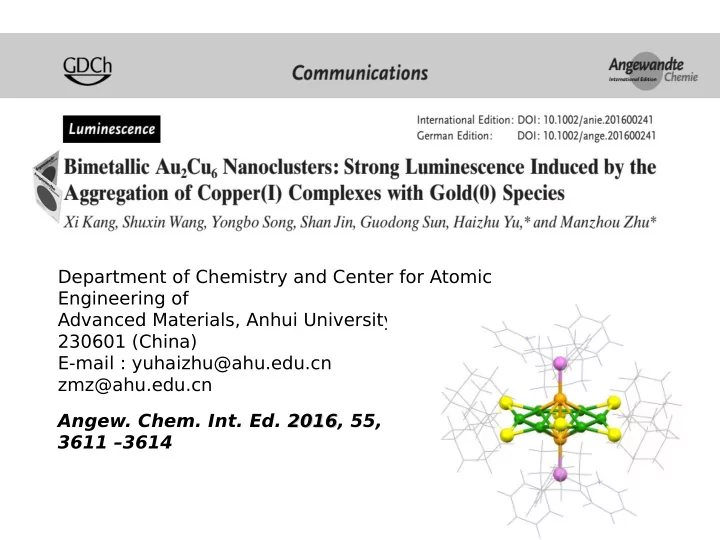
Department of Chemistry and Center for Atomic Engineering of - - PowerPoint PPT Presentation

department of chemistry and center for atomic engineering
SMART_READER_LITE
LIVE PREVIEW

Department of Chemistry and Center for Atomic Engineering of - - PowerPoint PPT Presentation

Department of Chemistry and Center for Atomic Engineering of Advanced Materials, Anhui University, Hefei, Anhui, 230601 (China) E-mail : yuhaizhu@ahu.edu.cn zmz@ahu.edu.cn Angew. Chem. Int. Ed. 2016 2016, 55, 3611 3614 Atomically


slide-1
SLIDE 1

Department of Chemistry and Center for Atomic Engineering of Advanced Materials, Anhui University, Hefei, Anhui, 230601 (China) E-mail : yuhaizhu@ahu.edu.cn zmz@ahu.edu.cn

  • Angew. Chem. Int. Ed. 2016

2016, 55, 3611 –3614

slide-2
SLIDE 2
  • Atomically precise noble-metal nanoclusters have attracted extensive

research interest. It is generally accepted that the structure of these NCs determines their physical and chemical properties (eg. electrochemical, catalytic and optical properties). Among these physical/ chemical properties, luminescence represents one of the most fascinating features of these materials.

  • T
  • date, several fmuorescent noble-metal NCs have been reported.

Nonetheless, the quantum yield of these NCs remained relatively low compared to those of other fmuorescent nanomaterials, such as quantum dots, carbon nanodots, and lanthanide nanoparticles.

  • Various strategies have been developed to enhance the quantum yield of

these NCs. In addition to the contribution from the M(0) core, the role of M(I)-SR shell

slide-3
SLIDE 3

Aggregation Induced Emission is a photoluminescence enhancement strategy for some of the organic molecules by aggregation.

Recent studies suggest that the restriction of intramolecular motion (RIM) is responsible for the AIE phenomenon of these molecular rotor systems. In general, the AIE active molecules consist of a number of rotors, which can rotate or vibrate freely in dilute solution. However, rotations and vibrations of these rotors in the aggregated state are largely restricted, leading to the strong AIE efgect.

Figure . Schematic illustration of the AIE phenomenon of a propeller-shaped luminogen of tetraphenylethene (TPE) through RIR and a shell-like luminogen of 10,10 ′,11,11 ′-tetrahydro-5,5 ′-bidibenzo- [a,d][7]annulenylidene (THBA) through RIV.

  • Adv. Mater. 2014, 26, 5429 −5479
slide-4
SLIDE 4

Gold(I)-Alkanethiolate Complexes Having Highly Ordered Supramolecular Structures

  • Chem. Mater. 2007, 19, 6297

−6303 Solvent-induced AIE properties of the oligomeric Au(I) −SG complexes

  • J. Am. Chem. Soc. 2012, 134,

16662 −16670

  • occured by certain divalent cation like Cd (II) which could electrostatically bind

negatively charged Au (I) – SG complexes.

slide-5
SLIDE 5
  • The concept of aggregation-induced emission (AIE) has been exploited to re

non-luminescent CuISR complexes strongly luminescent. The CuISR comple controlled aggregation with Au0.

  • Six thiolated Cu atoms are aggregated by two Au atoms (Au2Cu6 nanoclus

X-ray crystallography has validated the structure of this highly fmuorescent The quantum yield of this nanocluster is 11.7%.

  • The aggregation is afgected by the restriction of intramolecular rotation

high rigidity of the outer ligands enhances the fmuorescence of the Au2Cu6 na Unlike previous AIE methods, this strategy does not require insoluble The active metal complexes (e.g., Ag or Cu, which are frequently used as fmuorescent complexes) could act as the surface ligand , and are controllably aggregated by an inert metal core (such as Au0 ). This core– shell structure might hopefully activate the RIR process and boost the AIE of the active metal complexes. The active metal complexes (e.g., Ag or Cu, which are frequently used as fmuorescent complexes) could act as the surface ligand , and are controllably aggregated by an inert metal core (such as Au0 ). This core– shell structure might hopefully activate the RIR process and boost the AIE of the active metal complexes.

slide-6
SLIDE 6
  • Figure. Illustration of the Au 0-induced aggregation of CuSR1. Au0 was

generated by the selective reduction of AuPR2Cl with NaBH 4. Digital photographs of the corresponding complexes or NCs under visible (1) and UV light (2). Au gold, Cl blue, Cu green, P violet, S yellow. MOVEMENT OF CuISR UNITS WAS HIGHL Y RESTRICTED BY GOLD ATOMS MOVEMENT OF CuISR UNITS WAS HIGHL Y RESTRICTED BY GOLD ATOMS

slide-7
SLIDE 7

Figure . Crystal structure of Au2Cu 6 nanocluster I. A) The outer-loop hexagonal Cu6S6 moiety as the benzenoid-like framework of I. B) The central Au2P2 line across Cu6S6. C) Side view and top view of I. D) Overall structure of I. For clarity, the benzene and pyridine groups on the phosphine ligands and all H atoms are not shown, and the adamantane groups are shown in wireframe.

slide-8
SLIDE 8

Figure . A) Experimental absorption spectrum of nanocluster I. Inset: HOMO and LUMO of I. B) Photoluminescence properties of I. Excitation spectrum (left) and emission spectra (right) at difgerent excitation wavelengths, as indicated by the arrows.

Absorption features of Au2Cu6 nanocluster are at 325, 420, 515 and 595 nm. Au2Cu6 nanocluster exhibits a strong emission centred at 665 nm with a quantum yield of 11.7 %.

slide-9
SLIDE 9

Figure : The Kohn-Sham orbital energy level diagram for the Au2Cu6-I nanocluster and the HOMO and LUMO distribution of Au2Cu6-I.

According to the Kohn– Sham (KS) molecular orbital (MO) energy levels, HOMOs S 3p and Cu 3d atomic orbitals. HOMOs extend to the hexagonal (CuSR1)6 unit of the

  • verall structure.

LUMOs N 2p and C 2p

  • rbitals.

Au atoms hardly contribute to the frontier orbitals of Au2Cu6 nanocluster. The HOMO–LUMO gap ~ 1.92 eV , Emission peak ~ 1.87 eV.

The extremely low difgerence in energy (0.05 eV) implies that the fmuorescence possibly corresponds to the LUMO–HOMO transition. DFT calculations indicate that the LUMO–HOMO transition predominantly occurs between the ligands (aromatic and the copper centers through weak conjugation of the π-orbitals of the aromatic groups and the Cu (d )orbitals. The emission is due to LMCT.

slide-10
SLIDE 10

AIE is mostly caused by the RIR. Therefore, we expected the fmuorescence of the NCs to benefjt from the increased rigidity of the capping ligands and the resulting activation of the RIR.

1-Adamantanethiol (AdmSH) t-butyl mercaptan (TBM)

I Au2(PPh2Py)2Cu6(AdmSH)6 II Au2(PPh2Py)2Cu6(TBM)6

  • Figure. The UV/Vis absorption spectra
  • fAu2Cu6 NCs protected by difgerent

ligands.

slide-11
SLIDE 11
  • Figure. UV/Vis spectra confjrming the thermal stability of a) I and b)

II over time.

STUDY OF THE THERMODYNAMIC STABILITY OF ANALOGOUS NANOCL DFT CALCULATIONS TO EVALUATE RELATIVE STABILITY OF I A DFT calculations were performed to evaluate the relative stabilities of I and II by calculating the reaction enthalpy of the ligand-exchange reaction: I + 6TBM II + 6AdmSH. This reaction was found to be endothermic by 16.10 kcal mol -1, indicating that Au2Cu6

slide-12
SLIDE 12

Figure : Emission spectra of solutions of nanoclusters 1 (left) and II (right) under UV light

The luminescence spectra of these two NCs had the same optical density (OD … 0.05). The maxima in both emission spectra were located at about 665 nm. The fmuorescence of the more rigid Au2Cu6 nanocluster I is signifjcantly stronger than that of II (with less rigidity).

QY of nanocluster I is 11.7 QY of nanocluster II is 8.0 It is thus concluded that the enhanced fmuorescence of Au2Cu6 nanocluster I had indeed been achieved by activating the RIR of the outer ligands.

slide-13
SLIDE 13

 A novel strategy to activate aggregation-induced emission, which is based on the aggregation of active metal complexes (CuISR) with neutral gold atoms has been developed.  The structures of the resulting products (Au2Cu6 NCs) were successfully determined by X- ray crystallography, which revealed that six CuSR1 complexes were aggregated by Au0 atoms.  This compound showed strong emission centered at 665 nm with a quantum yield of 11.7 %.  It was found that the fmuorescence is due to ligand-to-metal charge- transfer process.  The rigidity of the ligands positively correlates with the quantum yield, indicating that

slide-14
SLIDE 14

 This paper gives direction for synthesis of luminescent nanoclusters and und the origin of luminescence in noble metal clusters.  It might be possible to synthesize highly luminescent clusters that could f as quantum dots and organic dyes.  Luminescent nanoclusters may fjnd good applications in sensing and ima