SLIDE 1
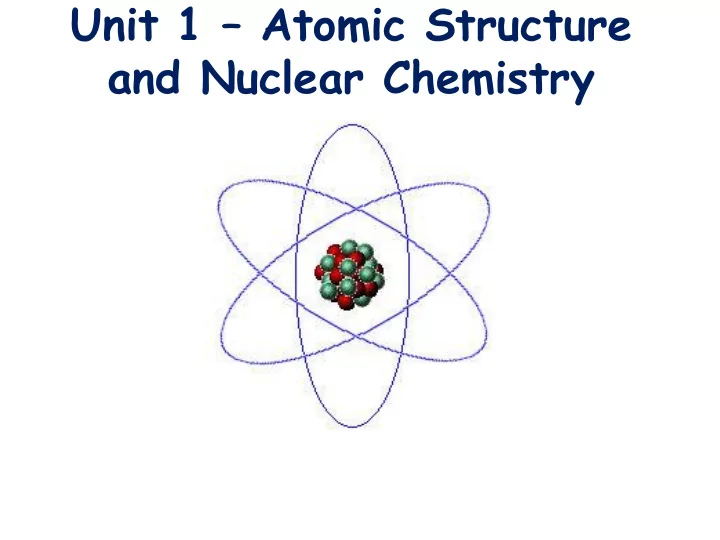
Unit 1 – Atomic Structure and Nuclear Chemistry
SLIDE 2
Introduction to the atom
SLIDE 3
SLIDE 4
Modern Atomic Theory
Atoms cannot be subdivided, created, or destroyed in ordinary chemical reactions. However, these changes CAN occur in nuclear reactions! Every atom has different properties from other atoms All matter is composed of atoms Ex: grinding down a gold ring
SLIDE 5 Modern Atomic Theory
Theory
- A set of tested hypotheses that gives an
- verall explanation of some natural
phenomenon. Ex: Cell theory & Evolutionary theory
Wait, it’s “only” a theory? Why are we learning it then?
- A theory is a powerful term in science
SLIDE 6 We can now see atoms …sort of
The Kanji characters for "atom." This image was formed by using the tiny tip of an STM to pick up individual atoms of iron and place them on a copper (111) surface. In 1981 a STM (Scanning Tunneling Microscope) was created.
manipulate them.
SLIDE 7 Nanotechnology is coming
Atoms can be moved and molded to make various devices such as molecular motors
SLIDE 8
Structure of the Atom
SLIDE 9
Accessing Prior Knowledge
1. Based on your previous science classes, draw a generic atom and label where you’d find the nucleus, protons, neutrons, & electrons. 2. For a common beryllium atom, what is the: a) # protons? b) # neutrons? c) # electrons?
SLIDE 10 Structure of an Atom
Particle Charge Mass # Location Purpose Electron
Electron cloud Behavior of element Proton +1 1 Nucleus Identity of element Neutron 1 Nucleus Stability of nucleus
Nucleus (protons + neutrons) Electrons (in electron cloud)
1/2000th the mass of P+ & N
SLIDE 11
Charges in an Atom
The atom is generally neutral because: # of negative electrons = # of positive protons The nucleus is positively charged because: Contains positive protons (and neutrons which don’t have a charge).
SLIDE 12 The Atomic Scale… most pictures are really inaccurate!
- nucleus (protons and neutrons) is
small and dense and contains most
- f the mass of the atom.
- The electron cloud (where
electrons are found) contain most of the volume (3-D space) of an atom.
Not drawn to scale (electrons would be really far away) & the nucleus tiny.
A penny has 2.9 x 10²² atoms. Atoms are mostly empty space.
SLIDE 13 Atomic sizing… an analogy
…the nucleus would be the size
sand. If you could make an atom as large as a football stadium… The nucleus is really tiny compared to the total size
- f the atom, but it’s never drawn that way.
(electron cloud takes up most of the volume)
SLIDE 14 Fun Fact…Quarks
up protons and neutrons.
SLIDE 15
Using the Periodic Table to determining # or protons, neutrons, and electrons
SLIDE 16 Reading the periodic table
Atomic #= # of protons & # electrons
- Proton # = Unique to every
atom (serves as an atom’s identity)
- (atoms are neutral and + and –
charges must balance out)
SLIDE 17 Reading the periodic table
Atomic mass= the average mass of that atom
- Round the atomic mass (ex:12 )
- (electrons don’t weigh much so
aren’t included in mass #) Mass #- = # protons + # neutrons
- Ex. Not all carbon atoms have
the same mass so we have an average (see isotopes).
SLIDE 18 Practice
Atomic # Atomic Mass Mass # # protons # electrons # neutrons
17
Cl
35.45
17 35.45 35 17 17 18
SLIDE 19
Forces that hold an Atom Together
SLIDE 20
Forces that hold atoms together
Electromagnetic Force Nuclear Force
Keeps electrons near the nucleus Keeps nucleus from breaking apart
SLIDE 21 Electromagnetic Force
Protons (in the nucleus) & Electrons are attracted to each
- ther because of their opposite
charges Idea is that opposite charges attract
SLIDE 22 Nuclear Force
- The nuclear force is a 100 X’s stronger than
the electromagnetic force and acts like a “glue”
- the “strong force” (aka nuclear forces)
- vercomes the electromagnetic forces as long as
the protons are very close together
- Electromagnetic forces should cause
this nucleus to break apart because
- f all the protons repelling each other
(same charge), but it doesn’t ????
SLIDE 23
Joke…
SLIDE 24
Atoms vs. Elements vs. Molecules/Compounds
SLIDE 25
Elements, atoms, & molecules
atom A B C molecule Element Contains only one kind of atom (pure) D Molecule (bonded) & element (pure) 2 or more atoms bonded together
SLIDE 26
Isotopes
SLIDE 27 Isotopes
- atoms of the same element having different masses due
to different #’s of neutrons. (most have at least 2)
Isotope (in hyphen notation) Nucleus Hydrogen–1 (protium) Hydrogen-2 (deuterium) Hydrogen-3 (tritium)
The # indicates the mass number of the isotope (version) you are referring to.
- They’re all still Hydrogen
because they have 1 proton
SLIDE 28
3 Isotopes (versions) of Carbon
Isotope = Almost all of the elements have at least 2 different isotopes. Some have 4, 5, or even 10. *They are all carbon because they have 6 protons
SLIDE 29 Calculating average atomic mass
Can you guess which isotope is most common in nature?
periodic table carbon has an average atomic mass of 12.01.
Isotope Atomic Mass (amu) % Natural Abundance C - 12 12.00000 98.89 C - 13 13.00335 1.11
SLIDE 30 Practice with Isotopes
Atomic # Atomic Mass Mass # # protons # electrons # neutrons 6 14.00 (estimate based on mass #) 14 6 6 8
One way to show isotopes in writing: Ex: Carbon-14
SLIDE 31 Notations- another way to show isotopes
235 92U
Element symbol Mass of Isotope (p+ + no) Atomic # (# of p+)
Hyphen Notation Nuclear Notation Uranium-235
SLIDE 32 Some Isotopes are Radioactive
- Some isotopes of elements
are unstable (aka radioactive)
- Too many protons or neutrons
in a nucleus (ratio important)
- Large elements (#84 & up)
are radioactive
- Small ones can be radioactive
too (see H isotopes )
Isotopes of hydrogen H-3 is radioactive
SLIDE 33
- Intro. to Radioactivity & the
Band of Stability
SLIDE 34 What determines if a nucleus will be radioactive?
- The neutron to proton ratio in
the nucleus is an important part
- f stability.
- Small, stable atoms= 1 neutron
for every 1 proton
- Bigger, stable atoms = 1.5
neutron/ 1 proton.
- Neutrons aid to increase the
nuclear force in larger atoms
- A nucleus with 84 protons or
more will be radioactive regardless of how many neutrons it has (because of proton repulsion)
Band of stability graph- isotopes located on edge are radioactive
SLIDE 35 How to use the Band of Stability Graph
protons (x-axis) vs. number of neutrons (y- axis) for the atom.
– off the band of stability = atom does not exist in nature (too unstable) – at the edge of the band of stability = atom is unstable (radioactive). – on the band of stability = atom is stable (not radioactive).
SLIDE 36 Types of Radioactive Decay
(Alpha, Beta, & Gamma)
& Balancing Nuclear Equations
SLIDE 37 Radioactive Decay (summary)
- An unstable nucleus will emit particles of alpha,
beta, or gamma rays (aka radiation) to become a more stable element.
- Elements with Atomic # 84 or higher are radioactive no matter
how many neutrons they have. (nuclear force only works when protons are close)
- Proton to Neutron Ratio determines stability (see band of
stability graph)
Ex: Uranium --> radioactive particles + Lead
(unstable) (stable)
- This happens naturally & spontaneously
SLIDE 38 3 Types of Radioactive Decay
particles that can be emitted from an unstable nucleus: – Alpha (α) particles – Beta (β) particles – Gamma (γ) particles
SLIDE 39 Alpha Decay-
- Symbol:
- Helium nucleus
- 2 protons & 2 neutrons
- Problem: the
nucleus has too many protons which cause excessive repulsion.
- Solution: In an attempt to reduce the repulsion
between protons, a Helium nucleus is emitted.
He
4 2
SLIDE 40 Beta Decay
- Symbol-
- an electron
- Problem: too many
neutrons causes instability.
- Solution: a neutron is split into a proton and an
electron.
- electron is then emitted at high speeds.
- Proton is kept
e
1
SLIDE 41 Gamma Decay- Electromagnetic Radiation
- Symbol:
- high energy
- Problem: the
nucleus is at too high an energy.
nucleus falls down to a lower energy state and, in the process, emits a high energy photon known as a gamma particle. Usually accompanies alpha and beta radiation
Y
SLIDE 42 Penetration and Damage by types of Radiation
Alpha- thin barrier can stop (they are big and heavy and can’t travel very far) Beta- clothing, wood, or aluminum can stop. Gamma- highly penetrating
ingested can be dangerous.
ingested can be dangerous.
- Can penetrate deeply into
the body & alter DNA (cobalt-60 used for cancer treatment)
SLIDE 43 Summary of 3 types of radiation
Symbol Nuclear Notation Identity Damage Alpha
α
Helium nucleus Least penetrating Beta ß electron Gamma γ High energy Most penetrating
He
4 2
Y
e
1
SLIDE 44 Balancing Nuclear Reactions
Unstable element Radioactive particle More stable element Law of conservation of Matter= matter can neither be created nor destroyed (“what goes in must come out”)
Rn He Ra
222 86 4 2 226 88
Mass 226 = 4 + 222 (just add top) Protons 88 = 2 + 86 (add bottom)
Gamma is not usually shown in equation (no effect)
Y
SLIDE 45
SLIDE 46
½ Life & Calculations
SLIDE 47
Nuclear Decay of Uranium-238
SLIDE 48 ½ Life & Radioactive Dating
takes for ½ of the atoms of a radioactive substance to decay into a stable isotope. Half-life Ex: Carbon-14 = 5730 years Uranium-235 = 704 million years
SLIDE 49 Radioactive Decay Graph
number of parent atoms remaining over time.
- The half-life is determined
by how many years it takes for ½ if the atoms to decay.
- There are 18 out of the
- riginal 36 parent atoms
after 3.9 years.
SLIDE 50
SLIDE 51 Radioactive Dating (w/ Carbon-14)
- 2 carbon isotopes are found in
living things: C-14 (a radioactive isotope) C-12 (more common)
- They are incorporated into living
things at a constant rate when they eat (1 in every trillion carbons is C-14). C-14 decays, but is constantly replaced.
- The ratio of C-14: C-12 is constant
while an organism is alive & is the same for every organism.
- When an organism dies the C-12
remains the same, but amount of C-14 decreases (decays) at predictable rates.
SLIDE 52 Solving a ½ life Problem
A 100 grams of a radioactive substance has a ½ life of 10
- years. How many grams are left after 30 years?
100 g 50 g 25 g 12.5 grams Solving it mathematically: Y=A(1/2) t/h (100)(1/2) 3 = 12.5g
y= final amount A=staring amount T=time H= half life 10 yrs 10 yrs 10 yrs
SLIDE 53 Sample Problem
- The half-life of K-42 is 12.4 hours. How much
- f a 750g sample is left after 62 hours?
Solution: 62 hours/ 12.4 hour = 5 half-lives have gone by. 750g x .5 x.5 x .5 x .5 x .5 (each .5 is a ½ life) Answer: 23.4 g
SLIDE 54
Other types of Nuclear Reactions: Fission & Fusion
Both processes require extraordinary conditions to happen, and do not occur naturally on Earth
SLIDE 55 Nuclear Fission
- large nucleus is split into
two or more smaller nuclei
(process sped up by hitting it with a neutron)
Gamma Rays and a lot of energy
weapons (atomic bombs), nuclear subs, & nuclear power plants
SLIDE 56 Nuclear Fusion
- 2 small nuclei smash into each
- ther forming a larger, more
stable nucleus.
- Uses: How our sun produces energy & how hydrogen
bombs work
- Pros: Release more energy than
fission & cleaner than fission (little radioactive waste)
- Cons: Takes a tremendous amount
- f heat and pressure to get atoms
to combine (no technology available yet)
SLIDE 57 Chemical Vs. Nuclear Reactions
Chemical Rxn Nuclear Rxn
new substances (atoms identities do not change)
- changing of the atoms nucleus (and
thus, the atom’s identity)
- Deals with small amounts of
energy
- Large amounts of energy released.
(1 million x’s more than chemical rxns)
Ex: burning of gas CH4 + O2 CO2 +H2O Ex: Fission, Fusion, & radioactive decay.
SLIDE 58 Mass Defect- the mass of an atom is
less than the sum of its parts!
- Mass of a Helium atom has been
mathematically calculated to be: 2 p+: (2 x 1.007276amu)= 2.014552 amu 2 N: (2 x 1.008666 amu)= 2.017330 amu 2 e: (2 x 0.0005486 “) = 0.001097 amu Total mass: 4.032979 amu
- The actual measured mass of the He atom put together is:
4.00260 amu
- Why is there a loss in mass?
(mass defect)
- The mass lost during the formation of the atom was
converted into energy to help hold the nucleus together.
SLIDE 59 Explaining mass defect: E= mc2
(Energy = mass x speed of light squared)
- E=mc2 says that mass can be
converted into energy when the nucleus is formed or changed.
- In nuclear reactions, large
amounts of energy are released when the nucleus changes.
- Energy is so large because c2
is speed of light2 and is a huge # ( c = 299,792,458 m/s)
SLIDE 60
Discovery of the Atom
SLIDE 61
SLIDE 62
Discovery of the Electron
In 1897, J.J. Thomson used a cathode ray tube to deduce the presence of a negatively charged particle (the electron). Cathode ray tubes pass electricity through a gas that is contained at a very low pressure.
SLIDE 63
Rutherford’s Gold Foil Experiment
Alpha particles are helium nuclei Particles were fired at a thin sheet of gold foil Particle hits on the detecting screen (film) are recorded
SLIDE 64 Rutherford’s Findings
The nucleus is small The nucleus is dense The nucleus is positively charged Most of the particles passed right through A few particles were deflected VERY FEW were greatly deflected “Like howitzer shells bouncing off
Conclusions:
SLIDE 65
Practical Uses of Nuclear Chemistry
SLIDE 66
Radiation is a natural phenomenon
We are exposed frequently to sources of radiation (most naturally) In fact, you emit radiation from K-40 inside you.
SLIDE 67
Mass Spectroscopy
Machine that allows for the separation of atoms based on mass.
SLIDE 68
Readout On a Mass Spectra
SLIDE 69 Important Uses of Radioactive Isotopes- Bone Scans
- Patient is injected with a
radioactive isotope (Tc-99) that is attached to another molecule (phosphate).
radioactive tag travels through the body and accumulates in areas that bone growth is high (injuries).
- A special scanner picks up
- n the gamma rays being
emitted by Tc-99
SLIDE 70 Uses of Gamma Radiation
frequency and penetrating power, gamma is useful in: – sterilization of medical equipment by killing bacteria – used to kill bacteria and insects in foodstuffs, particularly meat, marshmallows, pies, eggs, and vegetables, to maintain freshness “Gamma Knife”- Brain tumors are hit with gamma rays in this device.
SLIDE 71 “Atom Smashers”
The Large Hadron Collider (LHC) is a particle accelerator located at CERN, near Geneva,
- Switzerland. It lies in a tunnel under France and
Switzerland.
accelerated to high speeds & collided with target atoms.
the collision, as well as emitted radiation, are detected and analyzed.
particles that make up the atom and the forces that hold the atom together.
SLIDE 72
SLIDE 73 Joke
- A neutron goes into the pub and asks for a pint of
beer.
- "How much is that?" he asks the barman.
- The barman replies ...."For you, no charge."
SLIDE 74 Joke
- Proton runs into a bar and claims he just saw
big foot run by.
- Bar man ask, “are you sure?”
- Proton says, “I’m positive”
SLIDE 75 Joke
- Silver and copper are @ the bar when gold walks
in.
- They scream @ gold, " Au- You don't belong here."
SLIDE 76 joke
- Why do chemists call helium, curium and barium
the medical elements?
- A: Because if you can't helium or curium, you
barium!
SLIDE 77