
d e r i v a t i v e s o f t r i g o n o m e t r i c , e x p o n e n t i a l & l o g a r i t h m i c f u n c t i o n s
MCV4U: Calculus & Vectors
Derivatives of Sinusoidal Functions
(Sine and Cosine)
- J. Garvin
Slide 1/17
d e r i v a t i v e s o f t r i g o n o m e t r i c , e x p o n e n t i a l & l o g a r i t h m i c f u n c t i o n s
Derivative of f (x) = sin x
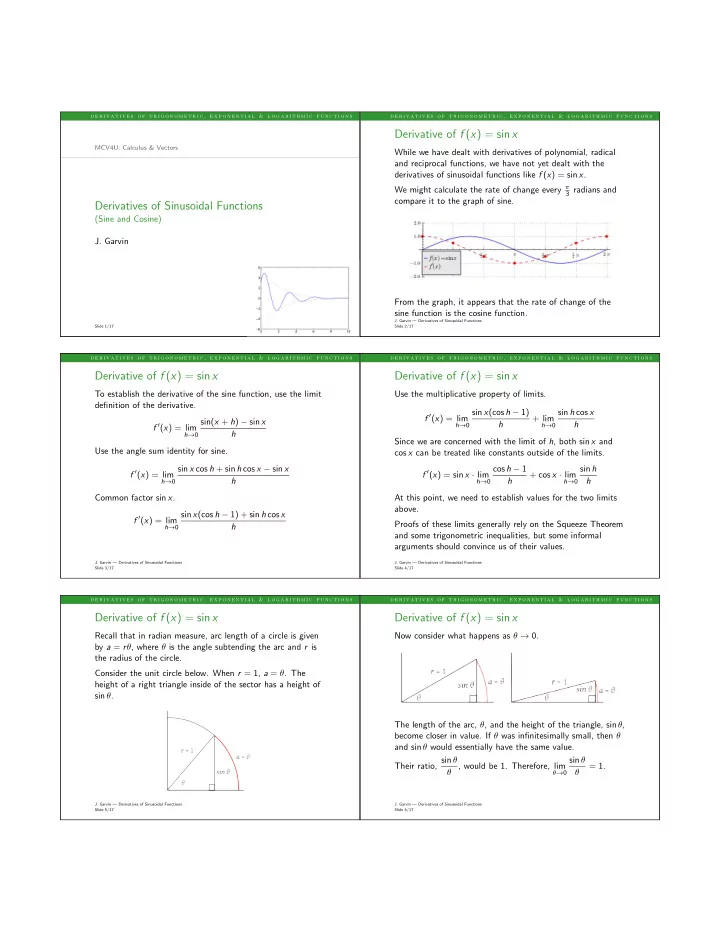
While we have dealt with derivatives of polynomial, radical and reciprocal functions, we have not yet dealt with the derivatives of sinusoidal functions like f (x) = sin x. We might calculate the rate of change every π
3 radians and
compare it to the graph of sine. From the graph, it appears that the rate of change of the sine function is the cosine function.
- J. Garvin — Derivatives of Sinusoidal Functions
Slide 2/17
d e r i v a t i v e s o f t r i g o n o m e t r i c , e x p o n e n t i a l & l o g a r i t h m i c f u n c t i o n s
Derivative of f (x) = sin x
To establish the derivative of the sine function, use the limit definition of the derivative. f ′(x) = lim
h→0
sin(x + h) − sin x h Use the angle sum identity for sine. f ′(x) = lim
h→0
sin x cos h + sin h cos x − sin x h Common factor sin x. f ′(x) = lim
h→0
sin x(cos h − 1) + sin h cos x h
- J. Garvin — Derivatives of Sinusoidal Functions
Slide 3/17
d e r i v a t i v e s o f t r i g o n o m e t r i c , e x p o n e n t i a l & l o g a r i t h m i c f u n c t i o n s
Derivative of f (x) = sin x
Use the multiplicative property of limits. f ′(x) = lim
h→0
sin x(cos h − 1) h + lim
h→0
sin h cos x h Since we are concerned with the limit of h, both sin x and cos x can be treated like constants outside of the limits. f ′(x) = sin x · lim
h→0
cos h − 1 h + cos x · lim
h→0
sin h h At this point, we need to establish values for the two limits above. Proofs of these limits generally rely on the Squeeze Theorem and some trigonometric inequalities, but some informal arguments should convince us of their values.
- J. Garvin — Derivatives of Sinusoidal Functions
Slide 4/17
d e r i v a t i v e s o f t r i g o n o m e t r i c , e x p o n e n t i a l & l o g a r i t h m i c f u n c t i o n s
Derivative of f (x) = sin x
Recall that in radian measure, arc length of a circle is given by a = rθ, where θ is the angle subtending the arc and r is the radius of the circle. Consider the unit circle below. When r = 1, a = θ. The height of a right triangle inside of the sector has a height of sin θ.
- J. Garvin — Derivatives of Sinusoidal Functions
Slide 5/17
d e r i v a t i v e s o f t r i g o n o m e t r i c , e x p o n e n t i a l & l o g a r i t h m i c f u n c t i o n s
Derivative of f (x) = sin x
Now consider what happens as θ → 0. The length of the arc, θ, and the height of the triangle, sin θ, become closer in value. If θ was infinitesimally small, then θ and sin θ would essentially have the same value. Their ratio, sin θ θ , would be 1. Therefore, lim
θ→0
sin θ θ = 1.
- J. Garvin — Derivatives of Sinusoidal Functions
Slide 6/17