What is enough! run at the end of the year. 3. We must (in 2012) do - - PowerPoint PPT Presentation

what is enough
SMART_READER_LITE
LIVE PREVIEW

What is enough! run at the end of the year. 3. We must (in 2012) do - - PowerPoint PPT Presentation

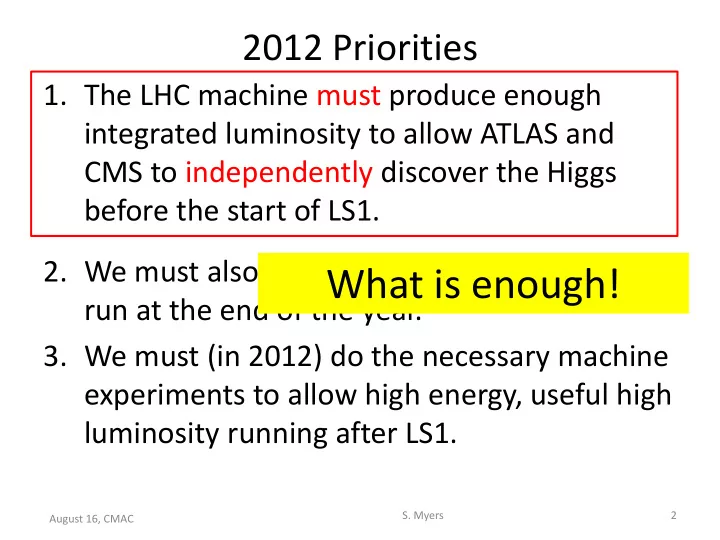
2012 Priorities 1. The LHC machine must produce enough integrated luminosity to allow ATLAS and CMS to independently discover the Higgs before the start of LS1. 2. We must also prepare for the proton-lead ion What is enough! run at the end of


slide-1
SLIDE 1

2012 Priorities

  • 1. The LHC machine must produce enough

integrated luminosity to allow ATLAS and CMS to independently discover the Higgs before the start of LS1.

  • 2. We must also prepare for the proton-lead ion

run at the end of the year.

  • 3. We must (in 2012) do the necessary machine

experiments to allow high energy, useful high luminosity running after LS1.

August 16, CMAC 2

  • S. Myers

What is enough!

slide-2
SLIDE 2

First (most critical) Break-point Second Break-point

Check if we are on track to produce sufficient integrated luminosity for the Higgs

If needed we can delay the start of LS1 by up to 2 months

August 16, CMAC

  • S. Myers

3

Enough?

slide-3
SLIDE 3

Performance in 2012

August 16, CMAC

  • S. Myers

4

slide-4
SLIDE 4

August 16, CMAC

  • S. Myers

5

Integral of all of 2010 now in 2.5 hours

Saturday 2nd June

Fill 2692 (238pb-1 in 23 hours)

slide-5
SLIDE 5

August 16, CMAC

  • S. Myers

6

7 Days of production (1.35fb-1) (June 10—16)

slide-6
SLIDE 6

August 16, CMAC

  • S. Myers

7

With Respect to estimates

4th July: Melbourne

Over-estimated!

slide-7
SLIDE 7

August 16, CMAC

  • S. Myers

8

Some Issues since the “Melbourne” Technical Stop

slide-8
SLIDE 8

SEE Failures

9

TS Xmas works

August 16, CMAC

  • S. Myers
slide-9
SLIDE 9

Fills lost before stable beams

Fill Comment 2857 RQ6.R7 trip (QPS) SUE? 2859 B2H instability at the end of the squeeze 2860 B2H instability when going in collision 2862 B2H instability when going in collision 2863 QFB dragged B2H tune away. 2865 Heavy losses on selected B2 bunches. 2866 Instability B2H at the end of the squeeze 2883 Instability B1H at the end of the squeeze 2897 Instability B1H when going in collision

  • Losses came with activity on H plane.
  • After fill 2866 (4th lost in a row)  intensity down to 1.35E11 ppb and slowly

ramped up afterwards

August 16, CMAC

  • S. Myers

10

slide-10
SLIDE 10

August 16, CMAC

  • S. Myers

11

Main loss categories at 4 TeV

Phase Type Affected bunches Comment Squeeze incoherent ~ all Dominant problem after TS1. Tail losses with tight collimators. Also from bad tune at end of ramp. Squeeze coherent

  • scillations

subset Rather rare events, but frequent loss cause during week-end week 29. Adjust coherent

  • scillations

subset Occurs frequently in the phase where LHCb V crossing is ramped up or during pre-collapse of the separation in IP1/5?

slide-11
SLIDE 11

Standard octupoles +417 A ROD

  • Strong non linearity 

another reason to run with low octupoles (on top of the fact that this would not work at 7 TeV)

August 16, CMAC

  • S. Myers

Beam Plane Q’ 1 H 2.4 1 V 2.4 2 H 1.7 2 V 2.5

12

slide-12
SLIDE 12

Octupoles (reversed polarity) -417 A ROD

Beam Plane Q’ 1 H 9.0 1 V 0.1 2 H 8.1 2 V 0.9

August 16, CMAC

  • S. Myers

13

slide-13
SLIDE 13

SPS tails: flat bottom (@2s)

August 16, CMAC

  • S. Myers

14

slide-14
SLIDE 14

SPS tails: high energy (operational timing)

  • H. Bartosik, K. Cornelis, Y. Papaphilippou

August 16, CMAC

  • S. Myers

15

slide-15
SLIDE 15

ADT tune measurement test

– Test tune measurement by selective excitation of 6 bunches. – FFT of data for each observed bunch, average the spectra, find the peak – Very successful test. Validation during a ramp required (including emittance blow-up measurement) + operational implementation

  • W. Höfle, D. Valuch
slide-16
SLIDE 16
  • 2011: Decrease from ≈10 UFOs/hour to ≈2 UFOs/hour.
  • 2012: Initially, about 2.5 times higher UFO rate

compared to October 2011. UFO rate decreases since then.

Arc UFO Rate

∙ 7535 candidate arc UFOs during stable beams between 14.04.2011 – 23.07.2012. Fills with at least 1 hour stable beams are considered. Signal RS04 > 2∙10-4 Gy/s.

slide-17
SLIDE 17

Outline

  • Motivation for changing MKI8D during TS3
  • Expected benefits
  • Planning
  • Possible risks

4 MKIs in RA87 MKI8D

MKI8C

MKI8B

MKI8A

Injected Beam

slide-18
SLIDE 18

August 16, CMAC

  • S. Myers

19

Up to the Minute Status

slide-19
SLIDE 19

Peak Luminosity (August 16)

August 16, CMAC 20

  • S. Myers
slide-20
SLIDE 20

August 16, CMAC

  • S. Myers

21

Integrated Luminosity per Day

Predictions

slide-21
SLIDE 21

2 weeks up to 2 August

VdM scans Instabilities LHCb polarity change

August 16, CMAC

  • S. Myers

22

slide-22
SLIDE 22

August 16, CMAC

  • S. Myers

23

Integrated from ATLAS (August 16)

slide-23
SLIDE 23

August 16, CMAC

  • S. Myers

24

Evolution of Integrated Luminosity (August 16)

slide-24
SLIDE 24

August 16, CMAC 25

Pile Up

  • S. Myers
slide-25
SLIDE 25

Where are we on Aug 16

August 16, CMAC

  • S. Myers

26

Non luminosity production

  • VDM scans, TOTEM, ALFA etc (7

days)

  • Octupole polarity
  • CMS solenoid (5 days)

This week: a new peak luminosity 6.8E33

slide-26
SLIDE 26

Q3/Q4 2012 New schedule 8th August

  • S. Myers

27

August 16, CMAC

?

Scrubbing and 25ns: Miguel Jimenez and Brennan Goddard

96 days to go

slide-27
SLIDE 27

August 16, CMAC

  • S. Myers

28

FUTURE

slide-28
SLIDE 28

LS1 then operation around 7TeV/beam

LS1 Work

  • Repair defectuous interconnects
  • Consolidate all interconnects with new

design

  • Finish off pressure release valves (DN200)
  • Bring all necessary equipment up to the level

needed for 7TeV/beam

August 16, CMAC 29

  • S. Myers
slide-29
SLIDE 29

Linear schedule

EDMS 1227656 (rev1.0, July 26th, 2012) No contingency

August 16, CMAC

  • S. Myers

30

slide-30
SLIDE 30

Then operation at 6.5TeV per beam

Assumptions

  • E=6.5TeV
  • β* = 0.5m
  • All other conditions as in 2012 i.e. no

improvement (yet ??) in injector brightness, LHC availability same etc

August 16, CMAC 31

  • S. Myers
slide-31
SLIDE 31

August 16, CMAC 32

6.5TeV: 25ns

6.5Tev: 25 ns β* = 0.5m 148 days of physics Lpeak ~7.5E33 µ = ~17 Days since start of 2015 run

Optimistic

  • Possible intensity limitation
  • Possible limitation to β*
  • More scrubbing needed
  • S. Myers
slide-32
SLIDE 32
slide-33
SLIDE 33

August 16, CMAC 34

Thank you for your attention

  • S. Myers
slide-34
SLIDE 34

LHC Machine Committee August, 2nd 2012 35

update on UFOs:

2012 Observations, Studies and Extrapolations

LMC 143

Tobias Baer August, 2nd 2012

Acknowledgements: M.J. Barnes, C. Bracco, F. Cerutti, B. Dehning, L. Ducimetière, A. Ferrari, N. Fuster Martinez,

  • N. Garrel, A. Gerardin, B. Goddard, M. Hempel, E.B. Holzer, S. Jackson, M.J. Jimenez, V. Kain, A. Lechner,
  • V. Mertens, M. Misiowiec, R. Morón Ballester, E. Nebot del Busto, A. Nordt, S. Redaelli, J. Uythoven, B. Velghe,
  • V. Vlachoudis , J. Wenninger, C. Zamantzas, F. Zimmermann, …
slide-35
SLIDE 35

LHC Machine Committee August, 2nd 2012 36

  • Distribution very similar to

2011.

  • Many UFOs around MKIs.
  • Some arc cells with

significantly increased number of UFOs: 19R3 B1, 25R3 B2, 28L6 B2,

28R7 B2, …

Spatial UFO Distribution

2011: 7668 UFOs at 3.5 TeV. 2012: 3719 UFOs at 4 TeV. Signal RS04 > 2∙10-4 Gy/s. Gray areas around IRs are excluded from the analysis.

MKI MKI

Additional BLMs in cell 19R3

slide-36
SLIDE 36

LHC Machine Committee August, 2nd 2012 37

Arc UFO Size

  • 44 UFOs over 10% of dump threshold in 2012 so far (at 4 TeV).

∝ 𝒚−𝟏.𝟘𝟖

2845 arc UFOs (≥ cell 12) at 4 TeV in 2012 until 17.07.2012.

10% of BLM dump threshold

slide-37
SLIDE 37

LHC Machine Committee August, 2nd 2012 38

Intensity Dependency

For low intensities: UFO rate ∝ Intensity, saturates at high intensities.

consistent with previous analysis (cp. E. Nebot, IPAC’11).

500 candidate UFOs during stable beams with a signal in RS04 > 2∙10-4 Gy/s. 28 fills with at least 1 hour in stable beams in the first quarter of 2012 are considered. The beam intensity is computed as the maximum intensity per fill, averaged over both beams.

slide-38
SLIDE 38

LHC Machine Committee August, 2nd 2012 39

Positive correlation between pressure at MKI and MKI UFO rate. Similar indications also from scrubbing runs and 2012 UFO MD.

Vacuum Correlation

141 MKI UFOs in Pt. 8 between last injection of beam 2 and beginning of ramp for 178 fills with 1374/1380 bunches until 23.07.2012.

5.1σ statistical significance of positive correlation.

slide-39
SLIDE 39

LHC Machine Committee August, 2nd 2012 40

  • UFO amplitude: At 7 TeV about 3-4 times higher than at 3.5 TeV.

From FLUKA simulations and wire scans during ramp.

  • BLM thresholds: Arc thresholds at 7 TeV are about a factor 5

smaller than at 3.5 TeV.

  • UFO rate: No energy dependence assumed. cp. E. Nebot et al., IPAC‘11, TUPC136

Energy Dependence

Courtesy of A. Lechner and the FLUKA team.

x4

At indicated longitudinal position for UFO at 7 TeV. Beam direction: out

  • f screen.

For UFO at Pos #1

slide-40
SLIDE 40

LHC Machine Committee August, 2nd 2012 41

Extrapolation to 7 TeV:

BLM Signal/BLM Threshold is about 20 times larger than at 3.5 TeV. Based on 2011 data: 112 UFO related beam dumps. Based on 2012 data: 50 UFO related beam dumps so far. In total 2 dumps by arc UFOs

  • bserved (since 2011).

Energy Extrapolation Arc UFOs

Based on the applied threshold table from 01.01.2012 (for 2011 data) and 19.07.2012 (for 2012 data). Apart from the beam energy, identical running conditions as in 2011/2012 are assumed. Several unknowns are not included: margin between BLM thresholds and actual quench limit, 25ns bunch spacing, intensity increase, beam size, scrubbing for arc UFOs, deconditioning after long technical stops.

slide-41
SLIDE 41

LHC Machine Committee August, 2nd 2012 42

Mitigation Strategies

  • MKI UFOs:

Change MKI.D5R8 in TS#3 (heating problems). better cleaning, reduced E-field due to 19 screen conductors (instead of 15). Cr2O3 coating. reduces SEY, increased voltage hold-off, seals surface (?). Screen conductor wires beyond surface (not feasible?). very difficult to manufacture.

  • Arc UFOs:

Increase BLM thresholds towards quench limit. Wire scanner quench test. ADT quench test. Different BLM distribution. could allow for increase of BLM thresholds.

(A. Lechner et al., Quench Test Strategy Working Group, May 2012)

slide-42
SLIDE 42

LHC Machine Committee August, 2nd 2012 43

Summary

  • 4 beam dumps due to UFOs in 2012 so far.

8,000 candidate UFOs below BLM dump thresholds observed in 2012 so far.

  • Arc UFO rate at beginning of 2012 ≈2.5 times higher than in

October 2011. Arc UFO rate decreases since then.

No significant decrease of number of MKI UFOs per fill.

  • Energy extrapolation to 7 TeV:

2011 arc UFOs would have caused 112 beam dumps. 2012 arc UFOs would have caused 50 beam dumps so far.

  • Plans for 2012/13:

Better understanding of quench limit. 25ns studies.

  • Mitigation strategies for MKI UFOs under active investigation.

Replace MKI.D5R8 in TS#3. An optimized BLM distribution can mitigate impact of arc UFOs.

slide-43
SLIDE 43

Proposal to replace LHC injection kicker MKI8D during TS3

Mike Barnes

Acknowledgements: Alessandro Bertarelli, Giuseppe Bregliozzi, Sergio Calatroni, Fritz Caspers, Hugo Day, Laurent Ducimetière, Marco Garlasche, Alexandre Gerardin, Brennan Goddard, Miguel Jimenez, Volker Mertens, Elias Métral, Benoit Salvant, Mauro Taborelli, Jan Uythoven, Wilhelmus Vollenberg, Wim Weterings

slide-44
SLIDE 44

Outline

  • Motivation for changing MKI8D during TS3
  • Expected benefits
  • Planning
  • Possible risks

4 MKIs in RA87 MKI8D

MKI8C

MKI8B

MKI8A

Injected Beam

slide-45
SLIDE 45

20 25 30 35 40 45 50 55 60 65 70

Temperature (˚C)

Date and Time

MKI8 D MKI8 B MKI8 C MKI2 B MKI2 A MKI2 C MKI8 A

62̊C

May-June 2012

week 24

Motivation for changing MKI8D during TS3

  • The MKI8D ferrite yoke is the hottest, and started to (temporarily) loose its magnetic properties

(approaching Curie Temperature). Behaviour is consistent with Oct. 2011.

  • During week 24 injection was delayed by a total of 13 h 40 min, distributed over 5 fills, waiting for

MKI8D to cool down. A simple model of ferrite heating and cooling, based on observations and simulations, has been used to forecast MKI heating and the waiting time for the ferrite to cool down to below the Curie temperature, for injection. The present MKI’s are expected to significantly limit LHC availability, for injection, with increased intensity.

  • An upgraded replacement of MKI8D has been under development (mentioned at Chamonix 2012

and LMC 129). The new MKI has measures to better limit ferrite temperature. It is important to validate these changes with high intensity proton beam, prior to LS1, in order to know if they can be implemented on other MKIs.

8A 8B 8D 8C

Protons/bunch Bunch spacing (ns) Number of bunches Expected peak measured temp. (˚C) Expected cooldown time to 62˚C 1.50E+11 50 1380 70 (measured) 4h 10min (measured) 1.70E+11 50 1380 98 15h

0.7 0.701 0.702 0.703 0.704 0.705 0.706 0.707 0.708 0.709 0.71 0.711

20 25 30 35 40 45 50 55 60 65 70

Rise Time (µs)

Temperature MKI8D_Dn (˚C)

MKI8: May-June 2012
slide-46
SLIDE 46

Expected benefits of replacement MKI (1)

  • The replacement MKI has 19 screen conductors installed, compared with 15 in the

present MKI8D – this modification is expected to reduce beam induced heating by a factor of between 2 and 2.5 – thus ferrite temperature will be reduced by ~30˚C (~15˚C measured) for a given beam.

  • The emissivity of the inside of the present MKI8D is thought to be relatively low (in

the range 0.05 to 0.1), therefore greatly contributing to ferrite heating. The new MKI tank, after treatment, has a measured emissivity of ~0.18, which is expected to result in a reduction of the temperature of the ferrite yoke by more than 10˚C (~5˚C measured), for a given power deposition.

Emissivity of inside of MKI tank Ferrite Temperature (˚C)

15 19

Courtesy: H. Day Courtesy: M. Garlasche

47 M.J. Barnes: LMC

slide-47
SLIDE 47

Expected benefits of replacement MKI (2)

  • The copper bypass tube, through which the counter-rotating beam circulates, is NEG

coated in the new MKI: this should suppress electron-cloud in the bypass tube.

  • The screen conductors, of the new MKI, have spheres on their capacitively coupled

end: these will reduce electric-field strength, and thus reduce the probability of a flashover from the screen conductor to ground: this allows more screen conductors to be inserted.

slide-48
SLIDE 48

LHC 1

August 16, CMAC 49

  • S. Myers
slide-49
SLIDE 49

August 16, CMAC 50

  • S. Myers
slide-50
SLIDE 50

 1983: Preliminary Performance Estimates for the LHC (S.Myers and W. Schnell,

11th April 1983)

 1984: Kick off meeting to discuss ideas for an accelerator to collide protons at

very high energy

 1996: Final decision for the LHC, the most complex scientific instrument ever

constructed

 10 September 2008: Start of commissioning with beam  19 September 2008: Serious incident and damage  19 November 2009: Restart of beam operation  December 2009: first collisions at 2.38 TeV

Today: successful operation, providing millions of particle collisions for the LHC experiments

 About 2035: The LHC physics programme to be finished ?

The LHC Life cycle

slide-51
SLIDE 51

August 16, CMAC 52

6.5TeV per beam with 50ns

6.5Tev: 50 ns β* = 0.5m 148 days of physics Lpeak ~10.5E33 µ = ~50 Days since start of 2015 run

  • S. Myers
slide-52
SLIDE 52

2013

August 16, CMAC

  • S. Myers
  • Minimum interventions before and during Xmas stop
  • Need both protons and lead (i.e. ion source, LINAC3, LEIR in addition…)
  • Non-LHC physics is not foreseen – flat line complex when beam not needed
  • Should foresee doing maximum p-A preparation before Christmas (pilot run, aperture

measurements, test squeeze…)

End ion run 06:00

53

slide-53
SLIDE 53

LHC MB circuit splice consolidation proposal

Phase I Surfacing of bus bar and installation of redundant shunts by soldering Phase II Application of clamp and reinforcement of nearby bus bar insulation Phase III Insulation between bus bar and to ground, Lorentz force clamping

August 16, CMAC 54

  • S. Myers