Developables D e v e l o p a b l e F r e e F o r m E n v e l o p - - PDF document

developables
SMART_READER_LITE
LIVE PREVIEW

Developables D e v e l o p a b l e F r e e F o r m E n v e l o p - - PDF document

Developables D e v e l o p a b l e F r e e F o r m E n v e l o p e s What are they? Developable surfaces are ruled surfaces , which means that at every point of itself there exists a straight line which remains within the surface. However


slide-1
SLIDE 1

Developables

What are they? So what?

D e v e l o p a b l e F r e e F o r m E n v e l o p e s

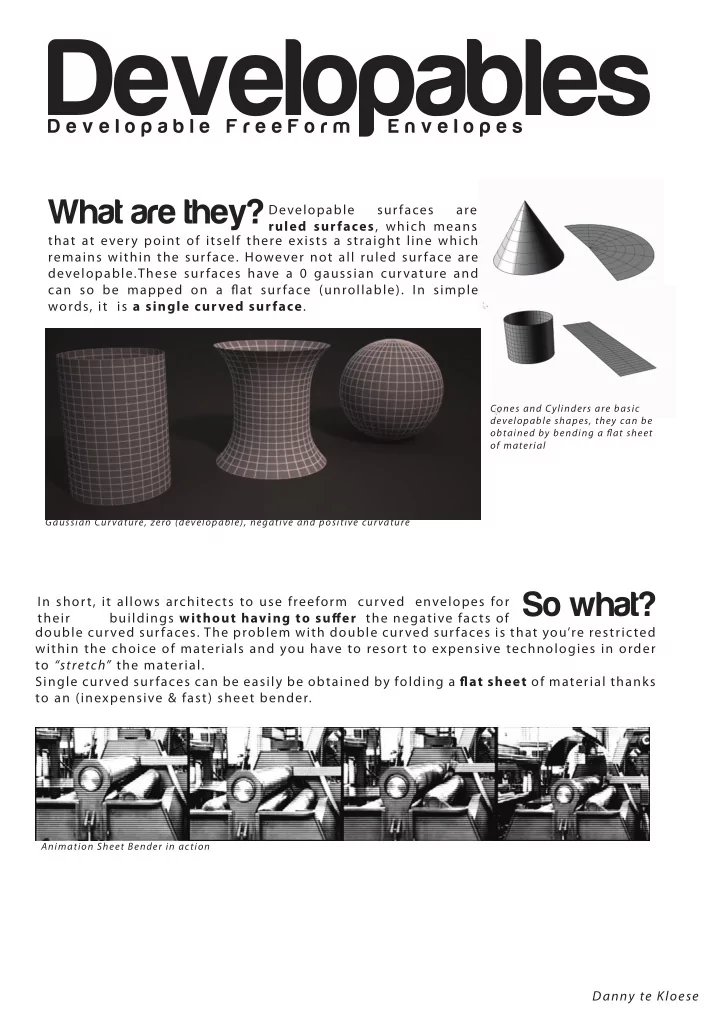
Developable surfaces are ruled surfaces, which means that at every point of itself there exists a straight line which remains within the surface. However not all ruled surface are developable.These surfaces have a 0 gaussian curvature and can so be mapped on a flat surface (unrollable). In simple words, it is a single curved surface. In short, it allows architects to use freeform curved envelopes for their buildings without having to suffer the negative facts of double curved surfaces. The problem with double curved surfaces is that you’re restricted within the choice of materials and you have to resort to expensive technologies in order to “stretch” the material. Single curved surfaces can be easily be obtained by folding a flat sheet of material thanks to an (inexpensive & fast) sheet bender. Danny te Kloese

Cones and Cylinders are basic developable shapes, they can be
  • btained by bending a flat sheet
  • f material
Animation Sheet Bender in action Gaussian Curvature, zero (developable), negative and positive curvature
slide-2
SLIDE 2

Is it new? No, not really. The benefic properties of developable surfaces have

been known for a longtime in many areas of enginieering. Especially in the domain of aeroplane industry it has proven it’s usefullness. In the architecture we began to use this kind of surfaces since the 50’s thanks to the constant innovations in

  • concrete. However the forms used within the buildings remained simple because the

technologies at that time didn't permit to design more complex forms. It's only since the last decade of the the past century that the complexity of the projects could evolve thanks to development of computer graphics.

So it's cheaper, that's all?

The innovations within concrete (and later-on plastics) from the 50’s-70’s gave architects the possibility to finally move away from the pythagorean geometries we’ve been using since thousands of years in construction. The problem is that it’s really hard to represent and create curved surfaces with a paper and pencil, so we need to make use of digitally driven techniques. The idea is nice but while a computer is able to show a perfectly curved surface on the screen, in real life it’s much harder to obtain such a shape. Single curved surfaces is a compromise between flat surfaces and fully curved ones. You can design complex curved envelopes while remaining almost the simplicity of pythago- rean geometries. Cristo Obrero Church, Eladio Dieste Designed in 1950 built in 1956

Restaurant at Xochimilco, Felix Candela, 1958

Project during construction Drawing showing the straight tangents at every point within the envelope.
slide-3
SLIDE 3

What is possible? What is important to notice is that developable free-

form envelopes can be subdivised in 2 categories: “Pure Developables” , which are envelopes of which the whole can be considerated as a developable form. Formwise you’relimited of the forms you can obtain. And the second one, “Composite Developables”. Which are envelopes which in themself are not a developable surface but which are composed of developable surfaces.

How to create them?

The easiest way to create developable sur- faces is to “loft” 2 freeform rails together. However this will give you just A result, not the result. Between two rails there exist an ini- finity of developable surfaces. In order to gain control of the loft command “ruling guides” need to be created. I’ve however not been able to find a way of creating them automaticly, so it’s a time costing process.

Three developable surfaces created each by identical lofting rails, however each surface has it’s own “.ruling guides” A typical compositive developable, every modul in itself is developable. Frank Gehry, Experience Music Project. Pure developable forms. Unrolled surface of each variation.
slide-4
SLIDE 4

And you?

trying to work with paper folding, trying to recreate some of the fantastic examples which can be found on
  • flickr. Handwise it’s too difficult to recreate accuratly the forms. After contacting them they seem to use a laser
cutter in order to weaken the paper exactlz where needed. Trying to find a way on how to recreate a double curved surface with multiple single curved surfaces. From left to right: Outline, Patch between outline (2 curved surface), Meshed surface (helps finding the lines), Lines used to loft the surface.
slide-5
SLIDE 5

Cafétéria Giacometti Cafétéria Giacometti

Exterior Enclosure

HD Studio 2009 ~ Danny te Kloese

Situation Plan