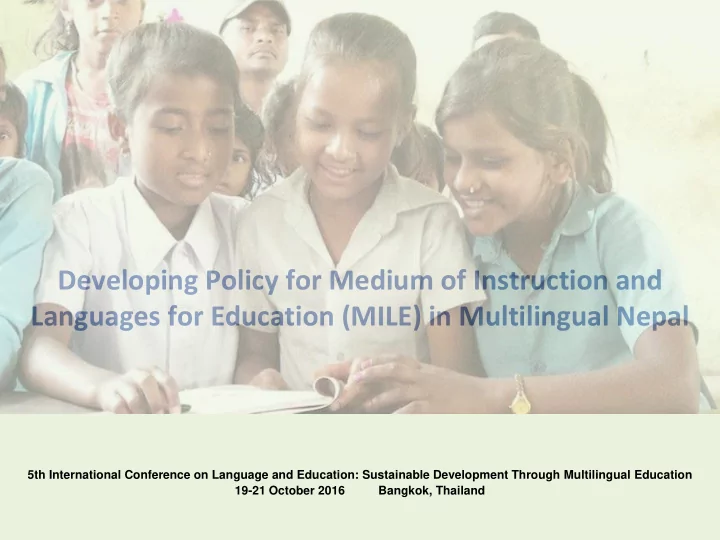
Developing Policy for Medium of Instruction and Languages for Education (MILE) in Multilingual Nepal
5th International Conference on Language and Education: Sustainable Development Through Multilingual Education 19-21 October 2016 Bangkok, Thailand
Developing Policy for Medium of Instruction and Languages for - - PowerPoint PPT Presentation
Developing Policy for Medium of Instruction and Languages for Education (MILE) in Multilingual Nepal 5th International Conference on Language and Education: Sustainable Development Through Multilingual Education 19-21 October 2016
5th International Conference on Language and Education: Sustainable Development Through Multilingual Education 19-21 October 2016 Bangkok, Thailand
Improved learning, literacy and cognitive outcomes for disadvantaged children Language revitalisation, multilingualism and an individual, community and national resource Equitable, sustainable development through empowerment and participation of marginalised groups Peace-building and social cohesion through more equitable access to- and benefits of- quality relevant education
11
– four language families
– a language isolate consisting of a single language without any genetic relationship with other languages, e.g. Kusunda. – Most of these languages belong to two language families:
– Austro-Asiatic and Dravidian – marginalized- less than 1% – Kusunda : just 28 speakers. i. ‘major’ languages - 19 – almost 96%. ii. ‘minor’ languages -104 – 4%
12
Development Region Ecological Zone Far-West Mid-West West Central Eastern Mountains Rasuwa (4 schools) Hills Dadeldhura (2 schools) Palpa (2 schools) Tanahaun (1 school) Kathmandu valley (7 schools) Dhankuta (1 school) Tarai Kanchanpur (1 school) Bardiya (1 school) Banke (1 school) Kapilvastu (2 schools) Dhanusha (1 school) Jhapa (1 school) Sunsari (1 school)
some endangered languages, different kinds of community language contexts (homogeneous, mix, varieties of issues and initiatives)
1. Community schools 2. Institutional (private English MoI) 3. MTB-MLE pilot schools (Finland supported program) and other MLE initiatives 4. Faith based schools – Gumba, Gurukul, Madrasa, and Vihar 5. Schools that included users of Nepali Sign Language and Braille scripts 6. Preprimary/ECED, primary , lower secondary, secondary and higher secondary
District School School types MoI Previously MoI Current Jhapa Rastriya Ekata P. Haldibari Community (MTB MLE pilot) Santhal and Rajbanshi English Dhankuta Deurali LS, Santang Community (MTB MLE pilot) Athpariya Nepali (Athpariya- subject) Sunsari Sharada P., Simariya Community (MTB MLE pilot) Uranw, Maithili and Tharu Uranw, Maithili and Tharu Rasuwa Bhinsen LS, Thulo Bharkhu Community (MTB MLE pilot) Tamang Tamang (G-1) Subject (G-2+) Saraswai LS, Thade Community (MTB MLE pilot) Tamang Tamang (G-1) Subject (G-2+) Palpa Nawa Jagriti P., Chidipani Community (MTB MLE pilot) Magar Magar Kanchanpur Rastriya LS Community (MTB MLE pilot) Rana Tharu Rana Tharu Dadeldhura Bhumiraj P., Bagchaur Community Doteli English Tanahun Nirmal HS, Damauli Community Nepali English
Sunshine English Boarding School, Dumre, Palpa Pathshala Nepal Private Boarding School , Lalitpur Grade English Nepali English Nepali Nursery 25% 75%
50% 50%
75% 25%
80% 20% 40% 60% Grade 2 90% 10% 50% 50% Grade 3 95% 5% 70% 30% Grade 4 95% 5% 80% 20% Grade 5 100% 0% 95% 5%
Economic dynamics
Political dynamics
Education sector governance dynamics
education
Social dynamics
Catchment MT base Nepali
Homogenous Nepali
Nepali is MT and MoI
Homogenous MT which is ‘MoI ready’
MT used as early grade MoI (and sometimes beyond), including literacy Introduced as L2 (becomes MoI in most cases)
Agreement on a number of ‘MoI ready’ MTs
Several MTs used as early grade MoI, including literacy Introduced as L2
Heterogeneous, lack of consensus, language is not yet ‘MoI-ready’
MTs included through systematic oral approaches Introduced as L2 and as language for learning to read