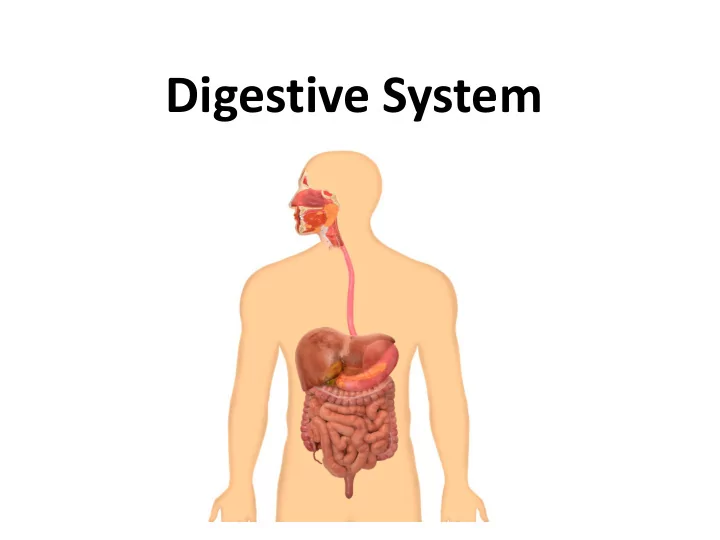
Digestive System What is the function of the digestive system? The - - PowerPoint PPT Presentation

digestive system
SMART_READER_LITE
LIVE PREVIEW

Digestive System What is the function of the digestive system? The - - PowerPoint PPT Presentation

Digestive System What is the function of the digestive system? The physical and chemical breakdown of large food molecules into smaller molecules that can be used by cells Diagram the pathway of food through the digestive system


slide-1
SLIDE 1

Digestive System

slide-2
SLIDE 2

What is the function of the digestive system?

  • The physical and chemical breakdown of large

food molecules into smaller molecules that can be used by cells

slide-3
SLIDE 3

Diagram the pathway of food through the digestive system (gastrointestinal tract)

(we will complete this part together in class on Friday, November 15th)

slide-4
SLIDE 4

Mechanical and Chemical Digestion

  • Physical breakdown of

large pieces of food into small pieces

  • Occurs in the mouth

and stomach

  • Chemical digestion of

polymers of food into monomers with the action of enzymes

  • Occurs in the mouth,

stomach and small intestine

slide-5
SLIDE 5

Mouth and Salivary Glands

slide-6
SLIDE 6

Mouth

  • Mechanically digests food with the teeth

when chewing

  • Salivary glands produce salivary amylase to

chemically digest polysaccharides into disaccharides (carbohydrates)

  • Food is mixed with saliva to form a bolus
slide-7
SLIDE 7

Pharynx

  • Back of the throat
  • Common passageway for food and air
  • Leads to a muscular tube called the

esophagus

slide-8
SLIDE 8

Esophagus

slide-9
SLIDE 9

Esophagus

  • Flap of cartilage called the epiglottis covers

the top of the trachea (airway) when food is swallowed

  • Produces mucus to lubricate food
  • Lined with involuntary smooth muscle
  • Pushes food to the stomach with wave-like

muscle contractions called peristalsis

slide-10
SLIDE 10

Stomach

slide-11
SLIDE 11

Stomach

  • Three layers of smooth muscle, protected by

mucus

  • Mechanically digests food by churning and

mixing food with gastric juices (HCl and pepsinogen)

  • Pepsin chemically digests proteins into

peptides in the stomach

  • Mixture of gastric juices and food is called

chyme

slide-12
SLIDE 12

Hydrochloric Acid

  • Produced by the stomach
  • Provides the proper pH (2.0) for the enzyme

pepsin to function

  • Converts inactive pepsinogen into active

pepsin

slide-13
SLIDE 13

Small Intestine

slide-14
SLIDE 14

Small Intestine

  • Three sections: duodenum, jejunum, ileum
  • Lined with two layers of smooth muscle and

finger-like projections called villi

  • Villi absorb nutrients from digested food into

the bloodstream

  • Chemical digestion of lipids, proteins and

carbohydrates

slide-15
SLIDE 15

Small Intestine Enzymes

  • Produces sucrase, maltase, and lactase –

chemical digestion of disaccharides into monosaccharides

  • Produces peptidase – chemical digestion of

peptides into amino acids

slide-16
SLIDE 16

Villi of Small Intestine

slide-17
SLIDE 17

Large Intestine

slide-18
SLIDE 18

Large Intestine

  • Also known as the colon
  • No further mechanical or chemical digestion

takes place

  • Absorbs excess water from undigested wastes
  • Absorbs vitamins, minerals, and other ions
slide-19
SLIDE 19

Rectum

slide-20
SLIDE 20

Rectum

  • Last 20 cm of the large intestine
  • Solid waste (feces) is stored here until it exits

the body through the anus

slide-21
SLIDE 21

Accessory Organs for Digestion

  • Liver, pancreas and gall bladder all produce

enzymes and/or fluids that assist in the digestion of food

  • FOOD DOES NOT PASS THROUGH THESE

ORGANS

slide-22
SLIDE 22

Liver, Gall Bladder and Pancreas

slide-23
SLIDE 23

Liver and Gall Bladder

  • Liver produces bile to emulsify fats (break up

large pieces of fat into smaller pieces)

  • Emulsification is mechanical digestion
  • Gall bladder is a storage pouch for bile
  • Bile is secreted into the small intestine

through the bile duct

slide-24
SLIDE 24

Pancreas

  • Produces pancreatic juice – consists of sodium

bicarbonate and enzymes

  • Sodium bicarbonate neutralizes the acidic

material from the stomach

  • Enzymes are secreted into the small intestine

from the pancreas to assist in digestion

slide-25
SLIDE 25

Pancreas Enzymes

  • Lipase – chemical digestion of lipids into fatty

acids and glycerol

  • Trypsin – chemical digestion of peptides into

amino acids

  • Pancreatic amylase – chemical digestion of

disaccharides into monosaccharides

slide-26
SLIDE 26

Bozeman Science - Digestion