Disclosures Clinical Approach: Evaluating Industry relationships: - - PowerPoint PPT Presentation

disclosures clinical approach evaluating
SMART_READER_LITE
LIVE PREVIEW

Disclosures Clinical Approach: Evaluating Industry relationships: - - PowerPoint PPT Presentation

11/5/2016 Disclosures Clinical Approach: Evaluating Industry relationships: CTD-ILD for the pulmonologist Actelion, aTyr Pharma, Boehringer-Ingelheim, Genentech- Roche, Gilead Aryeh Fischer, MD Associate Professor of Medicine Division


slide-1
SLIDE 1

11/5/2016 1

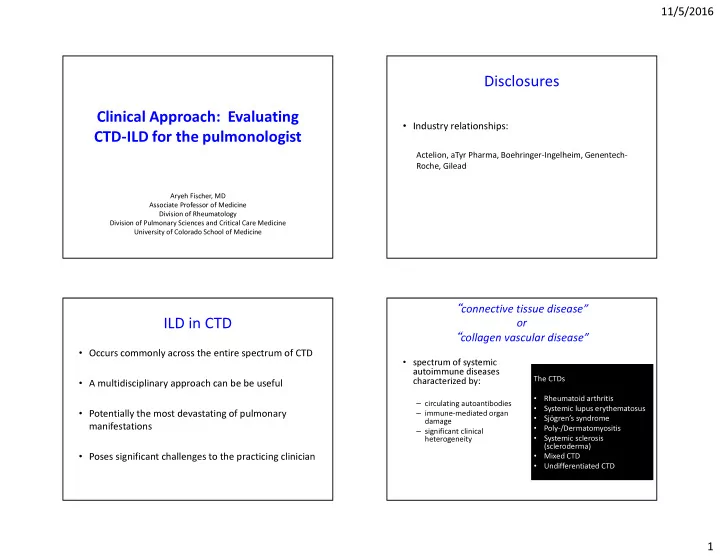
Clinical Approach: Evaluating CTD-ILD for the pulmonologist

Aryeh Fischer, MD Associate Professor of Medicine Division of Rheumatology Division of Pulmonary Sciences and Critical Care Medicine University of Colorado School of Medicine

Disclosures

  • Industry relationships:

Actelion, aTyr Pharma, Boehringer-Ingelheim, Genentech- Roche, Gilead

ILD in CTD

  • Occurs commonly across the entire spectrum of CTD
  • A multidisciplinary approach can be be useful
  • Potentially the most devastating of pulmonary

manifestations

  • Poses significant challenges to the practicing clinician

“connective tissue disease”

  • r

“collagen vascular disease”

  • spectrum of systemic

autoimmune diseases characterized by:

– circulating autoantibodies – immune-mediated organ damage – significant clinical heterogeneity The CTDs

  • Rheumatoid arthritis
  • Systemic lupus erythematosus
  • Sjögren’s syndrome
  • Poly-/Dermatomyositis
  • Systemic sclerosis

(scleroderma)

  • Mixed CTD
  • Undifferentiated CTD
slide-2
SLIDE 2

11/5/2016 2

ILD CTD

CTD-ILD represents a spectrum of diseases

CTDs

RA SLE SjS PM/DM SSc MCTD UCTD

ILDs

NSIP UIP OP LIP DAD

Estimated prevalence rates

  • f ILD in the various CTDs??

Adapted from Castelino and Varga Arthritis Res and Therapy 2010 CTD Estimated frequency of ILD Systemic sclerosis 45% (clinically significant) Rheumatoid arthritis 20 – 30% PM/DM 20 – 50% MCTD 20 – 60% Sjögren's syndrome Up to 25% SLE 2 to 8 %

Interstitial lung disease in scleroderma

  • The majority of SSc patients have ILD
  • F-NSIP is the most common pattern

– UIP far less common – Rare to see the other patterns

  • Clinically progressive in ~30%
  • The leading cause of death

Solomon et al. Eur Resp Reviews 2013

ILD in poly-/dermatomyositis

  • ILD is the most common lung

manifestation of PM/DM

  • Chief cause of mortality
  • NSIP and NSIP/OP are the

most common patterns

– Can also see LIP, DAD, UIP

  • Varied presentation
  • Anti-synthetase syndrome

Miller et al. Rheum Dis Clinics NA 2015

slide-3
SLIDE 3

11/5/2016 3

Interstitial lung disease in RA

  • ILD is the most common lung

manifestation of RA

  • Varied presentation
  • UIP is the most common pattern

– Can also see NSIP, OP, LIP, DAD

  • Accounts for 7% of all RA-associated

deaths

  • Risk of death is 3x higher than for RA

without ILD

K Brown Proc Am Thor Soc 2007, Doyle CHEST 2013, Olson AJRCCM 2011

familial

CTD-ILD

medications

idiopathic

environmental

  • ccupational

smoking infection ? ? ? ? ? ? ? ?

the clinical landscape

Park et al. AJRCCM 2007;175:705-711

why assess for CTD?

A CTD-ILD diagnosis may impact:

  • Treatment
  • Prognosis
  • Extra-thoracic disease

– clinical context – surveillance for other features

CTD-ILD IIP

Current approach to treatment

Idiopathic UIP (IPF) CTD-ILD (ANY pattern) Idiopathic non-UIP Clinical trials Lung transplantation Immunosuppression Immunosuppression Pirfenidone Nintedanib

slide-4
SLIDE 4

11/5/2016 4 Other common – and potentially important – reasons to assess for CTD

Patient perspective:

  • emotional
  • sense of belonging
  • frustrations with being

labeled as “idiopathic” Physician perspective:

  • “if it’s CTD, I can do

something about it”

  • “the last thing I want to tell

my patients is that it's idiopathic”

ILD in established CTD: Determine whether ILD is CTD-associated “ “ “ “Idiopathic” ” ” ” ILD: Identifying

  • ccult CTD

“ “ “ “Idiopathic” ” ” ” ILD: Is it really CTD?

the clinical landscape

55-year-old man former smoker, develops exertional dyspnea and cough…

  • 10-year history of RF / CCP positive,

erosive RA

  • arthritis well controlled on MTX and

an anti-TNF agent

  • crackles at B/L bases
  • chronic RA deformities without

synovitis

  • FVC 74%, FEV-1 73%, DLCO 64%
  • ESR 15

Is this CTD-ILD?

ILD in established CTD: checklist

  • 1. Confirm the CTD
  • 2. Consider alternative etiologies
  • 3. Determine whether the ILD pattern “fits”
  • 4. BAL to exclude infection
  • 5. Biopsy the atypicals

Concluding ILD is “CTD-associated” is a process of elimination

slide-5
SLIDE 5

11/5/2016 5

DIAGNOSTIC EVALUATION OF ILD IN CTD SYMPTOMS PHYSICAL EXAM RISK FACTORS CTD PHENOTYPIC ASPECTS PULMONARY PHYSIOLOGY DIAGNOSTIC IMAGING BRONCHOSCOPY BIOPSY

Symptoms

  • Dyspnea may be due to

any number of causes

– MSK impact / extra-thoracic disease – Sedentary patients / deconditioning – Cardiac – Anemia (e.g., GAVE) – Depression

  • Unreliable reporting
  • Unreliable assessment
  • Assess impact of dyspnea
  • n ADLs, other activities
  • Pace / progression
  • Cough more likely to be

due to GERD

  • Absence of dyspnea does

not mean absence of ILD

Physical exam

  • Audible bibasilar crackles strongly predictive of ILD
  • Absence of crackles does not mean absence of ILD
  • Skin informs about skin. Not the lungs.

– Same can be said re: joints in RA and muscles in myositis

High risk of missing significant SSc-ILD when relying solely on PFTs

64/102 (63.0%) with significant ILD on HRCT 27/102 (26.0%) had an FVC<80% 102 consecutive SSc patients enrolled 40/64 (62.5%) had significant ILD on HRCT and a normal FVC 5/40 (6.0%) with normal FVC had severe lung fibrosis Suliman et al Arthritis Rheum 2015

slide-6
SLIDE 6

11/5/2016 6

High resolution CT imaging

  • Modality of choice for detecting

CTD-ILD

  • Easy method to determine

disease extent

– i.e., disease severity

  • Multi-compartment disease
  • Esophageal findings
  • May suggest pulmonary vascular

disease: PA diameter, pericardial abnormalities

Role of surgical lung biopsy?

Clinical realities:

  • May not impact treatment

– Immunosuppression may be needed – for ILD and the extra-thoracic disease – irrespective of ILD pattern

  • Risks associated with the surgery

Park et al, AJRCCM 2007

Staging system – not histopathology – predicts prognosis in SSc-ILD

215 consecutive SSc patients evaluated at the Royal Brompton Hospital between 1990 and 1999 Goh et al. AJRCCM 2008

slide-7
SLIDE 7

11/5/2016 7 When do I recommend a surgical lung biopsy?

  • pre-existing CTD and

concerns for an alternative etiology

  • “atypical” HRCT
  • idiopathic ILD – and

thinking it may be CTD

  • ultimately, the decision is

individualized

35 year old limited SSc and positive Scl-70

ILD in established CTD: Determine whether ILD is CTD-associated “ “ “ “Idiopathic” ” ” ” ILD: Identifying

  • ccult CTD

“ “ “ “Idiopathic” ” ” ” ILD: Is it really CTD?

the clinical landscape identifying new CTD in those presenting with ILD is common

114 consecutive patients evaluated in an ILD referral center 34 (30%) with well-defined CTD 17 (15%) with well established CTD prior to ILD 17 (15%) diagnosed with new CTD

Mittoo S et al. Resp Med 2009. 103:1152

Identifying occult CTD: what’s helpful?

  • demographics

– 40 year old women don’t get IPF

  • extrathoracic manifestations
  • serologies
  • HRCT findings
  • histopathology

which ones?

slide-8
SLIDE 8

11/5/2016 8

Quantifiable, specific extra-thoracic features suggesting CTD

  • Sclerodactyly
  • Mechanic hands
  • Gottron’s papules
  • Digital edema
  • Raynaud’s

– capillary microscopy

  • inflammatory arthritis of

bilateral wrists or MCPs

  • KCS sicca?
  • Esophageal dilation /

hypomotility

tortuosity dilatation dropout

Useful autoantibodies for CTD-ILD (?)

Most common CTD association High-titer ANA (>1:320) Many RF (>60 IU/mL) Many / RA Anti-centromere SSc Nucleolar-ANA SSc Anti-CCP RA Anti-Scl-70 SSc Anti-Ro (SS-A) Many Anti-tRNA synthetase (Jo-1, PL-7, PL-12, others) PM / DM Anti-PM-Scl SSc / PM overlap Anti-La (SS-B) Sjögren's’ ’ ’ ’s, SLE Anti-dsDNA SLE Anti-RNP MCTD, SLE / SSc Anti-Smith SLE Anti-MDA-5 CADM

HRCT clues for CTD-ILD

  • multi-compartment

involvement

  • dilated esophagus
  • pericardial thickening or

effusion

  • NSIP, LIP, NSIP/OP, OP, (UIP)

Fischer et al Resp Med 2009 Hwang et al J Comput Assist Tomogr 33, 410-5

Histopathology features of CTD-ILD

  • secondary histopathologic

features: – dense perivascular collagen – extensive pleuritis – lymphoid aggregates with germinal center formation – prominent plasmacytic infiltration – inflammatory airways

  • follicular bronchiolitis
  • “multi-compartment”

involvement – parenchyma, airways, vascular, pleura

  • Primary patterns

– NSIP, OP, LIP – UIP – DAD

Leslie et al Semin Respir Crit Care Med 2007;28(4):369

slide-9
SLIDE 9

11/5/2016 9 Two “common” spectra worth highlighting…

  • Subtle scleroderma spectrum
  • Subtle myositis spectrum

systemic sclerosis (SSc)

limited cutaneous SSc diffuse cutaneous SSc SSc sine scleroderma Diffuse “easier” to diagnose; present to rheumatologists Limited / Sine more subtle may only come to attention due to lung disease

  • Classic presentation:

– Jo-1 positive – ILD – Myositis – Raynaud’s phenomenon – “mechanic hands” – Inflammatory arthritis – Often ANA negative

  • Other tRNA synthetase

antibodies have been identified but not routinely checked

anti-synthetase syndrome

“ “ “ “mechanic hands” ” ” ”

screening for CTD-ILD with an ANA, ANA profile, RF, CCP, and Scl- 70, misses the anti-synthetase syndrome

and many of these patients do NOT have myositis

slide-10
SLIDE 10

11/5/2016 10

ILD in established CTD: Determine whether ILD is CTD-associated “ “ “ “Idiopathic” ” ” ” ILD: Identifying

  • ccult CTD

“ “ “ “Idiopathic” ” ” ” ILD: Is it really CTD?

the clinical landscape

CTD-ILD?

  • 67 year-old woman

with exertional dyspnea

  • long-standing Raynaud’s

phenomenon

  • ANA negative
  • Isolated Ro-52 positive
  • HRCT: possible UIP
  • VATS: UIP with lymphoid

aggregates

CTD-ILD?

  • 40 year-old woman

with nothing extra- thoracic

  • ANA positive 1:320

speckled

  • biopsy-proven NSIP
  • overlapping features:
  • organizing pneumonia
  • lymphoid follicles with

germinal centers

CTD-ILD?

  • 60 year-old man
  • Recent onset Raynaud’s

phenomenon

  • HRCT with fibrosing

interstitial pneumonia

  • ANA 1:640 speckled
slide-11
SLIDE 11

11/5/2016 11

CTD-ILD?

  • 55 year old woman
  • No arthritis or other

CTD features

  • HRCT = UIP
  • High titer RF positive
  • High titer CCP positive

Statement of the problem

  • Many patients with IIP have subtle features suggestive of an

autoimmune etiology

  • Current strategies for identifying and classifying these patients are

controversial and inadequate

  • Proposed terminology:

– “UCTD”, “lung-dominant CTD”, and “auto-immune featured ILD”

  • Each have their own set of proposed criteria
  • None have been validated
  • Multi-centered prospective studies are needed to answer important

questions about the natural history of this ILD subgroup

Existing criteria only partly overlap

Assayag D et al, Respir Med 2015

  • 119 patients with

chronic fibrosing interstitial pneumonia

  • 4 different set of criteria

for interstitial pneumonia with features of autoimmunity

Patients with interstitial pneumonia with features of autoimmune disease have improved survival compared to patients that do not

P=0.03 P=0.06 P=0.07 P=0.10

Assayag D et al, Respir Med 2015

These data support the efforts to standardize the definition

Autoimmune features Autoimmune features Autoimmune features Autoimmune features

slide-12
SLIDE 12

11/5/2016 12 “Interstitial Pneumonia with Autoimmune Features” (IPAF)

Courtesy of Prof V Cottin

Fischer et al ERJ July 2015

Interstitial Pneumonia with Autoimmune Features (IPAF)

  • 1. Presence of an interstitial pneumonia (by HRCT or surgical lung biopsy) and,
  • 2. Exclusion of alternative etiologies and,
  • 3. Does not meet criteria of a defined CTD and,
  • 4. At least one feature from at least two of these domains:

A B C

67 year-old woman

  • Raynaud’s phenomenon
  • High titer Ro-52 / SS-A
  • VATS: UIP with extensive

lymphoid aggregates

Clinical domain Serologic domain Morphologic domain

The IPAF “intersect”

CTD-ILD

Idiopathic Interstitial Pneumonia (IPF, iNSIP) IPAF

Park et al. AJRCCM 2007;175:705-711

Do those with “IPAF” behave like CTD- ILD or IIP?

IPAF ? ?

slide-13
SLIDE 13

11/5/2016 13

Summary

  • ILD in pre-existing CTD:

– Exclude alternative etiologies – Biopsy the atypical HRCT / atypical scenario – CTD-ILD = diagnosis of exclusion

  • ILD as the first manifestation of CTD:

– Multidisciplinary evaluations are useful – Remember the scleroderma and myositis spectrum disorders – Consider demographics, serologies, clinical features, radiology, pathology

  • Challenges of suggestive forms of CTD-ILD:

– Consider “interstitial pneumonia with autoimmune features” – Needs to be studied