Disclosures: Research Grant and Salary Support, Speaker/Consulting - - PowerPoint PPT Presentation

▶
disclosures research grant and salary
SMART_READER_LITE
LIVE PREVIEW

Disclosures: Research Grant and Salary Support, Speaker/Consulting - - PowerPoint PPT Presentation

Disclosures: Research Grant and Salary Support, Speaker/Consulting Honorarium Research grant support (e.g., steering committee or data and safety monitoring committee) and/or speaker/consulting honoraria (e.g., advisory boards) from: Eli


slide-1
SLIDE 1

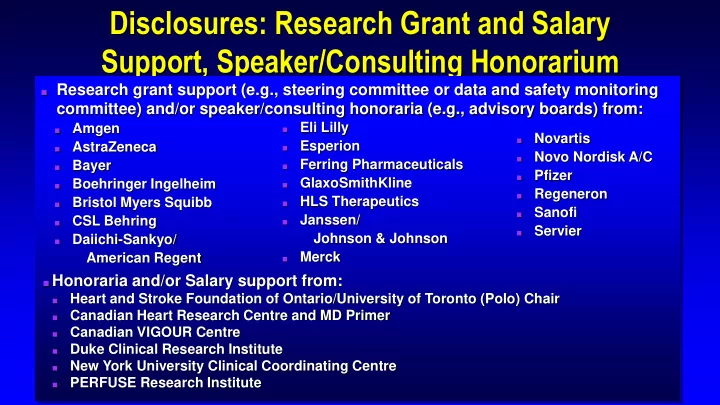
Disclosures: Research Grant and Salary Support, Speaker/Consulting Honorarium

■ Research grant support (e.g., steering committee or data and safety monitoring

committee) and/or speaker/consulting honoraria (e.g., advisory boards) from:

■

Amgen

■

AstraZeneca

■

Bayer

■

Boehringer Ingelheim

■

Bristol Myers Squibb

■

CSL Behring

■

Daiichi-Sankyo/ American Regent

■

Eli Lilly

■

Esperion

■

Ferring Pharmaceuticals

■

GlaxoSmithKline

■

HLS Therapeutics

■

Janssen/ Johnson & Johnson

■

Merck

■ Honoraria and/or Salary support from:

■

Heart and Stroke Foundation of Ontario/University of Toronto (Polo) Chair

■

Canadian Heart Research Centre and MD Primer

■

Canadian VIGOUR Centre

■

Duke Clinical Research Institute

■

New York University Clinical Coordinating Centre

■

PERFUSE Research Institute

■

Novartis

■

Novo Nordisk A/C

■

Pfizer

■

Regeneron

■

Sanofi

■

Servier

slide-2
SLIDE 2

Case

■ 54 year old male ■ Typical CCS Class I symptoms (slight limitation, with angina

  • nly during vigorous physical activity) over the past 3 months

■ Prior smoker (quit 5 years ago) ■ Hypertension on hydrochlorothiazide and amlodipine ■ LDL 4.0 mmol/L, Triglycerides 2.1 mmol/L ■ Examination normal apart from BP 152/88 mm Hg ■ CBC, Electrolytes, Creatinine and eGFR normal ■ Resting 12-lead ECG – non-specific ST-T wave changes ■ Primary care physician started ASA, Nitroglycerin spray PRN

slide-3
SLIDE 3

Exercise Perfusion Study

■

Exercises for 8:30 (Bruce protocol) to a maximal heart rate of 164 beats/min

■

Stops due to exertional dyspnea and mild central chest discomfort radiating to the jaw and left arm

■

Exercise ECG demonstrates additional 1 mm horizontal ST segment depression in leads II, III, and aVF

■

Stress and rest tomographic sestamibi images: moderate-to-large size, moderate-intensity, reversible defect involving the mid- and distal-anterior wall, extending into the apex and distal septum (LAD ischemia ~11% of left ventricle)

■

Gated wall motion at rest: very mild apical and distal septal hypokinesis (post- stress) with estimated EF 54%; normal at rest with estimated EF 60%

slide-4
SLIDE 4

■ 54 year old male with typical CCS Class I

symptoms x 3 months

■ Multiple risk factors for CAD, including

hypertension (not optimally treated) and dyslipidemia (untreated)

■ Stress Perfusion study demonstrates moderate

(~11% of LV) LAD territory ischemia

What management strategy would you undertake?

  • 1. Guideline-directed optimal medial therapy (OMT;

i.e., ASA, beta-blocker, ACE inhibitor, statin)

  • 2. Cardiac catheterization + OMT → ± coronary

revascularization

slide-5
SLIDE 5

Yusuf et al Lancet 1994;344:563-70

■

7 trials (1972-84) with 2,649 patients comparing initial CABG with medical therapy in stable CAD

■

94% assigned to surgery underwent CABG vs. 41% in medical group at 10 yrs

■

Significantly lower mortality with CABG at 5, 7, and 10 years

■

Greater risk reduction in Left Main vs. 3, 2,

  • r 1 vessel disease

■

Survival extension of 5 months in moderate-risk and 8.8 months in high-risk groups

■

In low-risk patients: non-significant trend towards greater mortality with CABG

Impact of Coronary Artery Bypass Graft Surgery (CABG) vs. Initial Medical Therapy in Stable CAD

0.00 0.10 0.20 0.30 0.40 0.50 2 4 6 8 10 12 Years

All studies

p<0.001 at 5 yrs p=0.03 at 10 yrs n=1,325 n=1,324

Medical treatment CABG

40 deaths (32%) within 30 days

slide-6
SLIDE 6

CABG vs. Medical Therapy: Limitations

■ Very few patients enrolled in

the randomized trials

■ Medical therapy did not often

include antiplatelet agents (ASA 3.2%), angiotensin- converting-enzyme (ACE) inhibitors or receptor blockers (ARBs), beta- blockers (47.4%), statins, or aggressive lifestyle interventions

Thus, the relevance of historic CABG vs. medical therapy trials today is uncertain

slide-7
SLIDE 7

Stable CAD: PCI vs. Conservative Medical Management

Revised Meta-analysis of 13 randomized trials (n=5,442)

Death Cardiac death or MI Nonfatal MI

Katritsis & Ioannidis N Engl J Med 2007;357:414-15

1 2

P value 0.25 0.87 0.43

Risk ratio (95% Cl)

Favors PCI Favors Medical Management

In patients with chronic stable CAD (in the absence of a recent MI), PCI does NOT offer any benefit in terms of death, MI, or the need for subsequent revascularization vs. conservative medical treatment

slide-8
SLIDE 8

ISCHEMIA Trial

International Study of Comparative Health Effectiveness with Medical and Invasive Approaches

slide-9
SLIDE 9

ISCHEMIA Trial Research Question

■ In stable patients with at least moderate

ischemia on a stress test, is there a benefit to adding cardiac catheterization and, if feasible, revascularization to

  • ptimal medical therapy?

Maron et al Am Heart J 2018;201:124-135

slide-10
SLIDE 10

Blinded Coronary CT Angiogram2 Stable Patient ≥21 years Moderate or Severe Ischemia1

2 Coronary CT Angiogram performed in all patients with eGFR >60 mL/min

to 3exclude patients with Left Main disease or no obstructive disease Maron et al Am Heart J 2018;201:124-135

1 Nuclear Perfusion, Stress Echocardiography, Stress Cardiac MRI, or Exercise

Treadmill Testing (without imaging)

Core lab anatomy eligible?3 Screen failure

no

slide-11
SLIDE 11

Blinded Coronary CT Angiogram Core lab anatomy eligible? RANDOMIZE Screen failure INVASIVE Strategy OMT + Cath + Optimal Revascularization CONSERVATIVE Strategy OMT alone Cath reserved for OMT failure Stable Patient Moderate or Severe Ischemia

no yes

4Sample size estimation: Conservative vs. Invasive (16% vs. 13% at 4 years); 18.5% RRR; two-sided alpha=0.05; >80% power)

~3.5 (1.5-7) Years of Follow-up Primary Endpoint: Time to CV death, MI, hospitalization for unstable angina, heart failure or resuscitated cardiac arrest4

Maron et al Am Heart J 2018;201:124-135

Major Secondary Endpoints: Time to CV death or MI; Quality of Life

slide-12
SLIDE 12

320 sites in 37 countries ~1 patient/site/month 19 sites

slide-13
SLIDE 13

ISCHEMIA* Canada

Country Leaders: Vladimir Dzavik, Gilbert Gosselin, and Shaun Goodman *CKD Country Leaders: Akshay Bagai, Kevin Bainey, and Ron Wald Gilbert Gosselin - Montreal Heart Institute Ariel Diaz – Centre Hospitalier de Regional Trois-Rivieres* Denis Carl Phaneuf – Höpital Pierre-Le Gardeur Pallav Garg – London Health Sciences Centre* Benjamin Chow – University of Ottawa Heart Institute Kevin Bainey – University of Alberta Hospital* Asim Cheema – St. Michael’s Hospital* Asim Cheema - Dixie Medical Group James Cha – Oshawa Andrew Howarth – U. of Calgary Foothills Medical Centre Graham Wong – Vancouver General Hospital* Amar Uxa – University Health Network* Paul Galiwango – Scarborough Cardiology Research Andy Lam – West Lincoln Memorial Hospital Shamir Mehta – Hamilton General Hospital Jacob Udell – Women’s College Hospital Philippe Généreux – Höpital du Sacré-Coeur de Montréal* Adnan Hameed – St. Catharines General Hospital Lejalem Daba – Northwest GTA CV & Heart Rhythm Program

*ISCHEMIA CKD

slide-14
SLIDE 14

Maron et al N Engl J Med 2020;382:1395-407

Published online March 30, 2020

slide-15
SLIDE 15

Hochman et al JAMA Cardiol 2019;4:273-86

Participant Flow From Enrollment to Randomization

Stable CAD with moderate-to-severe ischemia

Selected Exclusion Criteria:

▪ LV Ejection Fraction <35% ▪ Unacceptable level of angina despite maximal

medical therapy

▪ Very dissatisfied with medical management of

angina

▪ Significant Left Main Disease (≥50%) ▪ ACS within the previous 2 months ▪ PCI within the previous 12 months ▪ Prior CABG ▪ Coronary anatomy unsuitable for

revascularization

▪ eGFR < 30 ml/min

n~26,000 stress test reports screened* * All enrolling sites reported screening data for time-limited periods of variable duration

slide-16
SLIDE 16

Hochman et al JAMA Cardiol 2019;4:273-86 and Maron et al N Engl J Med 2020;382:1395-407

Selected Baseline Characteristics

Age, years* Female, % White/Asian, % Hypertension, % Diabetes, % Previous MI, % Previous PCI, % History/hospital. HF, % Ejection Fraction, %* History of CeVD, % History of PAD, % eGFR, ml/min* History of angina/>prior 3 months, % Stress imaging, % Exercise tolerance test, % Randomized (n=5,179) 64 (58, 70) 23 66/29 73 41 19 20 4/1 60 (55, 65) 7 4 81 (67, 97) 90/26 75 25

*Median (25, 75th percentiles)

slide-17
SLIDE 17

Maron et al N Engl J Med 2020;382:1395-407

Primary Outcome: CV Death, MI, Hospitalization for

Unstable Angina, HF, or Resuscitated Cardiac Arrest

Adjusted Hazard Ratio = 0.93 (0.80, 1.08) p=0.34 6 months: Δ = +1.9% (0.8%, 3.0%) 5.3 3.4 16.4 18.2 5 years: Δ = -1.8% (-4.7%, 1.0%)

First patient randomized Aug 7/12 Last patient enrolled Jan 31/18 → follow-up until Jun 30/19

Median duration of follow-up: 3.2 years

slide-18
SLIDE 18

Maron et al N Engl J Med 2020;382:1395-407

Key Secondary Outcomes

Death from Any Cause

9.0 8.3

Myocardial Infarction

2.6 4.3 11.9 10.3 6 months: Δ = +1.8% (0.8%, 2.8%) 5 years: Δ = -1.6% (-3.9%, 0.7%)

Invasive vs. Conservative: HRadjusted=1.05 (0.82, 1.32)

Increased procedural MI Reduced spontaneous MI

Cardiovascular Death: Invasive 5.2% vs. Conservative 6.5% HRadjusted=0.87 (0.66, 1.15)

slide-19
SLIDE 19

Goals of Treatment

■ Reduce morbidity and mortality

■ Help people have fewer heart attacks

and live longer

■ Relief of symptoms

■ Make people feel better

slide-20
SLIDE 20

Angina Frequency and Seattle Angina Questionnaire (SAQ)

Spertus et al N Engl J Med 2020;382:1408-19

Daily/Weekly Angina Several times per month No Angina SAQ Angina Frequency Score Invasive 22% 44% 34% 81 ± 20 Conservative 19% 46% 37% 82 ± 19 SAQ Physical Limitation Score SAQ Quality of Life Score 79 ± 24 61 ± 27 79 ± 24 61 ± 27 SAQ Summary Score 73 ± 19 75 ± 19 Higher scores indicate better health status

slide-21
SLIDE 21

Crude Mean Health-Status Scores

Spertus et al N Engl J Med 2020;382:1408-19

SAQ Angina Frequency Score SAQ Quality of Life Score

slide-22
SLIDE 22

Crude Mean Health-Status Scores

Spertus et al N Engl J Med 2020;382:1408-19

SAQ Summary Score SAQ Physical Limitation Score

slide-23
SLIDE 23

Probability of Being Angina-Free as a Function of Baseline Angina Frequency

Spertus et al N Engl J Med 2020;382:1408-19

Daily Weekly Monthly None

15% 45% NNT~3 No Difference

slide-24
SLIDE 24

■ ISCHEMIA is the largest trial of an invasive vs. conservative strategy

for patients with stable ischemic heart disease

■ Overall, an initial Invasive as compared with an initial Conservative

strategy did not demonstrate a reduced risk over median 3.2 years for

■ Primary endpoint - CV death, MI, hospitalization for UA, HF, resuscitated cardiac

arrest

■ Major Secondary endpoint - CV death or MI

■ Significant, durable improvements in angina control and quality of life

with an invasive strategy if patients had angina (daily/weekly or monthly)

■ In patients without angina (35%), an invasive strategy led to minimal symptom or

QoL benefits, as compared with a conservative strategy

■ In patients with angina, shared decision-making should occur to align

treatment with patients’ goals and preferences

Conclusions

Maron et al N Engl J Med 2020;382:1395-407 and Spertus et al N Engl J Med 2020;382:1408-19

slide-25
SLIDE 25

■ 54 year old male with typical CCS Class I

symptoms x 3 months

■ Multiple risk factors for CAD, including

hypertension (not optimally treated) and dyslipidemia (untreated)

■ Stress Perfusion study demonstrates moderate

(~11% of LV) LAD territory ischemia

What management strategy would you undertake?

  • 1. Guideline-directed optimal medial therapy (OMT;

i.e., ASA, beta-blocker, ACE inhibitor, statin)

  • 2. Cardiac catheterization + OMT → ± coronary

revascularization

slide-26
SLIDE 26

■ Patients with stable chest pain with a moderate to high

probability of obstructive coronary disease may benefit from a functional or anatomic test for diagnosis and prognosis (exercise treadmill test, nuclear stress test, or coronary CT angiography)

■ Consider referral to Cardiology prior to initiating testing to

determine the highest yield test and to minimize unnecessary testing

Guidance from the CCS COVID-19 Rapid Response Task Force (April 15, 2020)

Chronic Chest Pain Syndromes

Dipyridamole (Persantine)