
SLIDE 1
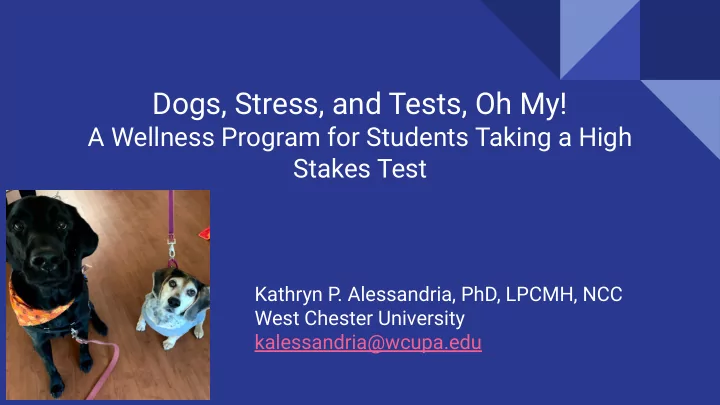
Dogs, Stress, and Tests, Oh My!
A Wellness Program for Students Taking a High Stakes Test
Kathryn P . Alessandria, PhD, LPCMH, NCC West Chester University kalessandria@wcupa.edu
Dogs, Stress, and Tests, Oh My! A Wellness Program for Students - - PowerPoint PPT Presentation
Dogs, Stress, and Tests, Oh My! A Wellness Program for Students Taking a High Stakes Test Kathryn P . Alessandria, PhD, LPCMH, NCC West Chester University kalessandria@wcupa.edu Learning Objectives 1. Describe a wellness program implemented
Kathryn P . Alessandria, PhD, LPCMH, NCC West Chester University kalessandria@wcupa.edu
1. Describe a wellness program implemented for students taking a high stakes test. 2. Discuss research on the effectiveness of interacting with a certified therapy dog on student stress and anxiety during high stakes testing. 3. Identify practical strategies to implement animal assisted intervention on college campuses 4. Identify at least three considerations (e.g. animal and human welfare, selecting appropriate animals for programs, etc.) that must be addressed prior to incorporating therapy dogs in outreach programming.
practice.
campuses are therapeutic outreach or as part of individual therapy.
large number of people while requiring few resources.
Stormy at Therapy Dog Extravaganza! Finals Week at WCU In a study of the prevalence of AAI programs, 62% of surveyed colleges had current stress relief programs using animals (Haggerty & Kiely Mueller, 2017).
et al., 2010): ○ lower predicted grades ○ feelings of being less prepared for exams ○ a negative view of courses completed
common among stress-induced college students (Adams et al., 2017): ○ Homesickness/friendsickness ○ sleep deprivation, ○ Feeling overwhelmed, ○ depression and anxiety
loneliness, and anxiety, often through outreach programs on campus (Gladding, 2016). ○ Interacting with a therapy animal can lower anxiety and loneliness ○ that these types of outreach programs can be a way to assist students on campus whose needs may not warrant ongoing counseling, but could benefit from programs aimed at reducing stress and anxiety.
Pendry et al. (2018) conducted a randomized controlled trial to evaluate the effects of a AAI intervention to reduce college students’ stress the week before final exams. Experimental Group: 10 minutes of interacting with dogs and cats. Control Group: watched a 10 minute slideshow of the dogs and cats. Waitlist Group: wait list group- assessed while waiting 10 minutes for their turn to interact with the dogs and cats. Outcome: experimental group had significantly higher levels of contentment and lower levels of irritability and anxiety compared to both other groups.
Ward-Griffin et al. (2018) studied the effect of a pre-exam therapy dog drop-in event on student well-being. This study added a delayed post-test adding the variable of time. Experimental Group: completed questionnaire immediately before/after interacting with therapy dogs, and again 10 hours later. Delayed Treatment Control Group: completed all the baseline measures and the 10 hour follow-up measures. Outcome: Therapy dog sessions had strong immediate benefits. Experimental group had significant:
than the delayed treatment control group
1. Ease student stress and anxiety prior to taking their comprehensive exam, a high stakes test. 2. Introduce CITs to the benefits of AAI through an AAI
least one person who has already taken the test
spinners, meditation balls
mindfulness coloring pages
Chinese Meditation Balls Stress balls
Mindfulness Coloring Tools
experience, it takes less than 5 minutes to answer. Survey Questions:
(scale of 1= not stressed to 5 = extremely stressed)
○ Why did you choose to attend this event? ○ What effect did participating in the wellness event have on you? ○ If you interacted with a therapy dog, please tell us about your experience. ○ Suggestions for future events
Fall 2018 - first time offered, no IRB, no data Spring 2019 - first survey and much larger group, 3 dogs, 4 volunteers, including an alum who had taken the test to graduate the semester prior Fall 2019 - exam moved to Main Campus, we were in a separate building, major storm night before closed roads and took out power Factors that influence success
Range = 2 to 5 Mean = 3.75 N= 20
Range = 1 to 3 Mean = 2.41 N = 17 This mean is 1.34 points lower than the pre-event score.
Range = 2 to 5 Mean = 3.73 N = 22
Range = 1 to 3 Mean = 2.44 N = 16 This mean is 1.29 points lower than the pre-event mean
Themes with Example Responses 1. Social support from peers and faculty
feeling stressed, so to be together for support was really helpful.”
chatting with classmates and Professor Alessandria would be helpful before the
2. Dogs
little bit….“
test, and I love dogs.”
Reported Reasons Why People Choose to Attend the Wellness Event cont.
Themes with Example Responses 1. Stress reduction
sure I had plenty of time to relax my body”
de-stress by petting the dogs!” 2. Food
that extra energy I may need prior to taking the test.”
What Effect did Participation in the Wellness Event Have on you?
Themes with Example Responses 1. Stress Reduction “I think it allowed for me to feel less stressed about the exam especially when speaking with those who took it previously. I believed participating in the wellness event relieved some test anxiety as well because it allowed me to realize I know a great deal of
2. Social Support “It normalized my stress about the exam. it was nice to have a chance to have fun with the dogs and people and find things to laugh about. Playing with the dogs was both relaxing and distracting. It was helpful to have Nicole share a little about when she took the exam in the summer. I didn’t expect to feel better after writing down my worry and placing it in the jar but I actually did. It felt good to fully “verbalize” it. “
What Effect did Participation in the Wellness Event Have on you?...
Themes with Example Responses
feel like we were all in it together, so it was less intimidating.”
was nice knowing that others were just as stressed as I was. “
earlier because I was so nervous. “
Themes 1. Calming effect ○ “Stormy was very friendly and allowed for me to feel really calm. Overall she was really fun and allowed for me to not think about the pending exam.” 2. Distraction ○ “The dogs were very lovable and friendly. Having the dogs to pet and get kisses from took my mind off of the test “ 3. Positive Experience ○ “Absolutely the greatest experience. I have never interacted with a therapy dog before but this was such a valuable experience “ 4. Friendliness ○ “They were wonderful. Very calm and friendly and it certainly helped! “ 5. Happy ○ “Loved Stormy. Very cute and excited to greet everyone. Her happiness made me happy and more relaxed/prepared. “
Other words that came up with less frequency: Relaxed, loved, comfortable, comforted
me and allowed me to pet her and she looked at me in my face so attentively, that I really felt like she was saying, it’s going to be alright. “
Interactions with therapy dogs 27.12% Interactions with people 25.42% Snacks 11.86% Stress & Meditation toys 10.17% MIndfulness Coloring pages 10.17% Worry Jar 5.08% Empowering Quotes 5.08% Gratitude Jar 5.08% Interactions with people 29.63% Interactions with therapy dogs 27.78% Snacks 22.22% Stress & Meditation toys 9.26% Empowering Quotes 7.41% Worry Jar 3.70% Gratitude Jar 0.00% MIndfulness Coloring pages 0.00%
When rank ordered by most helpful, therapy dogs were #1; Interactions with people was #2 in both semesters.
Practical Considerations... 1. Make sure the animals you bring in are certified therapy animals who are insured to do this work. 2. Therapy animals must be “invited” to the space. 3. Animal and human welfare ○ Prevention of transmission of zoonotic diseases. ○ Facilities management - cleaning the space post-event ○ Are consent forms necessary? 4. Allergies
Adams, A. C., Sharkin, B. S., & Bottinelli, J. J. (2017). The Role of Pets in the Lives of College Students: Implications for College Counselors. Journal of College Student Psychotherapy, 31(4), 306-324. Allen, K., Shykoff, B. E., & Izzo Jr, J. L. (2001). Pet ownership, but not ACE inhibitor therapy, blunts home blood pressure responses to mental stress. Hypertension, 38(4), 815-820. Austin, E. J., Saklofske, D. H., & Mastoras, S. M. (2010). Emotional intelligence, coping and exam‐related stress in Canadian undergraduate students. Australian Journal of Psychology, 62(1), 42-50. Cole, K. M., Gawlinski, A., Steers, N., & Kotlerman, J. (2007). Animal-assisted therapy in patients hospitalized with heart
Gladding, S. T. (2016). The creative arts in counseling (5th ed.). Animal-Assisted Therapy in Counseling, Therapeutic Horticulture, and Wilderness/Nature Therapy. Alexandria, VA:American Counseling Association. Haggerty, J. M., & Mueller, M. K. (2017, February 14). Animal-assisted stress reduction programs in higher education. Journal of Innovative Higher Education, 42, 379-389. https://doi.org/link.springer.com/article/10.1007/s10755-017-9392-0 Henry, C. L., & Crowley, S. L. (2015). The psychological and physiological effects of using a therapy dog in mindfulness
Hoffmann, A. O., Lee, A. H., Wertenauer, F., Ricken, R., Jansen, J. J., Gallinat, J., & Lang, U. E. (2009). Dog-assisted intervention significantly reduces anxiety in hospitalized patients with major depression. European Journal of Integrative Medicine, 1(3), 145-148. Jarolmen, J., & Patel, G. (2018). The effects of animal-assisted activities on college students before and after a final exam. Journal of Creativity in Mental Health, 13(3), 264–274. https://doi.org/10.1080/15401383.2018.1425941 Pendry, P ., Carr, A. M., Roeter, S. M. & Vandagriff, J. L. (2018). Experimental trial demonstrates effects of animal-assisted stress prevention program on college students’ positive and negative emotion. Human-Animal Interaction Bulletin, 6(1), 81-97. Stewart, L. A., Dispenza, F., Parker, L., Chang, C. Y., & Cunnien, T. (2014). A pilot study assessing the effectiveness of an animal-assisted outreach program. Journal of Creativity in Mental Health, 9(3), 332-345. Stewart, L. A., Chang, C. Y., Parker, L. K., & Grubbs, N. (2016). Animal-assisted therapy in counseling competencies. Alexandria, VA: American Counseling Association, Animal-Assisted Therapy in Mental Health Interest Network. Ward-Griffin, E., Klaiber, P ., Collins, H. K., Owens, R. L., Coren, S., & Chen, F. S. Petting away pre-exam stress: The effect of therapy dog sessions on student well-being. Stress and Health, 34, 468-473. 10.1002/smi.2804