DRESSED FOR SUCCESS: EVA System Competency and Containment for - - PowerPoint PPT Presentation

dressed for success eva system competency and containment
SMART_READER_LITE
LIVE PREVIEW

DRESSED FOR SUCCESS: EVA System Competency and Containment for - - PowerPoint PPT Presentation

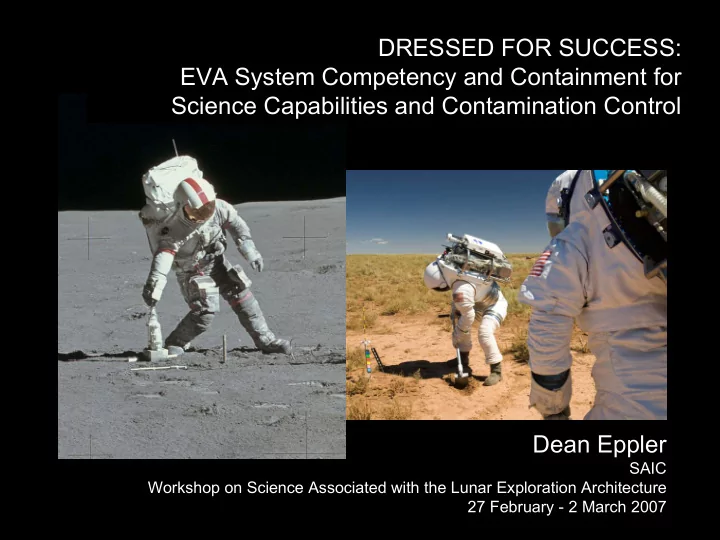
DRESSED FOR SUCCESS: EVA System Competency and Containment for Science Capabilities and Contamination Control Dean Eppler SAIC Workshop on Science Associated with the Lunar Exploration Architecture 27 February - 2 March 2007 What Im Going


slide-1
SLIDE 1

Dean Eppler

SAIC Workshop on Science Associated with the Lunar Exploration Architecture 27 February - 2 March 2007

DRESSED FOR SUCCESS: EVA System Competency and Containment for Science Capabilities and Contamination Control

slide-2
SLIDE 2

What I’m Going To Talk About…

  • Where we came from - specifically,

the capability of the Apollo A7L/A7LB suit system

  • The present capabilities of

experimental planetary EVA suits

  • What are the issues for meeting

planetary protection protocols with crewmembers in pressure garments

  • What’s next - plans for the next

generation lunar surface suit system

slide-3
SLIDE 3

Apollo EVA Suit System - A7L/A7LB

  • Apollo went to the Moon with the most advanced space suit system at the time,

the A7L/A7LB pressure garment and a separate backpack style portable life support system (PLSS)

  • This system had a number of tasks besides walking on the lunar surface,

including

– Provide a pre-breathe “container” pre-launch – Be comfortable when lying supine during a peak launch acceleration of ≈4.7g – Provide basic water survival capability in the event of a launch failure or an off-target entry – Be capable of supporting crewmembers’ vital functions for a period of up to 104 hours in the event of a multiple LM and CM pressurization failure

  • Allowing the crewmembers to conduct useful work on the lunar surface,

including using tools, deploy science packages, ingress/egress rovers, and walk-back to the LM from a disabled rover, was perhaps the biggest challenge to pressure garment design, due to the behavior of pressurized garments

– Soft goods generally want to attain a particular shape when pressurized, and do not like to be displaced from that shape without the input of an external force

slide-4
SLIDE 4

Pressure Garment Behavior

  • This is an example of what happens to

a suit subject when a pressure garment that does not have accommodations for movement is inflated

  • In this case, I’m pretty much immobile;

moving my arms away from this neutral position takes forces probably measured in 10s of pounds

  • For this particular pressure suit (the

Shuttle ACES emergency pressure suit), this is an acceptable condition as the suit is designed for unpressurized comfort, not pressurized mobility

slide-5
SLIDE 5

Pressure Garment Behavior

  • This is Gene Cernan’s flight A7LB; notice the

improved arm mobility, enabled by the combination of bellows, cables and pulleys

  • While aggressive, normal movement in each suit

requires force, the A7LB provides significantly greater mobility than the ACES pressure garment

slide-6
SLIDE 6

Apollo EVA Suit System - A7L/A7LB

  • Chief among these was glove performance

– The A7LB gloves were relatively simple, made with latex from molds of crewmembers hands and covered with a thermal garment to protect the hands, protect the glove and improve finger tip contact friction – In a pressurized state, these gloves were extremely cumbersome and had limited finger mobility, dexterity and tactility – In an effort to improve glove performance, most crewmembers had an extremely tight fit which, in turn, tended to damage finger tips and finger nails

  • An additional significant issue was bending down

– The force necessary to bend down was significant; in particular, touching the ground in forward bend was very difficult – In order to pick up rocks and other “ground-bound”

  • bjects, it was necessary to bend at the knees, lean

back and sideways in order to get one hand close to the ground, as shown here by Dave Scott on Apollo 15,

  • r kneel down
  • Although the A7LB had the best capability of any suit system at the time, there were

limitations that put significant stress on the crew

slide-7
SLIDE 7

Apollo EVA Suit System - A7L/A7LB

  • Despite the limitations of the A7LB system, the Apollo crews were able to coax every last bit of

performance out the system with a combination good physical conditioning, figuring out how to get around the limitations of the pressure garment, and the ability to work through the pain the suit often induced on them by the pressure garment

slide-8
SLIDE 8

Desert RATS

  • Since 1998, the Crew and Thermal Systems

Division at JSC, led by Joe Kosmo, Amy Ross and Barbara Janoiko, have been conducting annual forays to Flagstaff, AZ, to test suits, robots, information systems and field tools in preparation for conducting lunar and Martian exploration

  • The purpose of these exercises has been

extremely varied, but in general considered human-centered, external operations for exploration

– Mobility and dexterity testing of experimental suit systems – Carry ergonomics of suit/backpack systems – Suited interfaces with surface mobility systems and EVA tools – In-suit, “extra-habitat” recharge of life support systems – Use and design of field tools, including basic geologic exploration and mobility tools as well as analytical equipment

slide-9
SLIDE 9

Desert RATS - Suits

  • We have been using two experimental pressure garments that represent departures

from both the A7LB and the Shuttle/ISS EMU in ways that will improve their suitability for use on planetary surfaces

  • On the left is the ILC-Dover Rear

Entry I-Suit (REI Suit), a suit constructed mostly out of soft goods, with bearings at the shoulder, wrist, ankle and a two bearing hip,patterned convolute construction at the waist and shoulders, and mountaineering boots adapted to the pressure garment

  • On the right is the ZPS Mark III,

a hybrid hard and soft suit, with with a hard upper torso and briefs, bearings at the ankle, hip, waist, shoulder and wrist, with rolling convolutes at the waist and shoulder and military flight boots adapted to the pressure garment

slide-10
SLIDE 10

Desert RATS - Suit Mobility Evaluation

  • The diagram to the right shows the

joint ranges of motion between the Mark III suit and shirt sleeve activity

  • This data was acquired by doing

short geologic traverses at Meteor Crater first un-suited and then in the Mark III

Knee mobility flexion Suited range: 89°-178° Unsuited range: 80°-178° Shoulder adduction/ abduction Suited range: 9°-93° Unsuited range: -27°-58° Hip flexion/extension Suited range: 83°-180° Unsuited range: 77°-176° Ankle flexion/extension Suited range: 40°-167° Unsuited range: 50°-131° Hip abduction/ adduction Suited range: -13°-49° Unsuited range: -11°-34° Shoulder flexion & extension Suited range: 19°-93° Unsuited range: 5°-86° Elbow flexion/extension Suited range: 43°-159° Unsuited range: 59°-178°

slide-11
SLIDE 11

Desert RATS - PLSS Recharge Testing

  • One of the approaches to reducing backpack weight is to carry a reduced supply
  • f consumables and enabling top-off during EVA, either on the rover or at a

previously cached recharge station

  • This has worked very well, and we’re now doing it routinely to extend our in-suit

time on test EVAs

  • The biggest

concern is breaking hose connections in vacuum while ensuring you can’t get a stuck connector and a pressure garment open to vacuum

slide-12
SLIDE 12

Desert RATS - Gloves

  • For RATS, we have using a variety of operational and experimental gloves that

capitalize on advances in patterning techniques to improve fit and mobility

  • On the left is an Apollo era glove;

note that it is in a “neutral grip” position, even when unpressurized; pressurization made it very difficult to move the hand out of that position

  • On the right is an experimental

glove with flat pattern sewing and a “universal joint” wrist mechanism that allows the subject’s hands to move freely through many normal hand motions, even when pressurized

  • My experience with these gloves is

that, although hand fatigue is an inevitable part of working in pressure gloves, the fatigue level is not debilitating

  • The Shuttle and ISS EVA crews

have done many hours of exacting, tedious work in the Phase IV and Phase VI gloves without the problems the Apollo crews experienced with finger damage and extreme fatigue

slide-13
SLIDE 13

Desert RATS - Gloves

  • Perhaps more important than fatigue is the dexterity we’ve achieved with the new

gloves, including manipulating objects as small as a ball-point pen, and as complex as a multi-function hand-held RC airplane radio controller without substantial hand fatigue

slide-14
SLIDE 14

Desert RATS - Field Hand Tools

  • We have been using a variety of geologic hand tools similar to those used on Apollo,

with the added task of looking at planetary protection approaches to tool usage and evaluating if chemical analysis is a reasonable task to do on EVA

slide-15
SLIDE 15

Planetary Protection Issues with EVA Suits

  • The biggest issue associated with planetary protection and pressure garments is that they

leak…the “leak-proof” space suit is on the same par with a perpetual motion machine…

  • When suits leak, they leak gas, but they also leak particulates present within the suit

environment, including particles that undoubtedly harbor bugs

  • What you can manage, through the use of seals and suit closure approaches, is the

amount of leakage

  • Nominal leak rates on Shuttle/ISS EMU are as follows:

Ground-Level In-Space Level

  • Arms (each)

31.5 sccm/air 9.0 sccm/O2

  • Lower torso

24.5 sccm/air 7.0 sccm/O2

  • Gloves (each)

10.5 sccm/air 3.0 sccm/O2

  • Upper torso

21.0 sccm/air 6.0 sccm/O2

  • Helmet

7.0 sccm/air 2.0 sccm/O2

  • TOTAL

136.5 sccm/air 39.0 sccm/O2

  • The leak rates on the Mark III pressure garment are considerably higher

– However, that pressure garment has been in use for almost 20 years, and has around 1,000 hours

  • f pressurization time, which is far more time on the garment than any flight unit would be

expected to have – We should expect to have leak rates similar to the Shuttle/ISS EMU for lunar surface operations

slide-16
SLIDE 16

Planetary Protection Issues with EVA Suits

  • Additional leakage constituents from portable life support system (PLSS)

– Vent system loop (connector fittings) – Oxygen supply source (gaseous or cryogenic) – Heat removal system (water boiler - ≈1 lb/hr which will contain contaminants from the ALS water processor system) – Venting systems for regenerable CO2 and humidity control are currently among leading contenders to limit expendables and on-back weight

– These release ullage volume of space suit atmosphere as well as separated CO2, H2O, trace contaminants

  • f ≈2 lbs CO2 / EVA, ≈1.5 lbs H2O/EVA, ≈0.02 lbs O2 / EVA, with contaminants and higher O2 losses

possible with ejectors and other candidate technologies

  • Potential venting during assisted operations, emergency operations, EVA recharge or equipment change-out

activities

  • Additional potential contamination constituents

– Trace chemical contaminants associated with suit leakage, such as lubricants associated with suit bearings and other components – Suit surface contaminants from habitat and human contact – Elastomeric and other fabric materials from outer space suit coverings lost due to mechanical abrasion and off-gassing of volatiles

  • The lunar suits presently have no requirement to meet the planetary protection

requirements established for Mars, however, all of these data suggest that minimizing contamination from space suit systems will be a difficult development activity for a Mars space suit system

– There may be concerns in the lunar environment about off-gassing effects from suits on optical surfaces – This will need to be considered when items such as optical telescopes begin to be constructed on the lunar surface

slide-17
SLIDE 17

Planetary Protection Issues with EVA Suits

  • In an effort to understand the suit leakage of biological materials, we’ve run several

ad-hoc experiments on the REI Suit on two RATS excursions

  • These experiments, which Andrew Steele will report on, testing the biological load
  • f suit components prior to and after a suit run to see how many bugs leaked out
  • We hope to expand on this in the future by doing a rigorous biological challenge in

a vacuum chamber to quantify the biological output of the future lunar spacesuit system

slide-18
SLIDE 18

Desert RATS - Q & D Lessons Learned

(From The Suit Subject’s Perspective)

  • Suit mobility and glove dexterity have made tremendous advances since Apollo, and can

support the goal of frequent, routine EVAs without seriously beating up the crewmembers in the process

  • In-suit and on-rover recharge are relatively easy activities, provided the appropriate valve

interlocks are built to prevent malfunctions

  • We can do analytical work in a suit, but it is difficult and time consuming

– As good as the suits and gloves have become, we need to understand where the break point is between “exploration efficiency” and real-time analytical data collection

  • Rovers are great devices, both robotic, manned and hybrid versions

– Manned rovers greatly reduce crew fatigue and consumable usage and extend EVA time – Unmanned rovers are essential tools for a variety of operational duties

  • Scientific and operational reconnaissance
  • Equipment transport
  • Instrument deployment
  • Planetary protection will be an important design challenge for the Mars suit system, but it’s

unclear to what degree we will be able to reduce contamination

  • To a large extent, we know what works in spacesuit systems, but the ancillary systems

that will interact with the crewmembers remains wide open territory

– The cardinal rule that has to followed, however, is that crewmember is not a carbon-based robot – If we overwhelm the crewmember with systems management tasks that detract from their ability to

  • bserve and use their brains, we’re wasting the investment made to send them to the lunar surface

in the first place

slide-19
SLIDE 19

Exploration Techniques - Open Questions

  • Apollo barely pried open the door to planetary surface exploration
  • Sustained scientific lunar and Mars exploration will require us to answer a host

questions that are precipitated by having sustained exploration capability that was not available during Apollo

  • These questions can be grouped into the following larger topics:

– Scientific analysis capability – Exploration/science information management – Geographic information acquisition and delivery – Operations information delivery systems – Work allocation between human and robotic systems – Degree of autonomy of robotic systems – Operations philosophy and implementation

  • I see the answers to these questions as part of re-inventing the sciences of field

geology and biology so they can be practiced in places where we will never have the luxury working in a shirt-sleeve environment

– In short, how do we do what geoscientists and field biologists have always done - apply geological and biological data to a geographic base so the geologic history, geochemistry, geophysics and biodiversity of an area can be deciphered and understood?

slide-20
SLIDE 20

Conceptual Lunar Surface EVA Suit System

Enhanced Helmet hardware: TMG & lighting - Heads-Up-Display - SUT-integrated Audio - Enhanced Pressure Garment / Softgoods: TMG/MLI for relevant environment - Rear Entry Lunar SUT w/Waist & Scye Bearings - Wear/abrasion resistant softgoods - Enhanced LCG & Bio-Med Sensors Portable Life Support Subsystem (PLSS): High Pressure GOX - SWME/RCA - Potable Water in PLSS Tank - Power/CAI: Lithium Ion Batteries - C3I Processing in PLSS - Expanded set of suit sensors - Advanced Caution & Warning - On-suit Productivity Enhancements - Umbilicals & SOP: Same hardware from Orion Config. Upgrade umbilical for Recharge and Buddy Breathing/Cooling

Concept Drawings of the Suit System Reference Configuration Constellation Suit System Team - 26 Oct. 2006

Artwork by Jeannie Corte (ESCG)

* Hardware detailed text represents changes or additions of hardware (colored darker blue or purple) to the Orion configuration. * Hardware detailed text represents changes or additions of hardware (colored darker blue or purple) to the Orion configuration.

slide-21
SLIDE 21

Desert RATS is a strongly collaborative effort, involving enormous efforts by many people. My thanks goes out to all the engineers, suit techs, photographers, medics, comm guys, roboticists and general schleppers that have enabled us to learn all that we have in the last 10 years of work!