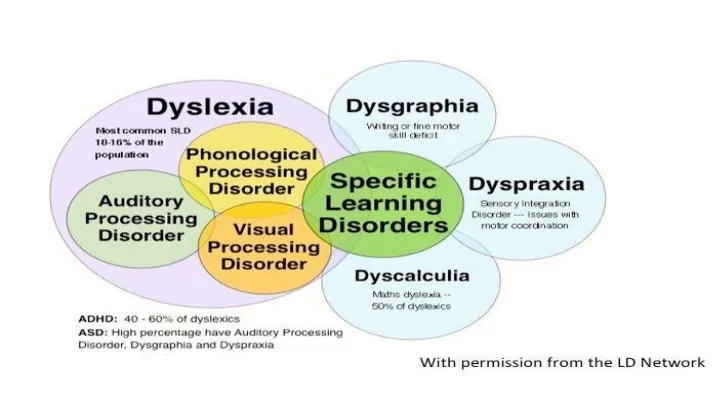
Dys Dysgraphia phia Dyscalculia Dyscalculia ??? ??? - - PowerPoint PPT Presentation

dys dysgraphia phia
SMART_READER_LITE
LIVE PREVIEW

Dys Dysgraphia phia Dyscalculia Dyscalculia ??? ??? - - PowerPoint PPT Presentation

Dysl Dyslexia xia Dys Dysgraphia phia Dyscalculia Dyscalculia ??? ??? Controversial theories Myths around these Do these exist ? Occurs in other languages Research done Different degrees The Oxford dictionary


slide-1
SLIDE 1
slide-2
SLIDE 2

Dysl Dyslexia xia Dys Dysgraphia phia Dyscalculia Dyscalculia ??? ???

  • Controversial theories
  • Myths around these
  • Do these exist ?
  • Occurs in other languages
  • Research done
  • Different degrees
slide-3
SLIDE 3
slide-4
SLIDE 4
slide-5
SLIDE 5
slide-6
SLIDE 6
  • The Oxford dictionary meaning for Dyslexia is “a

disorder involving difficulties to read or interpret words, letters or other symbols, but does not affect general intelligence”

slide-7
SLIDE 7

Descriptive Defi finition

  • describes the condition or the characteristics of Dyslexia; according to

Snowling (2008) continues to say that Dyslexia is characterized by “a deficit in phonological (speech) processing, but “its behavioral manifestations are varied ….

  • there are cardinal symptoms of reading and spelling difficulties,

and there are a range from problems of written expression, to aspects of mathematics, verbal memory and organizational skills.”

slide-8
SLIDE 8

Discrepancy Definition

  • not referred to anymore goes on to say that Dyslexia is according to

Selikovitz in Kelly & Phillips 2011 p.9; “an unexceptional and unexplained condition, occurring in a child of average or above intelligence, characterized by a significant delay in one or more areas

  • f learning.”

This theory was disregarded as there was no qualitative

difference in the patterns of reading errors between students with high

  • r low IQs.
slide-9
SLIDE 9

The working definition

  • can be used to identify learners with Dyslexia and provide a

basis for intervention. The Rose report suggests that Dyslexia is a learning difficulty that affects the following from Kelly & Phillips (2011 p 9, 10):

  • Primarily affects skills involving in accurate and fluent word

reading and spelling.

  • The key features are difficulties in phonological awareness,

verbal memory and verbal processing speed.

  • Dyslexia occurs across a range of intellectual abilities
  • It is thought as a continuum and not as a category and there

are no clear cut-off points

  • Co-occurring difficulties may be seen in aspects of language,

motor co-ordination, mental calculation, concentration and personal organization, but they are not by themselves, markers

  • f dyslexia
  • A good indication of the severity and persistence of dyslexic

difficulties can be gained by examining how the individual responds or has responded to well-founded intervention.

slide-10
SLIDE 10

In short, Dyslexia

  • falls on the spectrum of language disorder
  • affects the individual for life
  • Its characterized by a deficit in phonological (speech) processing
  • BUT its behavioural manifestations are varied
  • The cardinal symptoms are reading & spelling difficulties
  • Has a range of problems of written expression, to aspects of Maths,

verbal memory and organizational skills

slide-11
SLIDE 11

Factors contributing to Dyslexia as a continuum

  • Depends on the child’s patterns of strengths and weaknesses,

support, maturation, appropriateness and intensity of early intervention

  • Many individuals have other inter-related learning difficulties
  • It is not caused by the lack of motivation to want to learn to

read, sensory impairment, inadequate instruction or lack of environment opportunities or low intelligence

  • the disability varies on the severity and the prognosis

depending on the severity of the disability

  • The behavioural symptoms of some of the underlying

problems varies and changes with development therefore this should be seen on a cognitive level rather than a behavioural level.

  • More than other developmental disorders it is marked by a

high degree of compensations

slide-12
SLIDE 12

Early detection for dyslexia - is crucial

  • How soon can you test for dyslexia?

Children under the age of 9 cannot be diagnosed with dyslexia. There are several tests on the market at the present time for diagnosing dyslexia as early as 4 years of age. However, we term these early diagnoses as 'at risk' for dyslexia until the child is six months into their second grade of education.

slide-13
SLIDE 13

When is it a learning difficulty?

  • Excels in other areas
  • Poor grades or academic performance
  • School or task avoidance
  • Frequent absenteeism
  • Making excuses
  • High anxiety levels
  • Accident prone
  • Friendship, social issues
  • Becoming emotionally needy
slide-14
SLIDE 14

How do they test you for dyslexia?

  • A single test can't diagnose dyslexia. Rather, your doctor or a school

professional (such as a reading specialist) will ask you what signs

  • f dyslexia you and your child's teachers have seen. He or she will

ask your child questions too. ... It takes a team to diagnose dyslexia.

slide-15
SLIDE 15

Can schools test for dyslexia?

  • Federal education law does not require public schools to test children

for dyslexia. Schools only have to test to find out if a child is eligible for special education services, and if so, under what category. If a child with dyslexia is eligible, they will be placed in a category called Learning Disability.

slide-16
SLIDE 16

Testing procedure

Factor in:

  • For better results; early

detection is vital.

  • Initial take in interview and

testing is important

  • Background history: family

and school history

  • School reports
  • Other tests results: OT,

speech & language, paedatric assessment,

  • ther

Testing must involve:

Diagnostic Reading & Spelling & dictation tests Reading nonsense words Comprehension: aloud & silent & oral Rapid name calling Recalling of numbers forwards & backwards Handwriting speed & handwritten copying task Informal handwritten free writing task

slide-17
SLIDE 17

To sum up - Importance of intervention

Kelly & Phillips (2011 p11) suggests implications of practice is that

  • ‘Early detection and assessment of literacy difficulties is important in

view of the incidence of dyslexia.

  • Referrals should not be made on the assumptions of disruptive

behaviours

  • A ‘checklist for screening is a useful first step and it is worthwhile

remembering that characteristics/observable behaviours may be different at different ages.”

  • Systematic multisensory programme in your teaching is important
slide-18
SLIDE 18

Understanding how reading takes place

slide-19
SLIDE 19
slide-20
SLIDE 20

How can you help a child with dyslexia?

  • Go into detail. Kids with reading difficulties may need help when it

comes to noticing all the details in a new word—especially if the word has an unusual spelling. Take the word through, for example. Teach your child by first showing her the word and then reading it out loud.

slide-21
SLIDE 21

The principle approach needs to be

  • Structured: new concept is strictly ordered to a programme
  • Multisensory: VAKT
  • Cumulative: logical sequence of graded steps so that ant new point builds on

what was previous learnt

  • Phonics- based : synthetic ( letter-sound) and analytical ( whole word)
  • Overlearning: before moving on to the next one, repeat a particular routine

and drill until optimal learning is acquired

slide-22
SLIDE 22

Planning your lessons

  • Starting point established from your testing
  • Organization and planning and lesson lay out is vital
  • Factor in:
  • 1. Be well prepared before, during and concluding your lessons
  • 2. Have tools available and functioning and vary them from time to time
  • 3. Timing of each task in the lessons is important : ½ on revision and ½ on

new teaching point

  • 4. Concentration levels – bring multisensory or change activity
  • 5. Form a relationship
  • Be aware of sensory overload and too many activities
slide-23
SLIDE 23

Important teaching strategies: your lessons need

  • Structure & routine: spelling – dictation
  • Memory training: for automaticity
  • Support activities: visual & auditory sequential memory
  • Handwriting
  • Multisensory approach
slide-24
SLIDE 24

The importance of f memory ry

‘If we learned to use our brain the way it was naturally designed to work, we would astonish ourselves every day. ‘ Jensen,1995

slide-25
SLIDE 25

Importance of memory training

  • Memory is an activity to acquire retain and recall information – an areas

that students with Dyslexia have the most difficulties Improving working memory & long term memory

  • Metacognition
  • Actively involved
  • Verbal rehearsal
  • Pattern based
  • Reduce memory overload – chunking info
  • New knowledge built on previous knowledge
  • Alternative techniques for info beyond memory capacity - application
  • Practice for ‘real life’
slide-26
SLIDE 26

Working memory is

  • Described the ability we have to hold in mind and mentally

manipulate information over a short periods of time.

  • Working memory is thought as a mental workspace that we can store

important information in the course of our mental activity.

slide-27
SLIDE 27

Why is working memory important ?

  • Working memory is used for:

✓Controlling attention ✓Resisting distraction ✓Complex thinking ✓Organization ✓Problem Solving ✓Remembering tasks

  • Essential for academic areas:
  • Reading (especially

comprehension)

  • Maths (especially problem

solving)

  • Written expression
  • Test taking
slide-28
SLIDE 28

Structure & routines:

  • The need for numerous exposure to a stimulus ( the printed word)
  • Routine is built into the lessons aimed at improving speed of retrieval
  • Time management is important – avoid over planning
  • Ensure that correct information goes into working memory and is

stored in long term memory

slide-29
SLIDE 29

An example of a lesson plan

  • Alphabet and dictionary skills
  • Memory training
  • Revision
  • Reading & spelling pack
  • New teaching point
  • Handwriting
  • Reading in structure
  • Written task
  • Spelling & dictation in structure
  • Quick review
  • Support reading
  • Game
slide-30
SLIDE 30

An actual lesson would include

  • Alphabet and dictionary skills
  • Memory training
  • Revision
  • Reading & spelling pack
  • New teaching point
  • Handwriting
  • Reading in structure
  • Written task
  • Spelling & dictation in structure
  • Quick review
  • Support reading
  • Game
  • Individual if possible or homogenous groups
  • Lesson duration is
  • 30 min x 2 a week
  • 45 min 1x a week
  • 60 min 1x week
  • How many lessons to establish routine and progress -

from 7 lessons

  • How many lessons in total : 50 hours

lessons onwards depending on age, ability, continuity

slide-31
SLIDE 31

Examples of how Dyslexic students should be taught

  • https://www.youtube.com/watch?v=vulIeXCN9So
  • https://www.youtube.com/watch?v=jT35KppfFJk
slide-32
SLIDE 32

Laying out the alphabet – in an arc

slide-33
SLIDE 33

Alphabetizing ideas

slide-34
SLIDE 34

Dictionary ry skills – working with a place of reference and to extend vocabulary

slide-35
SLIDE 35

Memory ry training –

quick recall what was taught previous lesson, must not be unknown to them.

  • Ideas:

(on a whiteboard or in a book )

  • Read the words from your treasure box
  • Write all the words starting or end with or have the same sound as
  • Rhyming words – write them down, choose from a pack of cards
  • Flash cards
  • Use learnt words in a dictation
slide-36
SLIDE 36

Revision – spelling & reading pack

  • Word searches
  • Word worms
  • Building blocks
  • Tracking exercises
  • Flash cards – with missing letters
  • Cloze procedures ex.
  • Editing piece
slide-37
SLIDE 37

New teaching point – new content multisensory approach

  • Must be a build on from previous single sound or sound family
  • Introduce the sound – BME, rule and word examples
  • Involve the student – engage how they will remember best- come up

with the way they learn best

  • Formalize by recording in some way – multisensory
slide-38
SLIDE 38

Handwriting – writing task

Multisensory approaches: sand, clay, pipe cleaners, stamps, paint etc

slide-39
SLIDE 39

Handwriting

Print

  • Printed letters
  • Matching the lower case with

upper case

  • Reciting the movement of the

letters

  • i.e. up, down, round and again

round

Cursive

  • Introduction of cursive –
  • formation of each letter linking

the le

  • Stimulus response routine: sound,

clue word, letter name, letter shape

slide-40
SLIDE 40

Spelling & dictation in structure / quick review– formalizing the new teaching point

  • Copying from a sentence you wrote or
  • Writing their own sentence or
  • You dictate a sentence or
  • Have a sentence written out but leave out the new words out which

they have to fill in.

slide-41
SLIDE 41

Support/paired/ group R Reading – not work related

slide-42
SLIDE 42

Games – not task related, to relax, switch off

  • Board games
  • Computerized games
  • Games involving movement
  • Funny /silly games
slide-43
SLIDE 43

For the much older student

  • Alphabet and dictionary skills and vocabulary enrichment
  • Memory training and application techniques
  • Revision – aim is to achieve automaticity
  • Reading & spelling pack – aim is to generalization
  • New teaching point -

direct the lesson more to study & writing skills, answering questions

  • Handwriting
  • Reading in structure
  • Written task
  • Spelling & dictation in structure
  • Quick review
  • Support reading
  • Game
slide-44
SLIDE 44

Instructional recommendations:

  • Word study
  • Fluency
  • Vocabulary
  • Comprehension skills
  • Motivation
  • Way forward and generalize
slide-45
SLIDE 45

Meeting the child’s needs is the classroom

  • What best fits the child ( inclusion or special provisions)
  • Gain attention, wait 5 min for a response
  • Realistic praise/positive comments to encourage
  • Lots of routine
  • Consistent set of markings and a limited number of pages
  • Acknowledge the individuals learning style
  • Use visual aids/technology
  • Don’t ask to read out to the class
  • Provide hand outs

and short instructions

  • Outside sport interests
  • r hobbies
slide-46
SLIDE 46

Dysgraphia

  • Learning disability resulting from the difficulty in expressing thoughts

in writing and graphing.

  • Is often characterized by wrong or odd spelling and production of

words that are unknown e.g boy - for child

  • This problem often comes about when they are first introduced to

writing – and is not remediated

  • Can also come about in adult as well through trauma
slide-47
SLIDE 47

Characteristics or Symptoms

  • Generally poor handwriting it is usually distorted or incorrect –

neurological disorder

  • Inappropriately sized and spaced letters
  • Write wrong or misspell words despite thorough instructions
  • Have no social or academic problems
slide-48
SLIDE 48

David is a bright student and loves to participate in class. But when it comes to written assignments,

  • Ms. Lee can’t make heads or tails of what he turns in. His words run together, the letters are

different sizes, and his sentences trail off in the middle. His spelling tests are atrocious, even though he can often spell the words correctly out loud in class. All of this is starting to affect his grades—and his self-esteem. It’s not until Ms. Lee mentions her concerns to the school’s intervention specialist that she learns that David’s struggles might have a name: dysgraphia.

slide-49
SLIDE 49
slide-50
SLIDE 50
slide-51
SLIDE 51
slide-52
SLIDE 52

Teaching tips to assist Dysgraphia

  • A specialist can help determine the right accommodations for your

student, but here are some general strategies to try.

  • Think outside the pencil box. Learning to write is incredibly hard for kids

with dysgraphia. ...

  • Make writing count. ...
  • Give extra time. ...
  • Be flexible on spelling and grammar. ...
  • Start from basic, simple and progress to complex
  • Teach good composition skills.
  • Teach short cuts
  • Give a word bank they can refer to
slide-53
SLIDE 53

Dyspraxia

  • An impairment or immaturity of organization of movement, often

appear clumsy

  • Difficulties in Motor skills like :
  • Gross motor skills ( related to balance & coordination)
  • Fine motor skills ( manipulation of objects)
slide-54
SLIDE 54

Characteristics and Symptoms

  • Writing is generally difficult and time consuming
  • Computer keyboard skills are also difficult to acquire
  • Playing an instrument is difficult
  • Pronunciation may be affected
  • Sensitivity to noise, light and touch
  • Poor awareness of the body posture and position
  • Misread social cues
slide-55
SLIDE 55

How teachers can help

  • Pay attention to writing utensils and paper. ...
  • Consider alternatives to activities requiring handwriting. ...
  • Teach dyspraxic children touch-typing. ...
  • Adjust seating plans. ...
  • Provide breaks in the schedule. ...
  • Give plenty of extra time. ...
  • Emphasize directions in step-by-step form.
  • Provide written, visual and recorded support.
  • Keep a list of classroom rules and role-play expected behaviour.
  • Help with tasks that require fine motor skills.
slide-56
SLIDE 56

Let’s wrap up – key points

  • Specialised treatment
  • Sensitivity from teachers
  • Extra time
  • Coping strategies
slide-57
SLIDE 57

Dyscalculia

  • Having difficulties learning the most basic aspects of arithmetic skills
  • In some ways this term can be said to be ‘Dyslexia for numbers’ or

‘number blindness’

  • Difficulties in the reception, comprehension ,or the production of

quantitative and spatial information

  • They excel in non Mathematical subjects
slide-58
SLIDE 58

Cognitive skills required for Mathematical concepts

  • Visual sustained attention – staying focused for a period of time
  • Visual discrimination – ability to differentiate
  • Visual form constancy – able to recognize an object regardless of size, distance or
  • rientation
  • Visual processing speed – ability to process the stimuli
  • Visualisation – ability to recall an image
  • Directionality – knowing left and right
  • Long term memory – ability to store and retrieve info
  • Auditory or visual sequential memory – recall a sequence of steps
  • Working memory – hold info in the mind while one manipulates it
  • Conceptual thinking – abstract or interpretive thinking
slide-59
SLIDE 59

Reasons for the shortcomings were :

  • Outdated teaching practices and a lack of basic content knowledge
  • poor teaching standards were exacerbated by the large number of under-

qualified or unqualified educators who are expected to teach overcrowded and non-equiped classrooms

  • 50 % of the Maths teachers had no formal subject training
  • Despite about 85% of Maths educators are professionally qualified only 50%

have specialised in Maths in their training

  • Few students who excel in Maths go into teaching
  • Socio – economic factor like poverty showed the impact on the development of

early numeracy skills – Maths Skills later

  • The number of recent Maths curriculum changes in SA has impacted on the

standard and level of education that learners receive.

slide-60
SLIDE 60

Dyscalculia is

  • Having difficulties learning

the most basic aspects of arithmetic skills

  • In some ways this term can be said to be ‘Dyslexia for numbers’ or

‘number blindness’

  • Difficulties in the reception, comprehension, or the production of

quantitative and spatial information

  • A wide range of lifelong learning disabilities involving

mathematics and there is no single form of mathematical disability (2013 USA national Centre of learning disabilities)

slide-61
SLIDE 61

Acalculia is ………

  • Is a mathematical related learning disability where the

student displays a total inability to carry out any mathematical tasks at all.

  • This total inability to count usually indicates brain

damage.

  • This is when the student is unable to learn the basic

principles of counting. e.g

  • Count 1 to 10 or

carry out a simple addition sum 4 + 2 = 6

  • Acalculia constitutes less than 1% of the population
slide-62
SLIDE 62

Students with Dyscalculia present with the following ….

  • Usually have normal intellectual capabilities, but often display spectacularly uneven

results in the IQ tests. The causes are not related to emotional or psychological but can be traced to problems with certain specific (cognitive) thought processes.

  • 1. Automisation difficulty – can’t recall numerical facts quickly during a calculation i.e

take a lot of time, count on their fingers

  • 2. Language difficulties – problems understanding Maths concepts i.e sum of +,

difference between -

  • 3. Difficulties planning: difficulty carrying out a calculation i.e get lost or stuck in a

sequence

  • 4. Problems with visual perception: can lead to problems with logical ability and can

affect counting - this type find reading also difficult

slide-63
SLIDE 63

Dyscalculia is often confused with subtypes

  • f Maths disabilities
  • Procedural deficits – following a procedure or sequence or planning
  • r routine operations
  • Semantic memory deficit – retrieval of number facts (slow at recall)
  • Visuospatial deficit – placing numbers, reversals and inversions,

problems with insight in and notion of space

  • Number knowledge deficit- abstract number comprehension
  • These are more general problems with learning, not only Maths
slide-64
SLIDE 64

Pseudo - Dyscalculia

  • This is a BIG and important group in which learning difficulties arise from

emotional blocking.

  • These students have the cognitive ability to succeed in maths, but despite

this run in problems.

  • Committed themselves with the idea – they can’t succeed in the subject
  • Deep rooted , think they aren’t smart enough and have had personal

failures in Maths

  • Help them by talking to them and getting the teacher they can relate to
slide-65
SLIDE 65

Characteristic and symptoms of Dyscalculia

  • Slowness
  • Reliance on tangible counting
  • Difficulties with the language of maths
  • Difficulties with memory for Maths
  • Difficulties with sequences
  • Difficulties with position and spatial organization
  • Reliance on imitation and rote learning instead of understanding
  • Difficulties with writing
  • Problems with complex thinking and flexibility
slide-66
SLIDE 66

Teaching tips for Dyscalculia

  • Use concrete tools like a number chart
  • Use a calculator for basic computation
  • Always let them verbalise the starting point
  • Don’t bombard them with complex problem solving
  • Give clues or trigger words or phrases to follow sequential

procedures

slide-67
SLIDE 67

Special traits to work with:

1. Rapid grasp of concepts 2. Awareness of patterns 3. Energy 4. Curiosity 5. Concentration 6. Empathy 7. Vulnerability 8. Heightened perception 9. Divergent thinking 10. Talent in art and design 11. Multi-dimensional thinking 12. Originality and problem-solving

Reward their strengths rather than focus on their weaknesses

slide-68
SLIDE 68