1
Editing triangulated surfaces Nayla Lpez , Orlenys Lpez, Havana - - PowerPoint PPT Presentation
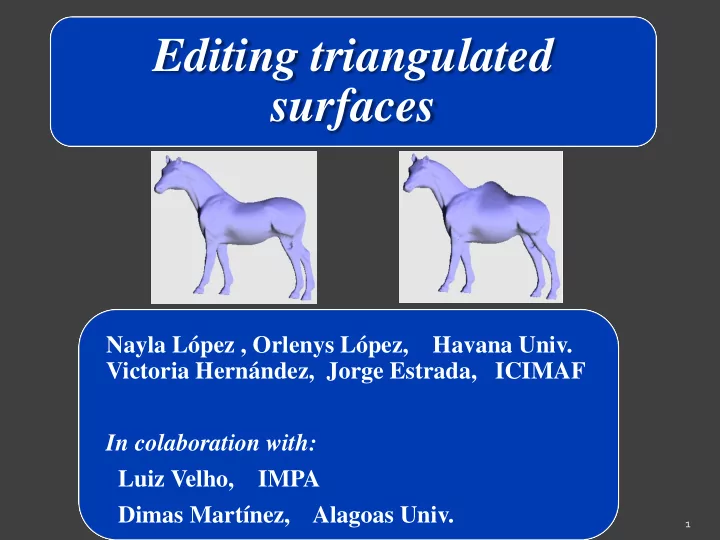
Editing triangulated surfaces Nayla Lpez , Orlenys Lpez, Havana Univ. Victoria Hernndez, Jorge Estrada, ICIMAF In colaboration with: Luiz Velho, IMPA Dimas Martnez, Alagoas Univ. 1 1-Motivation How to modify
1-Motivation
How to modify interactively a triangulated surface?
2004 2007
PreviousWork
General strategy: given a triangulated surface S
1 3
2
5
4 5
2-Geodesic curve- Geodesic distance
CG(A, B)
CG(A, B): Shortest curve on the surface passing through A and B.
g(S; AB)
Dg(S;AB): length between A y B of the geodesic curve CG(A,B)
Computing Geodesic distance
Eikonal equation: nonlinear PDE
DIFFERENCIABLE SURFACE NON DIFFERENCIABLE TRIANGULATED SURFACE
Good approximation to the gradient function restricted to a triangle
8
Theoretically
Geodesic distance is computed as the length of the geodesic curve
Practically
Solving the Eikonal equation it is possible to compute approximately the Geodesic Distance from any point on a triangulated surfaced to a prescribed boundary. Geodesic distances can be used to compute the geodesic curve passing through two points.
Geodesic curve- Geodesic distance
9
3-Fast Marching Method
Idea Kimmel & Sethian, 1998
- To sweep the front ahead in an upwind fashion by considering a set of
points in a narrow band around the existing front
Vertices where the geodesic distance is already known Boundary vertices Vertices in the front Vertices in the narrow band of the front
d=0 < d1 < d2 < d3
Fast Marching Method
Geodesic distance function restricted to a triangle
- Dg(C) is computed from all triangles ABC having C as a vertex if the geodesic
distance is already known in the other vertices A,B.
- The procedure for computing Dg(C) is different for acute and obtuse triangles.
Acute triangles
Geodesic distance function in ABC is approximated by a linear function interpolating Dg(A) and Dg(B ) and satisfying the Eikonal Equation. Dg(C) is computed as solution of a quadratic equation.
Obtuse triangles
Splits the obtuse angle into two acute ones, joining C with any point in the sector between the lines perpendicular to CB and CA. Extend this sector recursively unfolding the adjacent triangles, until a new vertex E is included in the
- sector. Compute Dg(C) as the distance between
C and E on the unfolded triangles plane.
Extensions of FMM
4 extensions
…are neccesary to implement some steps of the method for edition of triangulated surfaces…
…stop the advancing front when the geodesic distance reachs a given value
d=0 < d1 < d2 <d3
3.1-Computing a geodesic neighborhood
3.2-Computing the geodesic distance for a point which is not a vertex of the triangulation
3 cases depending on the position of the point P: update the list of adjacent points for the vertices of all triangles containing P
Vertices in the front Vertices in the narrow band of the front boundary target Vertices where the geodesic distance has been computed
3.3-Stop the advancing front when the geodesic distance has been computed for all points in the target set
Evolution of FMM Classic FMM Modification of FMM
3.4-Computing the closest vertex
boundary P0 P1 P2 P3
Dg(P P0 ) < Dg(P P1 ) < Dg(P P2 ) < Dg(P P3)
Yellow points are closer to than to the rest
- f the boundary points
P1
- Compute an initial approximation to the geodesic
curve passing through A,B using FMM.
- Correct the initial approximation of the geodesic
curve.
4-Computing Geodesic curves
Given two consecutive control points A,B on the triangulated surface S…
- D. Martínez, L. Velho, P. C. Carvalho, 2005
Computing the initial approximation to the geodesic curve
CG(AB) = CG(AC )U(C B)
Discrete geodesic curvature
19
Iterative correction of the polygonal approximation to the geodesic curve
A node P of the current polygonal approximation can be corrected if
- r
Correction
P is in the interior of an edge of S P is a vertex of S 2 Cases
2D 2D 3D 3D
Correction of the inicial approximation
Iterative process
Initial approximation Correction
Higest geodesic curvature point
Correction
Some iterations of the correction process
5-Defining the control curve and the control region
Control region: set of vertices P on the surface such that Control curve: a geodesic polygonal curve interpolating a set of given control points
Computing the normal vector at the vertices
- f the control curve
6-Deformation of the control curve
Deformation of the control curve
Parametrizing the control curve by chord length Changing the position of the knots to modify the geometry of the B-spline curve New position of Magnitude of the displacement for a vertex in terms of a cubic B-spline.
Moving the control curve vertices
7-Edition of the control region.
Magnitude of the displacement for P in the interest region
h(P)=(1- Dg(P,Pc)/dismax) h(Pc)
Dg( P,Pc) = 0 h(P) = h(Pc) Dg(P,Pc) = distMax h(P) = (1-1) h(Pc) =0
Selected points on the control region Points on the boundary of the control region Scaled normal vectors at selected points
Edition of the control region
(1) (2)
Edition of the control region
(2) (3)
Edition of the control region
(3) (4)
Edition of the control region
8-Implementation
Data structure:
- HalfEdge
Libraries:
- TriangMesh
- OpenGL
User Interface:
- GLUT
- GLUI
Programming Language:
- C++
Options for users
Modify the geometry of the control curve.
Selection of the width of the control region. Definition of the displacement magnitude.
MeshTools
Conclusions
A new method for editing a triangulated surface S in an instuitive way has been proposed. Deformations are introduced by means of:
- control curve: defined as a piecewise geodesic curve
- n S
interpolating given control points on S.
- control region:
geodesic neighborhood
- n S of the control
curve
- deformations in the control curve: introduced by means of a
cubic B-spline curve
- displacements of points in the control region: in the direction of
the normal vectors
- n S, with
magnitude depending on the geodesic distance to the control curve.
Future Work
- To introduce closed curves as control curves.
- Study new deformation patterns
for the control curve.
- To
improve the computation
- f
the initial approximation to the geodesic curve passing throught 2 prescribed points.
- To extend the method to introduce deformations
preserving surface details.
References
- D.
Martinez, Geodesic-based modeling
- n
manifold triangulations, Ph.D.Thesis, IMPA, Brasil, 2006.
- R. Kimmel and J.A. Sethian, Computing geodesic paths on
manifolds, In Proceedings of the National Academy of Sciences of the USA 95 (1998), no. 15, 8431-8435.
- J. A. Sethian, A fast marching level set method for
monotonically advancing fronts, In Proceedings
- f