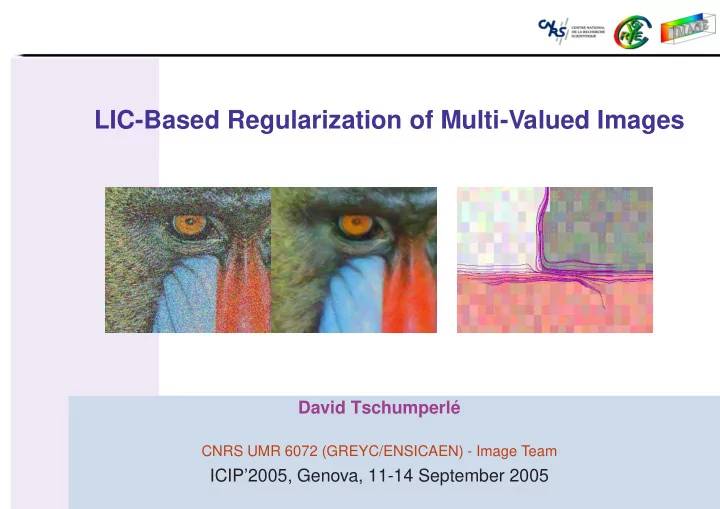
LIC-Based Regularization of Multi-Valued Images David Tschumperl - - PowerPoint PPT Presentation
LIC-Based Regularization of Multi-Valued Images David Tschumperl CNRS UMR 6072 (GREYC/ENSICAEN) - Image Team ICIP2005, Genova, 11-14 September 2005 Data Regularization Aim of regularization consists in transforming a noisy signal into a
Data Regularization
- Aim of regularization consists in transforming a noisy signal into a more regular
- ne, while preserving the important image informations (discontinuities).
Regularization of a noisy 1D signal Regularization of a noisy 2D image
- Several regularization methods exist in the litterature.
⇒ Non-linear diffusion PDE’s are particularly efficient for this task.
PDE Framework in Image Processing
- PDE = Partial Differential Equation :
∂I ∂t = ∂2I ∂x2 + ∂2I ∂y2
- Using PDE’s in Image Processing :
- I represents the data (1D signals or 2D/3D images) we want to process.
- t is an extra time variable corresponding to the PDE iterations.
⇒ Iterative Algorithm
- One starts from an image I(t=0) which evolves until convergence, or after a
finite number of iterations (t = tend). I(t=0) = I0
∂I(x,y,t) ∂t
= β(x,y,t)
PDE’s and Image Regularization
- Convolution and linear PDE’s (Koenderink[84], Alvarez-Guichard-etal[92], ...) :
I(t) = I(t=0) ∗ Gσ where Gσ = 1 4πt e−x2+y2
4t
⇐ ⇒ ∂I ∂t = ∆I
- Nonlinear PDE’s (Perona-Malik[90], Alvarez [92], ...) :
∂I ∂t = div (c(∇I) ∇I) with c : R − → R
Noisy scalar image linear PDE Perona-Malik PDE
PDE Regularization of Scalar Images
- A wide range of PDE-based methods have been proposed since Perona-Malik[90],
for scalar image regularization I : Ω → R.
(Alvarez, Aubert, Barlaud, Blanc-Feraud, Charbonnier, Chan, Cohen, Deriche, Kornprobst, Malladi, Munford, Morel, Nordström, Osher, Perona-Malik, Rudin, Sapiro, Sochen, Weickert,...) Noisy scalar image I : Ω → R Regularized image, using PDE
PDE Regularization of Multivalued Images
- Image I : Ω → N of multivalued points : vectors (N = Rn), matrices (N =
Mn). (Blomgren-Chan[98], Kimmel-Malladi-Sochen[98], Sapiro-Ringach[96], Tschumperle-
Deriche[01,03], Weickert[97,03], ...) Color Image (N = R3) Scalar PDE, channel by channel Multivalued PDE Noisy 2D vector field (N = R2) Regularized field
Principle of PDE-based Regularization
- PDE regularization is mainly based on local image smoothing.
- Local image smoothing is done as follows :
– On a edge, smoothing is done only along the edge, to preserve it. – On homogeneous regions, smoothing is done isotropically (in all directions).
How the smoothing is done ?
- Let I : Ω → Rn be a noisy multi-valued image.
- Smoothing depends on the local geometry of I. Computation of the smoothed
structure tensor field Gσ = G ∗ Gσ : ∀(x, y) ∈ Ω, G(x,y) =
i ∇Ii∇IT i
- Eigenvalues λ+, λ− and eigenvectors θ+, θ− of G describe the local configuration
- f I at point (x, y).
⇒ Definition of a diffusion tensor field T from G that will tell how the smoothing is
- performed. For instance :
T = f1(λ+ + λ−) θ−θT
− + f2(λ+ + λ−) θ+θT +
with f1(s) =
1 1+sp
f2(s) =
1 √1+sq
How the smoothing is done ? (2)
- Then, the smoothing itself is performed by the application of one or several PDE
iterations : ∂Ii ∂t = div (T∇Ii)
- r
∂Ii ∂t = trace (THi) ⇒ The smoothing behavior of the PDE process follows then the tensor field T :
Application of a diffusion PDE on a color image, following a synthetic tensor field T.
⇒ Efficient regularization of images when T is correctly defined.
LIC : Line Integral Convolution
- LIC has been proposed by Cabral & Leedom in 93 as a method to visualize vector
flows F : R2 → R2. ⇒ Starting from a pure noisy image Inoise, compute for each pixel X = (x, y) an averaging of the image intensities along integral curves CX of F : ∀(x, y) ∈ Ω, ILIC
(x,y) = 1
N +∞
−∞
f(p) Inoise(CX
(p)) dp
where CX
(0)
= X
∂CX
(a)
∂a
= F(CX
(a))
- From smoothing purposes, on may choose f(p) to be gaussian.
LIC : Line Integral Convolution (2)
- Smooth locally the image in different directions, following a vector field.
⇒ This suggests this can be used for PDE-based smoothing following a tensor field.
Contribution : Mixing LIC’s and PDE’s
- We propose a LIC-based process that smoothes an image along a tensor field T,
where T is defined as in the PDE-based regularization processes.
- We decompose a smoothing along a tensor T into several smoothing processes
along vectors wθ = TUθ, where Uθ = (cos θ, sin θ) : – If T(X) is isotropic then wθ
(X) = αUθ.
– If T(X) is anisotropic and directed along Uθ, then wθ
(X) ≃ αUθ.
– If T(X) is anisotropic and orthogonal to Uθ, then wθ
(X) ≃ ˜
0. ⇒ The more Uθ represents a part of T, the higher will be the norm wθ.
LIC-based smoothing along diffusion tensors
- One replace one PDE iteration by a multiple LIC computation :
Iregul
(X)
= 1 N π dtwθ
(X)
−dtwθ
(X)
f(a) Inoisy(Cθ
(X,a)) da dθ
where f() is a gaussian, N = f(a)dadθ, and dt is the overall smoothing strength.
- Cθ
(X,0)
= X
∂Cθ ∂a (X, a)
= wθ(Cθ
(X,a)) = T(Cθ (X,a)) U(θ)
Properties ⇒ Maximum principle is verified (only averaging of pixel values). ⇒ Very stable and fast algorithm compared to classical PDE implementations : Time step (dt) can be large, process remains stable. ⇒ Corners and curved structures are particularly well preserved.
(a) Original image (b) PDE-based (explicit Euler scheme) (c) LIC-based
Preservation of curved structures
- Smoothing processes are done around the corners, taking into account the
curvature of the image structures.
- LIC’s naturally provide sub-pixel accuracy for the smoothing.
Applications : Image Denoising
“Baboon” (detail) 512x512 (1 iter., 19s) “Tunisia” (detail) 555x367 (1 iter., 11s)
Applications : Image Denoising (2)
“Lena” (detail) 256x256 (1 iter., 6.4s) “Chris” (detail) 293x306 (1 iter., 5.6s)
Applications : Image Denoising (3)
“Penguin” (detail) 355x287 (1 iter., 12.8s) “Farm” (detail) 460x365 (1 iter., 26s)
Applications : Image Inpainting and Reconstruction
“Parrot” 500x500 (200 iter., 4m11s) “Owl” 320x246 (10 iter., 1m01s)
Applications : Image Interpolation
(a) Original color image (b) Bloc interpolation (b) Linear interpolation (b) Bicubic interpolation (b) PDE-based interpolation
Applications : Image Interpolation (2)
“Nude” (1 iter., 20s) “Forest” (1 iter., 5s)
Conclusions & Perspectives
- Very simple and efficient regularization process for multi-valued images.
- Mix between PDE and LIC based techniques.
⇒ Perspectives : ’Curvature-preserving PDE’ corresponding to our tensor-directed LIC formulation :
Fast Anisotropic Smoothing of Multi-Valued Images using Curvature-Preserving PDE’s.
- D. Tschumperlé