Education Funding in Pennsylvania: Inadequate, Inequitable & - - PowerPoint PPT Presentation

education funding in pennsylvania
SMART_READER_LITE
LIVE PREVIEW

Education Funding in Pennsylvania: Inadequate, Inequitable & - - PowerPoint PPT Presentation

Education Funding in Pennsylvania: Inadequate, Inequitable & Unconstitutional Dan Urevick-Ackelsberg Staff Attorney Public Interest Law Center LEGAL DISCLAIMER The information that follows is not legal advice It is a summary of


slide-1
SLIDE 1

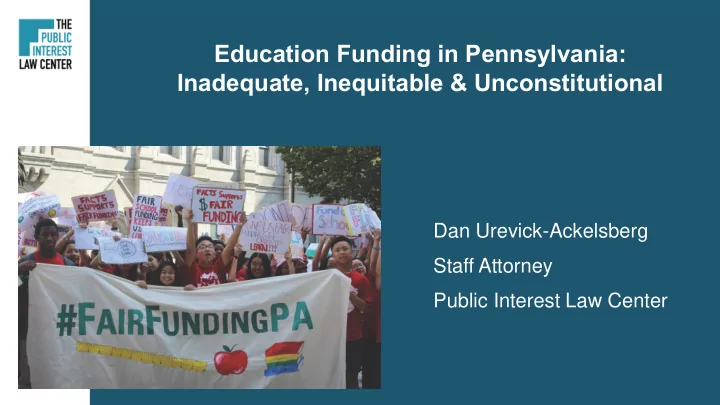
Education Funding in Pennsylvania: Inadequate, Inequitable & Unconstitutional

Dan Urevick-Ackelsberg Staff Attorney Public Interest Law Center

slide-2
SLIDE 2

LEGAL DISCLAIMER

  • The information that follows is not legal advice
  • It is a summary of the current law in this jurisdiction
  • n selected topics
  • Legal claims are very fact-specific
  • Always contact an attorney when faced with legal

questions

slide-3
SLIDE 3

ABOUT US

MISSION The Public Interest Law Center uses high- impact legal strategies to advance the civil, social, and economic rights of communities in the Philadelphia region facing discrimination, inequality, and poverty. We use litigation, community education, advocacy, and

  • rganizing to secure their access to

fundamental resources and services.

slide-4
SLIDE 4

OUR PRACTICE AREAS

HEALTHCARE PUBLIC EDUCATION ENVIRONMENTAL JUSTICE HOUSING EMPLOYMENT VOTING

slide-5
SLIDE 5

OUR HISTORY

The organization was founded in 1969 as an affiliate of the Lawyers’ Committee for Civil Rights Under Law following President Kennedy’s call for lawyers to get involved in the civil rights movement.

slide-6
SLIDE 6

The Long Term Problem

  • 1. No goal of fully funding schools
  • 2. Low relative state contribution
  • 3. Most funding not based on formula
  • 4. Unfair property tax burdens
  • 5. Unacceptable outcomes for

children

slide-7
SLIDE 7

How does Pennsylvania compare?

0.0 10.0 20.0 30.0 40.0 50.0 60.0 70.0 80.0 90.0 100.0

Percent of a State’s Contribution to Education

slide-8
SLIDE 8

Tax Disparity in Lancaster County

District Tax burden: Equalized Mills Local Revenue per Student

Solanco SD 13.8 $9,351.65 Eastern Lancaster County SD 14.1 $13,217.56 Conestoga Valley SD 15.9 $11,807.93 Manheim Central SD 16.5 $11,861.80 Pequea Valley SD 16.7 $17,888.97 Hempfield SD 19.1 $12,363.58 Manheim Township SD 19.2 $12,585.14 Penn Manor SD 19.3 $10,289.41 Warwick SD 20.1 $12,199.27 Ephrata Area SD 20.2 $10,955.72 Lampeter-Strasburg SD 20.4 $12,540.75 Elizabethtown Area SD 21.3 $10,497.13 Cocalico SD 21.8 $12,372.40 Donegal SD 22.4 $10,447.37 Lancaster SD 25.0 $7,708.00 Columbia Borough SD 31.5 $7,967.84

slide-9
SLIDE 9

Local Effort is Not the Problem: New Hope v. Reading

New Hope-Solebury

  • Tax rate: 12.3 mil
  • Local revenue per child:

$22,155

  • State revenue per child:

$4,258

  • State/local per child:

$26,414 Reading S.D.

  • Tax rate: 24.9 mil
  • Local revenue per child:

$2,419

  • State revenue per child:

$10,108

  • State/local per child:

$12,527

9

Difference = $13,887

slide-10
SLIDE 10

Which District Needs More?

  • New Hope S.D.
  • 8.8% Students in

Poverty

  • 1.7% English

Language Learners

  • Reading S.D.
  • 90.9% Students in

Poverty

  • 21.7% English

Language Learners

slide-11
SLIDE 11

How did we get here?

slide-12
SLIDE 12

The Movement Towards Adequacy

  • 2007 study commissioned by the Legislature

found $4.4 billion was needed to meet state proficiency standards.

  • Gov. Rendell sets target of $2.4 billion and

begins regular increases.

  • Governor Corbett takes office and cuts $851

million dollars of education funding.

slide-13
SLIDE 13

Budget Cuts Hit SDoL

slide-14
SLIDE 14

2011 Cuts Target Poorer Districts

$ Cut per Student N Students in Poverty

Over $700 29 districts 58.97% $500 to $700 130 districts 46.99% $300 to $500 187 districts 34.87% $150 to $300 103 districts 22.82% Under $150 51 districts 11.78% Note: Cuts include reductions in Basic Education, Accountability Block Grants, Reimbursement for Charter Schools, and Education Assistance Program from 2010-11.

slide-15
SLIDE 15

Harrisburg Over the Past Five Years

  • Governor Wolf Proposes $2 billion in Pre-K - 12

education over 4 years

  • Actually gets $698 million for K-12 after five years
  • $2 billion included $500+ million for 2015-2016, with

money targeted first to districts who were cut

  • After protracted budget struggle: $350 million total
  • ver two years for basic education funding, not

targeted first to districts which where cut

slide-16
SLIDE 16

Basic Education Funding Commission Formula (Enacted July 2016)

Strengths:

  • Uses 3 year average student count.
  • Adds weights for poverty, concentrated

poverty, English Language learners, district sparsity, charter students.

  • Takes account of district tax effort and

fiscal capacity to raise local share, replacing the traditional aid ratio.

slide-17
SLIDE 17

Basic Education Funding Commission Formula (Enacted July 2016)

Weaknesses:

  • Purposefully excludes total funding needed, so
  • nly looks at relative needs of districts
  • Only applies to funding added after its adoption,

so inequities are locked in

  • $1.2 billion worth of inequity baked in
  • Inequity gets worse each year, not better
  • No Impact on Unequal Local Tax Burdens
slide-18
SLIDE 18

The Realities of Hold Harmless

District Change if all through Formula Per Student Change

Columbia Borough SD $5,495,634.13 $3,684.78 Conestoga Valley SD $9,653,930.82 $2,202.19 Lancaster SD $19,099,127.70 $1,672.57 Manheim Township SD $6,909,258.76 $1,182.77 Lampeter-Strasburg SD $1,793,592.72 $598.85 Ephrata Area SD $2,083,910.79 $510.48 Eastern Lancaster County SD $1,300,020.64 $429.13 Pequea Valley SD $396,417.80 $251.80 Hempfield SD

  • $72,909.72
  • $10.75

Manheim Central SD

  • $284,036.88
  • $93.33

Donegal SD

  • $292,227.82
  • $95.86

Penn Manor SD

  • $609,112.80
  • $117.45

Warwick SD

  • $627,050.59
  • $150.53

Cocalico SD

  • $603,268.87
  • $198.90

Elizabethtown Area SD

  • $1,316,846.69
  • $344.34

Solanco SD

  • $2,796,909.91
  • $793.80
slide-19
SLIDE 19

School Funding Lawsuit

slide-20
SLIDE 20

William Penn SD et al., v. Pa. Dept.

  • f Education et al.:
  • Filed: November 2014
  • Court: Pennsylvania Commonwealth Court
  • Count I: “The General Assembly shall provide for the

maintenance and support of a thorough and efficient system of public education to serve the needs of the Commonwealth.”

  • Article III, Section 14, Constitution of the

Commonwealth of Pennsylvania

  • Count II: Equal Protection
slide-21
SLIDE 21

The Petitioners

slide-22
SLIDE 22

The Respondents

slide-23
SLIDE 23

Lawsuit Dismissed

  • Governor and Legislative leaders argued that the

case is not “justiciable;” the issue cannot be heard by the courts.

  • April 2015: Commonwealth Court dismissed the

case on this basis.

  • May 2015: Appeal to Pennsylvania Supreme

Court (as a matter of right)

slide-24
SLIDE 24

Legal Arguments by the Governor and Legislature

  • Similar cases decided in 1999; Supreme Court

ruled there were not manageable standards.

  • Process for securing a remedy is messy and

time-consuming.

  • The only obligation the legislature has is to

“turn the lights on;” they are meeting that

  • bligation.
  • No child has an enforceable right to a sound

education

slide-25
SLIDE 25

Legal Arguments by the Families and School Districts

  • Today there are measurable

standards.

  • No Court in any state has ever held

that education equal protection claims are not justiciable.

  • The Court is the only body that is

legally obligated to protects children’s constitutional rights.

slide-26
SLIDE 26

Supreme Court Rules: We Win!

slide-27
SLIDE 27

Education Clause

“[R]ecitations of the need for local control cannot relieve the General Assembly of its exclusive obligation under the Education Clause. . . . [T]he General Assembly alone must be held accountable, regardless of whether

  • ne perceives the cause of the

actionable deficiency to exist at the local

  • r state level.”
slide-28
SLIDE 28

Back to Commonwealth Court

slide-29
SLIDE 29

What Do We Need to Prove?

  • Education Clause (Adequacy):

– What is the Constitutional Standard? – Has it been met? – Does it require more money to meet it?

  • Equal Protection:

– What level of scrutiny is afforded? – Given that scrutiny, are the disparities in funding justified?

slide-30
SLIDE 30

What Will The Legislature Argue?

  • No right to an education of any quality
  • There is no problem
  • Money doesn’t matter
  • It is not our fault—it is Lancaster’s, or a

parent’s, or a child’s, or a community’s

  • Children in poverty are destined for

failure

slide-31
SLIDE 31

The Path to Trial

  • Discovery

– 100,000 pages of documents – 30 depositions

  • Trial Projected for Late 2020
slide-32
SLIDE 32

What the Suit Can Accomplish

  • Studies show that funding lawsuits:
  • Bring about more revenue than a state

would otherwise have raised

  • Increase academic achievement
  • It would break political impasse over

funding by invoking independent process based on cost analysis

slide-33
SLIDE 33

What Can You Do?

  • Our Website:

www.pubintlaw.org/school-funding- lawsuit

  • PASchoolsWork.org
slide-34
SLIDE 34

CONTACT US

DAN UREVICK-ACKELSBERG dackelsberg@pubintlaw.org 267-546-1316 PUBLIC INTEREST LAW CENTER www.pubintlaw.org 215-627-7100 Facebook.com/PublicInterestLawCenter @PubIntLawCtr

slide-35
SLIDE 35

THANK YOU!