Elkhorn Slough Tidal Wetland Project a time of decision between - - PowerPoint PPT Presentation

elkhorn slough tidal wetland project
SMART_READER_LITE
LIVE PREVIEW

Elkhorn Slough Tidal Wetland Project a time of decision between - - PowerPoint PPT Presentation

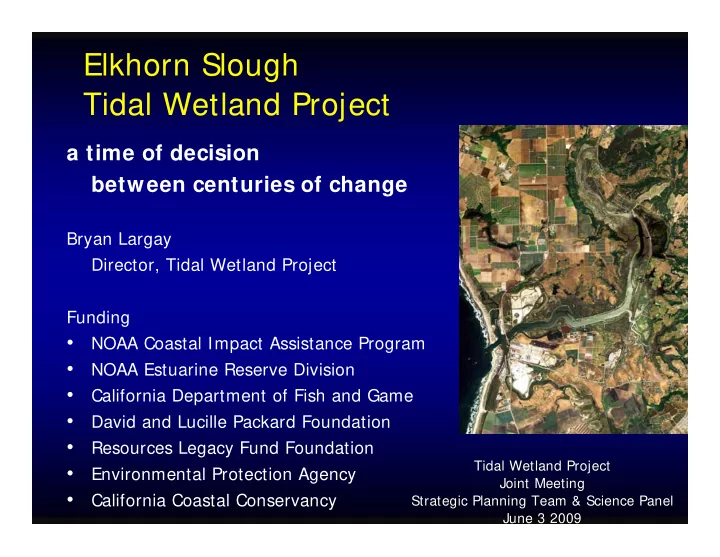
Elkhorn Slough Tidal Wetland Project a time of decision between centuries of change Bryan Largay Director, Tidal Wetland Project Funding NOAA Coastal Impact Assistance Program NOAA Estuarine Reserve Division California


slide-1
SLIDE 1

Elkhorn Slough Tidal Wetland Project

a time of decision between centuries of change

Bryan Largay Director, Tidal Wetland Project Funding

  • NOAA Coastal Impact Assistance Program
  • NOAA Estuarine Reserve Division
  • California Department of Fish and Game
  • David and Lucille Packard Foundation
  • Resources Legacy Fund Foundation
  • Environmental Protection Agency
  • California Coastal Conservancy

Tidal Wetland Project Tidal Wetland Project Joint Meeting Joint Meeting Strategic Planning Team & Science Panel Strategic Planning Team & Science Panel June 3 2009 June 3 2009

slide-2
SLIDE 2

Brief review of the Tidal Wetland Project Brief review of the Tidal Wetland Project and recent activities and recent activities Past decision making processes Past decision making processes The Parsons Slough Project The Parsons Slough Project Results for hydrology, geomorphology and sea level rise Results for hydrology, geomorphology and sea level rise Ecosystem based management: Lessons learned Ecosystem based management: Lessons learned

Outline Outline

slide-3
SLIDE 3

ELKHORN SLOUGH NATI ONAL ESTUARI NE RESEARCH RESERVE

Elkhorn Slough Foundation

slide-4
SLIDE 4

Goal 1. Conserve Estuarine Habitats Goal 1. Conserve Estuarine Habitats

More natural rate of change More natural rate of change

Goal 2. Restore estuarine habitats

Emphasize habitats with highest rates of loss

Goal 3. Restore processes that sustain the system Goal 3. Restore processes that sustain the system W Water and sediment

ater and sediment Objectives call for increasing (or reducing in the rate of loss) Objectives call for increasing (or reducing in the rate of loss) of:

  • f:

Process for setting goals: Process for setting goals: Meetings on History, Ecology, Hydrology Meetings on History, Ecology, Hydrology Brainstorming Goals and Objectives Brainstorming Goals and Objectives

  • salt marsh

salt marsh

  • soft sediment habitats

soft sediment habitats

  • tidal creeks

tidal creeks

  • tidal brackish marshes

tidal brackish marshes

  • sediment supply for marshes

sediment supply for marshes

slide-5
SLIDE 5

Examples:

  • Consider the broadest range of approaches
  • Accommodate economic activities
  • Minimize ongoing maintenance
  • Prioritize projects that improve water quality

Planning Principles (17) Planning Principles (17) Guidelines and constraints Guidelines and constraints

slide-6
SLIDE 6

BURNING QUESTION Vision Goals Objectives Planning principles Management alternatives Technical analysis Tradeoffs and constraints Recommended alternatives Implementation Technical analysis

The Process: transform goals into actions

Technical Analysis: What is possible? What are the tradeoffs?

slide-7
SLIDE 7

50% of marsh diked and drained (1000 acres) 20% of remaining marsh has died back (200 acres)

Marsh loss: Wetland soils and irreversible change

slide-8
SLIDE 8

Seal Bend Parsons Kirby Park Channel Depth (m) 5 10 Distance from Hwy 1 (km) 2 8 1 9 7

Tidal scour: No Action

slide-9
SLIDE 9

Sediment Sediment

  • Geomorphology consensus statement

Geomorphology consensus statement Army Corps Dredge Reuse Army Corps Dredge Reuse Pajaro River Sediment Pajaro River Sediment – – to be deferred to be deferred (June 11 meeting in Watsonville) (June 11 meeting in Watsonville) Should we move forward with requesting an Should we move forward with requesting an appropriation for Army Corps Involvement? appropriation for Army Corps Involvement?

slide-10
SLIDE 10

Other options: Other options: Beneficial re Beneficial re-

  • use of harbor dredge materials

use of harbor dredge materials

Pick-N-Pull Marsh and the Minhoto property

slide-11
SLIDE 11

Technical Analysis: Technical Analysis: Purpose: to Predict outcomes, describe tradeoffs Purpose: to Predict outcomes, describe tradeoffs

Hydrology, Sediment, & Habitats Hydrology, Sediment, & Habitats Nutrient Dynamics Nutrient Dynamics Biological Indicators Biological Indicators Socioeconomic Values Socioeconomic Values Legal / Policy Context Legal / Policy Context

Outcome: Informed decision about restoration strategies Outcome: Informed decision about restoration strategies Project Alternatives Project Alternatives

slide-12
SLIDE 12

Image: Google Earth

Management alternative: New Ocean Inlet Management alternative: New Ocean Inlet

Restores a sinuous shoaling inlet

slide-13
SLIDE 13

Management alternative: Sill at Highway 1 Management alternative: Sill at Highway 1

Dissipates the energy

  • f the tides

Image: Google Earth

slide-14
SLIDE 14

Historical reference condition provides a Historical reference condition provides a Conceptual model of change Conceptual model of change

Before Moss Landing Harbor: Before Moss Landing Harbor: the sand bar at the mouth the sand bar at the mouth dissipated the energy of Monterey Bay tides dissipated the energy of Monterey Bay tides

Monterey Bay sinuous channel Elkhorn Slough Monterey Bay tides Elkhorn Slough tides salt marsh thrives soft mud accumulates sand bar

slide-15
SLIDE 15

Present conditions Present conditions

After Moss Landing Harbor: After Moss Landing Harbor: The deep channel transmits The deep channel transmits the ocean the ocean’ ’s energy into the slough s energy into the slough

Monterey Bay Highway 1 bridge Elkhorn Slough Monterey Bay tides Elkhorn Slough tides soft mud is scoured away salt marsh drowns

slide-16
SLIDE 16

A submerged tidal barrier near the mouth of the slough A submerged tidal barrier near the mouth of the slough dissipates tidal energy dissipates tidal energy

Moss Landing Harbor Elkhorn Slough Monterey Bay tides Elkhorn Slough tides Sill salt marsh survives soft mud deposits

Management alternative: Sill at Highway 1 Management alternative: Sill at Highway 1

slide-17
SLIDE 17

reduce tidal scour (tidal energy)

infrequent hypoxia but more tidal scour less scour but frequent hypoxia management

  • ptions

invertebrate community crashes all marshes lost

Trade-offs: Identify constraints Eliminate alternatives Key: Define objectives, rank goals

Comparison of two

  • bjectives

improve water quality (dissolved oxygen)

slide-18
SLIDE 18

less hypoxia more tidal scour more hypoxia less tidal scour invertebrate community crashes? all marshes lost? fewer

  • ptions

Tradeoffs: Uncertainty, Adaptive Management Know what you don’t know

reduce tidal scour (tidal energy) improve water quality (dissolved oxygen) Reality sets in

slide-19
SLIDE 19

Project Leads

  • MBARI - Ken Johnson & Judy Kildow
  • ESNERR - Kerstin Wasson, Becky Suarez,

Eric Van Dyke

  • ESF - Mark Silberstein
  • Ocean Foundation – Linwood Pendleton

Consulting Team

  • Philip Williams and Associates, Ltd. &

H.T. Harvey & Associates

Modeling Advisory Team

  • CSUMB, USGS, USF, SFEI, UC-Davis,

Consultants

An Ecosystem Based Management Approach: An Ecosystem Based Management Approach:

Tradeoffs, Uncertainty, Tradeoffs, Uncertainty, Science directed towards Implementation Science directed towards Implementation

Funding – The Packard Foundation & Resources Legacy Fund Foundation

slide-20
SLIDE 20

Strategic Planning Team Strategic Planning Team

FEDERAL

  • Monterey Bay National Marine Sanctuary
  • National Marine Protected Areas
  • U.S. Army Corps of Engineers
  • U.S. Environmental Protection Agency
  • U.S. Fish and Wildlife Service

FEDERAL & STATE

  • Elkhorn Slough National Estuarine Research

Reserve – NOAA/CA DFG (lead)* STATE

  • CA Coastal Commission
  • CA Coastal Conservancy
  • CA Department of Fish and Game

LOCAL

  • Monterey County
  • Moss Landing Harbor District

NONPROFIT, ACADEMIC, CORPORTATE

  • Moss Landing Marine Laboratories
  • CA State University Monterey Bay
  • Elkhorn Slough Foundation
  • San Francisco Estuary Institute
  • The Nature Conservancy
  • The Ocean Conservancy
  • University of San Francisco
  • Union Pacific Railroad

Role: Primary decision-making body

slide-21
SLIDE 21

The decision approach for large The decision approach for large scale alternatives scale alternatives

  • Original concept:

Original concept: ‘ ‘election style election style’ ’ voting for voting for different alternatives different alternatives

  • Previously we identified broad goals (protect

Previously we identified broad goals (protect marsh) but did not identify constraints or marsh) but did not identify constraints or acceptable tradeoffs. acceptable tradeoffs.

  • Prefer prioritization (habitats, species, costs) and

Prefer prioritization (habitats, species, costs) and more specific criteria more specific criteria

  • Brock Bernstein: working with us to develop this

Brock Bernstein: working with us to develop this approach over the coming months. approach over the coming months.

slide-22
SLIDE 22

Today: Parsons Slough Project Today: Parsons Slough Project

  • Focused on the narrower decision of

Focused on the narrower decision of whether to move ahead whether to move ahead

slide-23
SLIDE 23

A starting place: A tidal barrier at Parsons Slough A starting place: A tidal barrier at Parsons Slough

Slightly reduce tidal exchange to Parsons Slough Slow currents throughout Elkhorn Slough

Parsons Slough Elkhorn Slough sill location

Approach (under development):

  • An adjustable structure
  • With detailed monitoring
  • That triggers management actions
  • To minimize risk to water quality, animal movement
slide-24
SLIDE 24

Restore Parsons Slough ___________ also: Sediment Additions to subsided areas No Action

Data: PWA

slide-25
SLIDE 25
slide-26
SLIDE 26
slide-27
SLIDE 27
slide-28
SLIDE 28

Parsons Slough Restoration Plan Parsons Slough Restoration Plan

Parsons Slough Team Parsons Slough Team

  • Trish Chapman (Coastal Conservancy)

Trish Chapman (Coastal Conservancy)

  • Ross Clark and Katie Morange (Coastal Commission)

Ross Clark and Katie Morange (Coastal Commission)

  • Jacob Martin and Mary Root (USFWS)

Jacob Martin and Mary Root (USFWS)

  • Jim Oakden (Moss Landing Marine Labs)

Jim Oakden (Moss Landing Marine Labs)

  • Peter Von Langen (Regional Water Quality Control Board)

Peter Von Langen (Regional Water Quality Control Board)

  • Melissa Scianni and Suzanne Marr (US EPA) (Cheryl McGovern earli

Melissa Scianni and Suzanne Marr (US EPA) (Cheryl McGovern earlier) er)

  • Lisa Windham Myers (USGS)

Lisa Windham Myers (USGS)

  • Andrea Woolfolk (ESNERR)

Andrea Woolfolk (ESNERR)

  • Becky Suarez (ESNERR)

Becky Suarez (ESNERR)

  • Eric Van Dyke (ESNERR)

Eric Van Dyke (ESNERR)

slide-29
SLIDE 29

Timeline for the Parsons Slough Project

Construction of the project could be completed, depending

  • n funding and final planning steps

1.5 to 5 years into the future Tidal Wetland Project Staff continue to collaborate with the consultants using other funds. 2009 January through present Bond Freeze 2008, December USEPA, the Coastal Conservancy and the David and Lucille Packard Foundation support development of the Parsons Slough Restoration Plan, for completion in March, 2009 2007 Tidal Wetland Project identifies Parsons Slough 2005 Breaching of dikes returns tidal exchange 1982-83 Diked and drained 1870-1982 Southern Pacific Railroad 1870 Extensive tracts of tidal marsh Prehistory to 1870

slide-30
SLIDE 30

Cost of Cost of Sediment Additions Sediment Additions

  • By Truck = $55 million;

By Truck = $55 million;

  • By Rail = $35 million;

By Rail = $35 million;

  • By Dredge From Ocean/Harbor = $41

By Dredge From Ocean/Harbor = $41 million; and million; and

  • By Slurry Line From Upstream Quarry =

By Slurry Line From Upstream Quarry = $14 to $22 Million Set $14 to $22 Million Set-

  • Up, Plus $700,000

Up, Plus $700,000 to $900,000 Annually for 3 to 5 Years. to $900,000 Annually for 3 to 5 Years.

slide-31
SLIDE 31

Alternatives Eliminated and Alternatives Eliminated and Those Remaining Those Remaining

  • Eliminated tidal muting alternatives

Eliminated tidal muting alternatives

– – Alternative 1 Alternative 1 – – Alternative 3, all muting scenarios Alternative 3, all muting scenarios

  • Retained alternatives with no tidal muting

Retained alternatives with no tidal muting

– – Alternative 2 Alternative 2 – – Alternative 3 with no muting, but with Alternative 3 with no muting, but with containment dikes containment dikes

slide-32
SLIDE 32

Cost Considerations Cost Considerations

  • f Each Alternative
  • f Each Alternative

Incremental Incremental fills fills -

  • more

more rapid over rapid over time time 229 Acres 229 Acres $25 $25-

  • $28

$28 Million Million 3 3 Large Large-

  • scale

scale fills fills -

  • slower

slower

  • ver time
  • ver time

460 Acres 460 Acres $50 Million $50 Million 2 2

Relative Relative Rate of Rate of Restoring Restoring Marsh Marsh Area Area Restored Restored Total Cost Total Cost Alternative Alternative

slide-33
SLIDE 33

A Parsons Slough Sill A Parsons Slough Sill

slide-34
SLIDE 34

A Parsons Slough Sill A Parsons Slough Sill

slide-35
SLIDE 35

Current velocity in Elkhorn Slough downstream of Parsons under the Narrow and Deep configuration

  • f a submerged sill at Parsons Slough
  • 4
  • 3
  • 2
  • 1

1 2 3 4 5 12/14/05 12/15/05 12/16/05 12/17/05 12/18/05 12/19/05 simulation date current velocity (feet/sec) existing condtions Narrow, Deep configuration

Analysis: Moffatt and Nichol

Effect on current velocity in Effect on current velocity in Elkhorn Slough Elkhorn Slough

slide-36
SLIDE 36

Water surface elevation in Parsons Slough under the Narrow and Deep configuration of a submerged sill at Parsons Slough

  • 3.00
  • 2.00
  • 1.00

0.00 1.00 2.00 3.00 4.00 5.00 6.00 7.00 8.00 9.00 10.00 12/14/05 12/15/05 12/16/05 12/17/05 12/18/05 12/19/05 12/20/05 simulation date water surface elevation (feet) existing conditions Narrow, Deep Configuration Analysis: Moffatt and Nichol

Effect Effect

  • n tidal
  • n tidal

heights heights

slide-37
SLIDE 37

The Parsons Slough Sill The Parsons Slough Sill

  • Pros

Pros

  • Cons

Cons

slide-38
SLIDE 38

Straw Man Management Target Straw Man Management Target

EXAMPLE: Dissolved Oxygen EXAMPLE: Dissolved Oxygen Option 1: Standard for estuarine fish habitat Option 1: Standard for estuarine fish habitat as the beneficial use as the beneficial use Dissolved oxygen less than 85% saturation. Dissolved oxygen less than 85% saturation. should occur less than 25% of the time should occur less than 25% of the time If criteria is met If criteria is met – – increase restriction increase restriction If criteria is not met If criteria is not met – – decrease restriction decrease restriction

slide-39
SLIDE 39

Management Targets and Management Targets and Monitoring Monitoring

Parsons Slough Only Parsons Slough Only

  • Purpose: Minimize risk to Parsons

Purpose: Minimize risk to Parsons All of Elkhorn Slough All of Elkhorn Slough

  • Track progress towards goals

Track progress towards goals

  • Inform whole slough management

Inform whole slough management

slide-40
SLIDE 40

Management Targets and Management Targets and Monitoring Monitoring

Top Priorities Top Priorities

slide-41
SLIDE 41

Elkhorn Slough Tidal Wetland Project Ecosystem Based Management

  • ptimization of ecologic resources

Please Stay Tuned www.elkhornslough.org Bryan Largay bryan@elkhornslough.org