
SLIDE 1
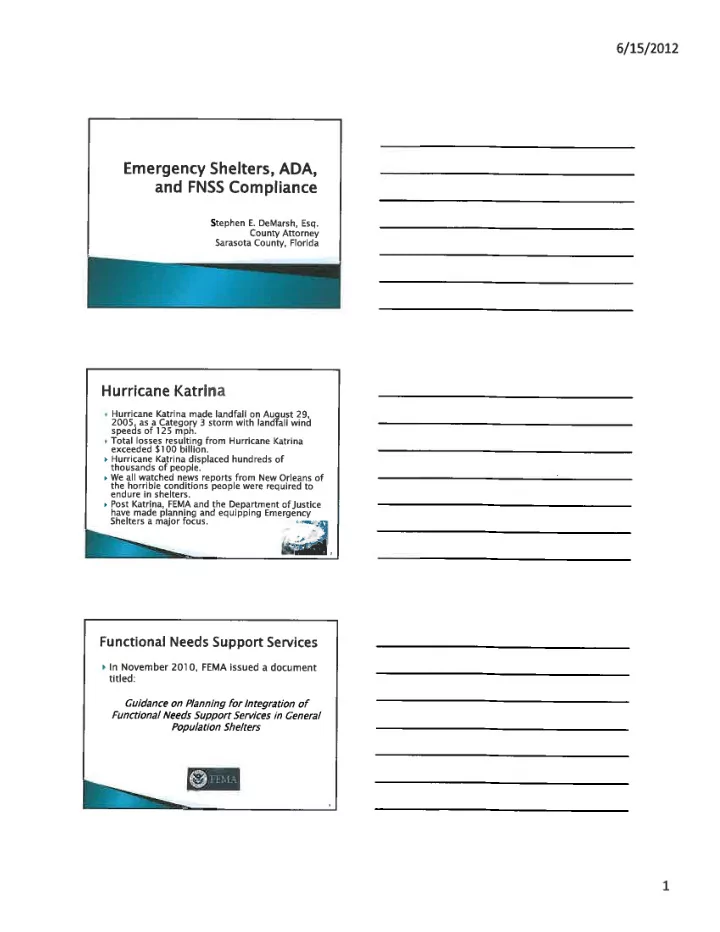
Emergency Shelters, ADA, and FNSS Compliance By: Stephen E. - - PDF document
Emergency Shelters, ADA, and FNSS Compliance By: Stephen E. DeMarsh, Esq., County Attorney Sarasota County, Florida I. Introduction. A. Emergency Shelters. Emergency Shelters are operated under the control and coordination of emergency
By: Stephen E. DeMarsh, Esq., County Attorney Sarasota County, Florida I. Introduction. A. Emergency Shelters. Emergency Shelters are operated under the control and coordination of emergency management agencies operated by Counties. Two types of public shelter space are typically provided. B. Special Needs Shelters. Persons requiring medical services are housed in Special Needs Shelters. Special Needs Shelters are mandated by state law and in many places operated by the state. County health departments serve a key role in coordinating the staffing
C. General Population Shelters. Persons that are not considered “medically fragile” are housed in General Population Shelters. D. The American Red Cross and County School Districts are vital partners and contributors to efforts to provide Emergency Shelters. E. Following the devastation caused by Hurricane Katrina emphasis has been placed upon the capabilities of General Population Shelters to meet the needs of the populations that they serve. Particular emphasis has been placed upon compliance with the Americans with Disabilities Act. These materials will describe the debate that is taking place as to the extent to which a General Population Shelter must be able to meet the needs of disabled persons and the applicable law.
2 II. The American with Disabilities Act (ADA). A. Title II of the ADA provides that: [No] qualified individual with a disability shall, by reason of such disability, be excluded from participation in or be denied the benefits of the services, programs, or activities of a public entity, or be subjected to discrimination by any such entity. 42 U.S.C. § 12132 (underlining added for emphasis). Regulations implementing Title II of the ADA include the integration regulation which provides that: [a] public entity shall administer services, programs, and activities in the most integrated setting appropriate to the needs of qualified individuals with disabilities. 28 C.F.R. § 35.130(d). B. To prove a violation of Title II of the ADA a plaintiff must prove: 1. he is a qualified individual with a disability; 2. he was either excluded from participation or denied benefits of a public entity’s services, programs, or activities or was otherwise discriminated against by the public entity; 3. such exclusion, denial or benefits, or discrimination was by reason of his disability. Townsend v. Quasim, 328 F.3d 511, 516 (9th Cir. 2003). III. The Department of Justice Toolkit. A. The Department of Justice (DOJ) has prepared a document titled: “ADA Best Practices Toolkit for State and Local Governments, Chapter 7, Emergency Management Under Title II of the ADA” (2007). B. The DOJ Toolkit is a touchstone for the DOJ in evaluating emergency management programs for compliance with Title II of the ADA and the federal
3 regulations promulgated under Title II. While the ADA Toolkit is not itself a statute or rule, practitioners would be well advised to review it because it represents the DOJ’s views of how local government should design and implement emergency management programs, services, activities, and facilities so that they remain accessible to people with disabilities. C. Chapter 7.A. of the Toolkit concerns the ADA Basics for Emergency
legal constraints applicable to local governments in the emergency management context: The ADA also requires making reasonable modifications to policies, practices, and procedures when necessary to avoid discrimination against a person with a disability and taking steps necessary to ensure effective communication with people with
emergency management programs to take actions that would fundamentally alter the nature of the program, service, or activity
IV. Stages of Emergency Management. A. Preparation. The DOJ places great significance upon the planning efforts of local
the needs of disabled people as part of any enforcement action under Title II of the ADA. Inclusion of input from people with a variety of disabilities and
the DOJ’s perspective.
4 B. Notification. The ADA Toolkit states that local governments need to make sure that they use warning methods designed to reach all residents, including people with
closed captioning
C. Evacuation and Transportation. Recognizing that a person that requires evacuation assistance may have mobility, vision, or hearing disabilities, the DOJ suggests that the local emergency management planning process create voluntary, confidential, registration of persons with disabilities who may need individualized notification or evacuation assistance. Once notified of an impending emergency requiring people to leave their homes, some people may require evacuation assistance and in some cases people will need assistance leaving their homes simply to access transportation that is made available. Emergency plans therefore should identify accessible forms of transportation available to help people with disabilities evacuate. Many local governments have existing emergency management plans that deal effectively with pre-disaster notification and evacuation and transportation. Practitioners may wish to inquire whether their local plan includes assistance for people who cannot exit their home to use available public transportation without personal assistance inside the home. It is possible that some emergency management plans do not adequately prepare for the high demands placed upon the emergency management program by these critical needs.
5 D. Emergency Shelters. The DOJ Toolkit identifies sheltering programs as being critical to ensuring the safety of people with disabilities. DOJ addresses its view of ADA compliance in the temporary emergency shelter context in two technical assistance documents that are organized as addenda to its toolkit. The first addendum is referred to as the Title II Checklist (Emergency Management). It will not be focused on in this outline. The checklist is designed to be used to conduct a preliminary assessment of emergency management programs, policies, procedures, and shelter facilities to identify whether there are potential ADA
The ADA and Emergency Shelters: Access for All in Emergencies and Disasters (Chapter 7, Addendum 2). The technical assistance document expands upon the integration regulation set forth in Title II of the ADA and addresses the following topics under a section addressing Eligibility Criteria: 1. House people with disabilities in mass care shelters. The ADA requires people with disabilities to be accommodated in the most integrated setting appropriate to their needs and the disability- related needs of people who are not medically fragile can typically be met in a mass care shelter. For this reason, people with disabilities should generally be housed with their family, friends, and neighbors in mass care shelters, and not be diverted to special needs or medical shelters. 2. Respect the right of people with disabilities to make choices about where to shelter. The ADA does not prohibit communities from designating shelters specifically for people with disabilities, but it does prohibit emergency
6 managers and shelter operators from requiring people with a specific disability to stay in such specialty shelters. 3. House people with disabilities in mass care shelters even if they are not accompanied by their personal care aides. The DOJ technical assistance document states that shelter
accommodate people with disabilities who are not medically fragile but need some assistance with daily living activities unless doing so would impose an undue financial and administrative burden. 4. Make arrangements in advance to ensure that the special needs and medical shelters have sufficient numbers of adequately trained medical staff and volunteers. 5. Keep families together whenever possible in special needs and medical shelters. V. Reasonable Modifications. Reasonable modifications to polices, practices, and procedures must be made to avoid discrimination under Title II of the ADA. The reasonable modification must be made unless it would fundamentally alter the nature of the program, service, or activity or impose an unreasonable financial and administrative burden. The technical assistance document lists a few modifications that emergency managers must make:
with their service animals.
7
require access to food.
VI. DOJ Enforcement. The DOJ filed a Statement of Interest in a private lawsuit filed in the United States District Court for the Central District of California: Communities Actively Living Independently and Free, et al. v. City of Los Angeles and County of Los Angeles (CALIF). DOJ’s Statement of Interest is notable because it describes the DOJ’s legal position relative to application of Title II of the ADA to emergency management. The DOJ cites a number of cases for the proposition that the department’s interpretation of its regulations through its technical assistance in the form of its ADA Best Practices Toolkit for State and Local Governments should be given deference, including Olmstead v. L.C., 527 U.S. 581, 597-98 (1999). (“[T]he well-reasoned view of agencies implementing a statute ‘constitute a body of experience and informed judgment to which courts may properly resort for guidance’.”) The Statement of Interest alleges that the Defendants had not planned to meet the needs of people with disabilities and that the Defendants’ assertion that it can nonetheless comply with the ADA by granting reasonable accommodations upon request is insufficient under Title II of the ADA. The DOJ focused on the integration regulation stating: Of fundamental importance, however, is the integration mandate, which requires public entities to “administer services, programs, and activities in the most integrated and appropriate setting appropriate to the needs of qualified individuals with disabilities.” The DOJ reads Title II of the ADA to require that local emergency managers provide people with disabilities with resources that they can readily use and that the failure to plan for and provide disability-related services, necessary consumable medical
8 supplies, and durable medical equipment in advance of request for such service or product constitutes a violation of Title II of the ADA. The DOJ’s Statement of Interest explains by stating: [G]eneral assurances to individuals with disabilities of an ad hoc response during the exigencies of an emergency are not equal to access being afforded to individuals without disabilities, for whom planning and preparations have already occurred. It is simply unrealistic to assure that physically accessible shelters, wheelchair-accessible transportation, and the ready availability of disability-related medications, medical supplies, equipment, and disability-related support services can be provided in an ad hoc manner when requested, without advance planning and preparations. Emergency managers and local government officials have been struggling with DOJ’s position with respect to the extent to which all of the services, supplies, and equipment necessary to meet the various needs of disabled people can be on hand when emergency shelters are first opened in advance of a possible emergency event. There has been some discussion of the fact that imposing these obligations on emergency managers will effectively convert all general population or mass shelters into special needs shelters. Emergency managers question the feasibility of such an approach both in terms of logistical concerns and based upon financial constraints. The DOJ in the Statement of Interest responds to arguments that the obligation to plan for and provide the services, supplies, and equipment necessary to meet the needs of disabled people in general population shelters is limited because compliance would result in a fundamental alteration in the nature of a service, program, or activity or would impose undue financial and administrative burdens on emergency managers and their local governments. DOJ’s position is that public entities are already planning to provide life-sustaining goods and services to the public generally such that it is reasonable that public entities provide additional services for disabled people to provide them with life- sustaining goods and services.
9 The DOJ does not accept the view that financial cost of providing additional services, supplies, and equipment can constitute an undue financial burden. The Statement of Interest cites Fisher v. Okla. Health Care Authority, 335 F.3d 1175, 1183 (10th Cir. 2003), “[i]f every alteration in a program or service that required the outlay of funds were tantamount to a fundamental alteration, the ADA’s integration mandate would be hollow indeed.” Congress was aware that integration “will sometimes involve short- term burdens, both financial and administrative,” but the long-term effects of integration “will benefit society as a whole.” The District Court issued an order in the CALIF case granting Plaintiff’s Motion for Summary Judgment. The Court determined that the Defendants’ emergency preparedness program was facially neutral. The Court went on to say that: Plaintiffs, however, have provided substantial evidence demonstrating that individuals with disabilities lack meaningful access to the City’s emergency preparedness program due to the City’s failure to address or provide for their unique needs. Although it is not necessary for the Court to enumerate every deficiency at this state of the litigation, Plaintiffs have established, and the City has failed to dispute, that the City’s emergency preparedness program does not include provisions to notify people with auditory impairments or cognitive disabilities of an emergency, or evacuate, transport, or temporarily house individuals with disabilities during or immediately following an emergency or disaster despite the fact that such individuals have special needs and may require reasonable accommodations during an emergency or disaster. The facts of the CALIF case seem to suggest that the Defendants had failed to plan for the needs of disabled people and that they had little to offer as a defense to the allegation that they denied disabled people access to services, programs, or activities available to the public in general. VII. Application of the Fundamental Alteration Defense. The integration regulation provides that “[a] public entity shall administer services, programs, and activities in the most integrated setting appropriate to the needs
10 Under the ADA, unnecessary segregation is considered a form of illegal discrimination against the disabled. In order to avoid discrimination, public entities are required to make reasonable modifications in policies, practices, or procedures. Public entities are not required to make modifications under the “fundamental alteration” regulation if the public entity can demonstrate that making the modification would fundamentally alter the nature of the service, program, or activity or impose undue financial and administrative burdens. See 28 C.F.R. § 35.130(b)(7), 35.150(a)(3), 35.164. The fundamental alteration defense has been discussed in a few cases that I wish to draw your attention to:
Facts: Persons with diagnosed mental disorders were denied placement in community-based treatment programs because of unavailability of space. Lower Court Ruling: The Eleventh Circuit, in applying the fundamental alteration defense, rejected the State of Georgia’s argument that inadequate funding justified retention of the disabled individuals in an institutional setting rather than a community-based treatment program. In rejecting the defense below, the District Court observed that the State could provide services to plaintiffs in the community at considerably less cost than is required to maintain them in an institution. The Eleventh Circuit affirmed the judgment of the District Court but remanded for a reassessment of the State’s cost-based defense. The Eleventh Circuit’s instruction to the District Court included its view of the cost- based defense, stating that the defense would fail unless the State could prove that requiring it to expend funds to provide the individual Plaintiffs with integrated services “would be so unreasonable given the demands of the State’s mental health budget that it would fundamentally alter the service that the State provides.”
11 In a plurality opinion, the Supreme Court concluded that the Court of Appeals construction of the reasonable modifications regulation was unacceptable for it would leave the State virtually defenseless. Rather the Court concluded that it would allow the State to defend based upon a showing that “in the allocation of available resources, immediate relief for plaintiffs would be inequitable, given the responsibility the State has undertaken for the care and treatment of a large and diverse population of persons with mental disabilities.”
Facts: The State of Oklahoma ceased to provide unlimited, medically- necessary prescription benefits to Medicaid program participants unless they agreed to enter a nursing home. Holding: The Tenth Circuit overturned lower court ruling concluding that it had applied the incorrect law in granting summary judgment to the Oklahoma Health Care Authority. The Court included an analysis of the fundamental alteration defense and made the following statements: Courts are to consider whether “in allocation of available resources, immediate relief for the plaintiffs would be inequitable given the responsibility the State has undertaken for the care and treatment of a large and diverse population of persons with…disabilities.” It is not sufficient to defend an ADA claim on the basis that it was “reasonable” to reduce a program benefit rather than to eliminate the program altogether when faced with a financial crisis. A close reading of the opinion would suggest that the Court was troubled by the fact that it was not clear from the record that the expenses incurred to preserve the unlimited prescription benefit would compel cutbacks in services to
would fundamentally alter the nature of the program.
12
FEMA has issued a document titled: “Guidance on Planning for Integration of Functional Needs Support Services in General Population Shelters” (FNSS guidance document) (November 19, 2010). The FNSS guidance document contains the following disclaimer: This guidance is not designed to establish local government as the single shelter operator or establish a new “tier” of sheltering. It is not intended to establish new legal obligations, alter existing obligations, or constitute a legal interpretation of statutes that are the basis of the guidance materials. Practitioners should consider the integration rule when considering what Functional Needs Support Services must be provided to avoid liability under Title II of the ADA. Emergency managers have been struggling with how a community could ever follow the FNSS guidance document issued by FEMA given the extensive recommendations contained within the document. From a legal perspective, it is recommended in advising your clients that while the FNSS guidance document may be useful in identifying alternative means to insure compliance with Title II of the ADA, the DOJ considers its ADA Toolkit as the document that local government should follow to meet its legal obligations. The FNSS guidance document in many instances may offer alternative approaches to providing for the needs of persons sheltering in General Population Shelters, but it does not establish minimum legal requirements. A. National Emergency Management Association (NEMA) Request for Clarification. NEMA prepared a list of concerns and questions relating to the FNSS guidance in a December 20, 2011 letter to Chief Counsel for FEMA. The letter asks 21 questions about use of the FNSS guidance. The questions relate to:
13
disaster
guidance document On March 23, 2012, FEMA Chief Counsel sent a letter to NEMA. The letter generally described federal support available to state and local governments. It also transmitted a March 19, 2012 letter from DOJ responding to NEMA’s ADA compliance questions. The DOJ Civil Rights Division March 19, 2012 letter to FEMA’s General Counsel was provided in response to NEMA’s December 20, 2011 letter. Practitioners should review the DOJ letter. The letter provides DOJ’s recitation of the relevant statutes and regulations and further explains that DOJ’s ADA Toolkit constitutes Technical Assistance to assist emergency managers in complying with the ADA. Before turning to NEMA’s questions, the DOJ discussed the relationship
Roth, Director of the Office of Disability Integration and Coordination, wherein she indicated that “While Title II and other authorities mentioned here provide rules, the FNSS Guidance provides tools.” In responding to NEMA’s questions, DOJ states that:
directly by state and local governments as well as those provided through third parties such as private relief organizations (e.g., Red Cross), non- profits, and religious entities.
14 DOJ places compliance obligations on local government and recommends explicit obligations to comply with Title II of the ADA be included in contracts with third-party providers of sheltering services or locations.
Statement of Interest filed in the CALIF case. DOJ recognizes that FNSS provided in General Population Shelters may include “medical assistance, triage, food, durable medical equipment, consumable medical supplies, safety, comfort, a sheltering environment and case management services.” Once emergency managers take on the obligation to provide these services generally, DOJ takes the position that reasonable accommodations must be made to provide the same services to persons with disabilities. DOJ sets out a laundry list of equipment and medical supplies that emergency managers should provide at General Population Shelters such as backup electrical power for medical apparatus, refrigeration, and air- conditioning that may be needed to address disability-related needs during power outages. DOJ also lists a number of communication techniques and other accommodations that emergency managers should be prepared to provide at General Population Shelters. DOJ seems to regard the FNSS guidance document as a resource to be used by local government when assessing its General Population Shelters for ADA compliance. DOJ gave no indication that the broad ranging obligations set forth in the FNSS guidance document extended beyond its view of the legal obligations placed upon local government by Title II of the ADA.
15
provide Integrated Emergency Sheltering. To the extent that eligibility requirements are established for admittance to General Population Shelters, they must ensure people with disabilities are only excluded if they are medically fragile. The DOJ also specifically stated that individuals that require assistance with activities of daily living, such as transferring, toileting assistance, and assistance in dressing are not medically fragile.
but offered little guidance on how local government could fund its Title II ADA obligations in General Population Shelters. IX. FNSS Issues in Florida. Over the past two years the Special Needs Interagency Committee created pursuant to Sec. 381.0303(5), Fla. Stat. has been working on a white paper pertaining to Functional Needs Support Services guidelines for General Population Shelters in Florida. The Interagency Committee was created under a section of the Florida Statutes that concerns Special Needs Shelters. See Sec. 381.0303, Fla. Stat. The legal authority for the effort to generate FNSS guidelines for General Population Shelters has been questioned by the Florida Emergency Preparedness Association (FEPA). FEPA is an organization of local and state emergency managers. On February 6, 2012, FEPA held its 2012 FNSS Summit. The Summit was held to provide assistance to emergency managers in determining what Title II of the ADA requires and how emergency managers should prepare for emergency sheltering in General Population Shelters.
16 FEPA has been seeking clarification from the Florida Division of Emergency Management (FDEM) on a number of “interpretation” issues. In response, DEM Senior Counsel Heather Stearns wrote a March 16, 2012 letter to Senior Assistant Attorney General Chesterfield Smith, Jr., requesting an Attorney General Opinion on:
assist residents with functional needs to evacuate; and
381.0303(5), Fla. Stat. is authorized to issue FNSS guidelines for General Population Shelters in Florida. X. Broward County’s Experience. In August 2007, DOJ initiated a Project Civic Access Review of the County’s emergency management program and the Broward County Schools used as emergency
well as a physical inspection of the schools. In May 2010, DOJ presented the County and the School Board with a proposed settlement agreement. The settlement agreement stated that the School Board had to make certain modifications to school facilities in order to comply with the ADA. The agreement also stated that the County should make changes to its emergency management program to ensure ADA compliance. The proposed settlement agreement is provided along with this outline. The County advised DOJ that it had already or would soon make the vast majority
items of the agreement. Those items were (1) the provision of medication and medical supplies in all mass care shelters (general population shelters); (2) the provision of some
17 aspects of assistance with daily living and medical care in all mass care shelters (i.e., toileting, dressing, bathing, bowel and bladder management, assistance with the administration of medication, and wound care); (3) certain aspects of home evacuation (i.e., entering into an individual’s home to retrieve belongings); and (4) the provision of air conditioning and back-up power in all mass shelters. The County believed that these modifications would result in an undue financial and administrative burden, and would fundamentally (if not radically) alter the County’s emergency management program. In February 2011, the County and DOJ exchanged letters regarding the County’s
County Commission voted to accept all aspects of the settlement agreement except those related to the four concerns noted above. The Commission also strongly expressed its desire to continue working with DOJ to ensure that the County’s emergency management program complies with all applicable law. A letter to the DOJ explaining the Board’s action is provided along with this outline. Since then, DOJ has requested updated information from the County. The County and DOJ continue to enjoy a positive working relationship, and the County looks forward to a mutually acceptable resolution of both parties’ concerns. XI. Practice Pointers. A. Determine whether your emergency managers have reviewed the DOJ ADA Best Practices Toolkit for State and Local Governments, Chapter 7, Emergency Management Under Title II of the ADA (2007). B. Evaluate your local emergency management using the DOJ Toolkit to identify modifications to policies, practices, and procedures that may be necessary to avoid discrimination. C. Implement changes to policies, practices, and procedures whenever possible. D. If a practice, policy, or procedure modification cannot be implemented explain why in relation to the fundamental alteration regulation.
18 E. Stay tuned. The practical application of Title II of the ADA to General Population Emergency Shelters is being debated at the State and National level.
APPENDIX A. Technical Assistance. ADA Best Practices Toolkit for State and Local Governments: http://www.ada.gov/pcatoolkit/toolkitmain.htm ADA Best Practices Tool Kit for State and Local Governments, Chapter 7, Emergency Management Under Title II of the ADA: http://www.ada.gov/pcatoolkit/chap7emergencymgmt.htm ADA Best Practices Tool Kit for State and Local Governments, Chapter 7 Addendum 1: Title II Checklist (Emergency Management): http://www.ada.gov/pcatoolkit/chap7emergencymgmtadd1.htm ADA Best Practices Tool Kit for State and Local Governments, Chapter 7 Addendum 2: The ADA and Emergency Shelters: Access for All in Emergencies and Disasters: http://www.ada.gov/pcatoolkit/chap7shelterprog.htm ADA Best Practices Tool Kit for State and Local Governments, Chapter 7 Addendum 3: ADA Checklist for Emergency Shelters: http://www.ada.gov/pcatoolkit/chap7shelterchk.htm Florida Developmental Disabilities Council Emergency Preparedness Guide for Floridians with Disabilities: http://www.fddc.org/sites/default/files/file/publications/Disaster%20Preparedness %20%20Guide.pdf Guidance on Planning for Integration of Functional Needs Support Services in General Population Shelters (November 19, 2010): http://www.fema.gov/pdf/about/odic/fnss_guidance.pdf
2 B. Laws and Rules. Florida Statutes
Management.
subdivisions.
Florida Administrative Code Chapter 64-3 - F.A.C. Special Needs Shelter C. Correspondence. NEMA’s December 20, 2011 Letter to FEMA (See Exhibit A) DOJ’s March 19, 2012 Letter to FEMA (See Exhibit B) FEMA’s March 23, 2012 Letter to NEMA (See Exhibit C) FDEM’s March 16, 2012 Request to the Attorney General (See Exhibit D) D. Cases. Communities Actively Living Independently and Free, et al. v. City of Los Angeles and County of Los Angeles, Case No. CV 09-0287 CBM DOJ Statement of Interest re: CALIF (October 10, 2010): http://www.ada.gov/briefs/calif_interest_br.pdf Fisher v. Okla. Health Care Authority, 335 F.3d 1175 (10th Cir. 2003) Olmstead v. L.C., 527 U.S. 581 (1999) Townsend v. Quasim, 328 F.3d 511 (9th Cir. 2003)
3 E. Broward County. Broward County’s Settlement Agreement (See Exhibit E) DOJ’s February 9, 2011 Letter to Broward County (See Exhibit F) Broward County’s February 10, 2011 Letter to DOJ (See Exhibit G) Broward County’s March 3, 2011 Letter to DOJ (See Exhibit H)
2
3
4
5
6
7
8
9
10
11
12
13
14
15
16
17
18
19
20
21
22
23
24
25
26
27
28
29
30
31
32
33
34
35
36
37
38