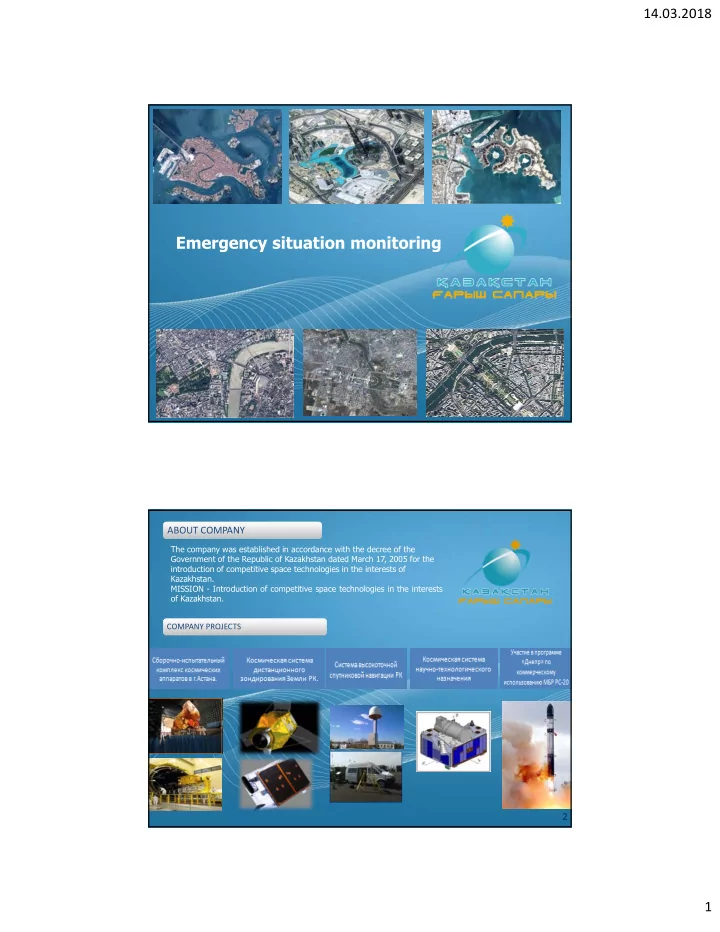
Emergency situation monitoring 1 ABOUT COMPANY ABOUT COMPANY The - - PDF document

emergency situation monitoring
SMART_READER_LITE
LIVE PREVIEW

Emergency situation monitoring 1 ABOUT COMPANY ABOUT COMPANY The - - PDF document

14.03.2018 Emergency situation monitoring 1 ABOUT COMPANY ABOUT COMPANY The company was established in accordance with the decree of the Government of the Republic of Kazakhstan dated March 17, 2005 for the introduction of competitive space


slide-1
SLIDE 1

14.03.2018 1

Emergency situation monitoring

1

COMPANY PROJECTS COMPANY PROJECTS

ABOUT COMPANY ABOUT COMPANY

The company was established in accordance with the decree of the Government of the Republic of Kazakhstan dated March 17, 2005 for the introduction of competitive space technologies in the interests of Kazakhstan. MISSION - Introduction of competitive space technologies in the interests

  • f Kazakhstan.

2

slide-2
SLIDE 2

14.03.2018 2

KazEOSat-1 Spatial resolution -1 м Shooting mode Panchromatic, Multispectral Scene size 20 х 20 kм Frequency of shooting from 3 to 5 days Efficiency 220 000 sq.km/days KazEOSat-2 Spatial resolution - 6,5м Shooting mode Multispectral Scene size 77 х 77 kм Frequency of shooting from 3 to 5 days Efficiency 1 000 000 sq.km/days Earth remote sensing space system 3 Land control complex of spacecrafts Land control complex of spacecrafts Land target complex Land target complex Antenna systems Antenna systems Land segment in Astana Earth remote sensing space system 4

slide-3
SLIDE 3

14.03.2018 3

MONITORING AND FORECAST OF SEASONAL FLOODS AND FLOODS OF THE RIVERS, DETECTION AND ASSESSMENT OF SCALES OF ZONES OF LARGE FLOODS

Flood situation in the Akmola region for April, 2015.

  • R. Nura and adjacent villages

KazEOSat-1.18.04.2015

5

MONITORING OF SEASONAL FLOODS AND FLOODS OF THE RIVERS IN THE KARAGANDA REGION

  • v. Kievka, Nurynsky district, KazEOSat-1 (04/13/2015)
  • v. Koktenkol, Shetsky district, KazEOSat-1 (13.04.2015)
  • v. Tengizshilik, Karkaraly region, KazEOSat-1 (04/13/2015)
  • v. Koktas, Karkaralinsky district, KazEOSat-1 (13.04.2015)

6

slide-4
SLIDE 4

14.03.2018 4

MODEL OPERATION OF THE TERRITORY DURING SEASONAL FLOODS AND FLOODS OF THE RIVERS ON THREE-DIMENSIONAL MODELS

  • Determination of the list of settlements that have fallen into the flood zone;
  • Determination of the list of industrial enterprises, cattle cemeteries, dumps,

warehouses of mineral fertilizers, fallen into the flood zone;

  • Determination of the length of roads and railways, bridges and engineering

structures that have fallen into the flood zone;

  • Determination of the length of the main pipeline lines that have fallen into

the flood zone;

  • The calculation of flooded areas in terms of their functional use

7

The upper part of the river. Irtysh in the territory of China

WATER RESOURCES MANAGEMENT

april - 457 sq.kм june - 363 sq.kм

  • ctober - 44 sq.kм

Changing the area of the water mirror of the Koksarai counter regulator

Decision:

  • 1. Monitoring of water

resources (construction of hydrological digital terrain models, monitoring of river and lake basins, monitoring of pollution of water bodies, monitoring

  • f water and ice regime
  • f reservoirs);
  • 2. Inventory of water

bodies, assessment of reserves and quality;

  • 3. Control of the activities
  • f water users and water

users;

  • 4. Development of water

protection measures;

  • 5. Monitoring of water

intakes and hydraulic structures;

  • 6. Establishment of GIS of

water management

Deficiency of water resources. Low water availability is 36.4 thousand cubic meters per 1 square kilometer (the lowest in the CIS). More than 4 thousand reservoirs and dams, an area of 100 thousand square meters. km.

Expected results: update of water cadastre databases, improvement of water supply, forecast and modeling of water processes

8
slide-5
SLIDE 5

14.03.2018 5

Верхняя часть р. Иртыш на территории КНР

FORECAST OF DISTRIBUTION OF POLLUTANTS IN THE WATER ENVIRONMENT WITH THE USE OF REMOTE SENSING METHODS AND GEOINFORMATION MODELING

  • Monitoring of oil infiltration;
  • Identification of oil

pollution;

  • Prognosis of the spread of oil

pollution. Не

9

Presumably, oil films from oil spills. Also during the monitoring

  • n

the KazEOSat-1 satellite im 06.11.2015, contamination of the surface of the C Sea with a total area of about 268,500 m2 was reve

KazEOSat-1, 06.11.2015

September 24, 2013 near installation of complex processing of oil and gas (ground complex of the p "Bolashak") due to the rupture of the gas pipelin leak of hydrogen sulphide (passing-bed gas). As a result of the acciden residual gas was sent and burned at the flares of th ground and sea complexe the Kashagan field.

10

Kashagan oil and gas field

(NCOC, KazMunaiGas, Total, ExxonMobil, Royal Dutch Shell, CNPC, Inpex, AgipCaspian Sea B

slide-6
SLIDE 6

14.03.2018 6

11

Monitoring of glaciers and mountain lakes

Picture of the KazEOSat-1 Spacecraft with the spatial resolution of 1 m 28.08.2017. Picture of the KazEOSat-1 Spacecra with the spatial resolution of 1 m 05.11.2017. 12

Monitoring of the Aral Sea

1973 y. 1987 y. 2010 y. 2012 y. 2014 y

slide-7
SLIDE 7

14.03.2018 7

Space monitoring and mapping of the burned-out territory

The area of the burned-out territory of 399 374 hectare in Hobdinsky and Uilsky district of the Aktobe region

13

The area of the burned-out territory - 75 561 hectare

Space monitoring of the burned-out territory in Bayganinsky district

14

slide-8
SLIDE 8

14.03.2018 8

Directions of space monitoring for prevention of emergency

  • Monitoring of glaciers;
  • Monitoring of the cross-border rivers (fresh and irrigation water):
  • - uneven use of an intake of water;
  • - construction of channels, reservoirs, hydro constructions.
  • Monitoring of the fires - quick response to the fires in the woods, the

steppe.

  • Environmental monitoring of the Caspian Sea (Kazakhstan, Russia,

Turkmenistan, Iran, Azerbaijan);

  • Monitoring of the Aral Sea:
  • - Syr-Darya Amu-Darya Rivers, :
  • - dams, the separating Small Aral Sea from the Big Aral Sea;
  • Prevention of river floods:
  • in the spring when thawing snow;
  • after downpours;
  • Erosion of soils, desertification.

15

Uncontrolled use of resources and ecological pollution have very seriously changed climate in a number of regions

  • f Central Asia. And these changes don't recognize frontiers.

Dust storms, severe winters, destructive summer, and in the future a lack of fresh and irrigation water — all this links of

  • ne chain.

It is necessary to develop geospatial statistical indicators and also on their basis to create an early warning system of accidents for timely taking measures, both the countries of the region, and the international organizations for sustainable development of Central Asia.

Conclusions

16

slide-9
SLIDE 9

14.03.2018 9

THANK YOU FOR YOUR ATTENTION THANK YOU FOR YOUR ATTENTION

17