Emphasis & Focal Point ATTRACTING ATTENTION How does a designer - - PowerPoint PPT Presentation

emphasis focal point attracting attention how does a
SMART_READER_LITE
LIVE PREVIEW

Emphasis & Focal Point ATTRACTING ATTENTION How does a designer - - PowerPoint PPT Presentation

Emphasis & Focal Point ATTRACTING ATTENTION How does a designer catch a viewers attention? How does the artist provide a pattern that attracts the eye? Nothing will guarantee success, but one de- vice that can help is a point of


slide-1
SLIDE 1

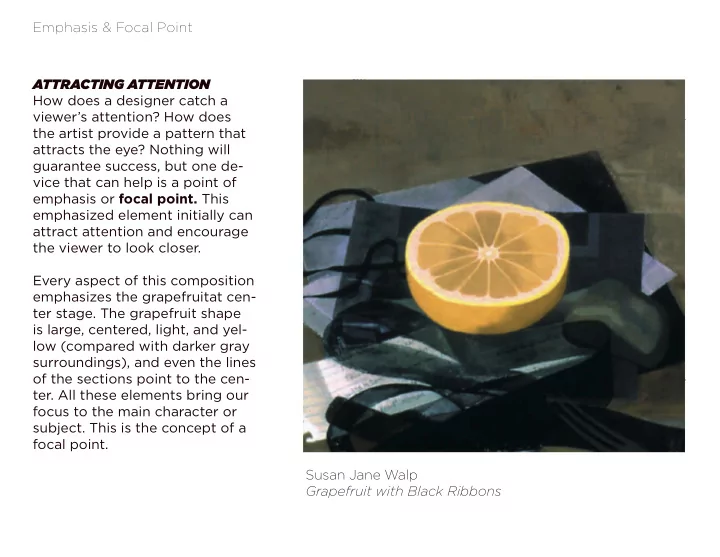
Emphasis & Focal Point ATTRACTING ATTENTION How does a designer catch a viewer’s attention? How does the artist provide a pattern that attracts the eye? Nothing will guarantee success, but one de- vice that can help is a point of emphasis or focal point. This emphasized element initially can attract attention and encourage the viewer to look closer. Every aspect of this composition emphasizes the grapefruitat cen- ter stage. The grapefruit shape is large, centered, light, and yel- low (compared with darker gray surroundings), and even the lines

  • f the sections point to the cen-
  • ter. All these elements bring our

focus to the main character or

  • subject. This is the concept of a

focal point. Susan Jane Walp Grapefruit with Black Ribbons

slide-2
SLIDE 2

Emphasis & Focal Point Henri Matisse Bathers with a Turtle This painting by Henri Matisse does not have the central, obvious target that is evident in Grapefruit, but the focal point is unambiguous and even humorous. The small red turtle is emphasized by contrast of size, unique color, and isolation. The figures direct our attention as well as we follow their gaze to the focal point. In this case even a very small area of emphasis is powerful enough to need balanc- ing counterpoints such as the bright hair of the left-hand fi gure and the abstracted blue stripe of water at the top of the painting.

slide-3
SLIDE 3

Emphasis & Focal Point This photograph is a view of an

  • rdinary street scene. The large

pine tree might go unnoticed in a stroll through the neighborhood. Several things contribute to the emphasis on this tree in the pho- tograph: placement near the cen- ter, large size, irregular shape, and dark value against the light sky. Jeff Wall The Pine on the Corner

slide-4
SLIDE 4

Emphasis & Focal Point More than one focal point Sometimes an artwork contains secondary points

  • f emphasis that have less attention value than the

focal point. These serve as accents or counterpoints as in the Matisse picture. However, the designer must be careful. Several focal points of equal emphasis can turn the design into a three-ring circus in which the viewer does not know where to look first. Interest is replaced by confusion: When everything is empha- sized, nothing is emphasized.

When everything is emphasized, nothing is emphasized

slide-5
SLIDE 5

Emphasis & Focal Point EMPHASIS BY CONTRAST As a rule, a focal point results when one element differs from the others. Whatever interrupts an overall feeling

  • r pattern automatically

attracts the eye by this dif- ference. When most of the elements are dark, a light form breaks the pattern and becomes a focal point. When most of the elements are muted or soft-edged, a bold contrast- ing pattern will become a focal point. George Stubbs Zebra

slide-6
SLIDE 6

Emphasis & Focal Point James Ensor Self-Portrait Surrounded by Masks EMPHASIS BY CONTRAST In an overall design of distorted expressionistic forms, the sudden introduction of a naturalistic im- age will draw the eye for its very different style.

slide-7
SLIDE 7

Emphasis & Focal Point EMPHASIS BY CONTRAST Text or graphic symbols will be a focal point (in this case, the eye is drawn to the num- ber 16. (top) When the majority of ele- ments are black and white, color will stand out as in Thomas Nozkowski’s work (bottom). Thomas Nozkowski Untitled Karl Kuntz

slide-8
SLIDE 8

Emphasis & Focal Point Call for entries for AIGA/New York

  • show. “Take Your Best Shot.” Design-

er: Michael Beirut, Vignelli Associ- ates, New York. EMPHASIS BY ISOLATION A variation on the device of emphasis by contrast is the useful technique of emphasis by isolation. There is no way we can look at this design and not focus our attention on that ele- ment at the bottom. It is identi- cal to all the elements above. But simply by being set off by itself, it grabs our attention. This is contrast, of course, but it is contrast of placement, not form. In such a case, the element need not be any different from the other elements in the work.

slide-9
SLIDE 9

Emphasis & Focal Point EMPHASIS BY ISOLATION In the painting by Eakins the doctor at left repeats the light value of the other figures in the operating are-

  • na. All the figures in this oval

stand out in contrast to the darker figures in the back-

  • ground. Isolation gives extra

emphasis to this doctor at the left. Thomas Eakins The Agnew Clinic

slide-10
SLIDE 10

Emphasis & Focal Point EMPHASIS BY ISOLATION Gérôme’s painting uses isolation to create a hierarchy of emphasis. The cluster of figures around the dying Pierrot is isolated to the left, the departing Harlequin to the right, and the awaiting car- riage in the center background. Gérôme The Duel after the Masquerade

slide-11
SLIDE 11

Emphasis & Focal Point In neither of these examples is the focal point directly in the center of the composition. This placement could appear too obvious and contrived. However, it is wise to remember that a focal point placed too close to an edge will tend to pull the viewer’s eye right out

  • f the picture.

Notice in Eakins’s painting how the curve of the oval on the left side and the doctor looking to- ward the action at right keep the isolated figure from directing our gaze out of the picture. In Gérôme’s painting the dra- matic cluster of figures on the left is balanced by the departing characters on the right. Even the sword is isolated on the ground for emphasis. Eakins Gérôme

slide-12
SLIDE 12

Emphasis & Focal Point EMPHASIS BY PLACEMENT It does not require much in the way of proof to say that putting something at the center of a composition creates emphasis. In fact, it is often a criticism of naïve or boring compositions to notice that the subject is plopped down smack in the center. So then it becomes interesting to see how the center can be used in a subtle way to achieve em- phasis. Gérôme The Duel after the Masquerade

slide-13
SLIDE 13

Emphasis & Focal Point EMPHASIS BY PLACEMENT Susan Moore’s portrait of her daughter offers a threequar- ter view and avoids a frontal “mug shot” composition. The center of the painting is not the center of her face. The central vertical axis of the painting does intersect her right eye and acts to draw attention to her gaze at us. We make eye contact through this placement. It succeeds because the focal point does not have to com- pete with other elements for prominence. Susan Moore Vanity (Portrait 1).

slide-14
SLIDE 14

Emphasis & Focal Point EMPHASIS BY PLACEMENT The position of the most famous apple of all time is also near the center of B. The painting is busy and crowded, and the passing of the apple takes place at the inter- section of the tree trunk and the lines formed by the arms of Adam and Eve. The composition has an equal balance to the left and right of this focal point, and the key element is emphasized It succeeds because the focal point does not have to compete with other elements for promi- nence. Lucas Cranach the Elder Adam and Eve

slide-15
SLIDE 15

Emphasis & Focal Point EMPHASIS BY PLACEMENT The bull’s-eye of a dartboard would be the simplest illus- tration of an absolute focal

  • point. This is the essence of a

radial design: the center of a circle from which all ele- ments radiate. Radial designs are more common in archi- tecture (temples) or the craft areas (quilts and ceramics) than in two-dimensional art. In pictures, perspective lines can lead to a point of em- phasis, and the result can be a radial design.

slide-16
SLIDE 16

Emphasis & Focal Point EMPHASIS BY PLACEMENT In Vermeer’s painting the girl is the focal point, and the perspective lines of the interior all direct our eyes back to the figure. It is a mark

  • f the subtlety and complexity of

Vermeer’s work that the painting is not simply constructed to point to the main figure but also unfolds

  • ther areas of interest and keeps
  • ur attention and involvement.

Notice how the one line on the floor that would lead straight from the viewer’s position to the girl is ob- scured by the tapestry and the cel-

  • lo. Vermeer employs the power of a

radial design without overstating it. Vermeer A Lady at the Virginals with a Gentleman (The Music Lesson)

slide-17
SLIDE 17

Emphasis & Focal Point DEGREE of EMPHASIS ONE ELEMENT A specific theme may at times call for a dominant, even visually overwhelming focal point. The use of a strong visual emphasis on one element is not unusual. In the graphic design of newspaper advertisements, billboards, magazine covers, and the like, we often see an obvious emphasis on one element. This emphasis can be necessary to attract the viewer’s eye and pres- ent the theme (or product) in the few seconds most people look casually at such material.

slide-18
SLIDE 18

Emphasis & Focal Point ONE ELEMENT Increased focus is also needed when an idea is being promoted, as in the illustration for an editorial shown here. The intent is to grab

  • ur attention in the hope that we

will read the commentary. The strik- ing red circle creates a mouth and gives voice to the marginalized sub- ject in a plea for peace. Lino Communication Arts

slide-19
SLIDE 19

Emphasis & Focal Point Maintaining Unity with a Focal Point A focal point, however strong, should remain related to and a part of the overall

  • design. The red circle in is

visually strong yet is related to other elements of strong contrast: the black head and white doves.

slide-20
SLIDE 20

Emphasis & Focal Point Maintaining Unity with a Focal Point In Picasso’s painting the singular treatment of the masklike “face” contrasts with the shapes and planes that unify the rest of the

  • painting. In this case the contrast is

less robust. Two very small circles and an arc are the only elements needed to snap our attention to the “face” of this abstract figure. The position of the white eye as a pivot point for the seesawing planes be- low it serves to integrate the face into the overall composition. Picasso Harlequin.

slide-21
SLIDE 21

Emphasis & Focal Point Maintaining Unity with a Focal Point In general, the principle of unity and the creation of a harmoni-

  • us pattern with related ele-

ments are more important than the injection of a focal point if this point would jeopardize the design’s unity. In the illustration by Maurice Vellekoop the unusual shape of the orange dress is accentuated by the blue figure and back-

  • ground. The figure dissolves into

the blue, and the dress pops! The strength of this focal point is integrated into the unity of the total composition. The curving shapes are balanced by other similar shapes, and the

  • range is echoed by the brown
  • f the man’s suit.

Maurice Vellekoop Christian Dior Boutique, Valentino

slide-22
SLIDE 22

Emphasis & Focal Point Maintaining Unity with a Focal Point The concept of a focal point is not limited to two-dimensional compo-

  • sitions. The hearth as a focal point

for a room is a standard feature in many homes. The fireplace shown here is eye-catching in form and accentuated by the sparseness of the space. Nevertheless it is not a domineering focal point since it is placed off center and allows the view through the window to be an alternative focus. The curving lines

  • f the seating echo the curves of

the fireplace and help to integrate it into the otherwise rectangular space. UrbanLab X House.

slide-23
SLIDE 23

Emphasis & Focal Point EMPHASIZING THE WHOLE OVER THE PARTS A definite focal point is not a necessity in creating a successful design. It is a tool that artists may or may not use, depending on their aims. An artist may wish to emphasize the entire surface

  • f a composition over any individual
  • elements. Lee Krasner’s painting is an
  • example. Similar shapes and textures

are repeated throughout the painting. These shapes and textures form loose rows and columns and a kind of grid. The artist creates an ambiguous visual environment that is puzzling. Dark and light areas repeat over the surface in an even distribution, and no one area stands out. The painting has no real starting point or visual climax. It has the effect of a surface in nature: a rock face, waves on the water, or leaves scattered in the ground. Lee Krasner. Untitled.

slide-24
SLIDE 24

Emphasis & Focal Point EMPHASIZING THE WHOLE OVER THE PARTS The collage painting by Mark Keffer shown here is less dense than A, and by comparison it seems open and airy. Here the grid is that of a street map. The added elements of pink shapes and circles punctuate different intersections. If only one shape or circle had been added, it would create a focal point, but the repetition and suggested continua- tion beyond the edge of the com- position emphasize the whole over the parts. Mark Keffer. Altered Map. Esopus

slide-25
SLIDE 25

Emphasis & Focal Point EMPHASIZING THE WHOLE OVER THE PARTS The cover design (C) shows that an emphasis of the whole over any one part is not limited to geometric re- peat patterns or something as simple as autumn leaves scattered evenly across a

  • lawn. In this case the very

graphic thumbprint serves to absorb or camouflage the

  • zebra. The purpose for this

carefully composed align- ment of the thumbprint and zebra stripe pattern is to em- phasize not the animal, but

  • ur effect on its environ-

ment. Chaz Maviyane-Davies. I UCN Annual Report 1998

slide-26
SLIDE 26
slide-27
SLIDE 27
slide-28
SLIDE 28