Encoding Byte Values Byte = 8 bits Binary 00000000 2 to 11111111 2 - - PowerPoint PPT Presentation

encoding byte values
SMART_READER_LITE
LIVE PREVIEW

Encoding Byte Values Byte = 8 bits Binary 00000000 2 to 11111111 2 - - PowerPoint PPT Presentation

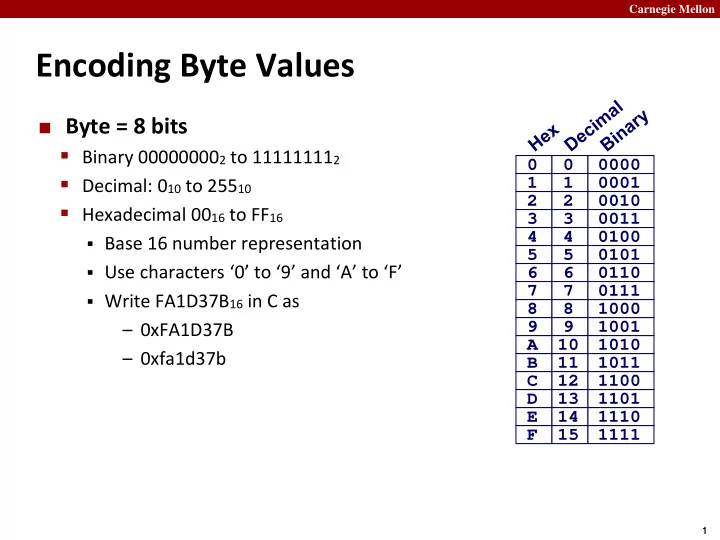
Carnegie Mellon Encoding Byte Values Byte = 8 bits Binary 00000000 2 to 11111111 2 0 0 0000 Decimal: 0 10 to 255 10 1 1 0001 2 2 0010 Hexadecimal 00 16 to FF 16 3 3 0011 4 4 0100 Base 16 number representation 5 5


slide-1
SLIDE 1

Carnegie Mellon

1

Encoding Byte Values

 Byte = 8 bits

  • Binary 000000002 to 111111112
  • Decimal: 010 to 25510
  • Hexadecimal 0016 to FF16
  • Base 16 number representation
  • Use characters ‘0’ to ‘9’ and ‘A’ to ‘F’
  • Write FA1D37B16 in C as

– 0xFA1D37B – 0xfa1d37b

0 0000 1 1 0001 2 2 0010 3 3 0011 4 4 0100 5 5 0101 6 6 0110 7 7 0111 8 8 1000 9 9 1001 A 10 1010 B 11 1011 C 12 1100 D 13 1101 E 14 1110 F 15 1111

slide-2
SLIDE 2

Carnegie Mellon

2

Byte-Oriented Memory Organization

 Programs Refer to Virtual Addresses

  • Conceptually very large array of bytes
  • Actually implemented with hierarchy of different memory types
  • System provides address space private to particular “process”
  • Program being executed
  • Program can clobber its own data, but not that of others

 Compiler + Run-Time System Control Allocation

  • Where different program objects should be stored
  • All allocation within single virtual address space
  • • •
slide-3
SLIDE 3

Carnegie Mellon

3

Machine Words

 Machine Has “Word Size”

  • Nominal size of integer-valued data
  • Including addresses
  • Most current machines use 32 bits (4 bytes) words
  • Limits addresses to 4GB
  • Becoming too small for memory-intensive applications
  • High-end systems use 64 bits (8 bytes) words
  • Potential address space ≈ 1.8 X 1019 bytes
  • x86-64 machines support 48-bit addresses: 256 Terabytes
  • Machines support multiple data formats
  • Fractions or multiples of word size
  • Always integral number of bytes
slide-4
SLIDE 4

Carnegie Mellon

4

Word-Oriented Memory Organization

 Addresses Specify Byte

Locations

  • Address of first byte in word
  • Addresses of successive words differ

by 4 (32-bit) or 8 (64-bit)

0000 0001 0002 0003 0004 0005 0006 0007 0008 0009 0010 0011 32-bit Words Bytes Addr. 0012 0013 0014 0015 64-bit Words

Addr = ?? Addr = ?? Addr = ?? Addr = ?? Addr = ?? Addr = ?? 0000 0004 0008 0012 0000 0008

slide-5
SLIDE 5

Carnegie Mellon

5

Data Representations

C Data Type Typical 32-bit Intel IA32 x86-64 char 1 1 1 short 2 2 2 int 4 4 4 long 4 4 8 long long 8 8 8 float 4 4 4 double 8 8 8 long double 8 10/12 10/16 pointer 4 4 8

slide-6
SLIDE 6

Carnegie Mellon

6

Byte Ordering

 How should bytes within a multi-byte word be ordered in

memory?

 Conventions

  • Big Endian: Sun Sparc (bi), older PPC Macs (bi), Internet, JPEG
  • Least significant byte has highest (numerically largest) address
  • Little Endian: x86, x86-64, ARM (bi), PCI and USB buses, BMP
  • Least significant byte has lowest (numerically smallest) address
slide-7
SLIDE 7

Carnegie Mellon

7

Byte Ordering Example

 Big Endian

  • Least significant byte has highest address

 Little Endian

  • Least significant byte has lowest address

 Example

  • Variable x has 4-byte representation 0x01234567
  • Address given by &x is 0x100

0x100 0x101 0x102 0x103

01 23 45 67

0x100 0x101 0x102 0x103

67 45 23 01 Big Endian Little Endian 01 23 45 67 67 45 23 01

slide-8
SLIDE 8

Carnegie Mellon

8

Representing Integers

Decimal: 15213 Binary: 0011 1011 0110 1101 Hex: 3 B 6 D 6D 3B 00 00 IA32, x86-64 3B 6D 00 00 Sun sparc

int A = 15213;

93 C4 FF FF IA32, x86-64 C4 93 FF FF Sun sparc Two’s complement representation (Covered later) 1111 1111 1111 1111 1100 0100 1001 0011 F F F F C 4 9 3

int B = -15213; long int C = 15213;

00 00 00 00 6D 3B 00 00 x86-64 3B 6D 00 00 Sun sparc 6D 3B 00 00 IA32

slide-9
SLIDE 9

Carnegie Mellon

9

Representing Pointers

Different compilers & machines assign different locations to objects

int B = -15213; int *P = &B;

x86-64 Sun sparc IA32 EF FF FB 2C D4 F8 FF BF 0C 89 EC FF FF 7F 00 00 LSB LSB MSB

Actual addresses: 0xEFFFFB2C 0xBFFFF8D4 0x00007FFFFFEC890C

slide-10
SLIDE 10

Carnegie Mellon

10

char S[6] = "18243";

Representing Strings

 Strings in C

  • Represented by array of characters
  • Each character encoded in ASCII format
  • Standard 7-bit encoding of character set
  • Character “0” has code 0x30

– Digit i has code 0x30+i

  • String should be null-terminated
  • Final character = 0

 Compatibility

  • Byte ordering not an issue
  • First character code in a string is always at numerically smallest

address, regardless of endianess

X86, x86-64 Sun sparc 31 38 32 34 33 00 31 38 32 34 33 00

slide-11
SLIDE 11

Carnegie Mellon

11

Encoding Integers

short int x = 15213; short int y = -15213;

 C short 2 bytes long  Sign Bit

  • For 2’s complement, most significant bit indicates sign
  • 0 for nonnegative
  • 1 for negative

B2T(X) = −xw−1 ⋅2w−1 + xi ⋅2i

i=0 w−2

B2U(X) = xi ⋅2 i

i=0 w−1

∑ Unsigned Two’s Complement Sign Bit

Decimal Hex Binary x 15213 3B 6D 00111011 01101101 y

  • 15213

C4 93 11000100 10010011

slide-12
SLIDE 12

Carnegie Mellon

12

Encoding Example (Cont.)

x = 15213: 00111011 01101101 y = -15213: 11000100 10010011 Weight 15213

  • 15213

1 1 1 1 1 2 1 2 4 1 4 8 1 8 16 1 16 32 1 32 64 1 64 128 1 128 256 1 256 512 1 512 1024 1 1024 2048 1 2048 4096 1 4096 8192 1 8192 16384 1 16384

  • 32768

1

  • 32768

Sum 15213

  • 15213
slide-13
SLIDE 13

Carnegie Mellon

13

Numeric Ranges

 Unsigned Values

  • UMin

=

000…0

  • UMax

= 2w – 1

111…1

 Two’s Complement Values

  • TMin

= –2w–1

100…0

  • TMax

= 2w–1 – 1

011…1

 Other Values

  • Minus 1

111…1 Decimal Hex Binary UMax 65535 FF FF 11111111 11111111 TMax 32767 7F FF 01111111 11111111 TMin

  • 32768

80 00 10000000 00000000

  • 1
  • 1

FF FF 11111111 11111111 00 00 00000000 00000000

Values for W = 16

slide-14
SLIDE 14

Carnegie Mellon

14

Values for Different Word Sizes

 Observations

  • |TMin | =

TMax + 1

  • Asymmetric range
  • UMax

= (2 * TMax) + 1

W 8 16 32 64 UMax 255 65,535 4,294,967,295 18,446,744,073,709,551,615 TMax 127 32,767 2,147,483,647 9,223,372,036,854,775,807 TMin

  • 128
  • 32,768
  • 2,147,483,648
  • 9,223,372,036,854,775,808

 C Programming

  • #include <limits.h>
  • Declares constants, e.g.,
  • ULONG_MAX
  • LONG_MAX
  • LONG_MIN
  • Values platform specific
slide-15
SLIDE 15

Carnegie Mellon

15

Sign Extension

 Task:

  • Given w-bit signed integer x
  • Convert it to w+k-bit integer with same value

 Rule:

  • Make k copies of sign bit:
  • X ′ = xw–1 ,…, xw–1 , xw–1 , xw–2 ,…, x0

k copies of MSB

  • • •

X X ′

  • • •
  • • •
  • • •

w w k

slide-16
SLIDE 16

Carnegie Mellon

16

Sign Extension Example

 Converting from smaller to larger integer data type  C automatically performs sign extension

short int x = 15213; int ix = (int) x; short int y = -15213; int iy = (int) y; Decimal Hex Binary x 15213 3B 6D 00111011 01101101 ix 15213 00 00 3B 6D 00000000 00000000 00111011 01101101 y

  • 15213

C4 93 11000100 10010011 iy

  • 15213 FF FF C4 93

11111111 11111111 11000100 10010011