multi-byte values in memory Store across contiguous byte locations. - - PowerPoint PPT Presentation

multi byte values in memory
SMART_READER_LITE
LIVE PREVIEW

multi-byte values in memory Store across contiguous byte locations. - - PowerPoint PPT Presentation

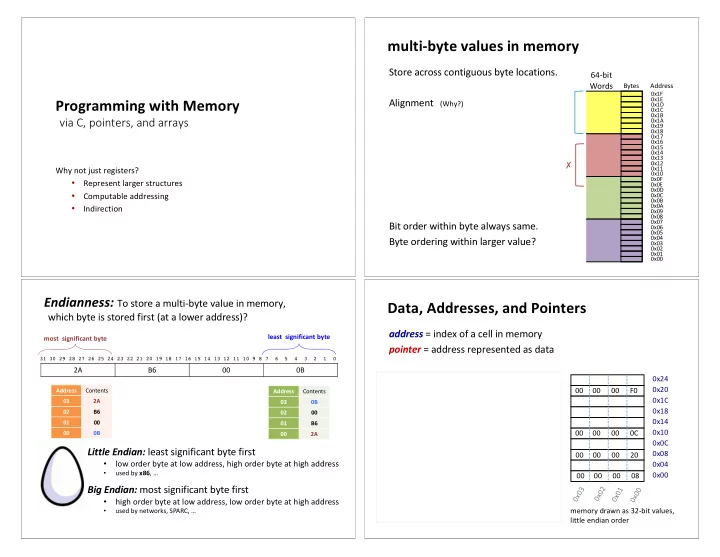
multi-byte values in memory Store across contiguous byte locations. 64-bit Words Bytes Address 0x1F 0x1E Programming with Memory Alignment (Why?) 0x1D 0x1C 0x1B via C, pointers, and arrays 0x1A 0x19 0x18 0x17 0x16 0x15 0x14 0x13


slide-1
SLIDE 1

Programming with Memory

via C, pointers, and arrays

Why not just registers?

  • Represent larger structures
  • Computable addressing
  • Indirection

multi-byte values in memory

Store across contiguous byte locations. Alignment (Why?) Bit order within byte always same. Byte ordering within larger value?

64-bit Words

Bytes Address

0x0F 0x0E 0x0D 0x0C 0x0B 0x0A 0x09 0x08 0x07 0x06 0x05 0x04 0x03 0x02 0x01 0x00

0x1F 0x1E 0x1D 0x1C 0x1B 0x1A 0x19 0x18 0x17 0x16 0x15 0x14 0x13 0x12 0x11 0x10

Endianness: To store a multi-byte value in memory,

which byte is stored first (at a lower address)?

31 30 29 28 27 26 25 24 23 22 21 20 19 18 17 16 15 14 13 12 11 10 9 8 7 6 5 4 3 2 1 0

least significant byte most significant byte

2A B6 00 0B

Little Endian: least significant byte first

  • low order byte at low address, high order byte at high address
  • used by x86, …

Big Endian: most significant byte first

  • high order byte at low address, low order byte at high address
  • used by networks, SPARC, …

Address Contents 03 2A 02 B6 01 00 00 0B Address Contents 03 0B 02 00 01 B6 00 2A

Data, Addresses, and Pointers

address = index of a cell in memory pointer = address represented as data

The number 240 is stored at address 0x20.

24010 = F016 = 0x00 00 00 F0

A pointer stored at address 0x08 points to the contents at address 0x20. A pointer to a pointer is stored at address 0x00. The number 12 is stored at address 0x10.

Is it a pointer? How do we know values are pointers or not? How do we manage use of memory? 0x24 0x20 0x1C 0x18 0x14 0x10 0x0C 0x08 0x04 0x00 20 00 00 00 08 00 00 00 F0 00 00 00 0C 00 00 00 x x 1 x 2 x 3 memory drawn as 32-bit values, little endian order

slide-2
SLIDE 2

C: variables are memory locations (for now)

Compiler maps variable à memory location.

Declarations do not initialize!

int x; // x at 0x20 int y; // y at 0x0C x = 0; // store 0 at 0x20 // store 0x3CD02700 at 0x0C y = 0x3CD02700; // load the contents at 0x0C, // add 3, and store sum at 0x20 x = y + 3;

14

x y

0x24 0x20 0x1C 0x18 0x14 0x10 0x0C 0x08 0x04 0x00 x x 1 x 2 x 3

C: Address and Pointer Primitives

address = index of a cell/location in memory pointer = address represented as data Expressions using addresses and pointers: &___ address of the memory location representing ___ *___ contents at the memory address given by ___ a.k.a. "dereference ___" Pointer types: ___* address of a memory location holding a ___ int* p; int x = 5; int y = 2; p = &x; y = 1 + *p; Add 1 to

C: Address and Pointer Example

19

that will hold the address of a memory location holding an int Declare two variables, x and y, that hold ints, and store 5 and 2 in them, respectively. … and store it in the memory location representing y. Declare a variable, p the contents of memory at the address stored in p the address of the memory location representing x Get ... and store it in p. Now, “p points to x.” & = address of

* = contents at

C: Address and Pointer Example

C assignment: Left-hand-side = right-hand-side;

int* p; // p: 0x04 int x = 5; // x: 0x14, store 5 at 0x14 int y = 2; // y: 0x24, store 2 at 0x24 p = &x; // store 0x14 at 0x04 // load the contents at 0x04 (0x14) // load the contents at 0x14 (0x5) // add 1 and store sum at 0x24 y = 1 + *p; // load the contents at 0x04 (0x14) // store 0xF0 (240) at 0x14 *p = 240;

x y

0x24 0x20 0x1C 0x18 0x14 0x10 0x0C 0x08 0x04 0x00 x x 1 x 2 x 3

p

What is the type of *p? What is the type of &x? What is *(&y) ? value location & = address of

* = contents at

slide-3
SLIDE 3

array indexing = address arithmetic

Both are scaled by the size of the type.

C: Arrays

Declaration: p Indexing: Pointers: a[6] = 0xBAD; a[-1] = 0xBAD; No bounds check: int* p; p = a; p = &a[0]; *p = 0xA; p[1] = 0xB; *(p + 1) = 0xB; p = p + 2; int a[6];

Address of a[i] is base address a plus i times element size in bytes. a is a name for the array’s base address, can be used as an immutable pointer. Arrays are adjacent memory locations storing the same type of data.

0x24 0x20 0x1C 0x18 0x14 0x10 0x0C 0x08 0x04 0x00 a[0] = 0xf0; a[5] = a[0];

{

equivalent a[5] a[0] … equivalent { *p = a[1] + 1; x x 1 x 2 x 3

C: Array Allocation

Basic Principle

T A[N]; Array of length N with elements of type T and name A Contiguous block of N*sizeof(T) bytes of memory

33 char string[12]; x x + 12 int val[5]; x x + 4 x + 8 x + 12 x + 16 x + 20 double a[3];

x + 24

x x + 8 x + 16 char* p[3]; (or char *p[3];) x x + 8 x + 16 x + 24 x x + 4 x + 8 x + 12

IA32 x86-64 Use sizeof to determine proper size in C.

C: Array Access

Basic Principle

T A[N]; Array of length N with elements of type T and name A Identifier A has type

Reference Type Value

val[4] int val int * val+1 int * &val[2] int * val[5] int *(val+1) int val + i int *

34

int val[5];

2 4 8 1

x x + 4 x + 8 x + 12 x + 16 x + 20

ex

C strings: arrays of ASCII characters ending with null character.

Does Endianness matter for strings?

int string_length(char str[]) { }

C: Null-terminated strings

0x48 0x61 0x72 0x72 0x79 0x20 0x50 0x6F 0x74 0x74 0x65 0x72 0x00 'H' 'a' 'r' 'r' 'y' ' ' 'P' 'o' 't' 't' 'e' 'r' '\0'

Why?

ex

slide-4
SLIDE 4

C: * and []

C programmers often use * where you might expect []:

e.g., char*:

  • pointer to a char
  • pointer to the first char in a string of unknown length

int strcmp(char* a, char* b); int string_length(char* str) {

// Try with pointer arithmetic, but no array indexing.

}

ex

Addr Perm Contents Managed by Initialized 2N-1

Stack

RW Procedure context Compiler Run time

Heap

RW Dynamic data structures Programmer, malloc/free, new/GC Run time

Statics

RW Global variables/ static data structures Compiler/ Assembler/Linker Startup

Literals

R String literals Compiler/ Assembler/Linker Startup

Text

X Instructions Compiler/ Assembler/Linker Startup

Memory Layout C: Dynamic memory allocation in the heap

void* malloc(size_t size); void free(void* ptr);

44

number of contiguous bytes required pointer to newly allocated block

  • f at least that size

pointer to allocated block to free

Allocated block Free block

Heap:

Managed by memory allocator:

Zip Cycles

0x10004380 0x10008900 0x00000000 zips 2 4 8 1 2 1 4 4

NULL!

// return a count of all zips the end with digit endNum int zipCount(int* zips[], int endNum) { int count = 0; while (*zips) { if ((*zips)[4] == endNum) count++; zips++; } return count; }

slide-5
SLIDE 5

C: scanf reads formatted input

54

int val; ... scanf(“%d”, &val); Read one int from input. Store it in memory at this address.

i.e., store it in memory at the address where the contents of val is stored: store into memory at 0xFFFFFF38.

Declared, but not initialized – holds anything.

0x7FFFFFFFFFFFFF3C 0x7FFFFFFFFFFFFF38 0x7FFFFFFFFFFFFF34 CE FA D4 BA

val int val; ... scanf(“%d”, val);

C: classic bug using scanf

55

!!!

Read one int from input. Store it in memory at this address.

i.e., store it in memory at the address given by the contents of val: store into memory at 0xBAD4FACE. 0x7FFFFFFFFFFFFF3C 0x7FFFFFFFFFFFFF38 0x7FFFFFFFFFFFFF34 CE FA D4 BA

val Declared, but not initialized – holds anything.

Best case: segmentation fault,

  • r bus error, crash.

Bad case: silently corrupt data stored at address 0xBAD4FACE, and val still holds 0xBAD4FACE. Worst case: arbitrary corruption ... 0x00000000BAD4FACE ... 34 12 FE CA