Engaging Patients, Stakeholders, and Community as Partners in - - PowerPoint PPT Presentation

engaging patients stakeholders and community as partners
SMART_READER_LITE
LIVE PREVIEW

Engaging Patients, Stakeholders, and Community as Partners in - - PowerPoint PPT Presentation

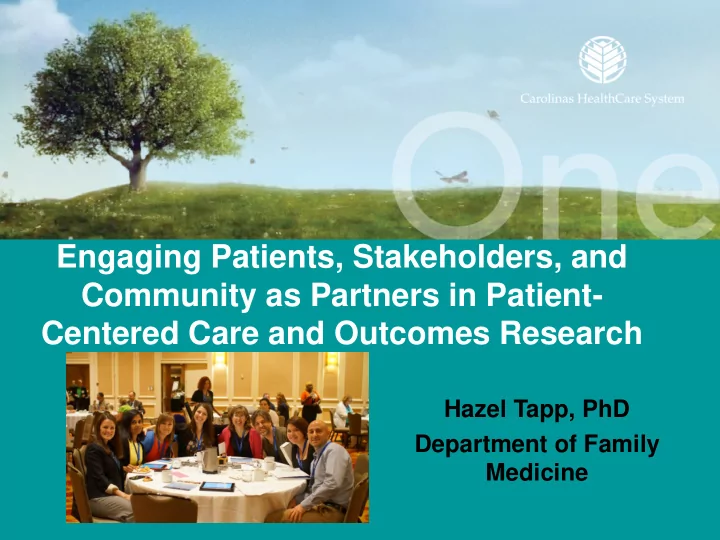
Engaging Patients, Stakeholders, and Community as Partners in Patient- Centered Care and Outcomes Research Hazel Tapp, PhD Department of Family Medicine Why do we need patient or stakeholder voices in patient care or outcomes research?


slide-1
SLIDE 1

Engaging Patients, Stakeholders, and Community as Partners in Patient- Centered Care and Outcomes Research

Hazel Tapp, PhD Department of Family Medicine

slide-2
SLIDE 2

2/6/2015 2

Why do we need patient or stakeholder voices in patient care or outcomes research?

  • As providers and

researchers we’ve been trained for many years in disease knowledge, research methods, and patient management.

  • Aren't we all patients

anyway?

  • Is there really a

problem?

slide-3
SLIDE 3

2/6/2015 3

Principles for Engaging Patients in Research

  • Engage patients and surrogates in all research phases
  • Engage patients based on the research questions being

asked and the overall aims of the research

  • Initiate patient engagement as early and frequently as

possible

  • Select representatives similar to the community or

population studied

slide-4
SLIDE 4

2/6/2015 4

Trust

  • Key element for patient-centered research
  • By establishing and maintaining trust between

researchers and patients, patients are motivated and empowered to actively participate in a learning environment

  • Trust is achieved through a process of continuous

partnering with the patient, family, and community

slide-5
SLIDE 5

2/6/2015 5

Evaluation Methods

  • Mapping of Patient Population with Disease or Condition

to Census Tracks

  • EMR Disease Outcome Data
  • Reduction in ED and Inpatient Visits
  • Focus Groups – access to care; disease management
  • Surveys (patient satisfaction; quality of life; disease

specific)

  • Key Informant interviews
  • Ethnography
slide-6
SLIDE 6

2/6/2015 6

Engaging Patients in Patient Centered Care

slide-7
SLIDE 7

2/6/2015 7

Shared Decision Making

  • Patient provides

information to the physician on values and preferences

  • Provider gives

treatment options and the benefits and risks

  • f each

Cartoon by Aaron Bacall

slide-8
SLIDE 8

2/6/2015 8

A Meeting of Two Experts

Patient gives information on: values, preferences, lifestyle, beliefs, and current knowledge about the illness and its treatment Provider gives all relevant disease information: benefits and risks of various treatments and potential effects

  • n the patient's

psychological and social well being

slide-9
SLIDE 9

2/6/2015 9

Engaging Patients in Research

slide-10
SLIDE 10

2/6/2015 10

Patient and Stakeholder Roles in ADAPT-NC

  • Individual Patients

– Study design discussions – Planning meetings and materials assistance (eAAP) – Participate in meetings with practices to discuss how the implementation of the intervention is going.

  • Community Care of North Carolina Asthma Workgroup

– Assist with recruitment and gave input into the toolkit

  • Members of Mecklenburg County Asthma Coalition

– Dissemination

  • Patient Advisory Board

– Feedback and updates

slide-11
SLIDE 11

2/6/2015 11

Community Advisory Boards (CAB)

slide-12
SLIDE 12

2/6/2015 12

Community Based Participatory Research (CBPR)

  • “Is the collaborative approach to research that involves

all partners in the research process and recognizes the unique strengths that each brings.

  • CBPR begins with a research topic of community

importance, and has the aim of combining knowledge with action to achieve social change that improve health

  • utcomes.”

WK Kellogg Foundation Community Health Scholars Program, September 10, 2012

slide-13
SLIDE 13

2/6/2015 13

slide-14
SLIDE 14

2/6/2015 14

slide-15
SLIDE 15

2/6/2015 15

Community Advisory Board

  • Reach out to key community stakeholders and engage in

the development of the research proposals

  • Establish a set time and day that meetings will take

place

  • Provide meals
  • Encourage members to take part in the research process

– Assist in data collection – Participant recruitment – Direct contact with community members

  • Ask for constant feedback about the process and their

participation

slide-16
SLIDE 16

2/6/2015 16

Needs Assessment

slide-17
SLIDE 17

Designing, Conducting and

Disseminating Results

  • f Pragmatic Research:

A Few Considerations for Patient Engagement

Milton “Mickey” Eder PBRN Pragmatic Research And Translation Learning Group January 5, 2015

slide-18
SLIDE 18

Ethical Issues for Patient Engagement?

Do Pragmatic Clinical trials blur distinctions between Treatment and Research? Doctor/patient and investigator/subject-participant relationship? e.g., therapeutic misconception; current standard of care questions (SUPPORT study)

slide-19
SLIDE 19

Who Engages Patients?

Research Staff? and/or Practice Staff? How is recruitment organized? Who obtains informed consent? Who responds to questions about a research project within the office?

Image from http://www.fowlersgroup.com.au/blog/2012/10/finding-the-right-balance-for-you/

slide-20
SLIDE 20

Engaging Patients and Practices

? Who trains/educates patients? ? Can Pragmatic Trials successfully compare treatment

  • ptions and involve patients in asking health services

and office/practice questions?

? How to include physician and

staff practice issues (e.g., practicality

  • f treatment, cost/reimbursement)

in projects?

slide-21
SLIDE 21

Results: Timeliness Challenges

? Will researchers share preliminary results with patients?

Communities? How to present preliminary results?

? Will publication delay release of results? ? Are researchers prepared to translate results for non-

specialists and develop multiple reports

  • Dr. Susie Nanney, University of Minnesota

Community Presentation, November 13, 2014