Environment and Natural Resources Trust Fund 2012-2013 Request for - - PDF document

environment and natural resources trust fund 2012 2013
SMART_READER_LITE
LIVE PREVIEW

Environment and Natural Resources Trust Fund 2012-2013 Request for - - PDF document

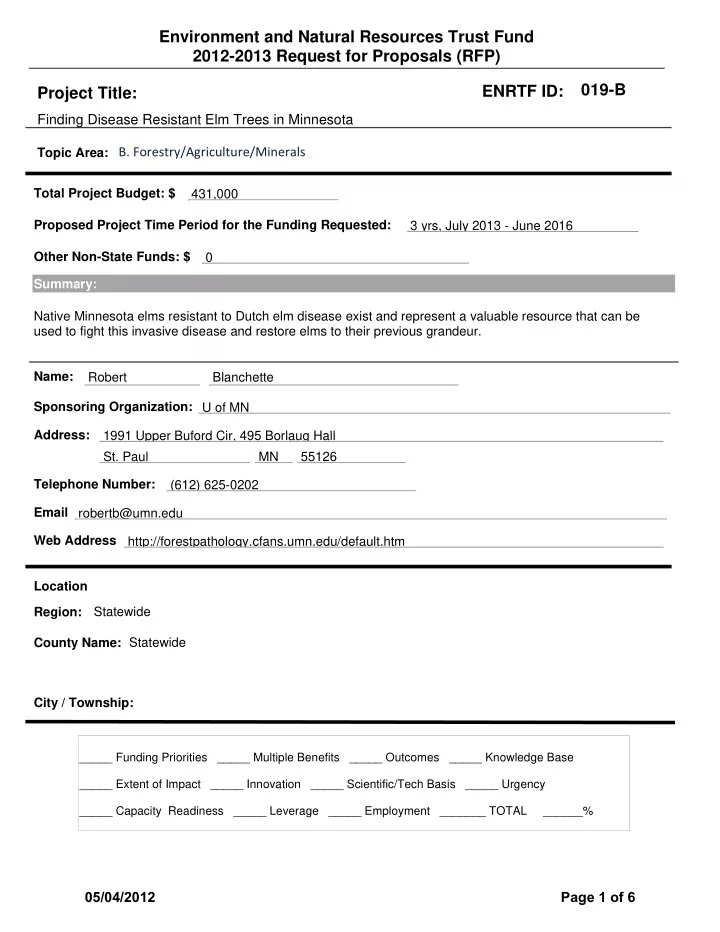
Environment and Natural Resources Trust Fund 2012-2013 Request for Proposals (RFP) 019-B ENRTF ID: Project Title: Finding Disease Resistant Elm Trees in Minnesota B. Forestry/Agriculture/Minerals Topic Area: Total Project Budget: $ 431,000


slide-1
SLIDE 1

Environment and Natural Resources Trust Fund 2012-2013 Request for Proposals (RFP) Project Title:

Total Project Budget: $ Proposed Project Time Period for the Funding Requested: Other Non-State Funds: $ Name: Sponsoring Organization: Address: Telephone Number: Email Web Address County Name: City / Township: Region: Summary: Location

Finding Disease Resistant Elm Trees in Minnesota

431,000 3 yrs, July 2013 - June 2016 Native Minnesota elms resistant to Dutch elm disease exist and represent a valuable resource that can be used to fight this invasive disease and restore elms to their previous grandeur. Robert U of MN 1991 Upper Buford Cir, 495 Borlaug Hall

  • St. Paul

MN 55126 (612) 625-0202 robertb@umn.edu http://forestpathology.cfans.umn.edu/default.htm Statewide Statewide Blanchette

_____ Funding Priorities _____ Multiple Benefits _____ Outcomes _____ Knowledge Base _____ Extent of Impact _____ Innovation _____ Scientific/Tech Basis _____ Urgency _____ Capacity Readiness _____ Leverage _____ Employment _______ TOTAL ______%

  • B. Forestry/Agriculture/Minerals

ENRTF ID: 019-B

Topic Area:

05/04/2012 Page 1 of 6

slide-2
SLIDE 2

PROJECT

  • I. PROJEC

D trees have pathogen There is n pollution

  • ther con

less funds introduce trees to b ecology o for wetlan butterflie wood pro Th these surv prelimina show som vital to fig

  • 1. Survey

and Grou resistance from thro Screening truly resis

  • 2. Screen

two steps The prelim show whi

  • 3. Study d

physical b defense m resulting i

  • 4. Field te

geneticall prelimina identify tr

  • II. DESCRI

Activity 1 With the landscape We prop and have shade tre

Environ 2012‐20

TITLE: Findin T STATEMEN utch elm dise e died people have been d no tree more and other str ntrol program s are available ed pests, such be used for re f Minnesota’ nds and add t s are support

  • ducts.

here is new h vivors appear ry work, seed me trees survi ght this deadl and identify nds Foundati

  • e. We have in
  • ughout Minn

g (injecting wi

  • stant. Once tr

selected tree s by injecting minary data s ch trees are r defense mech barriers are pr

  • mechanisms. O

in a rapid me esting of elms y different bu ry research a rees with the IPTION OF PR : Identify and help of lando e we will iden

  • se to find el

e a large num ee and import

nment and 013 Main

g Disease Re NT ease has killed e have just ab evastating an beautiful or w resses better s are expensi e for control a h as the Emera planting in ur s forests. The to the biodive ted by elms). hope for the e r to have spec dlings were gr

  • ve. Having a

y fungus. Our resistant elm

  • n we identif

nformation fro nesota that ap ith the fungus ree are select

  • es. To determ

trees with th hows that elm resistant and hanisms in re roduced by tr Once this is k thod of scree

  • s. Our goal is

ut all have res s well as new best growth ROJECT ACTIV d grow resista

  • wners, park a

ntify large, ma ms from acro mber of gene tant forest sp

d Natural Proposal

sistant Elm T d millions of e bout given up nd it has caus well suited fo than other tr

  • ive. Municipa

and elm mort ald Ash Borer rban areas is eir seed provi ersity of a hea Elms can also elm! We have cial character rown from th large genetic r proposed pr m trees. From fied and teste

  • m arborists

ppear to be re s in greenhou ed they will b mine if trees a e fungus in g ms resistant t with state wi esistant trees rees to stop in known, these ening trees w s to obtain a d

  • sistance. Field

w selections m and hardines VITIES ant Minnesot and city perso ature elms tha

  • ss Minnesota

tically differe pecies will be

Resource

1 Trees in Minn elms in Minn hope for this ed an ecolog r urban cond

  • rees. Removin

al budget cons tality has incr r, threatening greater than des importan althy forest (f

  • be used for

e observed th ristics making hese trees and stock of hard roject would: m preliminary ed several elm and city fores

  • esistant. They

use and field t be propagate are resistant, reenhouse st to Dutch elm ide screening . What make nvading path characteristi ith resistance diverse select d testing is es made from thi ss characteris a elms for tes

  • nnel, arboris

at have surviv a with resista ent trees wit brought back

es Trust Fu

esota esota over th s tree. Losses ical disaster. itions than th ng and dispos straints over reased steadi g Minnesota a

  • ever. Elms ar

nt food for wi for example, making furni at some elms g them resista d were injecte dy and resista : research sup ms and found sters about m y survive whe trials) will ide d using meth rigorous test tudies followe disease exist g we expect to s an elm resis

  • gens. This w

cs can be loo e. tion of elms f ssential and w is project. Fie stics. sting. sts and our su ved heavy pre ance to Dutch h resistance k to its previo

und (ENRT

he past five de s from this in Elms are mag he elm. They t sing of diseas recent years

  • ly. We now f

ash trees and re also play a ildlife, they ar 213 species o iture, boxes, c s have survive ant to Dutch e ed with the fu ant native Mi pported by th d 3 with differ many other ca ere all other e entify which o hods we recen ing is needed ed by addition t in Minnesota

  • find a large

stant to disea work will iden ked for in new rom Minneso will be done o eld testing wil Bud urveys of the essure from D h elm disease available so

  • us grandeur.

TF)

  • ecades. So m

vasive and ex gnificent tree tolerate salt, sed trees and have meant find other d the need for vital part in t re excellent t

  • f moths and

crates and ot ed the diseas elm disease. I

  • ungus. Result

nnesota elms e Minnesota rent levels of andidate elms elms have die

  • f these trees

ntly develope

  • d. This is done

nal field testi

  • a. Our testing

number of th ase? Chemica ntify the tree’s w selections

  • ta that are
  • n trees from

ll also be used dget: $113,00 Minnesota Dutch elm dis , test them ri that this ma . any xotic es. that r new the rees ther e and In our ts s is Turf s ed. s are ed. e in ng. g will hem. l and s

  • ur

d to 00 sease. gorously gnificent

05/04/2012 Page 2 of 6

slide-3
SLIDE 3

2 Cuttings will be taken from the growing tips of these trees and rooted and/or grafted to obtain propagate sufficient numbers of each tree for disease screening. Local arborists will be employed to help in obtaining the branch cuttings needed from the growing tips of these surviving large trees. Outcomes Completion Date

  • 1. Find and propagate 20 Minnesota elms that appear to have disease resistance

6/2014

  • 2. Find and propagate an additional 30 Minnesota elms with disease resistance

6/2015 Activity 2: Screen selected elms for resistance . Budget: $118,000 Using previous successful methods, replicated studies of selected seedlings will be grown in the

  • greenhouse. The Dutch elm disease fungus will be injected into these trees and disease monitored.

Outcomes Completion Date

  • 1. Complete disease screening for elms obtained during the first year

9/2015

  • 2. Complete disease screening for second year elm selections

3/2016 Activity 3: Study tree defense mechanisms to better understand disease resistance Budget: $99,000 Trees with resistance have mechanisms that help defend against the invading fungus. These can include chemical and physical barriers formed in the tree as well as genetic differences. These investigations will identify the mechanisms involved and use them as screening tools for more rapid selection of additional trees having these characteristics associated with resistance. Outcome Completion Date

  • 1. New tools obtained to rapidly screen future elms for resistance

6/2016 Activity 4: Field testing of selected clones with resistance. Budget: $101,000 Field plantings and evaluations will be done to the selected test trees in a natural setting to insure they are resistant, evaluate growth characteristics and determine their suitability for planting throughout Minnesota. Outcome Completion Date

  • 1. Field planting and field screening of selected elms

6/2016

  • III. PROJECT STRATEGY
  • A. Project Team/Partners
  • Dr. Robert Blanchette (Co‐PI, UMN) is a professor and Benjamin Held (UMN) is a research scientist in the

Department of Plant Pathology. They will take part in the finding and screening of resistant elms, as well as studies to elucidate resistance mechanisms.

  • Dr. Jeff Gillman (Co‐PI, UMN) is an associate professor and Chad Giblin (UMN) is a research scientist in

the Department of Horticulture Science. They will take part in finding, propagating and field planting of resistant elms. Additional partners include arborists, park and city foresters and landowners throughout the state.

  • B. Timeline Requirements

The time line of 36 months will allow selection and propagation of elms to occur, screening of the materials in the greenhouse and establishing field trials.

  • C. Long‐Term Strategy and Future Funding Needs

The main goal of this research is to identify and propagate resistant elms from Minnesota. Testing for resistance must be rigorous and thorough and field trials will be established. Although some information will be completed from the field, it can take 5‐6 years for more comprehensive observations. These field trials will continue at the University Research Center after the project has ended. It will also take a few years to propagate the selected trees in sufficient numbers so they are available for release to the nursery industry and the public.

05/04/2012 Page 3 of 6

slide-4
SLIDE 4

BUDGET ITEM Personnel: Graduate student 50% time ( 56%salary, 44% benefits, for 2 years) Graduate student 50% time ( 56%salary, 44% benefits, for 2 years) Scientist - pathology 50% time 71% salary, 29% fringe, for 3 years) Scientist- horticulture 25% time (71% salary, 29% fringe, for 3 years) 4 Undergraduate student workers (100% salary, $5000/year per student for 3 years) Contracts: N/A Equipment/Tools/Supplies: Field supplies (pots, stakes, pruning supplies, ferilizers, container substrate, $2100/yr, 3 yrs) Laboratory Supplies (microbiology and inoculation materials, microscopy, cytology, fungal genotyping, $3200/yr, 3yrs) Acquisition (Fee Title or Permanent Easements): N/A Travel: Throughout MN for collection of resistant elms Additional Budget Items: bucket truck contracting for sampling large trees , climbers for Greenhouse maintanance costs ($3000/yr, 3 yrs) TOTAL ENVIRONMENT AND NATURAL RESOURCES TRUST FUND $ REQUEST = SOURCE OF FUNDS AMOUNT Status Other Non-State $ Being Applied to Project During Project Period: $0 Other State $ Being Applied to Project During Project Period: N/A In-kind Services During Project Period: Blanchette (co-PI) salary and fringe for one month per year for 3 years $41,900 Gillman (co-PI) salary and fringe for one month per year for 3 years $36,900 Remaining $ from Current ENRTF Appropriation (if applicable): N/A Funding History: Minnesota Turf and Grounds Foundation: for preliminary screening of elms to prove proof of concept. $60,000 86,000 $ 8,000 $ N/A

  • V. OTHER FUNDS

431,000 $ 6,000 $ N/A 86,000 $ 115,000 $ 48,000 $ 60,000 $ 9,000 $ 9,000 $ 4,000 $

2012-2013 Detailed Project Budget

  • IV. TOTAL ENRTF REQUEST BUDGET 3 years

AMOUNT

C:\Users\dgriffit\Documents\proposals_recevied\blanchette-robert_0412-2-070-Budget

05/04/2012 Page 4 of 6

slide-5
SLIDE 5

Finding Diseas e Resist

Identify pos Obtain cut In Select res Study tr Propaga field re

tant Elm

elms from ssible resis ttings from nject seed sistant tre ee defense ate selecte trials for a The goal esistant el the Minn majesti

m Trees

m the Minn stance to D m identifie dlings with ees after th e mechani ed resistan additional

  • f this pro

ms that ca nesota land c tree to it

in Minne

nesota lan Dutch elm ed trees fo the patho hey have b isms in res nt seedling testing an

  • ject is to

an be grow dscape and ts previous

esota

dscape wi disease r propagat

  • gen

been inject sistant tree gs and plan nd screenin have nativ wn through d return th s grandeur th tion ted es nt in ng ve hout his r

05/04/2012 Page 5 of 6

slide-6
SLIDE 6

Project Managers Qualifications / Organization Description

  • Dr. Robert Blanchette (Co‐PI) is a professor in the Department of Plant Pathology. He has been involved

with research and teaching of forest and landscape trees at the University for 30 years. His research accomplishments include 2 books, over 200 publications, 14 US Patents and numerous foreign patents. He has received several honors for research accomplishments including Fellow of the American Association for the Advancement of Science, Fellow of the American Phytopathological Society, Fellow

  • f the International Academy of Wood Science, Hans Merensky Fellow for Wood Science and

Distinguished Service Award from the American Society of Microbiology. He teaches undergraduate and graduate classes at the University of Minnesota on forest and shade tree diseases. Research interests are in the area of forest pathology and wood microbiology with research in tree defense mechanisms, deterioration processes of wood and biotechnological uses of forest fungi. Projects involve novel, interdisciplinary approaches to solving tree disease problems and understanding the biology and ecology of forest microbes. In 2011, a selection of white pine that had been identified by his research group with disease resistance to white pine blister rust was released by the University of Minnesota.

  • Dr. Jeff Gillman (Co‐PI) is an Associate Professor in the Department of Horticultural Science where he

researches tree growth and transplanting. He holds a Ph.D. in horticulture and a master's degree in entomology. He is the author of five books and numerous scientific papers on a variety of tree and shrub related topics. He is also co‐author of the book Pruning Young Elms by Chad Giblin. He teaches courses on plant propagation, nursery management and pesticide use in horticulture. He directs the University research nursery located on the St. Paul campus where research focused on improved nursery practices for maximizing growth and improving long term tree health in the urban environment takes place. He is also a member of the University of Minnesota’s Urban Forestry & Horticulture Research Institute. Organization Description – University of Minnesota The Department of Plant Pathology and the Department Horticultural Science are in the College of Food, Agricultural and Natural Resource Sciences at the University of Minnesota St. Paul Campus. Modern research laboratories are available for this work and a 10 acre research field site on Campus can be used for the field trials proposed for this project. Professor Blanchette and Gillman will take an active part in this research and their salaries will be paid by the University of Minnesota. All equipment needed for this work is available in the PI’s laboratories.

05/04/2012 Page 6 of 6