Environment and Natural Resources Trust Fund 2012-2013 Request for - - PDF document

environment and natural resources trust fund 2012 2013
SMART_READER_LITE
LIVE PREVIEW

Environment and Natural Resources Trust Fund 2012-2013 Request for - - PDF document

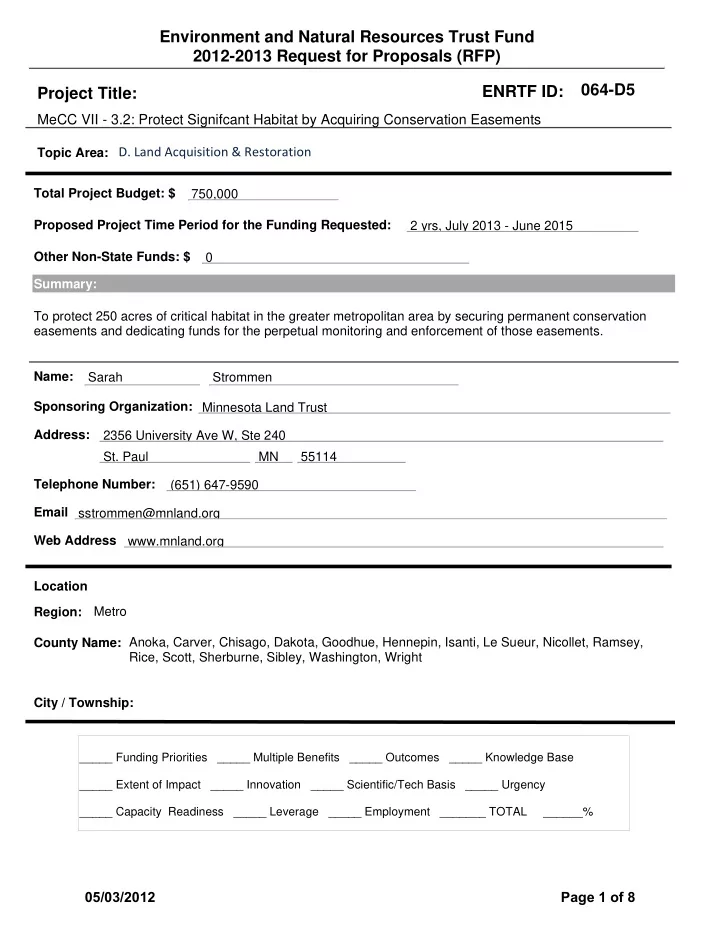
Environment and Natural Resources Trust Fund 2012-2013 Request for Proposals (RFP) 064-D5 ENRTF ID: Project Title: MeCC VII - 3.2: Protect Signifcant Habitat by Acquiring Conservation Easements D. Land Acquisition & Restoration Topic Area:


slide-1
SLIDE 1

Environment and Natural Resources Trust Fund 2012-2013 Request for Proposals (RFP) Project Title:

Total Project Budget: $ Proposed Project Time Period for the Funding Requested: Other Non-State Funds: $ Name: Sponsoring Organization: Address: Telephone Number: Email Web Address County Name: City / Township: Region: Summary: Location

MeCC VII - 3.2: Protect Signifcant Habitat by Acquiring Conservation Easements

750,000 2 yrs, July 2013 - June 2015 To protect 250 acres of critical habitat in the greater metropolitan area by securing permanent conservation easements and dedicating funds for the perpetual monitoring and enforcement of those easements. Sarah Minnesota Land Trust 2356 University Ave W, Ste 240

  • St. Paul

MN 55114 (651) 647-9590 sstrommen@mnland.org www.mnland.org Metro Anoka, Carver, Chisago, Dakota, Goodhue, Hennepin, Isanti, Le Sueur, Nicollet, Ramsey, Rice, Scott, Sherburne, Sibley, Washington, Wright Strommen

_____ Funding Priorities _____ Multiple Benefits _____ Outcomes _____ Knowledge Base _____ Extent of Impact _____ Innovation _____ Scientific/Tech Basis _____ Urgency _____ Capacity Readiness _____ Leverage _____ Employment _______ TOTAL ______%

  • D. Land Acquisition & Restoration

ENRTF ID: 064-D5

Topic Area:

05/03/2012 Page 1 of 8

slide-2
SLIDE 2

Environment and Natural Resources Trust Fund (ENRTF) 2012-2013 Main Proposal

1 PROJECT TITLE: MeCC 7–3.2 Protect Significant Habitat by Acquiring Conservation Easements

  • I. PROJECT STATEMENT

The Minnesota Land Trust has worked extensively in the greater Twin Cities area since 1992 to permanently protect natural and scenic lands with an emphasis on using conservation easements. This strategy has been acknowledged by a variety of stakeholders, and in the Statewide Conservation and Preservation Plan, as one of the key tools necessary to achieve land conservation goals in a metropolitan area where escalating land values prohibit fee title acquisition of many priority lands. Conservation easements also help communities by keeping land on the tax rolls while using fewer public services. Our goal is to permanently protect priority lands that contribute to a regional connected network of critical habitat within the greater Twin Cities area and help maintain water quality of some of the region’s most important rivers, lakes, and streams. To this end, the Land Trust will work to identify tracts of land within the mapped project areas critical to the protection of high-quality habitat for a variety of migratory birds and species in greatest conservation need, such as common loon, red- shouldered hawk, northern pintail, bobolink, and wood thrush. The Land Trust works only with conservation easements that are perpetual. These easements prohibit land uses or development that negatively affect important habitat and other conservation values, require habitat management plans as appropriate, and direct the use of native vegetation in conjunction with any required restoration. These easements are monitored annually and enforced as necessary under the Land Trust’s comprehensive conservation easement monitoring, management, and enforcement program funded in part through our Stewardship and Enforcement Fund.

  • II. DESCRIPTION OF PROJECT ACTIVITIES

Activity 1: Protect Significant Habitat through Conservation Easements Budget: $750,000 The Land Trust will protect critical habitat within the mapped corridors by: 1) contacting landowners; 2) negotiating and completing 4-6 permanent conservation easements on at least 250 acres of land (including documenting property conditions and creating management plans as appropriate); and 3) dedicating funds for the perpetual monitoring, management and enforcement of the easements. The Land Trust will work primarily with donated easements, purchasing easements when necessary and then at below market value whenever possible. Criteria for determining when a purchase is necessary include landowner ability to donate, connectivity of parcel to other protected lands, and quality of natural resources on the site. All potential easement projects are evaluated for habitat value (quality and quantity of existing habitat on site), context (proximity and relationship to other protected lands),

  • pportunity/threat (which landowners will participate now), and other benefits (including visual and

physical access, water quality, etc.). Current potential projects are identified on the attached list. New projects will be added as landowners are identified. We will continually evaluate potential projects and pursue those that protect the highest quality habitat and maximize public benefit. Outcome Completion Date

  • 1. Protect 250 acres by completing 4-6 conservation easements by identifying

and contacting landowners, completing all components of conservation easement projects, and dedicating funds for long-term management, monitoring, and enforcement. June 30, 2015

05/03/2012 Page 2 of 8

slide-3
SLIDE 3

2

  • III. PROJECT STRATEGY
  • A. Project Team/Partners

The Land Trust is the only entity receiving funds through this request; however, the Land Trust coordinates its work with other Metro Conservation Corridors partners (please see overall proposal for list of project partners) as appropriate. Additionally, our partners include private landowners, as well as various units of state and local government that help in identifying and completing potential projects.

  • B. Timeline Requirements

We anticipate completing the 4-6 conservation easements by June 30, 2015.

  • C. Long-Term Strategy and Future Funding Needs

This project is part of the Land Trust’s long-term strategic conservation agenda, which sets out the specific conservation focus of the Minnesota Land Trust. This focus includes natural habitats for wildlife, fish and plants, lakeshores, rivers and streams, and scenic landscapes accessible or visible to the public. The conservation agenda also identifies a suite of critical landscapes throughout the State that embody the natural and cultural features that make Minnesota unique. The Metropolitan Conservation Corridors is one of the Land Trust’s identified critical landscapes – one that addresses the unique conservation challenges that exist in a largely developed area. The Minnesota Land Trust has a comprehensive easement monitoring and enforcement program directed at preserving the conservation values of protected lands. With each easement accepted, the Minnesota Land Trust will secure the funds necessary to meet our long-term obligations, setting aside funds for each project as necessary to meet future needs.

05/03/2012 Page 3 of 8

slide-4
SLIDE 4

BUDGET ITEM Personnel: Staff expenses including salaries, eligible benefits and related costs for approximately 1 FTE for 2 years as follows: Conservation directors or other land protection staff (approximately 0.75 FTE) and Staff attorney and other support staff (approximately 0.25 FTE). Acquisition (Permanent Easements): Includes purchase price of conservation easement(s) and other acquisition expenses such as title work, insurance, etc.; maps, GIS (including project mapping by Community GIS); other (including appraisals, surveys, recording fees, etc.) to protect up to 250 acres of land through permanent conservation easements held by the Minnesota Land Trust. Travel: Mileage and related travel expenses in Minnesota. $2700 for mileage reimbursement estimated at $0.55 per mile and $300 for meals. Conservation Easement Monitoring, Management, & Enforcement Fund: Funds dedicated to perpetually monitoring, managing, and enforcing 4-6 easements acquired and held by the Land Trust as needed. Estimated at $15,000 per easement. TOTAL ENVIRONMENT AND NATURAL RESOURCES TRUST FUND $ REQUEST = SOURCE OF FUNDS AMOUNT Status Other Non-State $ Being Applied to Project During Project Period: $300,000 -These

  • ther funds represent an estimate of the potential value of easements donated to the Land

Trust under this project. The value of donated easements is difficult to predict, but we believe we can achieve at least one million dollars in leverage. 300,000 $ Pending, dependent upon actual projects completed Other State $ Being Applied to Project During Project Period: Unknown at this time Unknown In-kind Services During Project Period: While the Land Trust does not itemize the specific value of in-kind services, substantial amounts of unreimbursable staff time and

  • verhead are required to complete land protection projects with ENRTF funding.

Unknown Remaining $ from Current ENRTF Appropriation: Metro Corridors 2010: $172,000; Metro Corridors 2011: $220,000 392,000 $ Remaining funds are committed to projects Funding History: Metro Corridors 2005: $230,000; 2007: $134,000; 2008: $225,000; 2009: $250,000; 2010: $485,000; 2011: $240,000. These values represent past Trust Fund appropriations to prior phases of this project. They do not include donated value of easements or funds from other sources spent on projects completed or expected to be completed under these grants. 1,544,000 $

2012-2013 Detailed Project Budget

  • IV. TOTAL ENRTF REQUEST BUDGET 2 years

MeCC 7 - 3.2: Protect Significant Habitat by Acquiring Conservation Easements AMOUNT 3,000 $ 90,000 $

  • V. OTHER FUNDS

140,000 $ 750,000 $ 517,000 $

05/03/2012 Page 4 of 8

slide-5
SLIDE 5

2012-2013 Proposed Acquisition List

1 Wood-Rill Conservation Easement Hennepin Adjacent to Wood-Rill SNA 20 N/A MN Land Trust 2 Rum River Conservation Easement Isanti Adjacent to land previously protected with conservation easement 32 N/A MN Land Trust 3 Schendel Lake Conservation Easement Hennepin Adjacent to land previously protected with conservation easement, lies in a regionally signficant ecological area 187 0.8 MN Land Trust 4 Bullard Creek Conservation Easement Goodhue Decidous forest, scenic blufflands along Flower Valley Trail 94 N/A MN Land Trust 5 Valley Creek Conservation Easement Washington Contributes to the extended complex of protected forests, woods, grasslands, and wetlands in the watershed of Valley Creek, a trout stream 18 0.1 MN Land Trust 6 Elk River Conservation Easement Sherburne Undeveloped shoreline along the Elk River 125 0.2 MN Land Trust 7 Crow River Conservation Easement Hennepin Contains significant grassland and woodland that falls within Hennepin County's priority natural resouce corridors area 21 0.2 MN Land Trust 8 Little Lake Conservation Easement Chisago Large amount of forest, grasslands, and undeveloped shoreline along Little Lake 286 0.8 MN Land Trust 9 10

Acquisition Type (Fee Title or Conservation Easement) Environment and Natural Resources Trust Fund $ Request: $750,000 NOTES: This is a list of projects the Minnesota Land Trust currently is considering. Other projects may be added to the list as new landowners are identified and

  • contacted. Some projects on this list will not be completed, while other projects may be completed under other phases of this program.

Project Title: MeCC 7 - 3.2 Protect Significant Habitat by Acquiring Conservation Easements Project Manager Name: Sarah Strommen Proposed # of Acres Parcel Name # Ecological Significance Proposed Fee Title or Easement Holder (if applicable) Proposed # of Shoreline Miles (if applicable) County

05/03/2012 Page 5 of 8

slide-6
SLIDE 6

M e t r o C o n s e r v a t i o n C o r r i d o r s M e t r o C o n s e r v a t i o n C o r r i d o r s P h a s e V I I P h a s e V I I

20 10 Miles

MINNESOTA LAND TRUST POTENTIAL PROJECTS

^ _ ^ _

Wood-Rill Bullard Creek

^ _

Schendel Lake

^ _

Little Lake

^ _

Rum River

^ _

Crow River

^ _

Elk River

§ ¨ ¦

35

§ ¨ ¦

35

§ ¨ ¦

94

§ ¨ ¦

94

§ ¨ ¦

694

§ ¨ ¦

494

^ _

Valley Creek

MLT Potential Projects

^ _

Metro Conservation Corridors 05/03/2012 Page 6 of 8

slide-7
SLIDE 7

___________________________________________ Minnesota Land Trust • 2356 University Avenue West, Suite 240, St. Paul MN 55114 • 651.647.9590 • www.mnland.org

Minnesota Land Trust

Minnesota Land Trust Organizational Overview

The Minnesota Land Trust preserves Minnesota’s natural and scenic heritage through public and private

  • partnerships. A 501(c)(3) public charity, the Minnesota Land Trust has been working with landowners and

local communities since 1991 through the following three strategies:

  • PROTECT: Directly protecting land through conservation easements, land acquisition and

effective land management.

  • ASSIST: Providing agencies, communities and organizations with assistance in planning and

delivering on-the-ground conservation in order to expand the State’s overall capacity.

  • ENGAGE: Helping to foster a culture of conservation, to support enhanced conservation

legislation and funding, and to ensure the state has highly-skilled, trained professionals. As a statewide land trust, the Minnesota Land Trust has created a regional structure to deliver its programs effectively at a local level, with offices in Duluth, Ely, Red Wing and St. Paul. The Land Trust was one of first land trusts in the country to be accredited by the Land Trust Accreditation Commission and has also been recognized by the Charities Review Council as meeting all of its standards. With a conservation focus on protecting Minnesota’s natural and scenic lands—particularly its renowned lakes, rivers and streams— the Land Trust has completed 436 land protection projects, permanently protecting nearly 40,000 acres and more than 800,000 feet of shoreline.

Project Manager Qualifications

The Minnesota Land Trust employs 13 staff, relies on the skills of nearly 100 dedicated volunteers, and is governed by an active Board of Directors. Sarah Strommen joined the Land Trust staff in October 2005 and currently serves as the Associate

  • Director. Sarah has a bachelor’s degree in Biology from Grinnell College and a master’s degree in

Environmental Management from Duke University. She also was a Fulbright Scholar in Costa Rica, where she investigated sustainable development and bird conservation. Other Conservation Staff Nancy Kafka joined the Minnesota Land Trust staff in May 2008. As the Conservation Director for the southern region, she is responsible for overseeing the Land Trust’s conservation activities in the Mississippi Blufflands and surrounding areas in southeastern Minnesota as well as in other areas throughout southern Minnesota. Nancy returned to Minnesota after nearly 30 years living and working in New England, most recently as the senior program director in the Parks for People program at the Trust for Public Land’s Boston office. John Brosnan joined the Minnesota Land Trust in January, 2012 as a Project Manager and is responsible for implementing conservation projects. Previously, John spent 5 years as the Baylands Program Manager for the Sonoma Land Trust. Hs has a Masters of Public Affairs (Hubert H. Humphrey School of Public Affairs) to complement his Bachelor of Science in Natural Resources and the Environment (University of Michigan). Maggie Karschnia serves as the Land Protection Associate for the Minnesota Land Trust. Maggie joined the Land Trust in 2007 and assists with project development, preparing baseline property reports, and administrative support. Previously she worked for the Minnesota DNR with its SNA Program, restoring native prairie and woodland areas. She has a bachelor’s degree in Conservation from the University of Wisconsin.

05/03/2012 Page 7 of 8

slide-8
SLIDE 8

05/03/2012 Page 8 of 8