Epithelial Cells Using Lingual Organoid Culture Benjamin Tiano - PowerPoint PPT Presentation
Defining the Potency of Sox2-Positive Taste Epithelial Cells Using Lingual Organoid Culture Benjamin Tiano Barlow Lab-UC Denver ITTSD Conference 2018 What we know already LGR5-EGFP/ Sox2/LGR5-EGFP/ Sox2 KCNQ1 KCNQ1 Single LGR5+ cells
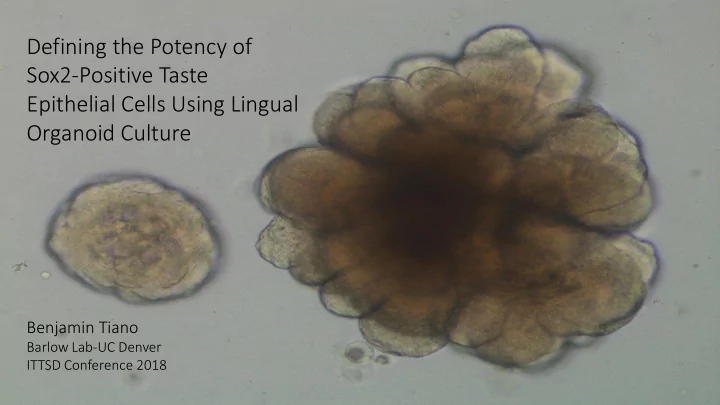
Defining the Potency of Sox2-Positive Taste Epithelial Cells Using Lingual Organoid Culture Benjamin Tiano Barlow Lab-UC Denver ITTSD Conference 2018
What we know already LGR5-EGFP/ Sox2/LGR5-EGFP/ Sox2 KCNQ1 KCNQ1 • Single LGR5+ cells generate renewing lingual organoids (Ren et al., 2014) • Basal proliferative Sox2+ cells give rise to all types of taste bud cells (Ohmoto et al., 2017) • Sox2 is expressed in LGR5+ Ohmoto et al., 2017 cells (Ohmoto et al., 2017) • Sox2 deletion in lingual progenitors disrupts taste Sox2 bud renewal (Castillo-Azofeifa et al., 2018) * * Suzuki, 2008
What we know already • Single LGR5+ cells generate Low-GFP renewing lingual organoids (Ren et al., 2014) • Basal proliferative Sox2+ MedLo- Sox2-GFP cells give rise to all types of GFP Circumvallate taste bud cells (Ohmoto et al., Papilla HiMed-GFP 2017) • Sox2 is expressed in LGR5+ High-GFP cells (Ohmoto et al., 2017) • Sox2 deletion in lingual Collect tongues and Dissociate into single FACS sort progenitors disrupts taste epithelia cell suspension based on GFP bud renewal (Castillo-Azofeifa expression level et al., 2018)
Do they grow?
Do different Sox2+ populations exhibit different growth potentials? 1000 cells/well 500 cells/well
LGR5 is differentially expressed by organoids from different Sox2 expression bins
Acknowledgements Barlow Lab Linda Barlow Dany Gaillard Erin Golden Jenn Scott Lauren Shechtman Kelly Zaccone
Recommend
More recommend
Explore More Topics
Stay informed with curated content and fresh updates.