ERISA Benefit Plans in M&A: Transitioning Pension, Retiree - - PowerPoint PPT Presentation

erisa benefit plans in m a transitioning pension retiree
SMART_READER_LITE
LIVE PREVIEW

ERISA Benefit Plans in M&A: Transitioning Pension, Retiree - - PowerPoint PPT Presentation

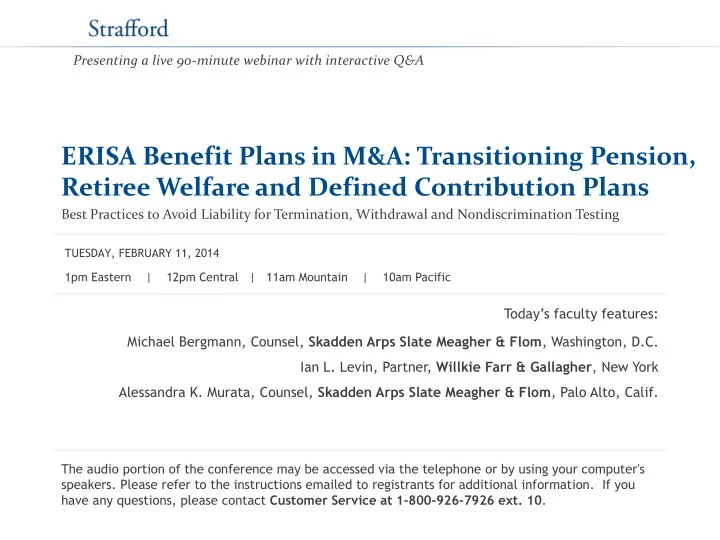
Presenting a live 90-minute webinar with interactive Q&A ERISA Benefit Plans in M&A: Transitioning Pension, Retiree Welfare and Defined Contribution Plans Best Practices to Avoid Liability for Termination, Withdrawal and Nondiscrimination


slide-1
SLIDE 1

ERISA Benefit Plans in M&A: Transitioning Pension, Retiree Welfare and Defined Contribution Plans

Best Practices to Avoid Liability for Termination, Withdrawal and Nondiscrimination Testing Today’s faculty features:

1pm Eastern | 12pm Central | 11am Mountain | 10am Pacific

The audio portion of the conference may be accessed via the telephone or by using your computer's

  • speakers. Please refer to the instructions emailed to registrants for additional information. If you

have any questions, please contact Customer Service at 1-800-926-7926 ext. 10.

TUESDAY, FEBRUARY 11, 2014

Presenting a live 90-minute webinar with interactive Q&A Michael Bergmann, Counsel, Skadden Arps Slate Meagher & Flom, Washington, D.C. Ian L. Levin, Partner, Willkie Farr & Gallagher, New York Alessandra K. Murata, Counsel, Skadden Arps Slate Meagher & Flom, Palo Alto, Calif.

slide-2
SLIDE 2

Sound Quality If you are listening via your computer speakers, please note that the quality

  • f your sound will vary depending on the speed and quality of your internet

connection. If the sound quality is not satisfactory, you may listen via the phone: dial 1-866-258-2056 and enter your PIN when prompted. Otherwise, please send us a chat or e-mail sound@straffordpub.com immediately so we can address the problem. If you dialed in and have any difficulties during the call, press *0 for assistance. Viewing Quality To maximize your screen, press the F11 key on your keyboard. To exit full screen, press the F11 key again.

FOR LIVE EVENT ONLY

slide-3
SLIDE 3

For CLE purposes, please let us know how many people are listening at your location by completing each of the following steps:

  • In the chat box, type (1) your company name and (2) the number of

attendees at your location

  • Click the SEND button beside the box

If you have purchased Strafford CLE processing services, you must confirm your participation by completing and submitting an Official Record of Attendance (CLE Form). You may obtain your CLE form by going to the program page and selecting the appropriate form in the PROGRAM MATERIALS box at the top right corner. If you'd like to purchase CLE credit processing, it is available for a fee. For additional information about CLE credit processing, go to our website or call us at 1-800-926-7926 ext. 35.

FOR LIVE EVENT ONLY

slide-4
SLIDE 4

If you have not printed the conference materials for this program, please complete the following steps:

  • Click on the ^ symbol next to “Conference Materials” in the middle of the left-

hand column on your screen.

  • Click on the tab labeled “Handouts” that appears, and there you will see a

PDF of the slides for today's program.

  • Double click on the PDF and a separate page will open.
  • Print the slides by clicking on the printer icon.

FOR LIVE EVENT ONLY

slide-5
SLIDE 5

ERISA BENEFIT PLANS IN M&A: TRANSITIONING PENSION, RETIREE WELFARE AND DEFINED CONTRIBUTION PLANS

Alessandra K. Murata

Skadden, Arps, Slate, Meagher & Flom LLP, Palo Alto Presented by

Michael Bergmann

Skadden, Arps, Slate, Meagher & Flom LLP, Washington, DC

Ian L. Levin

Willkie Farr & Gallagher LLP, New York

slide-6
SLIDE 6

AGENDA

I. Pension Plan Obligations II. Retiree Welfare Benefit Obligations III. Defined Contribution Plans IV. Non-Qualified Deferred Compensation Plans V. International Plans

6

slide-7
SLIDE 7
  • I. Pension Plan Obligations

7

slide-8
SLIDE 8
  • I. PENSION PLAN OBLIGATIONS
  • A. Treatment of Pension Plans
  • B. Single Employer Plan Underfunding Liability
  • C. Multiemployer Plan Withdrawal Liability
  • D. Joint and Several Controlled Group Liability (Sun Capital)
  • E. Minimizing Potential Liability in M&A Deal

8

slide-9
SLIDE 9
  • A. Treatment of Pension Plans

9

slide-10
SLIDE 10
  • I. PENSION PLAN OBLIGATIONS

Stock Sale & Merger:

  • Treatment of a plan depends on whether it is maintained at the target

entity (or any of its subsidiaries) versus a parent or other affiliate

  • Any plan maintained by the target entity or any of its subsidiaries will

continue to be maintained by that entity, unless the parties provide

  • therwise
  • If a plan is maintained at the target’s parent or other affiliate, parties

may agree to provide for the transfer of plan sponsorship or a division

  • f the plan
  • Employees of target who continue to be employed by target after

closing will not be terminating employment

  • A. Treatment of Pension Plans – In Transaction

10

slide-11
SLIDE 11
  • I. PENSION PLAN OBLIGATIONS

Asset Sales:

  • Assets of an entity, but not the entity, itself, are acquired
  • Absent agreement to provide otherwise, plans will remain with the

Seller and will not be transferred to buyer

  • Employees who transfer to Buyer will be terminating employment with

Seller (but if plan or spun-off plan is assumed by Buyer, no termination may occur)

  • A. Treatment of Pension Plans - In Transaction

11

slide-12
SLIDE 12
  • I. PENSION PLAN OBLIGATIONS
  • Possibilities
  • Plan is automatically assumed/continued
  • Plan is contractually assumed by Buyer
  • Portion of assets and liabilities of Plan are “spun-off” as a new plan and

contractually assumed

  • Portion of assets and liabilities of Plan are transferred by trust-to-trust

transfer to Buyer’s plan (e.g., a spin-off and merger)

  • A. Treatment of Pension Plans - In Transaction

12

slide-13
SLIDE 13
  • I. PENSION PLAN OBLIGATIONS
  • Transaction agreements should specifically address:
  • How plan will be assumed by Buyer
  • How trust-to-trust transfer/spin-off will be effected:
  • Timing
  • Activities
  • Actuarial assumptions
  • Dispute mechanism (“battle of the actuaries”)
  • A. Treatment of Pension Plans - In Transaction

13

slide-14
SLIDE 14
  • I. PENSION PLAN OBLIGATIONS

Transfer of Plan Assets: Trust-to-Trust Transfer /“Spin-off” IRC 414(l) (Treas. Reg. §1.414(l)-1)

  • DC Plans
  • Transfer of vested and unvested accounts
  • Active participants
  • Parties may agree to transfer accounts of inactive participants who were

employed by business or subsidiary

  • DB Plans
  • Assets and liabilities must be transferred to provide each participant in the

spun-off plan with a benefit that is at least equal to the value of the benefit the participant would have been entitled to receive before the merger

  • A. Treatment of Pension Plans - In Transaction

14

slide-15
SLIDE 15
  • I. PENSION PLAN OBLIGATIONS

Treatment of Plan by Buyer

  • Merge plan into Buyer’s existing plan
  • Freeze plan
  • Terminate plan
  • A. Treatment of Pension Plans – Post-Transaction

15

slide-16
SLIDE 16
  • I. PENSION PLAN OBLIGATIONS

Merging Plans

  • Plans may be merged into similar plans of Buyer
  • When plans are merged, it is necessary that the surviving plan include

all of the "protected benefits" of the merged plans

  • Protected benefits include early retirement benefits, certain retirement

subsidies, and optional distribution forms

  • Vesting schedules may need to be preserved
  • A. Treatment of Pension Plans – Post-Transaction

16

slide-17
SLIDE 17
  • I. PENSION PLAN OBLIGATIONS

Merging Plans

  • Before merging plans, determine which benefits must be sustained as

protected benefits.

  • The maintenance of certain protected benefits may make a plan merger

infeasible or administratively burdensome.

  • A. Treatment of Pension Plans – Post-Transaction

17

slide-18
SLIDE 18
  • I. PENSION PLAN OBLIGATIONS

Issues to Consider When Assuming Qualified Plans

  • Prior Service Credit. (IRC 401(a)(4))
  • If employees of target are hired, Buyer may be required to, or may voluntarily decide to,

amend its plans to grant prior service credit to transferred employees

  • Granting prior service credit to an employee of an acquired entity recognizes the employee's

service to the acquired entity as service to the buyer for plan purposes

  • In an asset sale, prior service credit can be granted to transferred employees of an acquired

entity for either eligibility or vesting purposes, or both, and can be limited to a maximum number of years

  • Such grant would be tested under IRC 401(a)(4) to determine whether such an amendment is

not discriminatory in favor of highly compensated employees

  • In a stock sale, the grant of prior service to the transferred employees of an acquired entity is

generally required for both eligibility and vesting purposes

  • A. Treatment of Pension Plans – Post-Transaction

18

slide-19
SLIDE 19
  • I. PENSION PLAN OBLIGATIONS

Transfer of Plan Assets: Trust-to-trust Transfer Spin-off:

  • If Buyer acquires only a division or subsidiary of seller and such

division or subsidiary participates in the seller's tax-qualified plan, Buyer will not be able to assume the plan in which the acquired entity participates.

  • Rather than assuming the plan, buyer may agree to take a trust-to-trust

transfer from such plan.

  • Typically called a “spin-off”
  • A. Treatment of Pension Plans – Post-Transaction

19

slide-20
SLIDE 20
  • I. PENSION PLAN OBLIGATIONS

Transfer of Plan Assets: Direct Rollover Distributions

  • Sale of assets may be a distributable event for most plans unless

Buyer assumes plan (or spin-off of plan)

  • Where stock of subsidiary is sold Buyer and subsidiary’s employees

participate in Seller’s tax-qualified pension plan, employees may be treated as having a termination of employment under the plan.

  • If there is a distribution event under the seller’s plan, transferred

employees may be permitted to roll over their benefits to one of Buyer’s plan

  • A. Treatment of Pension Plans – Post-Transaction

20

slide-21
SLIDE 21
  • I. PENSION PLAN OBLIGATIONS

Transfer of Plan Assets: Trust-to-trust Transfer/Spin-off

  • In a trust-to-trust transfer, an employee's account balance is paid by the

trustee of one plan to the trustee of another.

  • IRC 411(d)(6) requires that accrued benefits or optional forms of benefits not

be reduced or eliminated.

  • After a trustee-to-trustee transfer, a participant’s accrued benefits and optional

forms of benefits that existed under the transferor's plan must exist to the same extent under the Buyer's plan.

  • More flexibility to eliminate optional forms of benefit under DC Plans
  • If Buyer agrees to allow a trust-to-trust transfer to its plan, it should carefully

review the prior plan to ensure that such protected benefits will continue to be

  • ffered to transferred participants.
  • A. Treatment of Pension Plans – Post-Transaction

21

slide-22
SLIDE 22
  • I. PENSION PLAN OBLIGATIONS

Terminating Plans

  • Corporate action to terminate
  • Full vesting of participants required (may include certain terminated

participants)

  • DC Plans, including 401(k) plans, may be terminated at any time
  • In the case of a stock deal or merger, if a 401(k) is terminated after closing,

participants in the terminated plan may not participate in a new 401(k) plan for 12 months.

  • To avoid 12-month ineligibility period, 401(k) plan should be terminated immediately

prior to closing (actual distributions may be made after closing)

  • To terminate a single employer pension plan, plan will need to be fully funded,

which may be very costly

  • A. Treatment of Pension Plans – Post-Transaction

22

slide-23
SLIDE 23
  • I. PENSION PLAN OBLIGATIONS

Freezing Plans

  • An assumed plan may be “frozen”
  • eligibility
  • accruals
  • If a plan is frozen:
  • all active participants must continue to accrue vesting service in their plan

benefits

  • plan must continue to be maintained in compliance with applicable law

(e.g., Form 5500 should be filed, the plan document must be updated for legally required changes, etc.)

  • A. Treatment of Pension Plans – Post-Transaction

23

slide-24
SLIDE 24
  • I. PENSION PLAN OBLIGATIONS

Freezing Plans DB Plans

  • Plan sponsor of a closed DB plan typically provides a DC plan for its

new hires

  • In the early years after the DB plan has been closed to new entrants,

the plan may be able to satisfy the coverage requirement of IRC 410(b) without being aggregated with the DC plan

  • IRC 410(b) minimum coverage test typically becomes more difficult for

a closed DB plan to satisfy over time, as the proportion of plan participants who are highly compensated employees increases

  • A. Treatment of Pension Plans – Post-Transaction

24

slide-25
SLIDE 25
  • I. PENSION PLAN OBLIGATIONS

Freezing Plans DB Plans

  • IRC 401(a)(26) requires that each qualified pension plan to benefit at

least 50 employees or 40% of all employees in the controlled group

  • Plans may not be aggregated to satisfy this requirement
  • This requirement may restrict Buyer from maintaining a frozen pension

plan permanently

  • IRC 401(a)(26) provides a transition period to comply
  • Transition period being on the closing date and ends of the last day of

the first plan year beginning after the plan year in which the closing date occurs

  • A. Treatment of Pension Plans – Post-Transaction

25

slide-26
SLIDE 26
  • I. PENSION PLAN OBLIGATIONS

Issues to Consider When Assuming Qualified Plans

  • Nondiscrimination in Participation
  • To be tax-qualified, a plan must not discriminate in favor of "highly compensated

employees"

  • If a plan is assumed in connection with a transaction, difficulties may arise in complying

with IRC 410(b) depending on concentration of highly compensated employees in the acquired company and the overall concentration of highly compensated employees in Buyer’s controlled group

  • IRC 410(b) provides a transition period to comply with the coverage requirements

following a transaction

  • Transition period begins on the closing date and ends on the last day of the first plan

year beginning after the plan year in which the closing date occurs

  • A. Treatment of Pension Plans – Post-Transaction

26

slide-27
SLIDE 27
  • I. PENSION PLAN OBLIGATIONS

Issues to Consider When Assuming Qualified Plans

  • Nondiscriminatory Contributions or Benefits: (IRC 401(a)(4))
  • A plan must not discriminate with respect to contributions or benefits provided under

the plan discriminate in favor of highly compensated employees

  • IRC 401(a)(4) contains three basic requirements:
  • Either the contributions or the benefits provided under a plan must be nondiscriminatory in

amount (401(k) plans must satisfy a different nondiscrimination amount requirement)

  • Plan's benefits, rights, and features must be made available to participants in a

nondiscriminatory manner; and

  • Effect of plan amendments (including grants of past service credit) and plan terminations

must be nondiscriminatory

  • It may be difficult to satisfy this nondiscrimination requirement following a merger or

acquisition because of the change in the workforce and the plans in which various groups of employees participate

  • A. Treatment of Pension Plans – Post-Transaction

27

slide-28
SLIDE 28
  • I. PENSION PLAN OBLIGATIONS

Issues to Consider When Assuming Qualified Plans

  • Non-Discrimination of Optional Benefit Forms. (Treasury Regulation

§1.401(a)(4)-4(d))

  • Optional forms of benefit can continue to be available to participant in plan

if:

  • Benefit satisfied the requirements under IRC 401(a)(4) immediately before the

transaction and

  • Benefit is available under the plan of Buyer after the transaction on the same

terms as it was available under prior plan before the transaction.

  • A. Treatment of Pension Plans – Post-Transaction

28

slide-29
SLIDE 29
  • I. PENSION PLAN OBLIGATIONS

Freezing Plans – DB Plans

  • Notice 2014-5
  • Limited relief from nondiscrimination requirements if DB plan was frozen

before December 13, 2013

  • A. Treatment of Pension Plans – Post-Transaction

29

slide-30
SLIDE 30
  • I. PENSION PLAN OBLIGATIONS

Issues to Consider When Assuming Qualified Plans

  • 401(k) Plans
  • IRC 401(k) and 401(m) provide that the amount of participant elective

deferrals and matching contributions made on behalf of highly compensated employees cannot exceed the amount of deferrals and matching contributions to a plan on behalf of non-highly compensated employees by a certain amount

  • These tests, known as ADP and ACP tests are not performed on a

controlled group basis – each 401(k) plan must satisfy these tests

  • A. Treatment of Pension Plans – Post-Transaction

30

slide-31
SLIDE 31
  • B. Single Employer Plan Underfunding Liabilities

31

slide-32
SLIDE 32

Underfunded Defined Benefit Pension Plans

  • One of the most significant Buyer liability issues in corporate transactions
  • Funded based on actuarial assumptions on several factors, such as—
  • Long-term interest rates
  • Mortality
  • Turnover
  • Retirement age
  • Investment returns
  • Assumptions used may vary depending on purpose for which liability is determined—
  • Financial accounting
  • Termination liability
  • PPA funding target/minimum contribution requirements
  • I. PENSION PLAN OBLIGATIONS
  • B. Single Employer Plan Underfunding Liabilities

32

slide-33
SLIDE 33
  • I. PENSION PLAN OBLIGATIONS
  • In the past several years, underfunding of defined benefit pension

plans has become common, due to factors such as—

  • Economic Downturn – Impacts investment returns
  • Depressed Interest Rates – Increases present value of accrued benefits and

funding targets

  • PPA Funding Requirements – Limits use of credit balances to fund benefits

and requires higher funding levels than prior law

  • B. Single Employer Plan Underfunding Liabilities

33

slide-34
SLIDE 34
  • I. PENSION PLAN OBLIGATIONS
  • Primary issues Buyer needs to consider regarding target’s

underfunded single-employer defined benefit pension plans include—

  • Unfunded Termination Liabilities – Adversely impacts Buyer’s balance sheet
  • Requirement Minimum Contributions – Effect on cash flow
  • IRC§436 – Will benefit restrictions be triggered?
  • B. Single Employer Plan Underfunding Liabilities

34

slide-35
SLIDE 35
  • I. PENSION PLAN OBLIGATION
  • Underfunded DB Plan may be terminated through a “distress”

termination initiated by the plan sponsor or through an “involuntary” termination initiated by the PGBC

  • PBGC may initiate an involuntary termination if it determines, among other things,

that—

  • Plan has not met the minimum funding standard (e.g., a funding deficiency arises)
  • Plan will be unable to pay benefits when due
  • PBGC’s long-run loss with respect to the plan may increase unreasonably if the plan is

not terminated

  • Liability risk to PBGC of plan termination before a corporate transaction is compared to

liability risk of terminating plan after transaction.

  • For example, if transaction would substantially increase plan liabilities or reduce PBGC’s

ability to collect termination liability, PBGC may decide its potential long-run loss warrants termination of plan

  • B. Underfunding Liabilities: Termination Liability

35

slide-36
SLIDE 36
  • I. PENSION PLAN OBLIGATION
  • When an underfunded DB Plan terminates , the PBGC may assert

three types of termination liability claims—

  • Unfunded Liabilities: Difference, as of the date of plan termination, between

the value of all accrued benefits under plan over value of plan assets, using conservative actuarial assumption set out in PBGC regulations for this purpose

  • Liabilities determined under these assumptions can be substantially higher than plan

liabilities determined on an on-going basis

  • Unpaid Contributions: Unpaid contributions to the plan, prorated to the date
  • f plan termination
  • PBGC Premiums: Unpaid annual PBGC premiums, prorated to date of plan

termination, plus PBGC termination premiums

  • B. Underfunding Liabilities: Termination Liability

36

slide-37
SLIDE 37
  • I. PENSION PLAN OBLIGATIONS
  • Termination liability is joint and several obligation of contributing

sponsor and each member of its controlled group

  • PBGC may seek payment of 100% of joint and several termination liability

from any member of the controlled group

  • No provision in ERISA for allocating joint and several liability among

controlled group members

  • B. Underfunding Liabilities: Termination Liability

37

slide-38
SLIDE 38
  • I. PENSION PLAN OBLIGATIONS
  • Imposition of Lien
  • If the Unfunded Liabilities are not paid upon demand, a lien in favor of the

PBGC will be placed on all property of the plan sponsor and its controlled group members

  • Amount of lien is lesser of the Unfunded Liabilities and 30% of the combined net

worth of the plan sponsor and its controlled group members

  • B. Underfunding Liabilities: Termination Liability

38

slide-39
SLIDE 39
  • I. PENSION PLAN OBLIGATIONS
  • PBGC Intervention in Transaction (PBGC Early Warning Program)
  • PBGC monitors companies with underfunded pension plans and looks for transactions that

pose an increased risk of long-run loss to the PBGC

  • Focus is on transactions that may substantially undermine sponsor’s ability to fund plan or

PBGC’s ability to collect termination liability if plan is terminated. Examples—

  • Break-up of controlled group, including spin-off of subsidiary
  • Major divestiture by employer who retains significant underfunded pension liabilities
  • Transfer of significantly underfunded pension liabilities in connection with sale of business
  • PBGC might request additional information regarding transaction and then go away, or may

threaten involuntary termination of plan prior to the transaction if there are major issues

  • Threat of involuntary termination provides PBGC leverage to negotiate additional protections

for plan, such as additional contributions, security for future contributions or a guarantee from a financially sound company that is leaving the controlled group

  • B. Underfunding Liabilities: Termination Liability

39

slide-40
SLIDE 40
  • I. PENSION PLAN OBLIGATIONS
  • Evasive Transactions: 5 -Year Lookback Rule
  • If the principal purpose of entering into a transaction is to evade

termination liability and the pension plan terminates within 5 years after transaction, the transaction is ignored for purposes of assessing termination liability against prior contributing sponsor

  • Benefit increases that are effective after the transaction date are not taken

into account

  • If prior sponsor ceases to exist due to a reorganization, merger or

consolidate, the successor entity (and the members of its controlled group) will be responsible for the termination liability

  • B. Underfunding Liabilities: Termination Liability

40

slide-41
SLIDE 41
  • I. PENSION PLAN OBLIGATIONS
  • Minimum Required Contributions
  • Funding Target: Plan sponsors must make minimum required contributions to plans

when value of plan assets is less than present value of all benefits accrued as of the beginning of the plan year (the “funding target”)

  • Minimum required contribution for year equals plan's target normal cost plus amortization of the

funding shortfall

  • Target normal cost is the present value of all benefits accrued during the plan year
  • Funding shortfall is the difference between the plan's funding target and the plan's assets
  • Additional contribution requirements and a higher funding target apply to “at risk” plans, i.e. funding

target attainment percentage is less than 80%

  • Timing: Minimum required contribution for a plan year generally must be paid 8½ months

after the end of the plan year

  • Quarterly contributions are required if the plan had a funding shortfall for the prior year
  • J&S Liability: Like termination liability, liability for unpaid minimum required contributions

is joint and several obligation of plan sponsor and controlled group members

  • B. Underfunding Liabilities: Unpaid Contributions

41

slide-42
SLIDE 42
  • I. PENSION PLAN OBLIGATIONS
  • Excise Tax on Unpaid Minimum Contributions
  • If minimum required contribution isn't timely paid, sponsor will be charged an excise tax
  • For single-employer plans, the tax is 10% of the unpaid contribution
  • Can increase to 100% if contributions remain unpaid
  • Tax is in addition to interest charged on late payment.
  • Lien for Unpaid Contributions
  • If a minimum required contribution is not made when due and the balance of unpaid

contributions is more than $1 million, a lien may be imposed on the property of the liable controlled group members in the amount of the unpaid contributions

  • PBGC can perfect lien, which will give PBGC a security interest in the property of the plan

sponsor and controlled group members

  • Treated as federal tax lien
  • B. Underfunding Liabilities: Unpaid Contributions

42

slide-43
SLIDE 43
  • I. PENSION PLAN OBLIGATIONS
  • IRC §436 – Restricts benefit payments, benefit increases and benefit accruals

under single-employer defined benefit pension plans based on plan underfunding

  • If adjusted funding target attainment percentage (AFTAP) is less than 80%, but greater than or

equal to 60%—

  • 50% restriction on accelerated benefit distributions (e.g., lump sums)
  • No amendments increasing benefits
  • If AFTAP is less than 60%—
  • 100% restriction on accelerated benefit distributions
  • No amendments increasing benefits
  • No unpredictable contingent event benefits
  • Cessation of future benefit accruals
  • Buyer needs to be aware of these restrictions when assuming all or a portion of target’s

underfunded plan

  • For example, these restrictions can be particularly inconvenient where buyer assumes target’s underfunded

cash balance plan or other defined benefit plan that pays benefits in form of lump sum

  • B. Underfunding Liabilities: Benefit Restrictions

43

slide-44
SLIDE 44
  • C. Multiemployer Plan Withdrawal Liability

44

slide-45
SLIDE 45
  • I. PENSION PLAN OBLIGATIONS
  • Withdrawal liability arises when an employer participates in, and

then completely or partially withdraws from, an underfunded multiemployer pension plan

  • An employer that withdraws from a multiemployer plan is liable for the

employer’s share of the plan’s unfunded vested benefits

  • Amount of withdrawal liability is determined under statutory formula and

calculated as of the last day of the plan year before the plan year in which the employer withdraws

  • Upon withdrawal, the plan determines the amount of withdrawal liability,

notifies the employer of the amount and collects it from the employer

  • Joint and several obligation of each member of employer’s

controlled group of trades of businesses

  • C. Multiemployer Plan Withdrawal Liability

45

slide-46
SLIDE 46
  • I. PENSION PLAN OBLIGATIONS
  • Complete Withdrawal
  • A complete withdrawal occurs when an employer—
  • Permanently ceases to have an obligation to contribute to the multiemployer plan
  • Examples:
  • Employer sells the business that contributes to the plan
  • Employer ceases to be covered by a collective bargaining agreement
  • Permanently ceases all covered operations under the plan
  • Examples:
  • Employer permanently closes all plants and facilities that employ the

workers covered by the plan

  • Employer goes out of business
  • C. Multiemployer Plan Withdrawal Liability

46

slide-47
SLIDE 47
  • I. PENSION PLAN OBLIGATIONS
  • Partial Withdrawal
  • A partial withdrawal occurs when there is –
  • Decline of 70% or more in the employer’s “contribution base units”
  • Contribution base unit is the unit by which the employers contribution is measured (e.g., hours

worked, individuals employed per month, etc.)

  • Decline is measured over 3-year testing period, based on average number of contribution base

units for the two plan years in which contribution base units were highest out of the 5 plan years immediately preceding the 3-year testing period

  • Partial cessation of the employer’s obligation to contribute
  • Employer permanently ceases to have obligation to contribute under one or more, but not all,
  • f its collective bargaining agreements, but continues to perform work of the type for which

contributions were previously required

  • Employer permanently ceases to have obligation to contribute to plan with respect to work

performed at one or more, but fewer than all, of its facilities, but continues to perform work at the facilities of the type for which the obligation to contribute ceased

  • C. Multiemployer Plan Withdrawal Liability

47

slide-48
SLIDE 48
  • I. PENSION PLAN OBLIGATIONS
  • Amount of Withdrawal Liability
  • Depends on several factors, including –
  • Contribution history of withdrawing employer
  • Amount of plan underfunding
  • Plan investment performance
  • Number and timing of other withdrawing employers
  • Last employer in might shoulder lion’s share of liability
  • Withdrawal liability can be extremely expensive
  • In 2007, United Parcel Service paid over $6 billion in withdrawal liability to Central State

Teamsters Pension Plan

  • Even small employers can be assessed millions of dollars in withdrawal liability, depending
  • n extent of plan’s unfunded vested benefits
  • C. Multiemployer Plan Withdrawal Liability

48

slide-49
SLIDE 49
  • I. PENSION PLAN OBLIGATIONS

Withdrawal Liability in M&A Transactions

  • Buyer in corporate transaction generally is not responsible for withdrawal

liability resulting solely from the sale

  • But Buyer may expose itself to significant withdrawal liability if it sells or closes the

relevant facilities in a subsequent transaction

  • Where withdrawal liability exists at the time of corporate transaction—
  • Stock Sale: Buyer may assume potential withdrawal liability as a contingent liability
  • Buyer acquires contribution history of the acquired entity and will be responsible for

withdrawal liability upon the occurrence of any of the triggering events

  • Asset Sale: May trigger withdrawal liability for the Seller, unless the “sale of assets”

exception applies

  • C. Multiemployer Plan Withdrawal Liability

49

slide-50
SLIDE 50
  • I. PENSION PLAN OBLIGATIONS
  • Sale of Assets Exception
  • In an asset sale, Seller can avoid withdrawal liability if transaction is structured to

comply with the “sale of assets” exception under ERISA § 4204

  • Buyer retains an obligation to contribute to plan in substantially the same number of

contribution base units as Seller had prior to sale

  • Buyer picks up 5-year contribution history of Seller
  • Buyer posts bond to plan for period of 5 years after date of purchase equal to the greater of –
  • (i) the average required contributions of Seller for the 3 years prior to the sale, and
  • (ii) the amount of required contributions for the year immediately prior to the sale
  • The sales agreement includes a provision that the Seller will remain secondarily liable for a

Buyer’s withdrawal for a period of 5 years after the sale

  • If all, or substantially all, of Seller’s remaining assets are distributed or Seller is liquidated prior

to end of 5th plan year after transaction, Seller will be required to post bond or escrow amount equal to 100% of withdrawal liability Seller would have incurred without the exception

  • C. Multiemployer Plan Withdrawal Liability

50

slide-51
SLIDE 51
  • D. Joint and Several Controlled Group Liability

51

slide-52
SLIDE 52
  • I. PENSION PLAN OBLIGATIONS
  • Under ERISA, each member of the “controlled group” consisting of the

employer and each trade or business under common control with employer is jointly and severally liable for employer’s share of the DB Plan obligations previously discussed, i.e.—

  • PBGC termination liability
  • Withdrawal liability
  • Required minimum contributions
  • PBGC premiums
  • ERISA liens
  • Also, certain IRS tax-qualification requirements (e.g., coverage and

nondiscrimination testing, statutory plan limits, etc.) are applied on a controlled group basis

  • D. Joint and Several Controlled Group Liability

52

slide-53
SLIDE 53
  • I. PENSION PLAN OBLIGATIONS
  • Controlled Group Rules
  • ERISA defines “controlled group” by reference to the rules under IRC §§

414(b) and (c)

  • IRC § 414(b): Controlled group of corporations (as determined, generally, under

rules set out in IRC § 1563)

  • IRC § 414(c): Controlled groups of trades or business (whether or not

incorporated)

  • Regulations under IRC § 414(c) based on similar principles as apply under IRC § 414(b)
  • For purposes of joint and several withdrawal liability under Title IV of ERISA, “controlled

group” is defined by reference to trades or businesses under common control, as determined under IRC § 414(c)

  • D. Joint and Several Controlled Group Liability

53

slide-54
SLIDE 54
  • I. PENSION PLAN OBLIGATIONS
  • Types of Controlled Groups (Under IRC § 414(c))
  • Parent-Subsidiary Controlled Group
  • Trade or business owns, directly or indirectly, a controlling interest (generally 80% or greater) in the contributing

employer, or

  • Contributing employer owns, directly or indirectly, a controlling interest in the trade or business
  • Brother-Sister Controlled Group
  • Two or more organizations conducting trades or businesses are under common control if—
  • Same 5 or fewer persons who are individuals, estates or trusts own a controlling (80% or more) interest in each
  • f the organizations, and
  • Taking into account the ownership of each such person only to the extent such ownership overlaps, such person

are in effective control (50% or greater) of each organization

  • Combined Group
  • Any group of 3 or more organizations if—
  • Each organization is a member of either a parent-subsidiary or brother-sister group of trades of businesses

under common control, and

  • At least one such organization is the common parent of both a parent-subsidiary and brother-sister group of

trades or businesses under common control

  • D. Joint and Several Controlled Group Liability

54

slide-55
SLIDE 55
  • I. PENSION PLAN OBLIGATIONS
  • “Trades or Businesses” under Common Control
  • To impose joint and several controlled group liability under ERISA, both the

“trade or business” and “common control” elements must exist

  • Trade or Business:
  • Neither ERISA nor the IRC define what constitutes a “trade or business” for purposes
  • f applying the controlled group rules
  • Under tax-law precedents, Investment activity alone is not a trade or business:
  • “Devoting one’s time and energies to the affairs of a corporation is not, of itself, and without

more, a trade of business to the person so engaged. Though such activity may produce income, profit or gain in the form of dividends or enhancement in the value of an investment, this return is distinctive to the process of investing and is generated by the successful

  • peration of the corporation’s business as distinguished from the trade or business of the

taxpayer himself.” (Whipple v. Comm’r., 373 U.S. 193, 202 (1963))

  • Groetzinger test: A taxpayer is engaged in a trade or business if it is engaged in an

activity with “the primary purpose of income or profit” and it is involved in such activity “with continuity and regularity.” (Comm’r. v. Groetzinger, 480 U.SD. 23 (1987))

  • D. Joint and Several Controlled Group Liability

55

slide-56
SLIDE 56
  • I. PENSION PLAN OBLIGATIONS
  • Impact of Controlled Group Rules on Private Equity Funds
  • If PE Fund is considered to be a trade or business under ERISA, the Fund’s
  • wnership of a controlling interest in a portfolio company would cause the

PE Fund and the portfolio company (and any other portfolio companies controlled by the Fund) to be treated as a controlled group

  • Membership in the controlled group would expand each time the PE Fund

acquired a controlling interest in another portfolio company

  • The PE Fund and each portfolio company comprising the controlled group

would have joint and several liability under ERISA for the pension plan liabilities of each controlled portfolio company

  • D. Joint and Several Controlled Group Liability

56

slide-57
SLIDE 57
  • I. PENSION PLAN OBLIGATIONS
  • Private Equity Funds as Trades or Businesses
  • Historic Treatment: Passive investment vehicles, such as PE Funds, that

have no employees, no involvement in the day to day affairs of its investments and no income other than passive investment income, such as dividends, interest and capital gains were not considered to be conducting a trade of business for purposes of the controlled group rules

  • PGBC Position: In a 2007 PBGC Appeal Board letter, applying the

Groetzinger test, the PBGC took the position that a PE Fund was a trade

  • r business because the primary purpose of the Fund was to make a profit

and that through its general partner, as agent to the Fund, management of Fund’s investments was conducted with regularity

  • The PBGC position has been referred to as an “investment plus” standard
  • D. Joint and Several Controlled Group Liability

57

slide-58
SLIDE 58
  • I. PENSION PLAN OBLIGATIONS
  • Sun Capital Partners III LP v. New England Teamsters and Trucking

Industry Pension Fund (1st Cir. July 24, 2013)

  • First Circuit held that a PE Fund qualified as a trade or business under ERISA

and was potentially joint and severally liable for withdrawal liability owed to a multiemployer pension plan by a portfolio company in which Fund had invested

  • Court held that, at least where a passive investment in an entity might defeat the

imposition of withdrawal liability, the court should apply an “investment plus” test to determine whether the entity is a trade or business under ERISA

  • Investment Plus Test: Making investments in portfolio companies for principal

purpose of making profit is not enough to cause PE Fund to be treated as a trade or business

  • Additional factors would have to be present that would distinguish the PE Fund

from a mere passive investor

  • D. Joint and Several Controlled Group Liability

58

slide-59
SLIDE 59
  • I. PENSION PLAN OBLIGATIONS
  • Sun Capital (continued)
  • Factors: Court did not provide guidelines for identifying which factors should

be considered under “investment plus” test, but Court did hold that the following factors, in the aggregate, were sufficient to treat Fund as trade or business:

  • Partnership agreements and PPM contained statements to the effect that Fund would

be actively involved in management and operation of portfolio companies

  • General partners were granted broad authority under partnership agreements to

participate in management of portfolio companies, including authority to hire, terminate and compensate agents and employees of portfolio companies

  • Fund’s controlling stake in portfolio company enabled them and their affiliated entities

to participate in management and operation of portfolio company to a degree well beyond that of a passive investor

  • Fund received a direct economic benefit an ordinary passive investor would not

receive in the form of a management fee offset

  • D. Joint and Several Controlled Group Liability

59

slide-60
SLIDE 60
  • I. PENSION PLAN OBLIGATIONS
  • Sun Capital (continued)
  • Common Control: Court remanded case to district court to determine

whether Fund was under common control with portfolio company

  • Although investment was structured so that none of the Sun Capital Funds

individually held an 80% or greater interest in portfolio company, the plaintiff plan characterized investment agreement between Sun Capital Funds as a partnership or joint venture

  • If combined holdings of Funds were attributed to a single partnership or joint

venture, resulting 100% ownership interest would constitute a controlling interest

  • Resolution of this issue will have a significant impact on how PE Funds

structure their investments

  • D. Joint and Several Controlled Group Liability

60

slide-61
SLIDE 61
  • E. Minimizing Potential Liability in M&A Deal

61

slide-62
SLIDE 62
  • I. PENSION PLAN OBLIGATIONS
  • Pre-acquisition due diligence of underfunded pension obligations
  • Notes to Financial Statements
  • Form 5500
  • Actuarial reports
  • Funding notices
  • Request estimate of withdrawal liability for multiemployer plans, if any
  • To extent possible, structure transaction so as to avoid triggering complete
  • r partial withdrawal from multiemployer plan
  • Effective representations covering pension obligations
  • All required contributions made, and PBGC premiums paid, when due
  • No requests for funding waivers
  • E. Minimizing Potential Liability in M&A Deal

62

slide-63
SLIDE 63
  • I. PENSION PLAN OBLIGATIONS
  • Develop appropriate indemnification provisions and coordinate with
  • verall indemnification basket used in transaction
  • If possible, avoid assuming sponsorship of underfunded DB Plans
  • Where assumption of underfunded DB Plan cannot be avoided, Buyer

should negotiate appropriate adjustment to purchase price to account for unfunded liabilities, measured on a basis agreed upon by the parties

  • Escrow portion of purchase price pending resolution of issues/audits
  • Offset installment payments of purchase price
  • E. Minimizing Potential Liability in M&A Deal

63

slide-64
SLIDE 64
  • II. Retiree Welfare Benefit Obligations

64

slide-65
SLIDE 65
  • II. RETIREE WELFARE BENEFIT OBLIGATIONS
  • A. Overview
  • B. Funding Alternatives

(i) Pay-As-You-Go (ii) VEBA (iii) ERISA Considerations

  • C. Terminating Retiree Welfare Benefits
  • D. Retiree Welfare M&A Best Practices

65

slide-66
SLIDE 66
  • A. Overview

66

slide-67
SLIDE 67
  • II. RETIREE WELFARE BENEFIT OBLIGATIONS
  • Many companies subsidize health and life insurance benefits for retirees

and their dependents; liabilities for these benefits can be material

  • Structure of M&A transaction typically dictates whether Seller or Buyer will

be responsible for Seller’s retiree welfare obligations

  • Asset Sale: Buyer will rarely agree to a transfer of Seller’s retiree welfare
  • bligations (at least with respect to current retirees)
  • Stock Sale: Buyer must assume such liabilities
  • Possible exception: Buyer purchases stock of wholly-owned sub of Seller and

negotiates carve-out of sub’s retiree health obligations, which are retained by Seller

  • r other Seller-related entity
  • If liabilities for retiree health obligations will transfer to Buyer, Buyer

should negotiate a purchase price adjustment to reflect unfunded current and projected liabilities

  • A. Overview

67

slide-68
SLIDE 68
  • B. Funding Alternatives

68

slide-69
SLIDE 69
  • II. RETIREE WELFARE BENEFIT OBLIGATIONS
  • Pay-As-You-Go
  • There is no requirement under ERISA to pre-fund welfare benefit obligations,

including retiree welfare obligations

  • Participant contributions to welfare plans, although technically considered to be

plan assets, are generally exempt from ERISA’s trust requirement (ERISA Tech.

  • Rel. 92-01)
  • Unfunded retiree welfare obligations must be reflected as liabilities for “other

postemployment benefits” on employer’s income statement and balance sheet

  • Fund, such as a trust, in which employer irrevocably deposits assets to pay retiree

welfare obligations can be treated as an asset that at least partially offsets this liability

  • B. Funding Alternatives: Pay-As-You-Go

69

slide-70
SLIDE 70
  • II. RETIREE WELFARE BENEFIT OBLIGATIONS
  • Voluntary Employees’ Beneficiary Association (VEBA)

IRC§501(c)(9)

  • Most common type of funding entity for retiree welfare obligations
  • Tax-exempt organization that can accumulate tax-free income-producing

reserves for the payment of life, sickness, accident or similar benefits to VEBA members and their dependents

  • Contributions are tax-deductible when made, subject to limitations
  • Benefits not taxable when received by member
  • IRS determination letter required
  • B. Funding Alternatives: VEBA

70

slide-71
SLIDE 71
  • II. RETIREE WELFARE BENEFIT OBLIGATIONS
  • VEBA - General Requirements
  • Organization Requirement: Separate legal entity independent of members or employer
  • Typically a trust, but can be a corporation or unincorporated association
  • Activities: Substantially all of VEBA’s operations must be in furtherance of providing permissible benefits
  • Membership: Generally restricted to employees (including dependents) with an “employee-related

common bond,” such as—

  • Common employer
  • Labor union affiliation
  • Coverage under CBA
  • Employees of VEBA or union whose members are members of the VEBA
  • Nondiscrimination: Cannot discriminate in favor of highly compensated employees as to both eligibility

and benefits (IRC§505(b))

  • Does not apply to collectively bargained VEBAs
  • Anti-inurement: No part of the net earnings of a VEBA may inure to the benefit of any individual, other

than through the payment of permissible benefits

  • Payment of disproportionate benefits to officers, shareholders or HCEs of a contributing employer would constitute

inurement

  • On dissolution, assets may be distributed to members or used to pay benefits until depleted, but cannot revert back to the

contributing employer

  • B. Funding Alternatives: VEBA

71

slide-72
SLIDE 72
  • II. RETIREE WELFARE BENEFIT OBLIGATIONS
  • Funding a VEBA
  • No required minimum contributions
  • Maximum deductible contributions (IRC§§419 and 419A )
  • Referred to as “additional reserve for post-retirement medical and life

insurance benefits” in IRC §419A(c)(2). Does not apply to collectively bargained funds, funds sponsored by non-profits, employee pay all or 10-or- more employer plans.

  • Funded over working lifetime of covered members
  • Actuarially determined on a level basis using assumptions that are reasonable

in the aggregate

  • B. Funding Alternatives: VEBA

72

slide-73
SLIDE 73
  • II. RETIREE WELFARE BENEFIT OBLIGATIONS
  • Funding a VEBA (continued)
  • Most fund over working lifetime of active employees and remaining

lifetime of retirees

  • Separate accounts required for key employees
  • Key employee contributions count as annual additions under IRC §415
  • Assets cannot revert to employer, but some flexibility to redirect funds
  • Amend to allow funds to be used for other permissible benefits (e.g., active

medical, dental, life, disability, etc.)

  • Ensure that employer’s right to amend or terminate the VEBA at any time is

reserved

  • B. Funding Alternatives: VEBA

73

slide-74
SLIDE 74
  • II. RETIREE WELFARE BENEFIT OBLIGATIONS
  • ERISA Consideration for Funded Retiree Welfare Arrangements
  • Reporting and Disclosure: Annual reports for funded welfare plan with 100 or more participants

must include audited financial statements prepared by a qualified independent public accountant

  • Unfunded (pay-as-you-go) plans generally are exempt from this requirement (ERISA Tech. Rel. 92-01)
  • Fiduciary Responsibilities: ERISA fiduciary responsibility provisions apply to any funded ERISA

plan, including a funded retiree welfare plan

  • Must be established and maintained in writing and designate “named fiduciaries” who have authority to

control and manage plan operations and administration

  • Must be held in trust by one of more trustees with authority and discretion to manage the assets
  • Fiduciaries must act (i) solely in the interest of participants and beneficiaries, (ii) with prudence, (iii) by

diversifying investments and (iv) in accordance with plan terms

  • Trust assets must be held for exclusive purpose of providing to participants and beneficiaries and

cannot be used for, or diverted to, any other purpose

  • Can’t engage in certain ERISA “prohibited transactions” with trust assets
  • B. Funding Alternatives: ERISA Considerations

74

slide-75
SLIDE 75
  • C. Terminating Retiree Welfare Benefits

75

slide-76
SLIDE 76
  • II. RETIREE WELFARE BENEFIT OBLIGATIONS
  • ERISA Standard
  • ERISA §201(1) expressly excludes employee welfare benefit plans from

ERISA’s vesting provisions

  • Accordingly, the Supreme Court has held that—
  • “Employers or other plan sponsors are generally free under ERISA, for any reason

and at any time, to adopt, modify or terminate welfare plans” Curtiss-Wright Corp.

  • v. Schoonejongen, 514 U.S. 73, 78 (1995)
  • At the same time, the Court has recognized that employees may bargain for

lifetime vesting of benefits and employers may waive their rights to terminate lifetime welfare benefits

  • C. Terminating Retiree Welfare Benefits

76

slide-77
SLIDE 77
  • II. RETIREE WELFARE BENEFIT OBLIGATIONS
  • Contractual Vesting
  • Most courts will enforce an express promise to provide lifetime welfare benefits
  • Where to look—
  • Plan documents
  • Summary plan descriptions (SPDs)
  • CBAs
  • If language in official plan documents is unclear as to employer’s intent to vest

lifetime benefits, courts will consider extrinsic evidence

  • Benefit brochures
  • Employee handbooks
  • Enrollment materials
  • Informal communications
  • C. Terminating Retiree Welfare Benefits

77

slide-78
SLIDE 78
  • II. RETIREE WELFARE BENEFIT OBLIGATIONS
  • Contractual Vesting (continued)
  • Other places to look for lifetime benefit promises—
  • Employment/separation agreements
  • Change-in-control/severance plans
  • Voluntary retirement windows
  • Absent a “reservation-of-rights-to-amend-or-terminate” clause in plan

documents, SPDs or CBAs, language stating that “coverage will continue after retirement,” or similar language, in employee communications can give rise to a claim that retiree benefits are vested and cannot be terminated

  • Retirees can be sympathetic plaintiffs in such cases
  • C. Terminating Retiree Welfare Benefits

78

slide-79
SLIDE 79
  • II. RETIREE WELFARE BENEFIT OBLIGATIONS
  • Reservation-of-Rights Clause
  • Courts have held that an unambiguous reservation-of-rights clause in plan documents or

CBAs allowing employer to modify or terminate benefits is incompatible with promise to provide lifetime benefits

  • Where official plan documents and SPDs include unambiguous reservation-of-rights clause,

courts have held that plan or contractual language such as “medical benefits will continue beyond retirement,” or “continuous health insurance will be provided,’ does not conflict with the reservation-of-rights clause or otherwise create an ambiguity in plan language

  • Likewise, promise of “lifetime” coverage generally will not trump an unambiguous

reservation-of-rights clause

  • But where an unambiguous reservation-of-rights clause is not included in documents, courts will

generally interpret such “lifetime” language to require vesting of retiree welfare benefits

  • Also, where reservation-of-rights clause is in plan document, but not iSPD, some courts have held that

reservation-of-rights clause is not enforceable, and a promise of lifetime benefits in SPD creates a vested right to lifetime benefits

  • C. Terminating Retiree Welfare Benefits

79

slide-80
SLIDE 80
  • D. Retiree Welfare M&A Best Practices

80

slide-81
SLIDE 81
  • II. RETIREE WELFARE BENEFIT OBLIGATIONS
  • Due Diligence of Retiree Welfare Obligations
  • Assess FAS 106 liability for postretirement benefits
  • Notes to Financial Statements
  • Funded vs. unfunded liabilities
  • Review funding vehicles for legal compliance
  • Trust agreements
  • Form 5500, Schedule H
  • Confirm right to terminate benefits is reserved in plan documents, SPDs and CBAs
  • If not, check all relevant employee documents and employee communications for promises of lifetime

benefits

  • Check employment agreements, separation agreements, CIC plans, etc. for additional

promises of lifetime benefits

  • D. Retiree Welfare M&A Best Practices

81

slide-82
SLIDE 82
  • II. RETIREE WELFARE BENEFIT OBLIGATIONS
  • Allocation of Liabilities Among Parties
  • Purchase agreement should clearly delineate responsibility for retiree welfare obligations
  • Asset deal: Seller retains liability for current retirees; Buyer assumes for active employees
  • If benefits are vested and can’t be terminated by Buyer, Buyer should consider insisting that either

Seller retain liability for all obligations or that purchase price be adjusted to take future liabilities into account

  • Stock deal: If Buyer is purchasing entire company, retiree welfare obligations will transfer with

company to Buyer

  • Again, If benefits are vested and can’t be terminated by Buyer, Buyer should consider insisting

that purchase price be adjusted to take future liabilities into account

  • If Buyer is purchasing subsidiary of parent, Buyer can treat deal similar to an asset deal and insist

that Target’s parent retain responsibility for some or all of Target’s retiree health liabilities

  • D. Retiree Welfare M&A Best Practices

82

slide-83
SLIDE 83
  • III. Defined Contribution Plans

83

slide-84
SLIDE 84
  • III. DEFINED CONTRIBUTION PLANS
  • A. Overview
  • B. Benefit Transition Alternatives

(i) Stock Sale (a) Buyer Assumes Plan (b) Seller Terminates Plan (ii) Asset Sale (a) Buyer Assumes Plan (b) Asset Transfer to Buyer Plan (c) Rollover Account Balances

  • C. Plan Loan Issues in Asset Sales

84

slide-85
SLIDE 85
  • III. DEFINED CONTRIBUTION PLANS
  • DC Plans do not carry underfunding liability risks associated with DB Plans
  • Primary M&A issues associated with tax-qualified DC Plans involve—
  • Legal and administrative compliance of plans
  • Post-transaction plan integration
  • These issues are more easily managed if addressed early in the M&A process,

NOT as an afterthought

  • A. Overview

85

slide-86
SLIDE 86
  • III. DEFINED CONTRIBUTION PLANS
  • As early as possible in deal process, parties should decide whether—
  • Buyer will assume Target’s plan and either—
  • Merge it with Buyer’s plan, or
  • Maintain it as a separate stand-alone plan for Target employees
  • Target will retain its plan and either—
  • Distribute accounts of Target employees who become Buyer employees in connection with transaction
  • Distributions can then be rolled over to Buyer’s plan or an IRA, or
  • Make a plan-to-plan asset transfer of Target employee accounts to Buyer’s plan
  • Target will terminate its plan prior to closing and distribute accounts to Target employees, which can be

rolled over to Buyer’s plan or an IRA

  • Benefit integration alternative that works best for the parties will depend on factors

such as—

  • Structure of deal—asset vs. stock sale
  • Differences in benefit levels among plans
  • Legal compliance issues affecting plans
  • Benefit infrastructure in place at Buyer
  • To avoid issues down the road, DC Plan integration strategy should be decided up front

and be clearly reflected in transaction agreements

  • A. Overview

86

slide-87
SLIDE 87
  • III. DEFINED CONTRIBUTION PLANS

Stock Sale –

  • Unless Target plan is terminated prior to closing, Buyer will

assume sponsorship of Target plan by operation of law

  • Exception: If Target is wholly-owned sub of Parent, and Target

participates in Parent plan, Buyer’s purchase of Target stock from Parent will be treated like an asset sale for purposes of Target plan

  • If Buyer assumes Target plan, Buyer can either—
  • Maintain plan as a separate stand-alone plan for Target employees, or
  • Merge Target plan with Buyer plan
  • B. Transition Alternative – Stock Sale

87

slide-88
SLIDE 88
  • III. DEFINED CONTRIBUTION PLANS

Buyer Maintains Separate Stand-Alone Plans

  • Legal and Administrative Compliance Issues – Increased burdens and costs
  • Compliance Testing: Each plan must separately satisfy minimum coverage and

nondiscrimination testing on controlled group-wide basis

  • Can be problematic if, for example, differences between Buyer’s and Target’s compensation structure results

in one of the plans disproportionately covering a higher concentration of the combined entity’s HCEs

  • IRC §410(b)(6)(C) Transition Rule: During transition period that begins on closing date and ends on last day
  • f 1st plan year that begins after closing date, minimum coverage requirements of IRC §410(b) will be

deemed satisfied so long as the plans met requirements immediately prior to closing and plan coverage has not significntly changed during transition period

  • May need plan amendment to conform plan testing definitions and methods, if different
  • HCE definition—top-paid group election must be consistent across plans
  • Safe harbors
  • B. Transition Alternative – Stock Sale

88

slide-89
SLIDE 89
  • III. DEFINED CONTRIBUTION PLANS

Buyer Maintains Separate Stand-Alone Plans

  • Legal and Administrative Compliance Issues (continued)
  • Document Maintenance: Each plan document must continue to be kept current for tax law

changes

  • Eligibility: Each plan’s eligibility provisions must be reviewed and coordinated to ensure that

plans cover only those employees that are intended to be covered

  • E.g., if either plan extends eligibility to “all employees” of company, plan amendment will be required
  • Reporting and Disclosure: ERISA reporting and disclosure requirements must be separately

satisfied for each plan

  • Separate SPDs must be maintained
  • Separate Form 5500 and SAR required for each plan
  • Investment Issues:
  • Will each plan maintain its own slate of investment options, or will options be integrated?
  • Will separate trusts be maintained, or will Master Trust be used?
  • B. Transition Alternative – Stock Sale

89

slide-90
SLIDE 90
  • III. DEFINED CONTRIBUTION PLANS

Buyer Merges Target Plan into Buyer Plan

  • Eliminates duplicative burdens and costs associate with maintenance of separate plans, but

raises other compliance issues

  • Preservation of Protected Benefits (IRC §411(d)(6)): If Target plan permits in-service withdrawals,

including hardship withdrawals, or in-kind distributions, Target employees must continue to be permitted be receive such distributions under combined plan; also vesting schedules must generally be preserved

  • In most cases, annuity distribution options do not need to be preserved if combined plan provides for lump

sum distributions

  • Discrimination Testing Challenges: Variances, if any, in benefit levels and HCE concentration

levels between Buyer and Target participant populations may make it difficult for the combined plan to pass discrimination testing

  • Investment Option Integration: May require complex option mapping analysis, participant notices and

a blackout period to transition investments

  • Allocation of Forfeitures: IRC §414(l) requires unallocated forfeitures under each of the merged

plans be allocated before the merger, and cannot be allocated to participants in the other plan

  • Tainted Assets: If either plan has uncorrected or undiscovered qualification defects that can

potentially disqualify the plan, merger of the tainted plan’s assets with the otherwise compliant plan will potentially result in the disqualification of the combined plan

  • B. Transition Alternative – Stock Sale

90

slide-91
SLIDE 91
  • III. DEFINED CONTRIBUTION PLANS

Termination of Target Plan

  • To avoid the legal and administrative compliance burdens and costs of maintaining

separate plans and the tax-qualification risks associated with merging a potentially tainted Target plan with the Buyer’s plan, Buyer can insist that Target terminate its plan prior to closing and distribute accounts to Target participants, which can then be rolled

  • ver into Buyer’s plan (or an IRA)
  • Must Terminate Prior to Closing: Unless the Target plan’s termination is effective

as of a date before the deal closes, Buyer will be restricted from covering Target employees under one of its plans for a period of 12 months after distribution of Target plan assets is completed

  • Plan is considered terminated no earlier than the execution date of the board resolution or
  • ther similar legal action terminating the plan—i.e., can’t retroactively terminate plan
  • B. Transition Alternative – Stock Sale

91

slide-92
SLIDE 92
  • III. DEFINED CONTRIBUTION PLANS

Termination of Target Plan

  • Plan Termination Requirements
  • Update Plan: Plan must be updated before termination effective date for any legally required plan qualification

amendments that have yet to be adopted

  • Vesting: Account balances of all participants must be fully vested as of termination date
  • Restore accounts of participants who have terminated employment within 5 years prior to plan termination date and have not

received a distribution of their entire account balance

  • Allocate Forfeitures: Allocations must be in accordance with plan provisions for allocating forfeitures
  • Distribute Account Balances: Distributions must be made as soon as administratively feasible after

termination date, but in no event later than 12 months

  • Distributions must be in form of lump sum
  • No participant consent required, but rollover notices must be given
  • Reasonable efforts must be made to locate missing participants
  • Determination Letter Filing: Not required, but recommended
  • If D-Letter application is filed, no distributions should be made until letter is received, and 12-month deadline for distributing

account balances is measured from the date of the D-letter

  • Final Form 5500: Must be filed for plan within 7 months following completion of plan distributions
  • B. Transition Alternative – Stock Sale

92

slide-93
SLIDE 93
  • III. DEFINED CONTRIBUTION PLANS

Asset Sale –

  • Because Buyer will assume only those liabilities it agrees to assume, it is

particularly important that the deal treatment of Target’s DC Plan be addressed early in the process and that such treatment be set out in the applicable transaction agreement

  • Buyer may agree to either--
  • Assume sponsorship of Target plan
  • Accept an asset transfer of transferred employee accounts into Buyer’s plan, or
  • Not assume sponsorship or accept asset transfer, in which case transferred employees who

come to work for Buyer will incur a severance from employment under Target plan, which may entitle them to an immediate distribution that can be rolled over into Buyer’s plan (or an IRA)

  • B. Transition Alternative – Asset Sale

93

slide-94
SLIDE 94
  • III. DEFINED CONTRIBUTION PLANS

Buyer Assumes Target Plan

  • Does not happen automatically; requires affirmation action to assume plan
  • Assignment and Assumption Agreement
  • Corporate Resolutions
  • By Target—to transfer sponsorship to Buyer
  • By Buyer—to assume sponsorship and adopt plan
  • Otherwise, options and issues the same as for stock sale
  • Buyer can maintain Target plan as separate stand-plan, resulting in duplicative

administrative compliance burdens and legal compliance costs, or

  • Buyer can merge Target plan into Buyer plan, subject to associated tax-qualification

compliance risks

  • B. Transition Alternative – Asset Sale

94

slide-95
SLIDE 95
  • III. DEFINED CONTRIBUTION PLANS

Asset Transfer from Target Plan to Buyer Plan

  • If purchase agreement provides for transfer of Target employee accounts from Target

plan to Buyer plan, transfer of Target employees to Buyer will not be a distributable event under Target plan (Same Desk Rule)

  • Asset transfer treated under IRC §414(l) as spin-off from transferor plan followed by a

merger of the spun-off assets with the assets of the transferee plan

  • Accordingly, compliance issues are substantially identical to issues raised by plan mergers

in context of a stock deal

  • Need to preserve protected benefits
  • Discrimination testing challenges
  • Tainted assets issue, etc.
  • Buyer should insist on appropriate indemnifications in the event acceptance of tainted assets

disqualifies Buyer’s plan

  • B. Transition Alternative – Asset Sale

95

slide-96
SLIDE 96
  • III. DEFINED CONTRIBUTION PLANS

Asset Transfer from Target Plan to Buyer Plan (continued)

  • Asset Transfer Agreement: If not already included in purchase

agreement, terms and conditions of the asset transfer should be set out in separate transfer agreement

  • Which accounts will be transferred
  • Just actives, or actives and vested terms
  • Which plan will accept the transfer (if Buyer maintains more than one plan)
  • Preservation of distribution rights and vesting schedules with respect to

transferred accounts

  • Acceleration of unallocated matching contributions in Target plan, if applicable
  • Indemnities
  • B. Transition Alternative – Asset Sale

96

slide-97
SLIDE 97
  • III. DEFINED CONTRIBUTION PLANS

Target Retains Target Plan - Distribution and Rollover

  • Buyer in an asset deal may decide to avoid legal and administrative

compliance issues associated with Target plan by refusing to agree to assumption of Target plan or acceptance of an asset transfer from plan

  • Severance from Employment: If Target retains plan and does not transfer

accounts to Buyer’s plan, Target employees will incur a “severance from employment” when they go to work for Buyer

  • If Target’s plan permits distributions on a “severance from employment” (as most

plans do), then Target employees who are transferred to Buyer may request a distribution from Target plan and roll it over into Buyer’s plan (or an IRA)

  • Consent Required: Unlike a distribution made pursuant to plan termination, Target plan

participants whose account balances exceed $5,000 must consent to a distribution made pursuant to a severance from employment

  • B. Transition Alternative – Asset Sale

97

slide-98
SLIDE 98
  • C. Plan Loan Issues in Asset Sales

98

slide-99
SLIDE 99
  • III. DEFINED CONTRIBUTION PLANS
  • In an asset sale where Buyer is not assuming Target’s plan, treatment of

Target plan loans should be addressed up-front

  • Loan Acceleration: Upon either the termination of Target’s plan or a participant’s

severance of employment with Target (e.g., transfer employment to Buyer), any

  • utstanding Target plan loan balance will become immediately due and payable

Exception--

  • Rollover of Loan Notes: Purchase agreement can provide for the in-kind rollover
  • f loan notes to Buyer’s plan
  • May require amendments to one or both of Target’s and Buyer’s plans to permit in-

kind loan rollovers

  • Buyer’s plan will accept rollover of Target plan loans only if loans are not in default
  • To keep loans current, Target plan should continue to allow payments to be made on

plan loans until amounts are either distributed or rolled over

  • Failure to continue loan repayments pending a rollover to Buyer’s plan may result in

loan default and immediate taxation to participant

  • C. Plan Loan Issues in Asset Sales

99

slide-100
SLIDE 100
  • III. DEFINED CONTRIBUTION PLANS

Loan Defaults

  • Loan default results in either “deemed distribution” or “loan offset”
  • Deemed Distribution: Occurs when a participant is not otherwise entitled to a plan

distribution (e.g., the participant remains actively employed after the loan default)

  • Because not actually distributed, loan balance remains an outstanding obligation of

participant that must be repaid, even though loan is taxed as if it had already been distributed

  • If not repaid, continues to stay on plan books as an outstanding loan, restricting participant’s

ability to take out new loans

  • Loan repayments after a deemed distribution increase tax basis of account (like after-tax

contributions) and are not taxed again when ultimately distributed

  • Most deal-related defaults resulting “deemed distributions” are correctible under EPCRS
  • Only through VCP; SCP not available to correct loan defects after default
  • C. Plan Loan Issues in Asset Sales

100

slide-101
SLIDE 101
  • III. DEFINED CONTRIBUTION PLANS

Loan Defaults (continued)

  • Loan Offset: Occurs when the participant is otherwise entitled to a distribution

under the plan (e.g. participant incurs severance from employment or plan is terminated)

  • Is an actual distribution of loan balance for all tax purposes
  • Because it is an actual distribution, it can be rolled over to an IRA within 60 days following
  • ffset to avoid immediate taxation
  • Rollover would require participant to come up with out-of-pocket cash in amount of the loan
  • ffset
  • Practical effect is that it gives an extra 60 days to pay off loan before it become taxable
  • If new employer’s plan offers loans, it may be possible to take out new loan to come up with

cash to rollover loan offset amount

  • C. Plan Loan Issues in Asset Sales

101

slide-102
SLIDE 102
  • IV. NON-QUALIFIED DEFERRED

COMPENSATION PLANS

102

slide-103
SLIDE 103
  • IV. NQDC PLANS

Typical Plans

  • Voluntary elective deferred compensation
  • Employer-paid deferred compensation
  • Excess benefit plans
  • SERPs

103

slide-104
SLIDE 104
  • IV. NQDC PLANS

IRC 409A

  • Imposes strict rules regarding timing of distributions
  • Permitted distribution events
  • General prohibition on acceleration of distributions
  • Imposes strict rules regarding timing of deferral and distribution elections
  • Initial elections
  • Subsequent elections
  • Prohibits offshore rabbi trusts and financial health triggers

104

slide-105
SLIDE 105
  • IV. NQDC PLANS

409A Distributions Restrictions

  • Deferrals may be distributed/paid only upon specific triggers:
  • Separation from service (defined in IRC 409A regulations)
  • Death
  • Disability (defined in IRC 409A regulations)
  • A specified time or pursuant to fixed schedule specified at the deferral date
  • Change in Control (defined in IRC 409A regulations)
  • Unforeseeable Emergency (defined in IRC 409A regulations)
  • Other limited exceptions permit delay of distribution
  • Rules apply to election to defer and the time and form of payment
  • Any change in form and timing of payment must:
  • Not be effective until at least 12 months after date of election
  • Extend deferral for at least 5 years (except death, disability or unforeseeable emergency)
  • If payment date is tied to a specific time or pursuant to a fixed schedule, must be made at least

12 months prior to the date of the first schedule payment

105

slide-106
SLIDE 106
  • IV. NQDC PLANS

Price of Non-Compliance

  • Risk is on employees
  • All amounts deferred are included as taxable income
  • 20% additional tax on amount required to be included in income
  • Interest (underpayment rate plus 1%) imposed on underpayments that would have occurred had

the deferred compensation been includible in year of first deferral, or if later, the first year the deferred compensation is not subject to a "substantial risk of forfeiture”

  • All similar NQDC Plans of employer are aggregated for determining compliance and

imposing taxes (if non-compliance):

  • Account Plans
  • Non-Account Plans
  • Separation Pay Plans
  • Other Plans (generally, equity-based compensation)
  • If 409A violation occurs, all plans of that type are deemed to have violated 409A

106

slide-107
SLIDE 107
  • IV. NQDC PLANS

Funding

  • Deferred compensation plans must be “unfunded”
  • Payment of benefits must be subject to the credit of the employer
  • “Rabbi” trust may have been established to hold assets of employer to

pay benefits

  • If stock deal (including merger), important to determine that all benefit

liabilities under plan are reflected on financial statements of employer

107

slide-108
SLIDE 108
  • IV. NQDC PLANS

Asset Transactions

  • Unless otherwise agreed to, employees who transfer employment to

buyer will have a “separation from service”

  • If NQDC Plan provides for payment upon a separation from service,

transfer of employment pursuant to transaction will require payment

  • IRC 409A permits seller and buyer to uniformly treat all employees who

transfer to buyer (or its affiliate) as not having incurred a separation from service

108

slide-109
SLIDE 109
  • IV. NQDC PLANS

Stock Transaction

  • Employees of acquired entity will not incur a separation from service

for purposes of IRC 409A as a result of transaction

  • A spin-off (or sale) of a subsidiary will not result in a separation from

service if the employee continues employment with the spun-off entity (or its post-transaction affiliates)

  • If employees participate in a parent-level NQDC Plan:
  • Buyer may need to establish a new NQDC Plan (typically a “mirror”) plan to

implement any salary deferral elections made by affected employees for that year

  • Mechanism would need to be implemented to ensure that Seller has

information to pay benefits upon participant’s future separation from service

109

slide-110
SLIDE 110
  • IV. NQDC PLANS

Treatment of Plans in Transaction

  • In a stock deal or merger, a NQDC Plan will continue as an obligation
  • f employer (or its successor)
  • In asset transaction, NQDC Plan will remain as obligation of employer

unless parties agree to cause all or a portion of the plan to be assumed by buyer.

  • If any portion of NQD Plan is assumed, parties will reflect liabilities in

deal price (or other manner)

110

slide-111
SLIDE 111
  • IV. NQDC PLANS

Structure of Transactions

  • Alternatives are similar to tax-qualified pension plans
  • Assumption
  • Mirror Plan
  • Unlike treatment of tax-qualified plans, assets and liabilities may be

negotiated

  • Reflected in purchase price
  • Actual transfer of asset (or spin-off of rabbi trust) to Buyer

111

slide-112
SLIDE 112
  • IV. NQDC PLANS

Payment Trigger: Change in Control

  • If the terms of a plan require that plan pay all benefits on an

accelerated basis upon CIC, benefits must be paid to comply with 409A

112

slide-113
SLIDE 113
  • IV. NQDC PLANS

Plan Termination

  • If NQDC Plan does not provide for accelerated payment of distributions on a

CIC, NQDC Plan may be terminated if:

  • Irrevocable action taken by the employer within the 30 days preceding or the 12 months

following a CIC (within 409A definition)

  • Payments under all plans treated as a single plan must also be terminated and liquidated
  • Payments must be made within 12 months
  • Where CIC involves an asset purchase transaction, the applicable employer with

discretion to liquidate and terminate plans is the employer that is primarily liable immediately after the CIC for the payment of the deferred compensation

  • Termination must not need for participant consent

113

slide-114
SLIDE 114
  • V. INTERNATIONAL PLANS

114

slide-115
SLIDE 115
  • IV. INTERNATIONAL PLANS

Non-U.S. Pension Plans

  • Treatment of pension plan in transaction may require government approval
  • In the U.K., approval of Pension Regulator must be obtained
  • Notification of Works Council may be necessary
  • Applicable law of non-U.S. jurisdiction may not require pensions to be funded

pursuant to a separate vehicle, such as a trust

  • This heightens importance of the financial reporting of pension liabilities
  • Note that financial reporting of non-U.S. pension plans will differ from U.S.

(e.g., GAAP, IFRS)

  • Even in an asset deal, a buyer may be subject to liabilities with respect to

pension plans – even if buyer does not assume the plan

115

slide-116
SLIDE 116
  • Mr. Bergmann is Counsel in the Executive Compensation and Benefits practice

group of Skadden, Arps, Slate, Meagher & Flom LLP in New York. Mr. Bergman counsels clients on employee benefits, ERISA and executive compensation

  • matters. A significant portion of his practice is devoted to advising major public

companies on employee benefits and executive compensation arrangements in the context of mergers and acquisitions, as well as on an ongoing advisory basis.

  • Mr. Bergmann also has extensive experience with SEC rules governing executive

compensation disclosure and the tax rules imposing limits on the deductibility of executive compensation.

Michael T. Bergmann

Skadden, Arps, Slate, Meagher & Flom LLP Washington, DC 202.371.7133 | michael.bergmann@skadden.com

116

slide-117
SLIDE 117
  • Mr. Levi is a Partner and Co-Chair in the Executive Compensation and Employee

Benefits Department of Willkie Farr & Gallagher LLP in New York. Mr. Levin advises a diverse range of clients on executive compensation and employee benefits aspects of corporate transaction, including industry-defining mergers, acquisitions and joint ventures. In addition, Mr. Levin represents both executives and companies with the negotiation and drafting of executive employee agreements and advises as to the design and establishment of virtually all types

  • f employee benefit arrangements.

Ian L. Levin

Willkie Farr & Gallagher LLP New York, NY 212.728.8212 | ilevin@willkie.com

117

slide-118
SLIDE 118

Alessandra K. Murata

Skadden, Arps, Slate, Meagher & Flom LLP Palo Alto, CA 650.470.3194 | alessandra.murata@skadden.com

  • Ms. Murata is Counsel in the Executive Compensation and Benefits practice group
  • f Skadden, Arps, Slate, Meagher & Flom LLP in Palo Alto. Ms. Murata’s practice

focuses on advising public and private companies, boards, private equity clients, asset managers and members of management on executive compensation and benefits issues arising in the context of mergers, acquisitions, initial public offerings and other extraordinary corporate events, including private equity and leveraged buyout transactions.

118

slide-119
SLIDE 119

U.S. Treasury Department Circular 230 Notice

To ensure compliance with Treasury Department regulations, you are advised that, unless otherwise expressly indicated, any federal tax advice contained in this presentation was not intended or written to be used, and cannot be used, for the purpose of avoiding tax-related penalties under the Internal Revenue Code or promoting, marketing or recommending to another party any tax-related matters addressed herein.

119