Essentials of Womens Health An Integrated Approach to Primary Care - - PDF document

essentials of women s health
SMART_READER_LITE
LIVE PREVIEW

Essentials of Womens Health An Integrated Approach to Primary Care - - PDF document

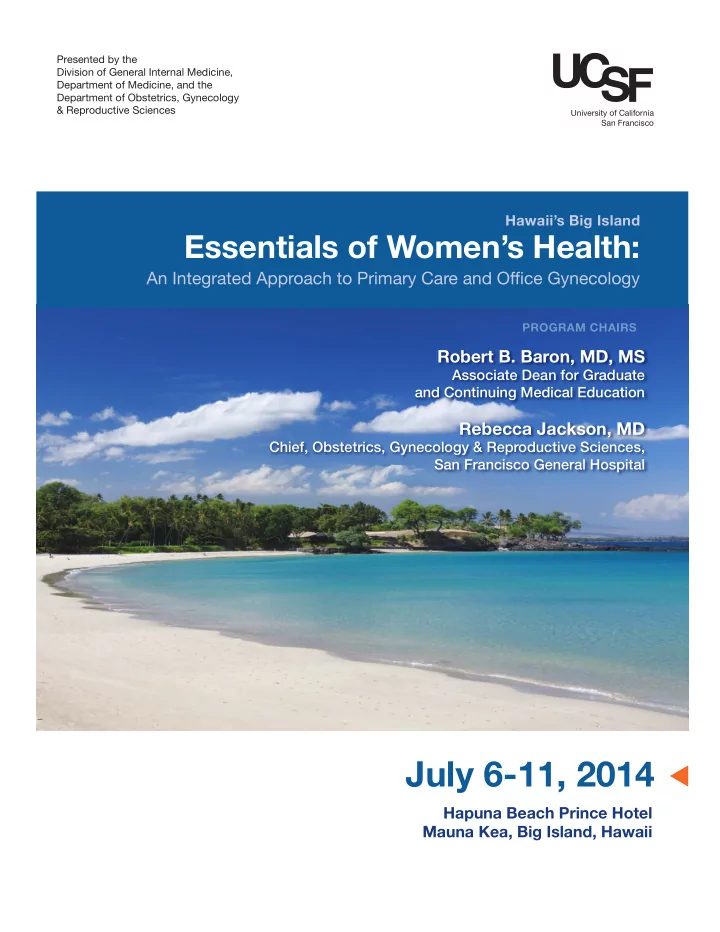
Presented by the Division of General Internal Medicine, Department of Medicine, and the Department of Obstetrics, Gynecology & Reproductive Sciences University of California San Francisco Hawaiis Big Island Essentials of Womens


slide-1
SLIDE 1

University of California San Francisco

Hawaii’s Big Island

Essentials of Women’s Health:

An Integrated Approach to Primary Care and Offjce Gynecology

July 6-11, 2014

Robert B. Baron, MD, MS

Associate Dean for Graduate and Continuing Medical Education

Rebecca Jackson, MD

Chief, Obstetrics, Gynecology & Reproductive Sciences, San Francisco General Hospital

PROGRAM CHAIRS

Hapuna Beach Prince Hotel Mauna Kea, Big Island, Hawaii

Presented by the Division of General Internal Medicine, Department of Medicine, and the Department of Obstetrics, Gynecology & Reproductive Sciences

slide-2
SLIDE 2

The Department of Medicine Division of General Internal Medicine, and The Department of Obstetrics, Gynecology & Reproductive Sciences present

Essentials of Women’s Health

An Integrated Approach to Primary Care and Office Gynecology

July 6-11, 2014

Hapuna Beach Prince Hotel Big Island, Hawaii Course Chairs Robert B. Baron, MD, MS Rebecca Jackson, MD

University of California, San Francisco School of Medicine

slide-3
SLIDE 3

Exhibitors

Bayer Hologic

slide-4
SLIDE 4

University of California, San Francisco School of Medicine Presents

Essentials of Women’s Health:

An Integrated Approach to Primary Care and Office Gynecology

OVERVIEW

This program, designed for family physicians, internists, gynecologists, nurses, nurse practitioners, physician assistants, pharmacists, and all others involved in providing quality health care for women, will provide a practical update on a full range of common but controversial issues in women’s health. The course will serve to enhance the skills of those already working in women’s health as well as help develop new skills for those expanding their work to include more primary care and office gynecology. Developed and taught by UCSF faculty in both primary care internal medicine and obstetrics and gynecology, the course will present an integrated approach to women’s health. Emphasis will be placed on new developments in preventive care and cardiovascular risk factors in women, issues in reproductive health, and clinical strategies in the diagnosis and treatment of common gynecologic complaints and common medical problems of women. Special emphasis will be placed on office skills needed for modern day practice including: enhanced skills in physical examination, common office procedures, clinical nutrition, assessment of new medical technologies, and how to better read the medical

  • literature. The course will use interactive lectures, clinical vignettes, hands-on

workshops, small group discussions, questions and answers, and an online syllabus.

EDUCATIONAL OBJECTIVES

The purpose of this course is to increase competence and improve clinician practice in women’s health. We specifically anticipate improvements in skills and strategies to:  Implement new guidelines in office-based preventive medicine for prevention and early detection of cancer with clinical exam, pap tests, genetic testing and diagnostic imaging;  Implement new guidelines for prevention and treatment of cardiovascular risk factors in women;  Provide vaccinations to adults and adolescents;  Diagnose and treat common problems in women's health including abnormal uterine bleeding, acute pelvic pain, sexually transmitted infections, amenorrhea, PCOS, vulvovaginal disorders, thyroid disorders, atrial fibrillation, hypertension, high blood cholesterol, diabetes, osteoporosis, sleep disorders and dementia;  Facilitate counseling and informed decision-making in contraception and abortion;  Examine patients and perform common office procedures in gynecology;  Evaluate and treat common musculoskeletal complaints;  Counsel patients about diet and nutritional supplements;  Critically read the medical literature in women’s health;  Provide empathic and professional communication with all patients;  Increase quality and decrease costs in medical practice.

slide-5
SLIDE 5

ACCREDITATION

The University of California, San Francisco School of Medicine (UCSF) is accredited by the Accreditation Council for Continuing Medical Education to provide continuing medical education for physicians. UCSF designates this educational activity for a maximum of 19.75 AMA PRA Category 1 Credits™. Physicians should claim only the credit commensurate with the extent of their participation in the activity. This CME activity meets the requirements under California Assembly Bill 1195, continuing education and cultural and linguistic competency. Geriatric Medicine: The approved credits shown above include 13.0 credits toward meeting the requirement under California Assembly Bill 1820, Geriatric Medicine. Nurses: For the purpose of recertification, the American Nurses Credentialing Center accepts AMA PRA Category 1 Credits™ issued by organizations accredited by the ACCME. Physician Assistants: AAPA accepts category 1 credit from AOACCME, Prescribed credit from AAFP, and AMA PRA category 1 credits™ from organizations accredited by the ACCME. Pharmacy: The California Board of Pharmacy accepts as continuing professional education those courses that meet the standard of relevance to pharmacy practice and have been approved for AMA PRA Category 1 Credits™. Family Physicians: This activity, Controversies in Women's Health, with a beginning date of December 6, 2012, has been reviewed and is acceptable for up to 19.50 Prescribed credits by the American Academy of Family Physicians. Physicians should claim only the credit commensurate with the extent of their participation in the activity. Obstetricians and Gynecologists: The American College of Obstetricians and Gynecologists has assigned 20 cognate credits to this program.

slide-6
SLIDE 6

General Information

Attendance Verification / CME Certificates

Please remember to sign-in on the sign-in sheet when you check in at the UCSF Registration Desk on your first day. You only need to sign-in once for the course, when you first check in. After the meeting, please visit this website to complete the online course evaluation: http://www.ucsfcme.com/evaluation Upon completing the online evaluation, your CME certificate will be automatically generated and emailed to you.

Evaluation

Your opinion is important to us – we do listen! We have two evaluations for this

  • meeting. The speaker evaluation is the light blue hand-out you received when you

checked in. Please complete this during the meeting and turn it in to the registration staff at the end of the conference. The overall conference evaluation is online at: http://www.ucsfcme.com/evaluation We request you complete this evaluation within 30 days of the conference in order to receive your CME certificate through this format.

Security

We urge caution with regard to your personal belongings and syllabus books. We are unable to replace these in the event of loss. Please do not leave any personal belongings unattended in the meeting room during lunch or breaks or overnight.

Exhibits

Industry exhibits will be available outside the ballroom during breakfasts and breaks.

Phone Messages

Any messages during the conference can be left by calling (808) 880‐1111 and asking for the UCSF “Women’s Health” course. Messages will be posted on the board near the registration desk.

Presentations

Color PDFs of the final lectures will be available on our website, www.cme.ucsf.edu, approximately 2-4 weeks post event. We will only post presentations for those authorized by the presenters.

slide-7
SLIDE 7

Federal and State Law Regarding Linguistic Access and Services for Limited English Proficient Persons I. Purpose. This document is intended to satisfy the requirements set forth in California Business and Professions code 2190.1. California law requires physicians to obtain training in cultural and linguistic competency as part of their continuing medical education programs. This document and the attachments are intended to provide physicians with an overview of federal and state laws regarding linguistic access and services for limited English proficient (“LEP”) persons. Other federal and state laws not reviewed below also may govern the manner in which physicians and healthcare providers render services for disabled, hearing impaired or other protected categories II. Federal Law – Federal Civil Rights Act of 1964, Executive Order 13166, August 11, 2000, and Department of Health and Human Services (“HHS”) Regulations and LEP Guidance. The Federal Civil Rights Act of 1964, as amended, and HHS regulations require recipients of federal financial assistance (“Recipients”) to take reasonable steps to ensure that LEP persons have meaningful access to federally funded programs and services. Failure to provide LEP individuals with access to federally funded programs and services may constitute national origin discrimination, which may be remedied by federal agency enforcement action. Recipients may include physicians, hospitals, universities and academic medical centers who receive grants, training, equipment, surplus property and other assistance from the federal government. HHS recently issued revised guidance documents for Recipients to ensure that they understand their

  • bligations to provide language assistance services to LEP persons. A copy of HHS’s summary

document entitled “Guidance for Federal Financial Assistance Recipients Regarding Title VI and the Prohibition Against National Origin Discrimination Affecting Limited English Proficient Persons – Summary” is available at HHS’s website at: http://www.hhs.gov/ocr/lep/ . As noted above, Recipients generally must provide meaningful access to their programs and services for LEP persons. The rule, however, is a flexible one and HHS recognizes that “reasonable steps” may differ depending on the Recipient’s size and scope of services. HHS advised that Recipients, in designing an LEP program, should conduct an individualized assessment balancing four factors, including: (i) the number or proportion of LEP persons eligible to be served or likely to be encountered by the Recipient; (ii) the frequency with which LEP individuals come into contact with the Recipient’s program; (iii) the nature and importance of the program, activity or service provided by the Recipient to its beneficiaries; and (iv) the resources available to the Recipient and the costs of interpreting and translation services. Based on the Recipient’s analysis, the Recipient should then design an LEP plan based on five recommended steps, including: (i) identifying LEP individuals who may need assistance; (ii) identifying language assistance measures; (iii) training staff; (iv) providing notice to LEP persons; and (v) monitoring and updating the LEP plan. A Recipient’s LEP plan likely will include translating vital documents and providing either on-site interpreters or telephone interpreter services, or using shared interpreting services with other

  • Recipients. Recipients may take other reasonable steps depending
  • n the emergent or non-emergent needs of the LEP individual, such as hiring bilingual

staff who are competent in the skills required for medical translation, hiring staff interpreters, or contracting with outside public or private agencies that provide interpreter services.

slide-8
SLIDE 8

HHS’s guidance provides detailed examples of the mix of services that a Recipient should consider and implement. HHS’s guidance also establishes a “safe harbor” that Recipients may elect to follow when determining whether vital documents must be translated into other languages. Compliance with the safe harbor will be strong evidence that the Recipient has satisfied its written translation

  • bligations.

In addition to reviewing HHS guidance documents, Recipients may contact HHS’s Office for Civil Rights for technical assistance in establishing a reasonable LEP plan. III. California Law – Dymally-Alatorre Bilingual Services Act. The California legislature enacted the California’s Dymally-Alatorre Bilingual Services Act (Govt. Code 7290 et seq.) in order to ensure that California residents would appropriately receive services from public agencies regardless of the person’s English language skills. California Government Code section 7291 recites this legislative intent as follows: “The Legislature hereby finds and declares that the effective maintenance and development of a free and democratic society depends

  • n the right and ability of its citizens and residents to communicate

with their government and the right and ability of the government to communicate with them. The Legislature further finds and declares that substantial numbers of persons who live, work and pay taxes in this state are unable, either because they do not speak or write English at all, or because their primary language is other than English, effectively to communicate with their government. The Legislature further finds and declares that state and local agency employees frequently are unable to communicate with persons requiring their services because of this language barrier. As a consequence, substantial numbers of persons presently are being denied rights and benefits to which they would

  • therwise be entitled.

It is the intention of the Legislature in enacting this chapter to provide for effective communication between all levels of government in this state and the people of this state who are precluded from utilizing public services because of language barriers.” The Act generally requires state and local public agencies to provide interpreter and written document translation services in a manner that will ensure that LEP individuals have access to important government services. Agencies may employ bilingual staff, and translate documents into additional languages representing the clientele served by the agency. Public agencies also must conduct a needs assessment survey every two years documenting the items listed in Government Code section 7299.4, and develop an implementation plan every year that documents compliance with the Act. You may access a copy of this law at the following url: http://www.spb.ca.gov/bilingual/dymallyact.htm

slide-9
SLIDE 9

Course Chairs

Robert B. Baron, MD, MS Professor of Medicine; Associate Dean for Graduate and Continuing Medical Education; Vice Chief, Division of General Internal Medicine University of California, San Francisco Rebecca Jackson, MD Professor of Obstetrics, Gynecology & Reproductive Sciences, and of Epidemiology & Biostatistics, University of California, San Francisco; Chief, Obstetrics, Gynecology & Reproductive Sciences, San Francisco General Hospital

Course Faculty (University of California, San Francisco)

Douglas Bauer, MD Professor of Medicine and Epidemiology and Biostatistics Katherine A. Julian, MD Professor of Medicine; Program Director, UCSF Primary Care General Internal Medicine Residency Program Michael S. Policar, MD, MPH Professor; Medical Director, UCSF/ Family PACT Program Support and Evaluation, California Office of Family Planning, Sacramento, CA Jody Steinauer, MD, MAS Associate Professor of Obstetrics, Gynecology, and Reproductive Sciences

slide-10
SLIDE 10

Disclosures

The following faculty speakers, moderators and planning committee members have disclosed NO financial interest/arrangement or affiliation with any commercial companies who have provided products or services relating to their presentation(s) or commercial support for this continuing medical education activity: Robert B. Baron, MD, MS Douglas Bauer, MD Rebecca Jackson, MD Katherine A. Julian, MD Michael S. Policar, MD, MPH Jody Steinauer, MD, MAS This UCSF CME educational activity was planned and developed to: uphold academic standards to ensure balance, independence, objectivity, and scientific rigor; adhere to requirements to protect health information under the Health Insurance Portability and Accountability Act of 1996 (HIPAA); and, include a mechanism to inform learners when unapproved or unlabeled uses of therapeutic products or agents are discussed or referenced. This activity has been reviewed and approved by members of the UCSF CME Governing Board in accordance with UCSF CME accreditation policies. Office of CME staff, planners, reviewers, and all others in control of content have disclosed no relevant financial relationships

slide-11
SLIDE 11

MDM15M01: Essentials of Women's Health

6/24/2014 University of California San Francisco City, State Name

Registrant List

UCSF OCME Page 1 of 3 1 Fremont, CA Afnan Jia 2 MD Torrance, CA Afonicheva Lyudmila 3 San Francisco, CA Alpers Leila 4 MD Meadow Vista, CA Avila-Kirwan Guadalupe 5 DO Los Angeles, CA Bansal Sumati 6 DO Phoenix, AZ Beach James L. 7 MD Morin-Heights, PQ, Canada Beaulieu Richard 8 MD Modesto, CA Belissary Nicole 9 CNM Fairfax, CA Berman Sylvia A. 10 MSN Olympia, WA Bodle-Shingu Rebecca Marie 11 MD Oakland, CA Bonacich Jane 12 MD Jacksonville, FL Brinker Todd M. 13 St Joseph Du Lac, QC, Canada Broughton Vanessa 14 MD

  • Mt. Vernon, WA

Bynum Daniel C. 15 MD Beaumont, TX Castro Mary Jane 16 MD La Canada Flintridge, CA Chamberlain Peter M. 17 MD Foster City, CA Chenumalla Madhavi 18 MD Alameda, CA Cremin Daniel J. 19 MD Oakland, CA Cronbach Emily 20 MD Scottsdale, AZ Daley Timothy M. 21 PA-C Prunedale, CA Davis Virginia (Ginny) K. 22 MD Bethel, AK Derbyshire Ella R. 23 ADN Aiea, HI Dureg Karen 24 FNP Fort Gibson, OK Elder Brenda 25 MD Pismo Beach, CA Ellman Megan 26 MD Montebello, CA Fedor George P. 27 force obrowski Rancho Cucamonga, CA Force Obrowski Sandra K 28 MD Lancaster, CA Francis Rodney 29 MD Manteca, CA Francisco Lee-Lee 30 MD Tigard, OR Garcia Rosa 31 MD Napa, CA George Michael J. 32 MD Lahaina, HI Gilbert Darcel 33 MD Mountain View, CA Gotmare Sonali 34 Piedmont, CA Grammer Jacklin Soopikian 35 MS San Francisco, CA Greenwood Margaret 36 MD Medford, OR Hagloch Nancy 37 Oakland, CA Hansen Erica Diane 38 Cupertino, CA Hashemi Vahideh
slide-12
SLIDE 12

City, State Name

Registrant List

UCSF OCME Page 2 of 3 39 MD Hilo, HI Helms Eric 40 MD Mill Valley, CA Iniguez Maria G. 41 MD Orinda, CA Jacques Anne 42 MD Martin, TN Johnson Susan 43 Grand Rapids, MI Joseph Mark Leland 44 Mercer Island, WA Kelly-hedrick Heather Marion 45 MD Belmont, CA Khouri Issa 46 MD Edgewater, NJ Kim Jeongwon 47 MD Renton, WA King Kristine 48 Koh Albany, CA Koh Yoojin 49 MD Kailua-Kona, HI Lachance Deborah 50 Broomfield, CO Le Amy 51 Wisconsin Rapids, WI Leaphart Candance 52 MD San Diego, CA Leung Jennifer 53 MD Renton, WA Lew Arthur 54 DO Golden, CO Lewis Lisa K. 55 MD Elk Grove, CA Libao Elizabeth 56 Los Angeles, CA Lim Lizbeth 57 DO Nome, AK Liu Sai-Ling 58 MD Sonoma, CA Malik Geeta 59 MD Solvang, CA Mariwalla Kiran 60 Lakewood, CO Martinez David P 61 MD Orinda, CA Matlock Beth 62 San Angelo, TX Mays Raymond 63 MD Boulder, CO Micielli Renee 64 MD Vancouver, WA Moroye Marc M. 65 RNC, ANP San Jose, CA Moschella Joan 66 MD Fremont, CA Nagarajan Suja 67 MD San Jose, CA Nakelchik Masha 68 MD Houston, TX Nguyen Khanh 69 San Angelo, TX Noack Tamara 70 MD Seattle, WA Oh Gigli Yue 71 MD, MBA, CPE Seattle, WA Oh Shenton 72 MD Abilene, TX Olabode Irene 73 MD Chula Vista, CA Oseguera Maria 74 MD Atherton, CA Patel Neeta 75 MD Lake Oswego, OR Payne Susan D. 76 San Francisco, CA Pellegrino Kristen 77 MD Huntington Beach, CA Pham David 78 Bakersfield, CA Pina Racquel 79 MD Bellevue, WA Pineda-liu Christine 80 DO Lafayette, CA Plotkin Mindy

slide-13
SLIDE 13

City, State Name

Registrant List

UCSF OCME Page 3 of 3 81 Tacoma, WA Posa Tania Rose 82 MD Palo Alto, CA Rangarajan Vai 83 Hillsboro, OR Rivers Peggy J. 84 MD Long Beach, CA Russo Jennefer A. 85 MD Salt Lake City, UT Rutledge Dale 86 MD Denver, CO Saavedra Tino 87 Atlanta, OH Sangvai Manjeeri 88 MD Oakland, CA Sapugay Anna Maria 89 Oalkland, CA Sharp Terese 90 Bathurst, Nsw, Australia Smith Christine 91 MD North Logan, UT Smith Erica 92 MD Hillsboro, OR Song Chin 93 MD Sunnyvale, CA Su Ted 94 DO Kamuela, HI Swift Jean 95 MD Phoenix, AZ Taylor Deshawn 96 Albuquerque, NM Tran Minhnga 97 Edmonton, AB, Canada Tsikata Setorme 98 MD Honolulu, HI Tsuzaki Wray Y. 99 MD Orinda, CA Unger Richard R. 100 MD Las Vegas, NV Veniegas Cheryl 101 MD Henderson, NV Vyas Chirag 102 MD Los Angeles, CA Washington

  • A. Eugene

103 MD Bend, OR Weeks James A. 104 FNP Lihue, HI Wright Ellen 105 MD Honolulu, HI Yamamoto Irene 106 MD Modesto, CA Younan Centi S. 107 Sunnyvale, CA Zamvar Uma 108 MD Fremont, CA Zhang Ying 109 BSN Sunnyvale, CA Zielinski Martha 109 Total Number of Attendees for MDM15M01:

slide-14
SLIDE 14

University of California San Francisco

UPCOMING UCSF PRIMARY CARE CME COURSES FALL IN SAN FRANCISCO

Primary Care Medicine: Principles & Practice Hotel Nikko, San Francisco October 22-24, 2014

DECEMBER IN SAN FRANCISCO

Controversies in Women’s Health Hotel Nikko, San Francisco December 11-12, 2014

APRIL IN HAWAII

Primary Care Medicine: Update 2014 Wailea Marriott, Maui, Hawaii April 5-10, 2015

JULY IN HAWAII

Essentials of Women’s Health: An Integrated Approach to Primary Care and Offjce Gynecology Hapuna Beach Prince Hotel, Hawaii’s Big Island July 5-10, 2015

AUGUST AT LAKE TAHOE

Essentials of Primary Care: A Core Curriculum for Adult Ambulatory Practice Resort at Squaw Creek, North Lake Tahoe August 2-7, 2015