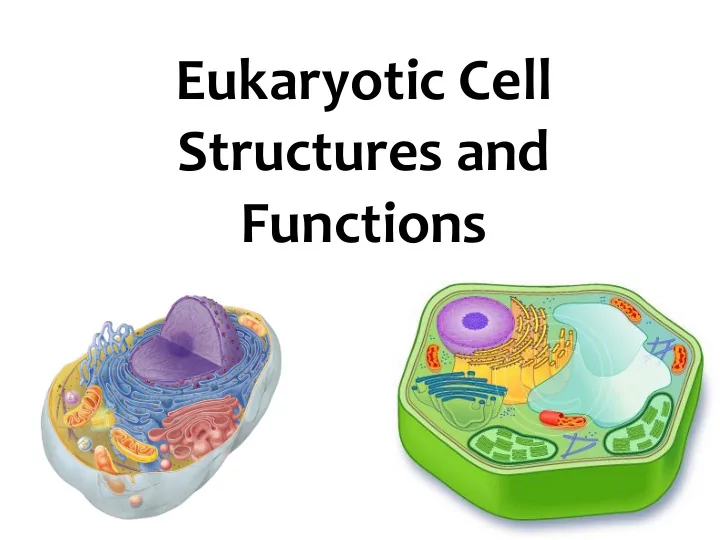
Eukaryotic Cell Structures and Functions General Animal Cell - PowerPoint PPT Presentation
Eukaryotic Cell Structures and Functions General Animal Cell Structure General Plant Cell Structure Plant Cells Animal Cells Cell Structures Plasma Membrane Surrounds the cell, selectively permeable Composed of a phospholipid
Eukaryotic Cell Structures and Functions
General Animal Cell Structure
General Plant Cell Structure
Plant Cells Animal Cells
Cell Structures
Plasma Membrane • Surrounds the cell, “selectively” permeable • Composed of a phospholipid bilayer (2 layers) and embedded proteins • Controls the passage of cell materials into and out of the cell
Cytoplasm • Primarily composed of water, salts and organic molecules • Suspends cell organelles inside the cell
Cytoskeleton • Internal support system for the cell • Assists in the movement of organelles within the cell • Composed of microfilaments and microtubules (contractile proteins)
Nucleus • Surrounded by a nuclear envelope with nuclear pores • Contains genetic information (DNA) which exists as chromatin in a non-dividing cell • Controls all cell activities
Nucleolus • Located within the nucleus • Produces parts of ribosomes
Nucleus, Nucleolus and Nuclear Pores
Mitochondrion • Produces cellular energy in the form of ATP molecules through a process called cellular respiration • During the process of cellular respiration, glucose is metabolized in the presence of oxygen to produce ATP
Ribosome • Site of protein synthesis • Ribosomes link amino acids together to form proteins during gene expression • All cell types contain ribosomes
Vesicle • Membrane-bound pouch that transports cell materials between organelles and throughout the cell
Endoplasmic Reticulum (ER) • Assists in the synthesis and transport of cell materials • Two types: rough (with ribosomes) and smooth (without ribosomes)
Rough and Smooth ER • Rough ER has ribosomes which give this structure a textured appearance, functions in synthesizing proteins • Smooth ER contains enzymes that function to synthesize lipids and hormones
Golgi Bodies • Consists of flattened stacks of membranes • Collects, packages and modifies cell materials to be used within the cell or exported out of the cell
Lysosome • Contain strong hydrolytic enzymes • Break down old cell parts and cell wastes
Centrioles • Composed of microtubules, used during cell division to move and separate chromosomes • Found only in animal cells
Vacuole • Specialized structure that primarily stores water in plants cells, sometimes waste storage
Chloroplast • Site of photosynthesis where light energy is converted into chemical energy (glucose) • Found in plant cells and photosynthetic protists (e.g. algae, Euglena)
Cell Wall • Exterior structure and support for cells, located surrounding the plasma membrane • Plants, bacteria and fungi all have cells with cells walls • Cell wall composition: – Plants – cellulose and pectin – Fungi – chitin – Bacteria - petidoglycan
Cell Movement • Some cells have structures that assist in movement – Cilia – numerous little hairs, cover cell surface – Flagella – whip-like structure that propels cells – Pseudopods – cytoplasmic extensions that help some cells move and obtain food (e.g. amoebas)
Recommend
More recommend
Explore More Topics
Stay informed with curated content and fresh updates.