Evaluations in the next programming period: evolution or revolution - - PowerPoint PPT Presentation

evaluations in the next
SMART_READER_LITE
LIVE PREVIEW

Evaluations in the next programming period: evolution or revolution - - PowerPoint PPT Presentation

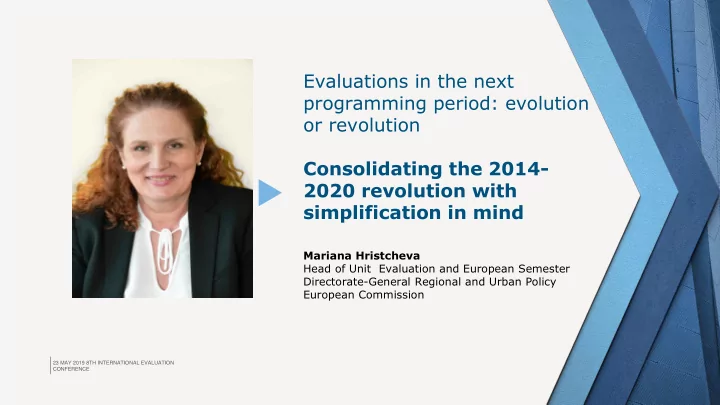
Evaluations in the next programming period: evolution or revolution Consolidating the 2014- 2020 revolution with simplification in mind Mariana Hristcheva Head of Unit Evaluation and European Semester Directorate-General Regional and Urban


slide-1
SLIDE 1

23 MAY 2019 8TH INTERNATIONAL EVALUATION CONFERENCE

1

Evaluations in the next programming period: evolution

  • r revolution

Consolidating the 2014- 2020 revolution with simplification in mind

Mariana Hristcheva Head of Unit Evaluation and European Semester Directorate-General Regional and Urban Policy European Commission

slide-2
SLIDE 2

23 MAY 2019 8TH INTERNATIONAL EVALUATION CONFERENCE

2

Evidence-based EU policy Ex-ante: New or reviewed initiatives Ex-post: Implemented initiatives

slide-3
SLIDE 3

23 MAY 2019 8TH INTERNATIONAL EVALUATION CONFERENCE

3

DG Regional and Urban Policy European Regional Development Fund, Cohesion Fund

✓ 24% of the EU Budget (€ 262 bln.) ✓ 318 programmes for 2014-2020

Focus on gathering evidence:

✓ Monitoring and Evaluation ✓ Impact Assessment and Economic Analysis

slide-4
SLIDE 4

Reinforced focus on results :

  • requirement for clearer programme objectives/improved intervention logic;
  • strengthened monitoring provisions;
  • stronger focus on evaluation of programme results;
  • introduction of a performance framework and related performance reserve.

4

2014-2020 revolution: strong focus on results

slide-5
SLIDE 5

23 MAY 2019 8TH INTERNATIONAL EVALUATION CONFERENCE

5

The Open Data Platform of ESI Funds

✓ Data collection and dissemination ✓ Public data platform for the programming period 2014-2020 ✓ Four ESI DGs: AGRI, EMPL, MARE, and REGIO ✓ Launched in December 2015 – updated, developed and enriched regularly

https://cohesiondata.ec.europa.eu/

slide-6
SLIDE 6

23 MAY 2019 8TH INTERNATIONAL EVALUATION CONFERENCE

6

The Open Data Platform of ESI Funds

slide-7
SLIDE 7

23 MAY 2019 8TH INTERNATIONAL EVALUATION CONFERENCE

7

Evaluation work in DG REGIO

  • Design and manage evaluations providing evidence of results and
  • utcomes of Cohesion Policy, including strategic and thematic

evaluations on selected EU priorities to feed policy developments,

  • Impact assessments,
  • Ensure coherent communication on evaluation results,
  • Analyse evaluation results from the Member States,
  • Support evaluation capacity in the Member States, facilitate the exchange
  • f good practices,
  • Manage the Evaluation Network, bringing together Commission and

Member State evaluation expertise.

slide-8
SLIDE 8

23 MAY 2019 8TH INTERNATIONAL EVALUATION CONFERENCE

8

Current evaluation activity in DG REGIO Recently finalised and on-going evaluations:

  • EU Solidarity Fund,
  • Major projects in the field of transport,
  • Major projects in the field of environment,
  • Jaspers mid-term evaluation.

Upcoming evaluations:

  • R&D infrastructure,
  • Ex-post evaluation of broadband projects,
  • E-cohesion
slide-9
SLIDE 9

23 MAY 2019 8TH INTERNATIONAL EVALUATION CONFERENCE

9

Evaluations by the Member States

2015 2016 2017 2018 2019 2020 2021 2022 2023 2024 2025

2019: 229 evaluations

slide-10
SLIDE 10

23 MAY 2019 8TH INTERNATIONAL EVALUATION CONFERENCE

10

Ex-post evaluations for the 2014-2020 programming period

  • Art. 57 CPR:
  • Ex-post evaluations to examine the efficiency and effectiveness of ESI

Funds and their contribution to the Unions strategy for smart, sustainable and inclusive growth,

  • To be completed by 31/12/2024.

To be finalized after a gap analysis based on MS evaluations. Details still to be decided, including how to best complement thematic and cross-cutting evaluations.

slide-11
SLIDE 11

23 MAY 2019 8TH INTERNATIONAL EVALUATION CONFERENCE

11

EU Cohesion Policy - continued investment support The Cohesion Policy will continue to provide support for jobs and growth in the upcoming programming period (2021-2027): 273 bln. (~21% of the EU budget)* Accompanied by an effective monitoring and evaluation framework

*In current prices, according to the EC proposal (May 2018).

slide-12
SLIDE 12

23 MAY 2019 8TH INTERNATIONAL EVALUATION CONFERENCE

12

Evaluation framework in the next programming period Designed in line with the overall drive for simplification, underpinned by the work of the High-Level Group on Simplification. Fine-tuning of the current provisions, to allow for more simplification, in line with the overall approach taken by COM in the legislative proposals of May 2018.

slide-13
SLIDE 13

23 MAY 2019 8TH INTERNATIONAL EVALUATION CONFERENCE

13

Post-2020 provisions – what remains unchanged

Member states (art. 39):

  • Evaluations during the programming period,
  • Functional independence of evaluators,
  • MS to guarantee procedures necessary to produce and collect data

needed for evaluations,

  • Evaluation plans to be submitted to MC within 1 year of programme

adoption,

  • MCs to examine progress in evaluations, synthesis and follow-up to

findings (art. 35). Commission (art. 40):

  • Impact evaluation of Funds (by 2031).
slide-14
SLIDE 14

23 MAY 2019 8TH INTERNATIONAL EVALUATION CONFERENCE

14

Post-2020 provisions – what is new

  • MS evaluations to assess programme relevance, effectiveness,

efficiency, coherence and EU added value,

  • Programme impact evaluation by June 2029,
  • MS to publish all evaluations on the internet,
  • Commission mid-term evaluation by end 2024,
  • Ex-ante evaluation no longer mandatory (possibility exists, where

necessary),

  • No more reporting on synthesis of evaluations (only MC, no AIR).
slide-15
SLIDE 15

23 MAY 2019 8TH INTERNATIONAL EVALUATION CONFERENCE

15

A coherent calendar for evaluation work – the milestones

  • 1 year after the OP adoption: evaluation plans by MS,
  • 2024: mid-term evaluation by COM,
  • 2025: mid-term performance review (MS and COM),
  • 2029: programme impact evaluations by MS,
  • 2031: retrospective evaluations by COM.

These are the milestones; other evaluations will be carried

  • ut by COM and the MS.
slide-16
SLIDE 16

23 MAY 2019 8TH INTERNATIONAL EVALUATION CONFERENCE

16

Magnitude of change

  • The changes aim at fine-tuning and improving the current system.
  • The revolution took place when we moved from the 2007-2013 to the

2014-2020 programming period:

  • introduction of evaluation plans,
  • systematic evaluations by the MS, with an emphasis on impact

covering all specific objectives.

slide-17
SLIDE 17

23 MAY 2019 8TH INTERNATIONAL EVALUATION CONFERENCE

17

A simplified, yet more coherent approach

Regulatory Regulations (only what is necessary) + Soft measures (evaluation culture, summer schools, peer reviews, tailored methodological support). Evaluation work Increased coherence between COM and MS evaluations.

slide-18
SLIDE 18

23 MAY 2019 8TH INTERNATIONAL EVALUATION CONFERENCE

18

Conclusion

The evaluation framework for the post-2020 programming period aims at:

  • Simplifying the rules to reduce the burden on MA and beneficiaries,
  • Maintain those aspects which have proved useful and eliminate certain

requirements (ex-ante evaluations, reporting on synthesis of evaluations),

  • Rely more on soft measures, instead of the regulatory approach.

Simplification-driven evolution of the Cohesion Policy evaluations

slide-19
SLIDE 19

23 MAY 2019 8TH INTERNATIONAL EVALUATION CONFERENCE

19

4

THANK YOU!