
SLIDE 1
Exercise Sheet 1: Hashing and Bloom filters
COMS31900 Advanced Algorithms 2019/2020
Please feel free to discuss these problems on the unit discussion board. If you would like to have your answers marked, please either hand them in in person at the lecture or email them to me with the email subject ”Problem sheet 1” by the deadline stated.
1 Weakly-universal Hashing
A hash function family H = {h1, h2, . . . } is weakly-universal iff for randomly and uniformly chosen h ∈ H, we have Pr(h[x] = h[y]) ≤ 1/m for any distinct x, y ∈ U. Consider the following hash function families. For each one, prove that it is weakly universal or give a counter-example.
- 1. Let p be a prime number and m be an integer, p ≥ m.
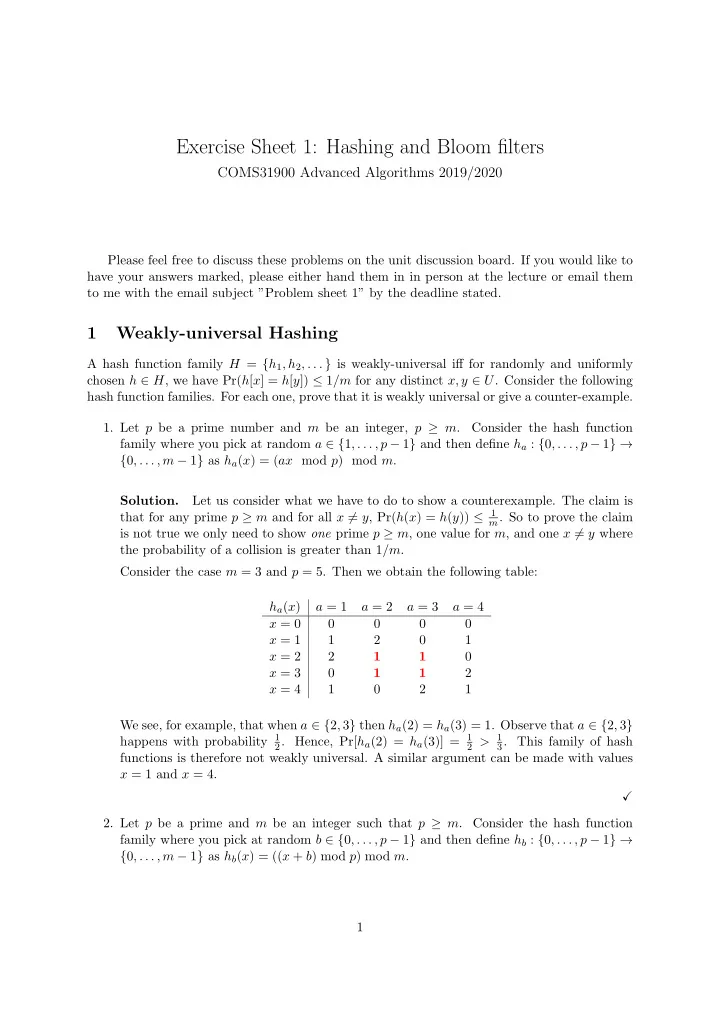
Consider the hash function family where you pick at random a ∈ {1, . . . , p − 1} and then define ha : {0, . . . , p − 1} → {0, . . . , m − 1} as ha(x) = (ax mod p) mod m. Solution. Let us consider what we have to do to show a counterexample. The claim is that for any prime p ≥ m and for all x = y, Pr(h(x) = h(y)) ≤ 1
- m. So to prove the claim
is not true we only need to show one prime p ≥ m, one value for m, and one x = y where the probability of a collision is greater than 1/m. Consider the case m = 3 and p = 5. Then we obtain the following table: ha(x) a = 1 a = 2 a = 3 a = 4 x = 0 x = 1 1 2 1 x = 2 2 1 1 x = 3 1 1 2 x = 4 1 2 1 We see, for example, that when a ∈ {2, 3} then ha(2) = ha(3) = 1. Observe that a ∈ {2, 3} happens with probability 1
- 2. Hence, Pr[ha(2) = ha(3)] = 1
2 > 1
- 3. This family of hash
functions is therefore not weakly universal. A similar argument can be made with values x = 1 and x = 4.
- 2. Let p be a prime and m be an integer such that p ≥ m. Consider the hash function