
SLIDE 1
Experience with gas calibration within the last 30 years
BY JESPER BUSK, FORCE TECHNOLOGY
Experience with gas calibration within the last 30 years BY JESPER - - PowerPoint PPT Presentation
Experience with gas calibration within the last 30 years BY JESPER BUSK, FORCE TECHNOLOGY About me EMPLOYED HEAD OF PROJECT EURAMET EuReGa DEPARTMENT MANAGER at FORCE Technology Oil & Gas flow for the construction of the responsible
Experience with gas calibration within the last 30 years
BY JESPER BUSK, FORCE TECHNOLOGY
About me
at FORCE Technology since 1983. Oil & Gas flow since 1989. for the construction of the high-pressure facilities and primary facilities. responsible for flow in Denmark Acitivity on behalf of FORCE Technology
EMPLOYED HEAD OF DEPARTMENT PROJECT MANAGER EURAMET EuReGa
Agenda
CALIBRATION
volume, weight, balance, force
SYSTEMS
Metrology in FORCE Technology
1985 1992 1996 2003 2014 2013 8 bar facilities with air High-pressure facilities 32000m3/h@65 bar Primary facilities 400m3/h@100 bar and EuReGa member High-pressure facilities 6500m3/h@50bar 2020 Higher pressure? Higher flow? Microflow, from 1 ml/min 2006 10000m3/h @50bar
Gas flow history
CALIBRATION As found – Adjustment - As left - Verification - sealing Before adjustment, After adjustment. Communication with service advisors Cleaning the meter CERTIFICATES Certificates with digital signature Hard copy certificates Lot of individual needs about information in the certificate. (spin- down test, Hz, Meter-factor pr. point, customer set-up, imperial units etc.) Parameter list within the certificate Logging/adjustment in manufactures USM
20:1 50:1 100:1 2017 2010 1985 What will happen next?
0,25 – 0,30% 1985 0,10% 2020 What is needed?
2005
0,20-0,25% 2015 0,15 – 0,20%
Requirement from accreditation body 1985 Requirements from manufacturer Requirements from end-user 2008 to 2017
1985
Just gear-wheels of turbine meters
2017
K-factor Lineazation Constant Point to point Multipoint Piece-wise linear Polynomia Gear Wheels
forcetechnology.com 1985
below 20/year 2017 Above 700/year
2017 1985 stop
Missing meter to a booked slot Any customers present? (who will participate) Internal audits The time is running Mounting/Dismounting Flange rating and pipe schedule Leaking connections Temperature tappings in customer spools Dust in spools
CHALLENGES IN A HIGH-PRESSURE LABORATORY
12” High-pressure facilities
12” High-pressure facilities
Our own development – length compensator
Technical data
Calibration pressure: 0 - 50 bar Flow: 5 – 10 000 Meter sizes: 2” - 18” Calibration pressure: 0 - 65 bar Flow: 8 – 32 000 (41000 m3/h at low pressure) Meter sizes: 4”- 42” (52”)
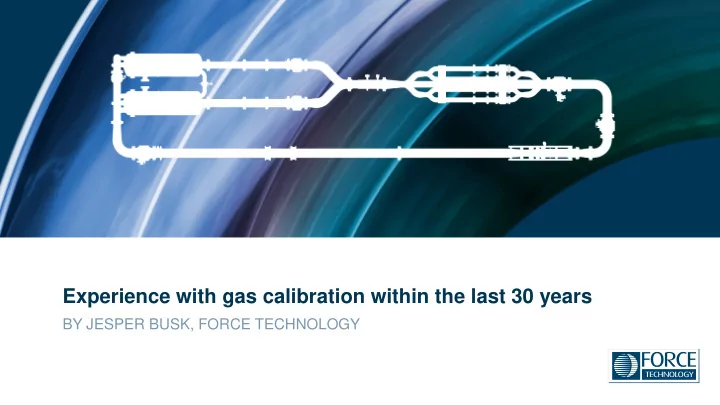
Closed loop for calibration with natural gas
The blower system
Circulates the gas in the loop Compensates for the pressure drop in the loop Keeps the flow stable Makes a lot of noize Uses a lot of power
compressor
into a 4 bar distribution line
Cooling system/heating system
A water reservoir is used to store cooling water
calibrations A second water reservoir is used to store hot water
Traceability and uncertainty: Example from SI unit to customer meter
SI Unit
Transfer standards calibrated against the Piston Prover Hydraulic driven twin High Pressure Piston Prover
400 m³/h, CMC: 0,07%
Customer meter 5 - 32000 m³/h 0-65 bar
CMC: 0,14 – 0,21%
Boot strapping system
CMC: 0,08 – 0,12%
Uncertainty Budget:
Calibration of customer meter by using 6 Inch Working Standard
Model Equation: EDUT = ((impDUTend - impDUTstart)/IDUT/ (((impWS5end - impWS5start)/IWS5*(Po+dPDUTWS)/Po*TDUT/TWS5*ZDUT/ZWS5/(1+0.01*(EWS5+CWS5+driftWS5))))-1)*100
Result:
Quantity: EDUT Value: 0.0 % Expanded Uncertainty: ±0.15 % Coverage Factor: 2.00 Coverage: manual Quantity Value Standard Uncertainty Degrees of Freedom Sensitivity Coefficient Uncertainty Contribution Index impDUTend 10000.000 imp 0.289 imp ∞ 0.010 2.9·10-3 % 0.2 % impDUTstart 0.0 imp. 0.289 imp. ∞
0.2 % IDUT 5300.9 imp/m3 impWS5end 10000.000 imp 0.289 imp ∞
0.2 % impWS5start 0.0 imp 0.289 imp ∞ 0.010 2.9·10-3 % 0.2 % IWS5 5300.9 imp/m3 Po 4.0132 bar 0.0144 bar ∞ 0.18 2.7·10-3 % 0.1 % dPDUTWS 0.030000 bar 577·10-6 bar ∞
3.8 % TDUT 293.1500 K 0.0289 K ∞
1.8 % TWS5 293.1500 K 0.0289 K ∞ 0.34 9.8·10-3 % 1.8 % ZDUT 0.99 - ZWS5 0.990000000 - 618·10-9 - ∞ 100 62·10-6 % 0.0 % EWS5 0.7453 % 0.0450 % 250 0.99 0.045 % 37.2 % CWS5 0.0 % 0.0289 % ∞ 0.99 0.029 % 15.3 % driftWS5 0.0 % 0.0462 % ∞ 0.99 0.046 % 39.2 % EDUT
0.0732 % 1800
Primary system: Twin high-pressure piston prover
Max pressure:
100 bar.
Flow range:
1 – 400 m³/h Forward and reverse movement during calibration
EuReGa
Traceability on the basis of mass. Traceability on the basis of length Traceability on the basis of length. Traceability on the basis of length and mass
EuReGa Harmonized references
between calibration facilities.
The future of EuReGa Harmonized references
It is time to test a USM meter as a Harmonized reference.
ADVANTAGES
Energy and cooling demand not as high as for closed loop
DISADVANTAGES
Maximum pressure dependent of the pressure in grid where gas is taken from Max flow rate is dependent of the capacity of the grid Gas composition may change during calibration Flow rate stability depends on stability of grid pressure
Open loop technology
ADVANTAGES
Can reach any pressure and flow rate within the capacity of the loop
DISADVANTAGES
High energy and cooling demand Limit in pressure drop across the meter to be calibrated
Closed loop technology
Calibration with same gas for the duration of the calibration
Safety – very important We do what we can to keep your safe More than 25% of the investments used on safety systems
Thank you for your attention! Jesper Busk Head of Oil & Gas Flow jrb@force.dk