Experimenting with quinoa: the Indian experience By: Atul Bhargava, - - PowerPoint PPT Presentation

experimenting with quinoa the indian experience
SMART_READER_LITE
LIVE PREVIEW

Experimenting with quinoa: the Indian experience By: Atul Bhargava, - - PowerPoint PPT Presentation

International Quinoa Conference 2016: Quinoa for Future Food and Nutrition Security in Marginal Environments Dubai, 6-8 December 2016 www.quinoaconference.com Experimenting with quinoa: the Indian experience By: Atul Bhargava, Sudhir Shukla and


slide-1
SLIDE 1

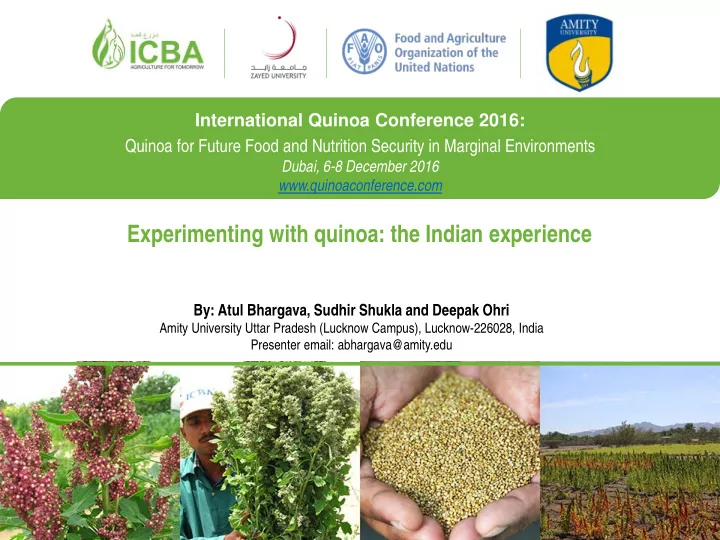
International Quinoa Conference 2016: Quinoa for Future Food and Nutrition Security in Marginal Environments

Dubai, 6-8 December 2016 www.quinoaconference.com

Experimenting with quinoa: the Indian experience

By: Atul Bhargava, Sudhir Shukla and Deepak Ohri

Amity University Uttar Pradesh (Lucknow Campus), Lucknow-226028, India Presenter email: abhargava@amity.edu

slide-2
SLIDE 2

Introduction

INDIA

  • Seventh largest country

in the world.

  • Area: 4.4 million sq. km.
  • Total

population: 1.26 Billion.

  • 4th Largest Economy in

the world in PPP.

  • GDP

Growth rate

  • f

7.3%- Highest in the world.

  • Enormous

diversity in agroclimatic regions & edaphoclimatic conditions.

slide-3
SLIDE 3

With respect to population

  • Population: predicted to rise to 1.53 billion by 2030.
  • 23.6% of Indian population, or about 276 million

people, lived below $1.25 per day (World Bank 2011).

  • India is 20th amongst leading countries with a serious

hunger situation (Global Hunger Index Report 2015).

  • India: ranked 67 among the 80 nations having the

worst hunger situation.

  • Widespread malnutrition and protein deficiency.

With respect to agriculture

  • Salinity and alkalinity: 6.73 million ha of land.
  • Acidity: 25 million ha of land is having pH below 5.5

and 23 million ha fall under the pH range of 5.6 - 6.5.

  • Drought:

Dryland area

  • f

228.3 million hectares (about 69.6% of total area).

Quinoa Introduction in India

slide-4
SLIDE 4

1990s: Research on quinoa was initiated at the National Botanical Research Institute (CSIR-NBRI), Lucknow. Lucknow: 26.5°N, 80.5°E, 120 m asl 2000: Research intensified as part of a coordinated effort by different departments, namely genetics and plant breeding, lipid chemistry, plant pathology, experimental taxonomy and biomass biology. Germplasm: United States Department of Agriculture (USDA) and IPK Gatersleben, Germany.

History of Quinoa Research in India

slide-5
SLIDE 5

Objective

  • Assess the potential of quinoa as a n alternative crop

for marginal lands.

Parameters of research

  • Cytological studies and karyotyping.
  • Nuclear DNA content and genome size.
  • Floral structure and Breeding system.
  • Field

Trials & Breeding- Genetic diversity (morphological and molecular), phylogenetic analysis, correlation and path analysis.

  • Nutritional studies.
  • Pathology
  • Phytoremediation
slide-6
SLIDE 6

[I] Cytological studies and karyotyping

Results

  • Classical cytogenetic studies involving 7 accessions.
  • Symmetry index (TF%): 43.9% (PI 584524, most asymmetrical)

to 47.4% (CHEN 58/77, most symmetrical).

  • One satellite pair:

morphologically similar in all the accessions being median (m) or median-submedian (msm).

  • First chromosome: either m or msm with arm ratios varying

between 1.18-1.56, while 4th, 9th and 18th pairs were the most conserved in being median in the accessions studied.

slide-7
SLIDE 7

Table 1. Karyotype arrangements in 9 taxa of Chenopodium species.

aSymmetry

index (TF%)= (total sum

  • f

short arm length/total sum

  • f

chromosome length)x 100.

bNumber within parenthesis denotes the chromosome in order of decreasing

size.

Taxa 2n

  • No. of

satellite pairs Ratio of longest/ shortest x+SE Maximum r-index x+SE Symmetry indexa Karyotypic formula Class. (Stebbins 1958)

  • C. quinoa PI 587173

36 1(2)b 2.12+0.04 1.58(7)b+0.05 44.7 4M+9m+5msm 1b

  • C. quinoa PI 584524

36 1(8) 1.67+0.02 1.86(10)+0.02 43.9 6M+4m+6msm+2sm 1a

  • C. quinoa PI 596498

36 1(2) 1.64+0.02 1.64(8)+0.04 44.7 4M+6m+8msm 1a

  • C. quinoa PI 510537

36 1(12) 2.11+0.03 1.56(14)+0.04 46.2 5M+8m+5msm 1b

  • C. quinoa CHEN 71/78

36 1(8) 1.73+0.06 1.68(5)+0.05 44.8 7M+4m+7msm 1a

  • C. quinoa CHEN 58/77

36 1(3) 2.13+0.04 1.50(1)+0.02 47.4 10M+7m+1msm 1b

  • C. quinoa CHEN 33/84

36 1(2) 2.45+0.02 1.64(3)+0.04 46.2 9M+6m+3msm 1b

  • C. berlandieri subsp.

nuttalliae PI 568156 36 1(3) 1.63+0.03 1.58(3)+0.02 44.1 4M+6m+8msm 1a

  • C. bushianum Ames

22376 54 2(3,18) 2.65+0.03 1.86(26)+0.04 45.1 8M+12m+5msm+2sm 1b

Results
slide-8
SLIDE 8

Results

Figure 1. Idiograms of (a) C. quinoa PI 587173, (b) C. quinoa PI 584524, (c) C. quinoa PI 596498, (d) C. quinoa PI 510537, (e) C. quinoa CHEN 71/78, (f) C. quinoa CHEN 58/77, (g)

  • C. quinoa CHEN 33/84, (h) C. berlandieri subsp. nuttalliae PI 568156, (i) C. bushianum

22376.

slide-9
SLIDE 9

Results

Karyotypic studies

  • C.

quinoa (4x) showed minor but consistent differences in the arm ratio of various chromosomes within the complements of different accessions.

  • Quinoa chromosomes could be arranged in 18 pairs

that suggest its allotetraploid nature.

  • Karyotype of C. berlandieri subsp. nuttalliae (4x) was

basically similar to that of C. quinoa.

  • C. bushianum (6x) was distinctly different from the

above two species in showing highest ratio between longest and shortest chromosomes.

slide-10
SLIDE 10

[II] Nuclear DNA content

Results

  • Microdensitometry- wavelength of 565 nm.
  • DNA content in 21 accessions of quinoa and 2 accessions of C.

berlandieri subsp. nuttalliae, along with several other species.

  • C. quinoa: 1.02-fold variation in 4C DNA amounts (Pachytene

stage) ranging from 6.34 to 6.47 pg.

  • C. berlandieri subsp. nuttalliae: 5.79 to 5.90 pg.
  • DNA amount of C. berlandieri subsp. nuttalliae: 8.31% less than

the mean DNA amount of C. quinoa.

  • The significant differences in DNA amounts of C. quinoa and C.

berlandieri subsp. nuttalliae show that both of them have evolved in widely separated geographical areas subsequent to their independent origin.

  • Small genome size: Species are evolutionarily flexible, allowing

them to colonize new and more diverse environments.

slide-11
SLIDE 11

[III] Floral structure and breeding system

Results

  • Quinoa: Gynomonoecious i.e. the female and perfect flowers are

present on the same individual.

  • Floral structure: Flowers can be divided into 5 types based on

their being hermaphrodite or female, presence or absence of perianth and size.

  • I. Terminal hermaphrodite flower

II.Lateral hermaphrodite flower III.Chlamydeous female flowers-large IV.Chlamydeous female flowers-small V.Achlamydeous flowers-small

slide-12
SLIDE 12

Results

10 types of flower clusters or glomeruli Breeding implications: The ones having low frequency of hermaphrodite flowers can be used in breeding programs as the quinoa flowers being rather small are not amenable to emasculation.

slide-13
SLIDE 13

[IV] Genetic variability- Morphological, Biochemical and Molecular

Results

Genetic variability and interrelationships among morphological and quality traits 27 germplasm lines of Chenopodium quinoa and 2 lines of C. berlandieri subsp. nuttalliae

slide-14
SLIDE 14

Results

slide-15
SLIDE 15

Results

slide-16
SLIDE 16

Results

  • Seed yield: 0.32 to 9.83 t/ha, higher yields being shown by four

Chilean, two US, one Argentinian and one Bolivian accessions.

  • Seed protein:12.55-21.02% with an average of 16.22 %.
  • Seed carotenoid: 1.69–5.52 mg/kg
  • Leaf carotenoid: 230.23-669.57 mg/kg.
  • Genetic gain: Highest for dry weight/plant, followed by seed

yield and inflorescence length.

  • All

morphological traits except days to flowering, days to maturity and inflorescence length exhibited significant positive association with seed yield.

  • Path analysis: 1000 seed weight had highest positive direct

relationship with seed yield (1.057), followed by total chlorophyll (0.559) and branches/plant (0.520).

  • Total chlorophyll: exerted strongest direct positive effect (0.722)
  • n harvest index, followed by seed yield (0.505) and seed protein

(0.245).

slide-17
SLIDE 17

Molecular diversity

Results

RAPD and directed amplification of minisatellite DNA (DAMD) markers- 55 accessions

  • f 14 species of Chenopodium (23 of quinoa)
slide-18
SLIDE 18

Results

The first cluster joins all the accessions

  • f

C. quinoa with C. berlandieri subsp. nuttalliae, one C. album (4x) from Mexico and three north Indian 2x accessions

  • f

C. album. The other clusters comprises mainly 6x accessions

  • f

C. album and Chenopodium giganteum forming two subclusters.

Cluster analysis of the combined RAPD and DAMD data.

slide-19
SLIDE 19

Evaluation of quinoa for foliage yield

Results

Rationale for study

  • Grazing lands have become rare in the Indo-Gangetic Plains.
  • Small farmers depend on wild grasses and plants along with hay for

feeding the livestock.

  • Thus both inadequate availability and inadequate nutritive quality of

forage are a major constraint to livestock production in this region.

Experiment

  • An accession containing low saponin was used to ascertain up

to what extent can foliage yield and quality of foliage be influenced by varying the sowing dates and row spacing for high quality foliage production in C. quinoa.

  • Split-plot design in each experiment.
  • Sowing date as the main plot and row spacing and final harvest

dates as subplots.

  • Plot size for each subplot was 4 m2.
  • Inter-row spacing: 15, 20 and 25 cm.
slide-20
SLIDE 20

Results

Year 1 Year 2

Effect of sowing date and row spacing on the foliage yield (t/ha)

slide-21
SLIDE 21

Results

Leaf carotenoid (mg/g) Leaf protein (g/100 g) Year 1 Year 2 Year 1 Year 2

Effect of sowing date and row spacing on the foliage yield (t/ha)

slide-22
SLIDE 22

Pathology: Downy mildew infestation

Results

Pathogen: Peronospora farinosa (Fr.) Fr. f. sp.chenopodii Experiment 27 accessions of quinoa were assessed for degree of resistance and classified into disease reaction classes based

  • n

epidemiological parameters, i.e. severity index, AUDPC and rate. Methods for quantification of disease epidemic based on AUDPC. Model 1- AUDPC estimated

  • ver

the entire season utilizing weekly severity data. Model 2- AUDPC estimated on only two assessment dates, first at the start of epidemic and second at the peak severity stage of epidemic. Results

  • 4 accessions namely PI 510532, CHEN 67/78, Ames 22158 and CHEN

7/81 could be ideal source for the introgression of resistance genes in high yielding but downy mildew disease susceptible accessions through backcross breeding or molecular approaches.

  • Method 2 was more suitable for quantification of disease epidemic in

Indian conditions.

slide-23
SLIDE 23

Current state of quinoa in India

  • Rice and Wheat are staple food crops in India.
  • For India: Quinoa is a cash crop that has wide nutritional

ramifications.

  • If India grows Quinoa at 1 percent of annual production area
  • f rice and wheat, the yield will be 2 million tonnes.
  • Economic value: could be about $10 billion (Rs 60,000 crore).
  • India needs several million tonnes of quinoa a year to meet

the requirement

  • f

its diabetics, cardiac patients and malnourished children.

  • India has 130 agro-climatic zones and several of them can be

suitable for quinoa.

slide-24
SLIDE 24

Current state of quinoa in India

Andhra Pradesh

PROJECT ANANTHA

  • Ananthapuramu district- Drought affected.
  • Quinoa: good alternative to the groundnut crop which has

become unsustainable due to decreasing rainfall.

  • Quinoa was grown both at Hyderabad and in Ananthapuramu

district.

  • Experiments resulted in emergence of an Indian specific variety

which is known as ‘Project Anantha Quinoa’.

  • The

crop has been successfully harvested by a farmer in Ananthapuramu district and being successfully grown by 47

  • ther farmers.
  • A quinoa processing facility is being developed in Anantapur

which provide for manufacturing of value added products.

slide-25
SLIDE 25

Current state of quinoa in India

Uttar Pradesh

  • Bundelkhand region- Severely drought prone.
  • Last few years:

Normal rainy days: Reduced from 52 to 24 days annually. Rainfall: Reduced from 800-900 mm to 400–450 mm annually. Food grain production: Reduced from 15 % to 7%. Wheat production: 2012-13- 23.87 quintals per hectare 2014-5- 11.28 quintals per hectare

  • Around 18 lakh people have migrated from Bundelkhand over

the years.

  • Since 2003, 3,500 farmers are estimated to have committed

suicide in the region.

  • In 2015, Organic Wellness Products Ltd distributed seeds of the

crop to over 500 farmers of Bundelkhand villages.

  • Sowing: November; Harvesting: March.
  • Goal: 1500 MT of Quinoa in 2015-16 and aim of 5000 MT in

2016-17.

slide-26
SLIDE 26

Current state of quinoa in India

Rajasthan

  • Private entrepneurs: First planted quinoa on outskirts of Jaipur,

later in Jaisalmer and Pokhran.

  • The state will start cultivation of quinoa with Government

initiatives.

  • Bhilwara and Chittorgarh districts have been identified.
  • Government aims to increase the farmer’s income by more than

20% by cultivating quinoa.

  • Buyback

guarantee scheme for quinoa in cooperation with export companies.

Uttarakhand

2013: Uttarakhand government signed a horticulture research agreement with Peru to grow quinoa in the state.

Maharashtra; Himachal Pradesh, Jammu and Kashmir (Laddakh region)

slide-27
SLIDE 27
  • Rs. 599/500 g
  • Rs. 299/500 g

Quinoa in India

slide-28
SLIDE 28

Future Directions

(i) Invoking the interest of farmers: Disseminating information to producers regarding the benefits of the crop in terms of income generation and nutritional security. (ii) Educating farmers: regarding cultivation, cultural practices, agronomy and pathology of the crop. (iii) Seed availability: free or subsidized high-quality seeds. (iv) Building a suitable marketing infrastructure. (v) Initiation of participatory research: most importantly crop stability and selection

  • f

genotypes suited to different agroclimatic conditions.

slide-29
SLIDE 29

Indian model of quinoa development

Cultivation

  • Should be favoured initially for marginal lands.

Consumption

  • As

a supplement in wheat flour for general population, especially the protein undernourished.

  • Mid Day Meal Scheme.

SOCIAL OBJECTIVE

slide-30
SLIDE 30

THANK YOU

OUR TEAM