
SLIDE 1
+ ¡
Energy Assurance Planning: Creating the Framework for Resiliency
David Terry, Executive Director National Association of State Energy Officials
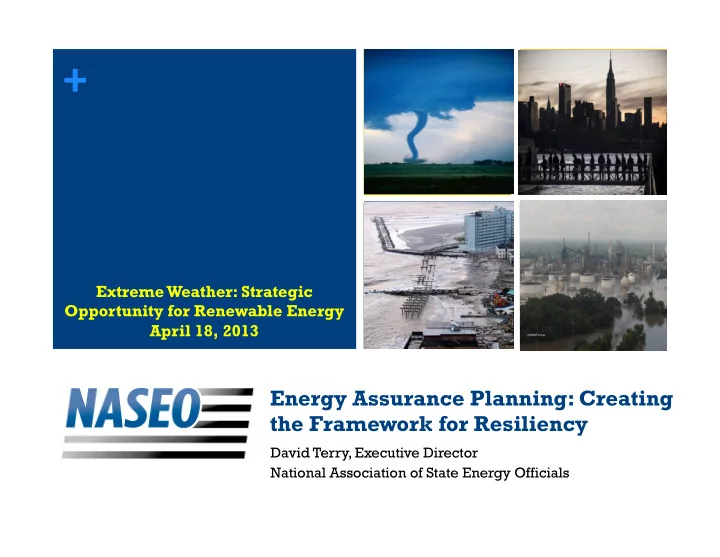
Extreme Weather: Strategic Opportunity for Renewable Energy April 18, 2013
+ Extreme Weather: Strategic Opportunity for Renewable Energy - - PowerPoint PPT Presentation
+ Extreme Weather: Strategic Opportunity for Renewable Energy April 18, 2013 Energy Assurance Planning: Creating the Framework for Resiliency David Terry, Executive Director National Association of State Energy Officials + 2 2012
Energy Assurance Planning: Creating the Framework for Resiliency
David Terry, Executive Director National Association of State Energy Officials
Extreme Weather: Strategic Opportunity for Renewable Energy April 18, 2013
n Derecho (June 29, 2012)
n 28 deaths attributed to storm n Over $1 billion in damages n 4.2 million customers without power at peak n ~9 days for power restoration n 8 states and the District of Columbia
effected
n Super Storm Sandy and the Nor’easter
(October 29 – 31, 2012)
n 132 deaths attributed to storm n Over $60 billion in damages n 8.2 million customers without power at peak n ~14 days for power restoration n 21 states effected
2
n State Energy Offices were generally first created as a result of the Arab
Oil Embargo in 1973, as such, states have been have been working on energy supply, disruption, planning, mitigation, and response measures for nearly 40 years.
n For more than twenty years, NASEO has partnered with the U.S.
Department of Energy and National Association of Regulatory Utility Commissioners to encourage energy assurance planning and regional coordination among states in planning, communication, information sharing, and coordination of activities before, during, and after energy disruptions.
n The Energy Policy and Conservation Act, Section 363, 42 U.S.C. 6322(e)
was amended by the State Energy Efficiency Programs Improvement Act of 1990.
n To be eligible for financial assistance to assist in the development and
implementation of energy conservation plans, a State must submit to the Secretary of Energy, as a supplement to its energy conservation plan, an energy emergency planning program for an energy supply disruption as designated by the State consistent with applicable Federal and State law. The contingency plan, “... shall include an implementation strategy or strategies (including regional coordination) for dealing with energy emergencies.”
3
n Respond to events that disrupt energy supply and assuring a rapid
return to normal conditions. This is a coordinated effort involving the private energy sectors’ response, augmented by local, state and federal government as needed; and
n Prevent and Protect to mitigate risks by making investments that
provide for a more secure, reliable, and resilient energy infrastructure.
n Renewable energy and energy efficiency are part of state strategies
to encourage fuel diversity, risk assessment, and mitigation measures.
¡
4
n Approximately $38 million was made available to states in August
2009 by the U.S. Department of Energy’s Office of Electric Delivery and Energy Reliability
n NASEO has collected 23 completed state energy assurance plans
and will collect additional plans as they are completed. All plans will be completed by the end of September 2013.
n Each state plan is unique and reflects the needs, organizational
structures, energy infrastructures, types of hazards, and other
needs of others.
n NASEO is conducting a review of state energy assurance plans to
identify well developed planning elements and creative public- private approaches.
5
State and Local Energy Assurance Guidelines available for download at: http://www.naseo.org/eaguidelines ¡
6
7 Private Sector Government Private Sector Petroleum Refiners and Pipelines Federal Response Plans Electric Independent System Operator Petroleum Local Retail Jobbers/Distributors State Disaster Plan Electric Transmission Natural Gas Producers Interstate Pipelines State Energy Assurance Plan Electric Local Distribution Utilities Natural Gas Local Distribution Utilities Local Energy Assurance Plan Other Critical End User Sectors
n Infrastructure that may be critical to a state may be in another state
(or country)
n States need to maintain contacts in the energy sector and with other
states in region
n State response plans should be coordinated regionally n The states’ energy emergency assurance coordinators provides
crisis communication procedures
n Regional energy emergency exercises are essential to sustaining
energy assurance capabilities and preparedness as they result in improved coordination and more rapid response
n In 2011 NASEO, in partnership with DOE, hosted
four regional energy assurance exercises and
8
n Communications
n Keep industry, federal, state and local contact information up to date and maintain
relationships
n Effective outreach to the public is a critical and can help manage public expectations
n Interdependencies
n Energy interdependencies must be understood and considered in plans n Interdependencies can compound the effects of an energy supply disruption causing
cascading impacts and limiting the response capabilities of others n Roles and Responsibilities
n Clearly defined roles and responsibilities are critical n Staff turnover, retirements and reorganizations will continue to pose challenges for
maintaining institutional knowledge and continuity n Collaboration and Coordination
n Coordination with federal organizations and at the state and local level is critical n Collaboration between states and private energy sector partners can always be
improved n Resource Allocations
n Consistent communication with infrastructure owners and operators during response is
key to establishing priorities for allocating resources and restoring services 9
n Renewable energy and energy efficiency can be strategically linked
into state and regional energy assurance planning to help build resiliency
n As a tactical approach renewable energy sources can be used to provide
back-up power to support critical facilities in the event of an outage
n As a long-term resource planning approach renewable energy and energy
efficiency can be used to diversify energy supply in states
n More energy efficient homes and buildings can retain heat longer in a
winter power outage allowing time for restoration
n Examples of supply side renewable resources include solar, wind,
biomass, biofuels, hydro- and geothermal
10
Supply Side Demand Side
Solar Energy Combined Heat and Power Energy Efficiency and Smart Grid Programs Wind Energy Distributed Generation Energy Star Appliances and Standards Solar and Wind Energy Renewable Energy Portfolio Hybrid Transportation Technology
Demand Response Management
Biomass
Technology Energy Building Codes Hydropower Geothermal Load Management and Smart Grid 11
¡
n Lead by Example
n Pursue green building initiatives that result in structurally sound and
energy lean critical facilities
n State of Kentucky built the first net-zero school in Bowling Green n State of Kansas provided funds to support green planning for
Greensburg rebuild effort
n Resiliency Planning
n Build resiliency to prepare for future disasters n State of Oregon recently released a resiliency plan for earthquakes and
tsunamis based on recommendations from eight task groups comprised
private industry, and the general public
n Build Resiliency into Power Grid
n Use of renewable energy sources to support the electrical grid n State of Montana has the ability to use renewables to provide black-start
capability for all balancing authorities in the state should the grid collapse and need to be restarted
12
n Consolidated Solar, SolarCity, Solar One, and the New York State Energy
Research and Development Authority partnered to dispatch mobile solar generators to 17 areas without electricity following the storm
n Iberdrola Renewables, in consultation with local power transmission
companies, shut down the company’s wind turbines to avoid potential damage and an overflow of energy to the system. The result was very minimal damage to the turbines which were used to help fill the power grid with energy that was needed for operation
n Co-Op City, located in the Baychester section of the Bronx, contains a 40
megawatt combined heat and power plant which provided lights and heating for its more than 60,000 residents during and after the storm
n Atlantic City’s 190 Jitneys, which run on compressed natural gas, served as
the city's emergency response vehicles and supplied fuel to South Jersey Gas vehicles and local refuse operators.
n The State of Pennsylvania waived their biodiesel requirements till the end of
November allowing additional conventional diesel to move in from other states to help with the resupply effort
13
David Terry, Executive Director National Association of State Energy Officials Email: dterry@naseo.org Telephone: 703.299.8800