
SLIDE 1
Fisheries Management on Lake Vermilion 2014 Update
Duane Williams Large Lake Specialist Tower DNR Fisheries
Fisheries Management on Lake Vermilion 2014 Update Duane Williams - - PowerPoint PPT Presentation
Fisheries Management on Lake Vermilion 2014 Update Duane Williams Large Lake Specialist Tower DNR Fisheries Introduction Lake Vermilion is part of the statewide Large Lake Program, an intensive fisheries management program on the 10 largest
Duane Williams Large Lake Specialist Tower DNR Fisheries
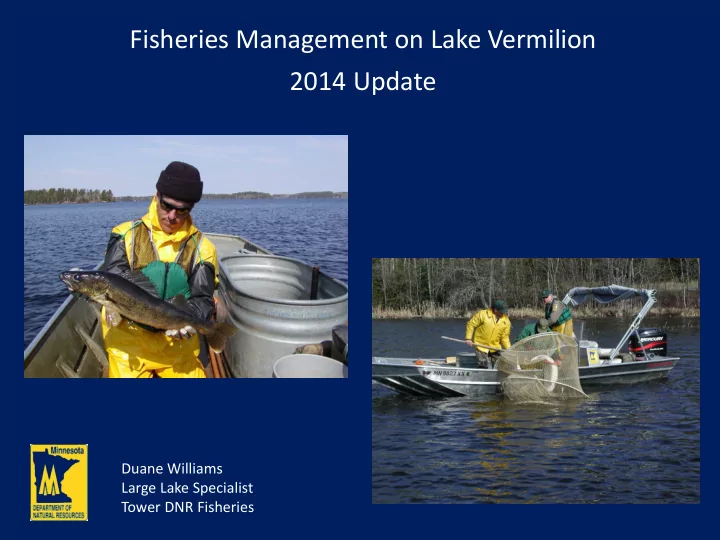
Lake Vermilion is part of the statewide Large Lake Program, an intensive fisheries management program on the 10 largest lakes in Minnesota. The Large Lake Program was started in 1984 when it became apparent that more detailed biological information was needed to properly manage these important lakes. A Large Lake Specialist was assigned to each lake to manage the program at the area level. The Large Lake Program includes annual fish population assessments, annual water quality monitoring, and regularly scheduled creel surveys. A variety of sampling gear is used during population assessments to collect the various fish species and life stages; including gill nets, trap nets, beach seines, and an electrofishing boat. Sampling for each gear type is conducted at the same time and place each year in order to determine population trends for the major species. Data is also collected on length, weight, age, and growth for each of the major species. Creel surveys are scheduled on Lake Vermilion for two consecutive years out of every six
series of boat counts and angler interviews. A creel survey was conducted in 2014 and another is scheduled for 2015. The results of the 2014 fish population assessment and 2014 creel survey are presented in the balance of this report. We encourage anyone with questions or comments to contact the Tower Fisheries office or stop by our office for a visit. We are located just west of Tower on Highway 169.
The walleye gillnet catch in 2014 was 10.8 fish/net, lower than catches have been in recent years. The lower walleye catch in 2014 was due in part to poor reproduction in 2009 and 2013, as well as lower than expected catches of the 2010 and 2011 year classes. Poor weather during part of the survey may have impacted the walleye gillnet catch as well. 5 10 15 20 25 1984 1987 1990 1993 1996 1999 2002 2005 2008 2011 2014 Number/Net Year
Annual Catches Long-Term Average
10.8
Gillnet catches of age 1 walleye (2013 year class), age 3 walleye (2011 year class), age 4 walleye (2010 year class), and age 5 walleye (2009 year class) were all below average. Walleye experienced poor reproduction in both 2013 and 2009. Gillnet catches of the 2010 and 2011 year classes were considerably lower than they had been in previous assessments, possibly due in part to high angling mortality in 2014. 1 2 3 4 5 Age 0 Age 1 Age 2 Age 3 Age 4 Age 5 Age 6 Age 7 Age 8+ 2014 2013 2012 2011 2010 2009 2008 2007 Number/Net Age/Year Class
Long-Term Average 2014 Catch
The gillnet catch of 11-16 inch walleye was below the long-term average for that length group, due to poor reproduction in 2009 and low catches of fish from the 2010 and 2011 year classes. The high catch of 10 inch walleye was due to a relatively strong 2012 year class. The gillnet catch of 19-22 inch fish was well above average. Many of these fish came from a strong 2007 year class on West Vermilion. 10 20 30 40 50 4 5 6 7 8 9 10 11 12 13 14 15 16 17 18 19 20 21 22 23 24 25 26 27 Number Length Increment (inches)
Long-Term Average 2014 Lengths
Walleye year class strength indices are calculated for each year class using several years of netting. High values represent strong year classes, while low values represent weak year classes. Strong year classes were produced in 2006, 2007, and
suggest the 2013 and 2014 year classes may be weaker than average as well. High year to year variation in year class strength is a normal condition in large natural walleye lakes. Because lake productivity is limited, it is not possible for lakes to sustain strong year classes every year. 1 2 3 4 5 6 1984 1987 1990 1993 1996 1999 2002 2005 2008 2011 2014 Index Year Class
Annual Indices Long-Term Average Indices for 2013 and 2014 are predictions based on electrofishing catches.
The 2014 northern pike gillnet catch was 0.5 fish/net, slightly below the long-term average. It was the third consecutive year northern pike catches were below average. The northern pike population is relative low on Lake Vermilion, although some of the shallow weedy bays have higher numbers of fish, especially on West Vermilion. 1 2 3 1984 1987 1990 1993 1996 1999 2002 2005 2008 2011 2014 Number/Net Year
Annual Catches Long-Term Average 0.5
The 2014 perch gillnet catch was 32.5 fish/net, slightly above the long-term average. The perch catch declined substantially after an unusually high catch in 2013. Low perch gillnet catches from 2007 to 2012 were believed to be related to an expanding cormorant population on the lake. A cormorant control program was started in 2013. 10 20 30 40 50 60 1984 1987 1990 1993 1996 1999 2002 2005 2008 2011 2014 Number/Net Year
Annual Catches Long-Term Average 32.5
Night electrofishing is used to sample smallmouth bass and young-of-the-year walleye, which are not often caught in standard lake survey nets. Smallmouth bass are sampled in June, while young-of-the-year walleye are sampled in late September.
The smallmouth bass electrofishing catch in 2014 was 57.0 fish/hour of electrofishing, well above the long- term average. All size categories were well represented in the electrofishing catch. Strong year classes were produced in 2005, 2006, 2010, and 2011. Weak year classes were produced in 2008 and 2009. No sampling for smallmouth bass was done in 1990, 2000, and 2013. 20 40 60 80 1989 1992 1995 1998 2001 2004 2007 2010 2013 Number/Hour Year
Annual Catches Long-Term Average
57.0
The young-of-the-year walleye electrofishing catch in 2014 was 81.3 fish/hour of electrofishing, slightly below the long-term average. Electrofishing catches have declined recently after relatively high catches in 2011 and 2012. The length that young-of-the-year walleye reach by fall is also important in determining year class strength. Large fish tend to produce strong year classes, while small fish produce weak year classes. The mean length in 2014 was 5.0 inches, slightly below the long-term average. 100 200 300 400 1988 1991 1994 1997 2000 2003 2006 2009 2012 Number/Hour Year
Annual Catches Long-Term Average 81.3
Creel survey is a scientific method of estimating fishing pressure and fish harvest from a series of boat counts and angler surveys. On Lake Vermilion, boat counts are done by DNR Enforcement pilots while angler interviews are done by creel survey clerks travelling the lake by boat. Creel surveys on Lake Vermilion are done two consecutive years out of every six years. Creel surveys on Lake Vermilion only include boat anglers fishing during daylight hours from opening day thru the end of September.
200,000 400,000 600,000 800,000 1984-85 1990-91 1996-97 2002-03 2008-09 2014 Angler Hours Year
Annual Pressure Long-Term Average 480,000
There were an estimated 480,000 hours of fishing pressure on Lake Vermilion during the 2014 survey period, slightly below the long-term average. Lower fishing pressure in 2014 was due in part to ice cover on opening weekend and poor weather in May and June. Fishing pressure was well below average in May and June, near average in July, and above average in August and September.
An estimated 45,400 pounds of walleye were harvested during the 2014 survey period, well below both the long- term average and the safe harvest target established for the lake (65,000 pounds). The DNR uses fish harvest in pounds for most management planning. The low harvest was due to a number of factors, including low fishing pressure in May and June, a decline in the number of keeper-sized walleye in the population, and the protected slot regulation (18-26 inch protected slot with one fish allowed over 26 inches and a 4-fish bag limit). High walleye harvest in 2002 and 2003 prompted the special regulation that began in 2006. 20,000 40,000 60,000 80,000 100,000 1984-85 1990-91 1996-97 2002-03 2008-09 2014 Harvest in Pounds Year
Annual Harvest Safe Harvest Target 45,400 lbs. Special regulation begins in 2006
In terms of numbers of fish, anglers harvested an estimated 49,700 walleye during the 2014 survey period, with an additional 108,200 walleye caught and released. Nearly 60% of the walleye caught in 2014 were released, mostly because they were too small. An estimated 11,200 walleye were released because they were in the protected slot. Release estimates are not available for 1984, 1985, and 2002. 50,000 100,000 150,000 200,000 1984-85 1990-91 1996-97 2002-03 2008-09 2014 Number Year Harvested Fish Released Fish
49,700 108,200 Special regulation begins in 2006
The angler catch of walleye in 2014 was dominated by small fish, with 64% of the walleye caught being less than 13 inches long. Many of these fish came from a strong year class produced in 2012. An estimated 11,200 walleye within the protected slot were caught and released, fish that would have been vulnerable to harvest had the protected slot regulation not been in place. 5,000 10,000 15,000 20,000 25,000 30,000 35,000 4 5 6 7 8 9 10 11 12 13 14 15 16 17 18 19 20 21 22 23 24 25 26 27 28 29 30 Number Length Increment (inches) Harvested Fish Released Fish
18-26 inch protected slot
An estimated 4,700 pounds of northern pike were harvested during the 2014 survey period, the lowest northern pike harvest observed in any creel survey to date. Harvest of northern pike has been declining since the first creel survey in 1984, probably due to a combination of fewer anglers targeting northern pike, increased catch and release fishing, and restrictions from the special regulation for northern pike (24-36 inch protected slot with
initiative to improve the size structure of pike populations in a number of lakes in the state. 10,000 20,000 30,000 40,000 1984-85 1990-91 1996-97 2002-03 2008-09 2014 Harvest in Pounds Year
4,700 lbs. Special regulation begins in 2003
An estimated 2,400 northern pike were harvested during the 2014 survey period, with an additional 16,000 northern pike caught and released. It was the lowest total catch of northern pike observed in any creel survey to
northern pike caught in 2014 were harvested. Release estimates are not available for 1984, 1985, and 2002. 20,000 40,000 60,000 1984-85 1990-91 1996-97 2002-03 2008-09 2014 Number Year Harvested Fish Released Fish
Special regulation begins in 2003 16,000 2,400
An estimated 6,000 pounds of smallmouth bass were harvested during the 2014 survey period, slightly less than harvests observed in other recent creel surveys. Harvest of the smallmouth bass declined considerably after the first set of surveys in 1984 and 1985, probably due in part to more catch and release fishing. 4,000 8,000 12,000 1984-85 1990-91 1996-97 2002-03 2008-09 2014 Harvest in Pounds Year
6,000 lbs.
An estimated 4,000 smallmouth bass were harvested during the 2014 survey period, with an additional 51,200 smallmouth bass caught and released. The total catch was similar to other recent creel surveys. Only 7% of the smallmouth bass caught in 2014 were harvested, reflecting the prevalence of catch and release fishing for this
20,000 40,000 60,000 80,000 1984-85 1990-91 1996-97 2002-03 2008-09 2014 Number Year Harvested Fish Released Fish
51,200 4,000
No muskie harvest was documented during the survey. There are occasional reports of muskie being harvested, but it is believed harvest is very low. An estimated 1,800 muskie were caught and released during the survey period, similar to the 2009 muskie catch. Muskie caught at night or after September 30 were not documented during this survey, although there are probably a substantial number of fish caught at these times. 1,000 2,000 3,000 1984-85 1990-91 1996-97 2002-03 2008-09 2014 Number Year
32 128 307 338 434 349 333 100 200 300 400 500 2004 2007 2010 2011 2012 2013 2014
Number Nests Year
control may be allowed if there is evidence of damage.
collaboration with USFWS.
population to recover, while still maintaining a viable nesting colony.
tournaments in a manner that will protect fish populations and minimize conflict with other lake users. To date, two permits have issued for fishing tournaments on Lake Vermilion in 2015:
destroyed much of the aquatic vegetation in the areas they have colonized
Vermilion sponsored a chemical treatment in Everett Bay in 2013 with the goal of reducing abundance and helping prevent spread to other areas of the lake.
become a nuisance when large die-offs occur.
the spread of invasive species. Boaters should always take preventative measures to avoid moving water, plants, or animals to other lakes. Boats and trailers should be thoroughly cleaned or dried before moving to other bodies of water. All bilges and live wells must be
mouth of the Pike River. Walleye produced at the hatchery are used for stocking programs in northeastern Minnesota and other areas of the state. A portion of the fry produced each year is stocked back into Lake Vermilion to mitigate egg removal from the lake. In recent years, 5-20 million walleye fry have been stocked into Lake Vermilion annually. There is also substantial natural reproduction of walleye in Lake Vermilion. While it is important to have sufficient walleye fry for producing good year classes, excessive stocking beyond that level is probably not productive and may actually be counter-productive by slowing growth and reducing survival.
available.
zooplankton sampling, and water chemistry sampling.
The season is now the same as walleye and northern pike.
Contact: Duane Williams Edie Evarts Large Lake Specialist Area Fisheries Supervisor 218-753-2580 ext. 224 218-753-2580 ext. 222 duane.williams@state.mn.us edie.evarts@state.mn.us