SLIDE 1 PHENOD meeting 05/07/2019
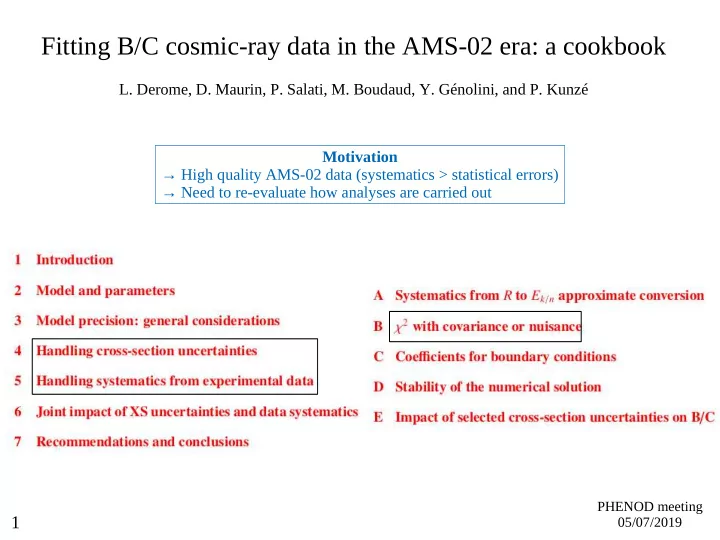
Fitting B/C cosmic-ray data in the AMS-02 era: a cookbook
- L. Derome, D. Maurin, P. Salati, M. Boudaud, Y. Génolini, and P. Kunzé
1
Motivation → High quality AMS-02 data (systematics > statistical errors) → Need to re-evaluate how analyses are carried out
SLIDE 2
χ2 with covariance and nuisance
2 How to compare model to data? → Standard χ2 → Account for possible nuisance parameters: penalty if parameter value several σ away from its expected value (from `external’ experiment) – ‘t’: depends on data taking periods (e.g., modulaton level per given CR dataset) – ‘q’: depends on specific quantities considered – Time- and quantity-independent (e.g., cross section values) → Include possible correlations in adjacent data bins via covariance matrix of data errors
qties time periods generic
SLIDE 3
Handling cross-section uncertainties (1)
3 Impact of different XS datasets on B/C → Enable ‘continuous deformations’ of XS to encompass XS uncertainties
SLIDE 4
Handling cross-section uncertainties (2)
4 Impact of different XS datasets on B/C + Dominant reactions → Enable ‘continuous deformations’ of XS to encompass XS uncertainties → Nuisance on `deformation’ parameters of most impacting reactions (stop when impact < data uncertainties)
+
SLIDE 5
Handling cross-section uncertainties (3)
5 Vaidation on mock data + nuisance NSS (Norm, Slope, Scale) → If wrong XS, biased statistical interpretation (model excuded)
SLIDE 6
Handling cross-section uncertainties (4)
6 Vaidation on mock data + nuisance NSS (Norm, Slope, Scale) → If wrong XS, biased statistical interpretation (model excuded) → Nuisance parameters ‘NSS’ allow to recover true values and meaningful χ2
SLIDE 7
Handling systematic from experimental data (1)
7 l = 0 → no correl. (e.g. stat. errors) l = ∞→ full correl. = norm. (e.g. scale) → Correlation lengths built from detector and analysis characteristics AMS-02 level of systematics + `model’ for correlation length
SLIDE 8
Handling systematic from experimental data (2)
8 AMS-02 level of systematics + `model’ for correlation length → Acceptance is one of the most complicated systematics (includes several effects) → Choice of its correlation length crucial for sound statistical interpretation of data
SLIDE 9
Conclusions (1)
9 Cross sections → 10-15% uncertainties from XS: using wrong XS bias transport parameters → nuisance parameters propagate ‘uncertainties’ and remove biases AMS-02 data systematics → 3-6% uncertainties, correlation matrix and lengths built from ‘detector’ → Fix lacc to get meaningful χ2 N.B.: to do better would require lot of work from AMS-02 collaboration Model precision, numerical convergence, etc. → Ensure that model calculation much better than data uncertainties → Ensure qty calculated with model is same as in data (# events in bin) → Sound and flexible framework to carry out AMS-02 data analyses, accounting for all dominant uncertainties
SLIDE 10
Conclusions (2)
10 → All analyses performed with USINE [https://lpsc.in2p3.fr/usine] https://arxiv.org/abs/1807.02968