Focus on Enforcement Insights from research and analysis in support - - PowerPoint PPT Presentation

focus on enforcement
SMART_READER_LITE
LIVE PREVIEW

Focus on Enforcement Insights from research and analysis in support - - PowerPoint PPT Presentation

Focus on Enforcement Insights from research and analysis in support of San Franciscos Vision Zero plan to eliminate traffic deaths Joe Lapka Corina Monzn 7/21/2017 Presentation to SFMTA Policy & Governance Committee Office of the


slide-1
SLIDE 1

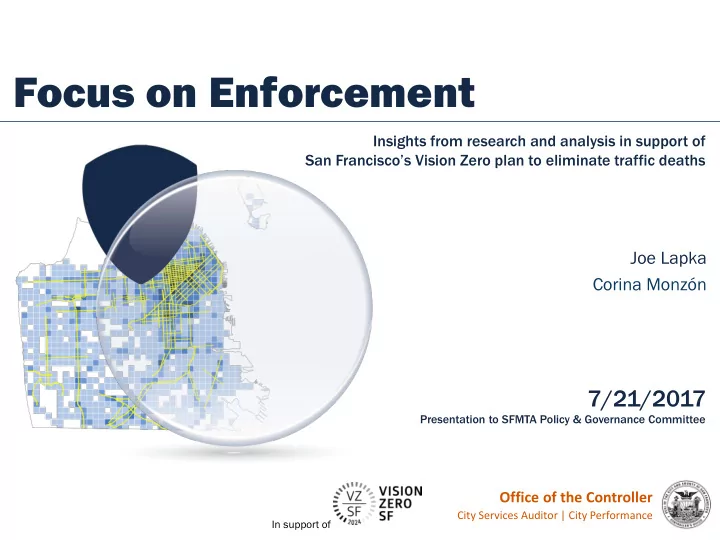
Focus on Enforcement

Insights from research and analysis in support of San Francisco’s Vision Zero plan to eliminate traffic deaths

Joe Lapka Corina Monzón

Office of the Controller

City Services Auditor | City Performance

7/21/2017

In support of

Presentation to SFMTA Policy & Governance Committee

slide-2
SLIDE 2

Introduction

  • Every year in San Francisco about 30 people lose their lives and over 500 more are

seriously injured while traveling on City streets

  • SFMTA data shows that the number of fatal and injury collisions has stagnated since around

2004 following steady decreases throughout the 1990s and early 2000s

  • With the release of the new 2017-2018 Vision Zero Action Strategy, now is an opportune time

to think critically about how to set the number of collisions back on their downward trend

  • At the request of the SFPD, SFMTA, and DPH, the Controller’s Office has analyzed the

most recently available collision data to gain a better view of the relationship between traffic enforcement and collisions, and inform potential refinements to the SFPD’s traffic enforcement strategy

slide-3
SLIDE 3

Introduction

  • This analysis is also timely in that the SFPD is

currently implementing 479 recommendations it has received over the last 18 months from the Department of Justice, Blue Ribbon Panel, US, Civil Grand Jury, and other sources. Collectively, these recommendations emphasize the importance of:

  • Engaging in community policing and community
  • utreach
  • Bringing police and community members together

to foster an improved understanding of police practices and community perceptions, and

  • Engaging with the community to develop district-

based, co-produced public safety strategies

  • We hope this analysis will be helpful in facilitating

conversations among the SFPD and the communities in each District as the SFPD implements these recommendations

slide-4
SLIDE 4

Introduction

Information Gathering

Academic research ● Informational interviews - Cmdr. Mannix, Cmdr. O’Sullivan, others ● Data collection

Preliminary Analysis and Application Development SFPD Review

Traffic Company ● Central, Mission & Southern Districts

Additional Internal Review External Feedback

VZ Taskforce ● Walk SF SF Bicycle Coalition

Report Development Process

slide-5
SLIDE 5

Recommendations:

  • 1. The SFPD should seek out opportunities to extend its

enforcement presence beyond the HIN so as to create the impression among the driving public that violations of the law, wherever they occur, will be detected. The selection of alternative sites should be data driven and should consider vulnerable populations at sites such as schools and senior

  • centers. The online collision maps we have developed as a

companion to this report can be used for such a purpose.

  • 2. The SFPD should modify its Focus on the Five strategy so that

it is better suited to the unique environment of each police district and allows for an appropriately varied response to the problem of traffic collisions. We recommend structuring the goal such that: a) each district is individually responsible for meeting its

  • wn district-based target; and

a) the districts are jointly responsible for a department- wide goal (i.e., 100% of the districts should meet their target each month).

  • 3. In implementing the recommendations of the Department of

Justice, the SFPD should utilize the City’s Vision Zero Action Strategy as a framework for working collaboratively with the community to understand traffic violence and jointly develop strategies to address it. As appropriate, the SFPD may additionally consider incorporating specific community concerns into its Focus on the Five goals.

  • 4. The SFPD should develop and publicly report on measures

related to procedural justice and social equity in traffic enforcement.

  • 5. Consistent with our recommendations that the SFPD broaden

the spatial extent of its traffic enforcement activities and the range of illegal behaviors on which it focuses, the SFPD should similarly ensure that the temporal scope of its

  • perations is sufficient to deter illegal driving behaviors at all

times throughout the day and over the course of a week.

  • 6. The SFPD should consider the feasibility of measuring the

level of effort it dedicates to traffic enforcement if it wishes to further explore the relationship between the level of policing and the rates of traffic collisions or violations in San Francisco.

  • 7. In evaluating the Safe Speeds SF campaign, the City should

not only evaluate its effectiveness in reducing average vehicle speeds and the number of speeding vehicles, but it should also evaluate its impact on the SFPD’s resources and consider how sustainable the program is over the long term. continued on next page… 5

Introduction
slide-6
SLIDE 6

6

Introduction

Recommendations:

  • 8. In light of scientific research which shows that effective

traffic enforcement programs should be based on proactive rather than reactive measures, and given the proven efficacy

  • f automated speed enforcement in preventing fatal and

serious injury collisions, the City and County of San Francisco should continue to advance the use of automated speed enforcement as a tool for encouraging people to drive at safe speeds.

  • 9. The SFPD should work quickly to implement its eCitation and

eStops initiatives, which will enable officers to issue citations electronically and provide for the electronic collection of data on the race and ethnicity of those who are stopped. In implementing these initiatives, the SFPD should work with its Vision Zero partner agencies to ensure the new systems will support quality data analyses.

slide-7
SLIDE 7

7

Introduction

  • 1. The SFPD should seek out opportunities to extend its

enforcement presence beyond the HIN so as to create the impression among the driving public that violations

  • f the law, wherever they occur, will be detected. The

selection of alternative sites should be data driven and should consider vulnerable populations at sites such as schools and senior centers. The online collision maps we have developed as a companion to this report can be used for such a purpose. Recommendations:

slide-8
SLIDE 8

Fatal, Severe Injury & Non-severe Injury Collisions (2013-2015)

8

Collision Data Pertaining to the Spatial Extent of Enforcement

Number of Collisions 1-7 8-17 18-30 31-51 52-88 High Injury Network

slide-9
SLIDE 9

Distribution of Fatal & Injury Collisions (2013-2015)

9 Collisions not on the HIN

A sizeable fraction of fatal and injury collisions occur outside

  • f the Vision Zero HIN. The City’s goal of eliminating traffic

fatalities by 2024 requires enforcement strategies that deter illegal and unsafe driving behaviors not only on the 12% of city streets that make up the HIN but everywhere throughout the City.

slide-10
SLIDE 10

10

Collision Data Pertaining to the Spatial Extent of Enforcement

http://sfcontroller.org/collisiondata

slide-11
SLIDE 11

11

Introduction

  • 2. The SFPD should modify its Focus on the Five strategy so that

it is better suited to the unique environment of each police district and allows for an appropriately varied response to the problem of traffic collisions. We recommend structuring the goal such that: a) each district is individually responsible for meeting its

  • wn district-based target; and

b) the districts are jointly responsible for a department- wide goal (i.e., 100% of the districts should meet their target each month). Recommendations:

slide-12
SLIDE 12

Benefits and Limitations of the Focus on the Five Strategy

12

Collision Data Pertaining to Dangerous Road User Behaviors

Percentage of “Focus on the Five” Citations1

SFPD Overall Northern District

Notes: 1. Effective September 2016, the percentage of citations for the top five causes of collisions is calculated as a percentage of traffic citations. Before September 2016, this calculation was as a percentage of all citations.

Benefits

  • Has helped SFPD direct more of its traffic

enforcement resources toward road user behaviors that result in severe injury and death

Limitations

  • Factors that contribute to collisions are

not the same in every district

  • There are other collision factors and

associated factors that are equally as dangerous and the SFPD should not be “penalized” for issuing citations for them

slide-13
SLIDE 13

Methodology for Identifying Priority Behaviors in each District

13

natural breaks among PCF groups

Top Class Middle Class Bottom Class

Jenks natural breaks optimization

slide-14
SLIDE 14

Results of PCF Clustering Analysis

14

(2013-2015; fatal and injury collisions excluding those with only a complaint of pain)

slide-15
SLIDE 15

Current Focus on the Five Factors

Recommended Collision Factors and Vehicle Code Violations for Focused Enforcement

15 x x

Factors resulting from the clustering analysis Expanded factors

slide-16
SLIDE 16

16

Distribution of the Primary Collision Factors in the Ingleside District The top two classes of collision factors1 account for 71% of collisions with known primary factors2,3

Notes: 1. Excluding pedestrian violations of the California Vehicle Code 2. Excluding complaint of pain cases 3. Some totals may be slightly off due to rounding

slide-17
SLIDE 17

17

Distribution of the Primary Collision Factors in the Central District The top two classes of collision factors1 account for 60% of collisions with known primary factors2,3

Notes: 1. Excluding pedestrian violations of the California Vehicle Code 2. Excluding complaint of pain cases 3. Some totals may be slightly off due to rounding

slide-18
SLIDE 18

18

Distribution of the Primary Collision Factors in the Taraval District

The top two classes of collision factors1 account for 76% of collisions with known primary factors2,3

Collision Data Pertaining to Dangerous Road User Behaviors

Notes: 1. Excluding pedestrian violations of the California Vehicle Code 2. Excluding complaint of pain cases 3. Some totals may be slightly off due to rounding

slide-19
SLIDE 19

19

General Groups of Dangerous Behaviors

  • 1. Speeding and Speed-related Violations
  • CVC §21703

– Following too closely prohibited

  • CVC §22350

– Unsafe speed for prevailing conditions

  • 2. Right-of-Way Violations
  • CVC §21453(a,c) – “Red” signal – vehicular responsibilities
  • CVC §21950(a,c) – Driver to yield right-of-way at crosswalks
  • CVC §21801(a,b) – Violation of right-of-way – left turn
  • CVC §21802(a,b) – Violation of right-of-way – entering through highway
  • CVC §22450(a)

– Failure to stop at a STOP sign

  • 3. Impaired & Distracted Driving
  • CVC §23152

– Driving under the influence of alcohol or drug

  • CVC §23123(a)

– Driving while using a wireless telephone not configured for hands-free use

  • CVC §23123.5(a) – Driving while using a wireless device to send, read, or write text communication unless the device is used in

a hands-free and voice-operated manner

  • 4. Turning, Lane Change and Stopping/Starting Violations
  • CVC §22107

– Unsafe turn or lane change prohibited

  • CVC §21658(a,b) – Lane straddling/failure to use specified lanes
  • CVC §22101(d)

– Violating special traffic control markers

  • CVC §22517

– Opening door on traffic side when unsafe

  • CVC §22106

– Unsafe starting or backing on highway

  • 5. Community Priorities

1-2 additional district-specific factors based on community input

slide-20
SLIDE 20

20

Distribution of the Primary Collision Factors Recommended for Focused Enforcement

The thirteen collision factors we are recommending for focused enforcement collectively account for approximately 74% of collisions with known primary factors

Collision Data Pertaining to Dangerous Road User Behaviors

slide-21
SLIDE 21

21

Appendix

PCF Grouping Analysis Results

  • City-wide

Note: This table appears as Appendix D in the full report

slide-22
SLIDE 22

22

PCF Grouping Analysis Results

  • City-wide (continued)

Appendix

slide-23
SLIDE 23

23

PCF Grouping Analysis Results

  • City-wide (continued)

Appendix

slide-24
SLIDE 24

For More Information

Contact:

Corina Monzón Office of the Controller City and County of San Francisco (415) 554-5003 | corina.monzon@sfgov.org

  • r

Joe Lapka Office of the Controller City and County of San Francisco (415) 554-7528 | joe.lapka@sfgov.org

To download the report, visit:

http://sfcontroller.org/

To access the district collision maps, visit:

http://sfcontroller.org/collisiondata