
SLIDE 1
Food, Culture, & Obesity in Latin America
Dan Fenyvesi, MS, RD
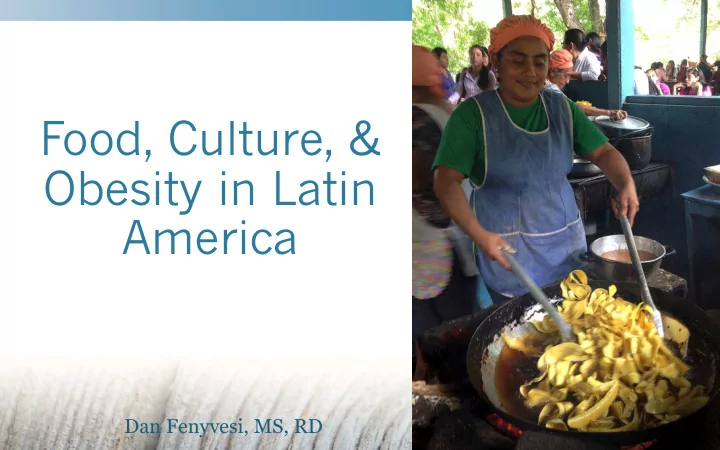
Food, Culture, & Obesity in Latin America Dan Fenyvesi, MS, RD - - PowerPoint PPT Presentation
Food, Culture, & Obesity in Latin America Dan Fenyvesi, MS, RD If there were no health consequences, would you rather eat If there were no health consequences, would you rather eat If there were no health consequences, would you
Dan Fenyvesi, MS, RD
6 million inhabitants Ethnicity 70% Mestizo 16% White 9% African heritage 5% Indigenous Average income is the equivalent
57% have at least a fifth-grade
education
High infant death rate
Born underweight
Poor maternal health
Pregnancies in quick succession
Endemic sickness (dengue, malaria, STDs) Unsafe workplace conditions: toxic chemicals lead
to neurological problems; kidney, liver disease
Mental health and alcoholism Disabilities (violence, accidents) Malnutrition and chronic disease/obesity
(cardiovascular, diabetes, and renal problems)
Cancers
Currently over half
are overweight or obese.
For most of the 20th
century, over half of the Nicaraguan population was undernourished
2015 interview with a 25-year-old whose BMI was 28. What are the consequences of continued weight gain?
Diet Timeline Key Foods
1 Hunter- Gatherer From 20,000 BCE game, seafood, wild-gathered plants (grains, legumes, seeds, tubers) 2 Agricultural From 7,000 BCE–present beans, corn, vegetables 3 Processed Agricultural Mid-20th century–present white rice, vegetable oil, sugar 4 Modern Processed Urban: 1990s–present Rural: 2000s–present processed food and drink, and factory-farmed animal products
Land redistribution: Subsistence
farmers were moved to smaller plots of less-fertile land. The best land became large plantations focusing on export-
Beef, cotton, sugar, tobacco, chocolate,
and coffee were exchanged for foreign investment and money for modernization
Sugar, rice, and oil became widely available
and were promoted by the government and NGOs to meet calorie deficits.
Nicaragua’s traditional agrarian diet shifted to a processed agrarian diet in the space of 50 years.
Traditional agrarian meal (above) Processed agrarian meal (left)
are higher in the processed diet *animal products are eaten when available or when budget allows
Sample Traditional Agricultural Diet
Breakfast Egg, beans, tortillas, corn-based drink (pinol) Lunch Soup with squash, carrot,
Dinner Beans, tortillas, cabbage salad, mango, juice
Sample Processed Agricultural Diet
Breakfast Fried rice, beans, coffee, tortillas Lunch Fried rice, meat,* cheese,* juice, coffee Dinner Fried rice, beans, Tang, fried plantains, cabbage salad
Modern processed foods Instant noodles, hot dogs, pastries, candies, canned goods, sweet beverages, factory-farmed meat and dairy, etc. Processed agrarian foods White rice, sugar, oil Animal foods meat, fish, eggs, cheese Plant foods Beans, corn, plantains, vegetables, fruit
As the percentage of processed food increases, calorie density and overall calorie intake rise.
Whole-Foods Agrarian Diet of the Rural Poor Processed Agrarian Diet of the Rural Poor Modern Processed Diet of the Urban Poor
Concentration in Fuel Sources
Levels of increasing energy density
Fairly simple processing Industrial processing Millenia
selection
Raw plants Cooked plants Meat, dairy, and seafood Processed foods Pairs of roughly comparable fuel sources Same fuel source
Overview Survey of 50 households in rural Nicaragua More than 60% of calories come from oil, rice, and sugar Deficiencies in vitamins A, B6, B12, E, and all the minerals Deficiencies affect bone density, brain development;
are causes of cavities, anemia, growth stunting, and obesity
Nutrients for brain development include protein, iron, zinc, selenium, iodine, folate, vitamin A, choline, EFAs
Borderline protein deficiency
Incidence of overweight/obesity
(BMI of more than 25%)
Location % overweight El Quebracho 57% Las Palmas 44% La Labranza 37% Los Pinares 36% Barrio Nuevo 35% Macronutrient Processed Agrarian Traditional Agriculture Carbohydrate 57% 60-70% Protein 7% 10-15% Fat 36% 10-20% Differences in diet composition from traditional to modern
Overweight and Diet
A closer look
One ounce of almonds is about 22-25 nuts
Compare corn kernels and cashews. Per calorie, corn has the same amount of protein. All nuts and seeds are raw, one-ounce portions. Serving size calculated without inedible shells/hulls. Data comes from the USDA. 1 tortilla = 1.5 g 1 average ear = 3 g 1 cup = 4/5 g
These tables are derived from estimating the average dietary intake of the 200 study participants based on their 24-hour dietary recalls
Vitamin Percent of US RDA
A 18% B3 54% B5 81% B6 58% B12 23% D 4% E 68%
Mineral Percent US RDA
Calcium 18% Magnesium 73% Potassium 39% Selenium 57% Zinc 58%
Nutrition Deficiencies
Traditional
All food is good Food is fuel Food is all grown locally Diet is highly repetitive Fewer people are overweight, and being overweight carries status Love to eat but rarely discuss food Prepare all meals at home
Modern
Complex hierarchy of food (status) Food can be used as entertainment, status, drug Little (local) food production Diet is varied Being overweight is regarded negatively Food is heavily discussed Less cooking
Credit is not easily attainable in
Latin America
Latinos arrive in the USA and are
rate mortgages
As with diet the long term
implications are often underestimated or misunderstood
Differences in prices/quantities
(“Walmart” effect)
Many see sickness and disease as fate. A common phrase
people use is “que Dios quiere” (“what God wants”)
Few, including many doctors, understand the connection
between diet and disease.
People find it hard to grasp problems caused by obesity,
finding the onset too gradual to connect and the future detriment too vague
Excess food, especially after a legacy of deprivation,
is seen as exciting and a sign of high social status.
Hearing
Hearing
Taste
Taste Smell Smell Touch Touch Sight Sight
Nicaragua United States
Raw agricultural
products are exported
Refined foods and
prescription drugs are imported
Addictive, cheap food Obesity and disease Need for treatment $$ dependence Stress of poverty and exploitation
(dietary guidelines)
Grains and legumes are the
base, and together with fruits and vegetables (“protectors”) should be eaten every day
Meat and diary (“shapers”)
should be eaten three times per week)
Fats and sweets (“energy”)
are to be eaten in moderation
Breakfast, no frying: 357 calories Fried breakfast: 507 calories
Easy-to-make, delicious banana ice cream
170 lbs. (5’6”) Cholesterol: 230 Waist: 35” BMI: 28 Knee pain, digestive problems Low energy, high stress
2006
Consider status of food Other cultures lack familiarity with impact of S.A.D. Lack of familiarity with long term RX use/regimen Newness to culture of recreational sports/activities
(particularly for adults)
Vulnerability to marketing/health fads/diets/pills Lack of distinction between titles, I.E. life coach vrs RD All processed foods are very cheap in USA in comparison to
salaries and in particular…
Animal foods are cheaper in the USA
Free on YouTube! Educators are using this to spark dialogue A Faustian Bargain
Obesity in Nicaragua/ Obesidad en Nicaragua
References
Prevalence of obesity, tobacco use, and alcohol consumption by socioeconomic status among six communities in Nicaragua. TS, Bert PJ, González M, Unruh M, Aragon A, Lacourt CT. Rev Panam Salud Publica. 2012;32(3):217–255. Childhood Obesity: CDC Childhood Obesity Prevention Fact Sheet, 2015. Atlanta, GA: Division of Population Health, National Center for Chronic Disease Prevention and Health Promotion. “Worldwide trends in diabetes since 1980: a pooled analysis of 751 population-based studies with 4·4 million participants” The Lancet, Volume 387 (2016): 1513-1530 National Center for Health Statistics. Health, United States, 2015: With Special Feature on Racial and Ethnic Health Disparities. Hyattsville, MD; U.S. Department of Health and Human Services (2016): 271-272 Zhong et al. “Age and Sex Patterns of Drug Prescribing in a Defined American Population.” Mayo Clinic Proceedings. 88 (2013): 697–707 United States Agency for International Development Nutrition Assessment Sector for Nicaragua Managua, Nicaragua. May 14, 1976 http://pdf.usaid.gov/pdf_docs/PNAAF434.pdf
References
John Price, “Latin America’s Booming Pharma Industry Is A Local Affair,” Latin Trade, October 8, 2013. Darna L. Dufour, “Diet and nutritional status of Amerindians: a review of the literature.” Cadernos de Saúde Pública 7 (1991), 481-502. Hoebink, Paul. Sugar from Nicaragua. Nijmegen, Netherlands: Centre for International Development Issues Nijmegen, Radboud University www.ru.nl/publish/pages/.../nicaragua_sugar_report_-_final_version_02062014.pdf Dapi L.N., Omoloko C., Janlert U., Dahlgren L., Håglin L. “I eat to be happy, to be strong, and to live. Perceptions of rural and urban adolescents in Cameroon, Africa.” Journal of Nutrition Education Behavior; 39(6) 2007 Nov-Dec: 320-6. Trends in dietary patterns of Latin American populations. Bermudez OI, Tucker KL Cad Saude Publica. 2003;19 Suppl 1:S87-99. Epub 2003 Jul 21. http://www.ncbi.nlm.nih.gov/pubmed/12886439 The Nutrition Transition: Evidence from Nicaragua, Costa Rica, and Chile by Pawloski, Moore, Waters, Rojas Global Studies Review http://www.globality-gmu.net/archives/2158 Christiane Berth “Food Policy and Consumption in Nicaragua 1965-1995” Dialogues Electronic Journal of History, Volume 15 Number 1 February/August 2014