Forced Pooling in Oil and Gas: Navigating State Laws, Addressing - - PowerPoint PPT Presentation

forced pooling in oil and gas navigating state laws
SMART_READER_LITE
LIVE PREVIEW

Forced Pooling in Oil and Gas: Navigating State Laws, Addressing - - PowerPoint PPT Presentation

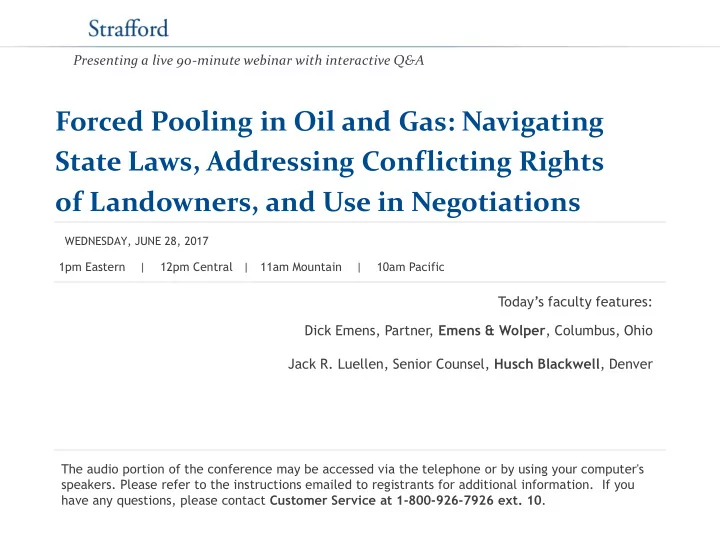
Presenting a live 90-minute webinar with interactive Q&A Forced Pooling in Oil and Gas: Navigating State Laws, Addressing Conflicting Rights of Landowners, and Use in Negotiations WEDNESDAY, JUNE 28, 2017 1pm Eastern | 12pm Central |


slide-1
SLIDE 1

The audio portion of the conference may be accessed via the telephone or by using your computer's

  • speakers. Please refer to the instructions emailed to registrants for additional information. If you

have any questions, please contact Customer Service at 1-800-926-7926 ext. 10.

Presenting a live 90-minute webinar with interactive Q&A

Forced Pooling in Oil and Gas: Navigating State Laws, Addressing Conflicting Rights

  • f Landowners, and Use in Negotiations

Today’s faculty features:

1pm Eastern | 12pm Central | 11am Mountain | 10am Pacific WEDNESDAY, JUNE 28, 2017

Dick Emens, Partner, Emens & Wolper, Columbus, Ohio Jack R. Luellen, Senior Counsel, Husch Blackwell, Denver

slide-2
SLIDE 2

Tips for Optimal Quality

Sound Quality If you are listening via your computer speakers, please note that the quality

  • f your sound will vary depending on the speed and quality of your internet

connection. If the sound quality is not satisfactory, you may listen via the phone: dial 1-866-755-4350 and enter your PIN when prompted. Otherwise, please send us a chat or e-mail sound@straffordpub.com immediately so we can address the problem. If you dialed in and have any difficulties during the call, press *0 for assistance. Viewing Quality To maximize your screen, press the F11 key on your keyboard. To exit full screen, press the F11 key again.

FOR LIVE EVENT ONLY

slide-3
SLIDE 3

Continuing Education Credits

In order for us to process your continuing education credit, you must confirm your participation in this webinar by completing and submitting the Attendance Affirmation/Evaluation after the webinar. A link to the Attendance Affirmation/Evaluation will be in the thank you email that you will receive immediately following the program. For additional information about continuing education, call us at 1-800-926-7926

  • ext. 35.

FOR LIVE EVENT ONLY

slide-4
SLIDE 4

Program Materials

If you have not printed the conference materials for this program, please complete the following steps:

  • Click on the ^ symbol next to “Conference Materials” in the middle of the left-

hand column on your screen.

  • Click on the tab labeled “Handouts” that appears, and there you will see a

PDF of the slides for today's program.

  • Double click on the PDF and a separate page will open.
  • Print the slides by clicking on the printer icon.

FOR LIVE EVENT ONLY

slide-5
SLIDE 5

W E B I N AR P R E S E N TE R S

  • J. RICHARD EMENS

EMENS & WOLPER LAW | COLUMBUS, OHIO

JACK R. LUELLEN

HUSCH BLACKWELL, LLP | DENVER, COLORADO

JUNE 28, 2017 – 1:00 PM TO 2:30 PM Strafford Publications

Forced Pooling in Oil & Gas: Navigating State Laws, Addressing Conflicting Rights of Landowners, and Use in Negotiations

5

06-28-2017

slide-6
SLIDE 6

Strafford Publications - Forced Pooling Webinar Emens/Luellen Presentation

Outline I Introduction Definitions, Pooling, Forced Pooling, Unitization II State Laws Regarding Forced Pooling A. Colorado B. Ohio C. Other States III Conflicts Between Landowners A. Full Landowners B. Surface Only Owners C. Mineral Only Owners IV Forced Pooling – Landowner v. Operator V Conflicts over Mineral Rights and Forced Pooling

6

06-28-2017

slide-7
SLIDE 7

Strafford Publications - Forced Pooling Webinar Emens/Luellen Presentation

I. Introduction Pooling Definition:

The joining together or combination of separately

  • wned tracts or portions of tracts to create

sufficient acreage to receive a drilling permit under applicable state spacing rules and regulations, such that production costs are shared by all working interest owners, and production is shared by all of the mineral interest owners in the pooled unit.

7

06-28-2017

slide-8
SLIDE 8

Strafford Publications - Forced Pooling Webinar Emens/Luellen Presentation

 Forced Pooling Definition:

The act of being forced by state law into participation in an oil and/or gas producing unit.

 Unitization Definition:

The combining of multiple wells to produce from a specified reservoir.

8

06-28-2017

slide-9
SLIDE 9

Strafford Publications - Forced Pooling Webinar Emens/Luellen Presentation

 Forced Pooling vs. Unitization

 Historical Differences;

Pooling was originally for combining small tracts for

primary recovery

Unitization was mainly for secondary recovery of

large tracts

 Present Context:

Over time, in many states, including Ohio, these

differences have disappeared in statues and common usage, and most individuals now use “forced pooling” to refer to both primary and secondary recovery.

9

06-28-2017

slide-10
SLIDE 10

Strafford Publications - Forced Pooling Webinar Emens/Luellen Presentation

 Often, pooling is done voluntarily.  Interest owners agree to the benefits of the

combined acreage.

 Most oil and gas leases contain provisions

allowing the lessee to pool the acreage covered by the lease; sometimes this right is virtually unlimited.

10

06-28-2017

slide-11
SLIDE 11

Strafford Publications - Forced Pooling Webinar Emens/Luellen Presentation

 The “standard” Producers 88 Paid Up Oil and Gas Lease has

a “typical” pooling provision:

Lessee, at its option, is hereby given the right and power at any time and from time to time as a recurring right, either before or after production, as to all or any part of the land described herein and as to anyone or more of the formations hereunder to pool or unitize the leasehold estate and the mineral estate covered by this lease with

  • ther land, lease or leases in the immediate vicinity for the

production of oil and gas, or separately for the production of either, when in Lessee’s judgment it is necessary or advisable to do so, and irrespective of whether authority similar to this exists with respect to such other land, lease or leases.

11

06-28-2017

slide-12
SLIDE 12

Strafford Publications - Forced Pooling Webinar Emens/Luellen Presentation

 There are times, however, when voluntary pooling is

impossible.

 In such cases, many states (but not all) provide for

“statutory” or “compulsory” pooling, which is more commonly referred to as “forced” pooling.

 Under forced pooling, various sized tracts can be

joined, even without the consent of the mineral interest owners.

12

06-28-2017

slide-13
SLIDE 13

Strafford Publications - Forced Pooling Webinar Emens/Luellen Presentation

 Policy behind forced pooling: conservation and protection

  • f correlative rights

∙ A mineral interest owner who refuses to enter into a

lease should not be permitted to forestall development and production of the oil and gas resources.

∙ Forced pooling promotes the more efficient

extraction of natural resources, which has lower impacts on a community and the environment and directly increases state and local tax revenues.

13

06-28-2017

slide-14
SLIDE 14

Strafford Publications - Forced Pooling Webinar Emens/Luellen Presentation

Additionally, many argue that forced pooling is

necessary because it is fundamentally unfair for fractional owners of mineral interests not to generate royalties through production of the oil and gas because minority mineral interest

  • wners will not sign a lease, or cannot be found

to sign a lease.

14

06-28-2017

slide-15
SLIDE 15

Strafford Publications - Forced Pooling Webinar Emens/Luellen Presentation

II STATE LAWS REGARDING FORCED POOLING

ACCORDING TO WILLIAMS AND MEYERS:*

  • A. THE FOLLOWING STATES HAVE VARIOUS

FORMS OF FORCED POOLING STATUTES:

ALABAMA, ALASKA, ARIZONA, ARKANSAS, CALIFORNIA, COLORADO, FLORIDA, GEORGIA, HAWAII, ILLINOIS, KANSAS, KENTUCKY, LOUISIANA, MICHIGAN, MISSISSIPPI, MISSOURI, MONTANA, NEBRASKA, NEVADA, NEW MEXICO, NEW YORK, NORTH DAKOTA, OHIO, OKLAHOMA, OREGON, SOUTH CAROLINA, SOUTH DAKOTA, TENNESSEE, UTAH, VERMONT, WASHINGTON, WEST VIRGINIA, WYOMING

  • B. STATES WITHOUT FORCED POOLING STATUTES

THERE ARE 17 STATES WITHOUT FORCED POOLING STATUTES

*6-9 Williams & Meyers, Oil and Gas Law § 912 (2016).

15

06-28-2017

slide-16
SLIDE 16

Strafford Publications - Forced Pooling Webinar Emens/Luellen Presentation

Examples of forced pooling statutes

Most states that have implemented forced pooling have done so through both statute and the rules and regulations of the administrative agency overseeing oil and gas operations in the state. A As one example, in Colorado, forced polling is authorized by C.R.S. § 34-60-116(6), which provides:

When two or more separately owned tracts are embraced within a drilling unit, or when there are separately

  • wned interests in all or a part of the drilling unit, then persons owning such interests may pool their interests

for the development and operation of the drilling unit.

In the absence of voluntary pooling, the commission, upon the application of any interested person, may enter an order pooling all interests in the drilling unit for the development and operation thereof. Each such pooling order shall be made after notice and hearing and shall be upon terms and conditions that are just and reasonable, and that afford to the owner of each tract or interest in the drilling unit the opportunity to recover

  • r receive, without unnecessary expense, his just and equitable share.

Operations incident to the drilling of a well upon any portion of a unit covered by a pooling order shall be deemed for all purposes to be the conduct of such operations upon each separately owned tract in the unit by the several owners thereof. That portion of the production allocated or applicable to each tract included in a unit covered by a pooling order shall, when produced, be deemed for all purposes to have been produced from such tract by a well drilled thereon.

16

06-28-2017

slide-17
SLIDE 17

Strafford Publications - Forced Pooling Webinar Emens/Luellen Presentation

 Colorado’s forced pooling mandate is accomplished through the

administrative processes of the Colorado Oil and Gas Conservation Commission (the “COGCC”). Colorado’s process is illustrative of the process in most states with forced pooling laws (though all state processes are different and practitioners should be familiar with the laws and regulations of the individual state in which they are working).

17

06-28-2017

slide-18
SLIDE 18

Strafford Publications - Forced Pooling Webinar Emens/Luellen Presentation

 COGCC Rule 530 is titled “Involuntary Pooling Proceedings”

and provides the basic framework for seeking and opposing a forced pooling order.

 At the outset, the statute allows an application for an

involuntary pooling order to be filed by “any interested party,” which generally is a party owning an interest in the mineral estate of the tracts to be pooled.

 Most commonly, the application is filed by the operator of the

well.

 Under Rule 530, a forced pooling application can be filed any

time prior to or (more commonly) after the drilling of a well, but any involuntary pooling order issued is retroactive to the date the application is filed.

18

06-28-2017

slide-19
SLIDE 19

Strafford Publications - Forced Pooling Webinar Emens/Luellen Presentation

 Following the filing of the application, notice is provided to

mineral interest owners.

 Under Rule 530(c), “[a]n unleased owner shall be deemed a

nonconsenting owner if, after at least 35 days’ written notice, the unleased owner has failed or refused a reasonable offer to lease.”

 In considering whether a reasonable offer to lease has been

tendered the Commission shall consider the following lease terms “for the drilling and spacing unit in the application and for all cornering and contiguous units that are under the proposed lease”:

19

06-28-2017

slide-20
SLIDE 20

Strafford Publications - Forced Pooling Webinar Emens/Luellen Presentation

(1) Date of lease and primary term or offer with acreage in lease; (2) Annual rental per acre; (3) Bonus payment or evidence of its non- availability; (4) Mineral interest royalty; and (5) Such other lease terms as may be relevant.

20

06-28-2017

slide-21
SLIDE 21

Strafford Publications - Forced Pooling Webinar Emens/Luellen Presentation

 A hearing is held before the COGCC where objections to the

pooling request can be heard. If a mineral owner, after notice, does not elect to participate in the cost of the well or does not agree to a reasonable offer to lease, the mineral owner is deemed to be a nonconsenting owner.

 In states such as Colorado, there are significant economic

consequences associated with being deemed a nonconsenting mineral interest owner.

 The Colorado statute allows the consenting owners of a drilling

unit, who are taking all of the risk in drilling the well, to recover a risk penalty from nonconsenting owner’s share of production

  • f:

21

06-28-2017

slide-22
SLIDE 22

Strafford Publications - Forced Pooling Webinar Emens/Luellen Presentation

  • ne hundred percent of the nonconsenting owner’s share of the

cost of surface equipment beyond the wellhead connections … plus one hundred percent of the nonconsenting owner’s share of the cost of operation of the well commencing with first production and continuing until the consenting owners have recovered such costs, [and] two hundred percent of that portion of the costs and expenses of staking, well site preparation, obtaining rights-of-way, rigging up, drilling, reworking, deepening or plugging back, testing, and completing the well, after deducting any cash contributions received by the consenting owners, and two hundred percent of that portion of the cost of equipment in the well, including the wellhead connections. (Emphasis added).

22

06-28-2017

slide-23
SLIDE 23

Strafford Publications - Forced Pooling Webinar Emens/Luellen Presentation

 A non-consenting unleased owner in a tract is treated as

a royalty owner for a 1/8 royalty until costs are recovered for the well and but is not liable for the risk penalties identified above.

 Once the consenting owners have recovered their costs,

including the risk penalties, the non-consenting unleased owner “shall then own his proportionate eight-eighths share of the well, surface facilities, and production and then be liable for further costs as if he had originally agreed to drilling of the well.”

23

06-28-2017

slide-24
SLIDE 24

Strafford Publications - Forced Pooling Webinar Emens/Luellen Presentation

 The risk penalty, such as Colorado’s, is utilized in some

form in many of the oil and gas producing states including, in Louisiana, Montana, Nebraska, New Mexico, New York, North Dakota, New York, Ohio, Texas, Utah and Wyoming.

24

06-28-2017

slide-25
SLIDE 25

Strafford Publications - Forced Pooling Webinar Emens/Luellen Presentation

B. Another example is Ohio, where two statutory sections govern: ORC section 1509.27 provides for forced pooling requirements, (small tracts) ORC section 1509.28 outlines the (forced) unitization guidelines.

 In Ohio, the Oil and Gas Commission has held the difference between

pooling and unitization stems from size, with a pool being a smaller tract and a unit comprising larger tracts.

 Under 1509.27 if a tract or tracts are of insufficient size or shape to meet

the requirements for drilling a proposed well, and the owner has been unable to reach an agreement, the owner may apply for a mandatory pooling order.

 Under 1509.28 if the owners overlaying a pool and operator cannot come

to voluntary terms for unitization of the pool, and if at least 65% of the land overlaying the pool leased and controlled by the operator, then the

  • perator can apply for an order for unit operations

25

06-28-2017

slide-26
SLIDE 26

Strafford Publications - Forced Pooling Webinar Emens/Luellen Presentation

 The Ohio Division of Oil and Gas Resources Management

adopted Unitization Application Guidelines:

 In 2017, the Division of Oil and Gas Resources Management updated the

unitization application procedural guidelines.

 The new guidelines have added additional requirements and necessary

documents to the application. There must be an identification of the amount of acreage included in the unit and how the acreage was determined (Auditor’s records, surveys, GIS, or other (specify)). The estimate of the value of the recovery must include the net present value of oil and gas for each well proposed to be drilled in the unit area. Additionally, the estimate of the cost to drill and operate each well in the proposed unit, must include an explanation of what costs are included in the estimate.

26

06-28-2017

slide-27
SLIDE 27

Strafford Publications - Forced Pooling Webinar Emens/Luellen Presentation

An affidavit attesting to a valid joint venture or other agreements for the unit that discloses all joint venture partners, must be attached. Finally, the prefiled testimony of a geologist, engineer, and a landman is now necessary.

 Furthermore, the application is now required to include certain necessary

exhibits. It must contain the name of each mineral owner, current address, parcel number, and respective acreage of the tract. A plat map of the unit, identifying the counties, townships, section numbers, parcel boundaries, and all parcels in the unit, including the tract and corresponding parcel number as Exhibit A-1. A list, as Exhibit A-2, of all mineral owners, leased or unleased. Two separate lists, one for the committed working interest owner and another for the uncommitted working interest owners as Exhibits A-4 and A-5. Finally, a list identifying all parcels subject to Dormant Mineral Act disputes as Exhibit A-6.

27

06-28-2017

slide-28
SLIDE 28

Strafford Publications - Forced Pooling Webinar Emens/Luellen Presentation

 The 2017 version expanded the requirements and options for notification.

The guidelines now require that notice should be sent by certified mail to both leased and unleased mineral owners. It also allows for publication in either a weekly or daily newspaper as long as the requirements are met. The 2014 version only outlined notice in daily publication, and was silent about weekly publication. Daily notice in the 2017 version requires that the publication run for 5 consecutive days at least 2 weeks prior to the hearing. The certified proof of publication must be submitted no later than 14 days prior to the scheduled hearing, whereas the 2014 guidelines only required submission at the time of the hearing. The division also included a new provision which requires notice by publication if the hearing is continued or an application is withdrawn.

 Under the new guidelines, the applicant is required to provide the Division with 3

copies of an affidavit both attesting to the fact that the applicant holds a valid lease agreement for all of the acreage that the applicant claims to have under lease, and attesting to the fact that the applicant has the right to drill and produce from the Unitized formation

28

06-28-2017

slide-29
SLIDE 29

Strafford Publications - Forced Pooling Webinar Emens/Luellen Presentation

 There have been 17 unitization hearings and 6 orders

published by the Chief since the beginning of 2017.

 Each order in 2017 provides for a cost recovery of 200%

for the first well and 150% for additional wells, and a 12.5% royalty for the unleased mineral owners, with no bonus

29

06-28-2017

slide-30
SLIDE 30

Strafford Publications - Forced Pooling Webinar Emens/Luellen Presentation

 After, an order by the chief of the division of oil and gas

resources management has been published, any adversely affected party can appeal to the oil and gas commission as outlined in ORC section 1509.36

The party that has appealed has the burden of proof beyond the preponderance of the evidence that the unit order was unlawful or unreasonable The Oil and Gas Commission makes its own de novo review of the appeal, but this includes interpreting whether the chief’s order was “just and reasonable” An order by the Oil and Gas Commission can be appealed to the court of common please of Franklin County in Columbus, Under ORC Section 1509.37.

30

06-28-2017

slide-31
SLIDE 31

Strafford Publications - Forced Pooling Webinar Emens/Luellen Presentation

C.

In Oklahoma and Arkansas, a nonconsenting, non-

  • perating working interest owner will have the option to

assign or surrender its interest to the operator (with compensation), or forfeit its share of production after completion of the well, or it may be carried with a risk penalty.

31

06-28-2017

slide-32
SLIDE 32

Strafford Publications - Forced Pooling Webinar Emens/Luellen Presentation

  • III. Conflicts Between Landowners:
  • A. Full Landowners - - owning both the surface and the oil

and gas mineral rights (FLO):

1.

Have the rights to both the surface and the minerals.

2.

Usually willing to work with operators for the right price, both in royalties and a signing bonus.

3.

These landowners’ concerns typically depend on their use of the property.

4.

They may be more willing to sign a lease with the operator if the operator agrees not to put the drilling pad on their property.

32

06-28-2017

slide-33
SLIDE 33

Strafford Publications - Forced Pooling Webinar Emens/Luellen Presentation

  • B. Surface Only Owners - - own only the surface, but no

minerals (SOO)

1.

These landowners only own the surface rights to the property, and not the mineral rights

2.

These landowners usually have only one money making

  • pportunity - - to lease with the operator with a drill pad on

their property

3.

These landowners will have major concerns that may not be satisfied.

33

06-28-2017

slide-34
SLIDE 34

Strafford Publications - Forced Pooling Webinar Emens/Luellen Presentation

C. Mineral Only Owners - - own the oil and gas minerals, but no surface (MOO)

1.

The landowners who only have mineral rights to the property.

2.

These landowners are much more driven to work with the

  • perator because they have nothing to lose with respect to the

surface use of the property, and only money to gain through leasing and drilling.

3.

Therefore, similarly to the FLO’s, the MOO’s are willing to lease their mineral rights for a good price, based on royalty percent and the signing bonus offered.

34

06-28-2017

slide-35
SLIDE 35

Strafford Publications - Forced Pooling Webinar Emens/Luellen Presentation

  • IV. Forced Pooling – Landowner v. Operator

 In day-to-day practice, small mineral interest owners or

  • wners of small tracts are more likely to be subject to

forced pooling efforts.

 However, one cannot ignore the reality that forced pooling

at times is used as a weapon when lease negotiations breakdown: “Accept our offer or we will force pool you.”

 In such instances, the reasonableness requirements in the

Colorado statute, and other states’ statutes, are important. Unleased interest owners and their counsel should not be bullied into accepting an unreasonable lease for fear of a forced pooling application.

35

06-28-2017

slide-36
SLIDE 36

Strafford Publications - Forced Pooling Webinar Emens/Luellen Presentation

V. Potential Conflicts over Mineral Rights and Forced Pooling

 Current drilling practices in many shale plays may require

consideration of additional factors relating to the utility of forced pooling.

 For example, in many locations, horizontal wells are

characterized as having longer and longer laterals. As the length

  • f the laterals increase, so too does the spacing units associated

with them. Thus, particularly in the Rocky Mountain region and Ohio it is not uncommon to see spacing units of 1280 acres or more.

 QUESTION: If pooled, could one well hold a 1280-acre unit?

Should it?

36

06-28-2017

slide-37
SLIDE 37

Strafford Publications - Forced Pooling Webinar Emens/Luellen Presentation

Questions

Dick Emens

Emens & Wolper Law| Columbus, Ohio demens@emenswolperlaw.com (614) 414-088 8

Jack Luellen

Husch Blackwell, LLP | Denver, Colorado Jack.Luellen@huschblackwell.com (303) 749-7237

37

06-28-2017