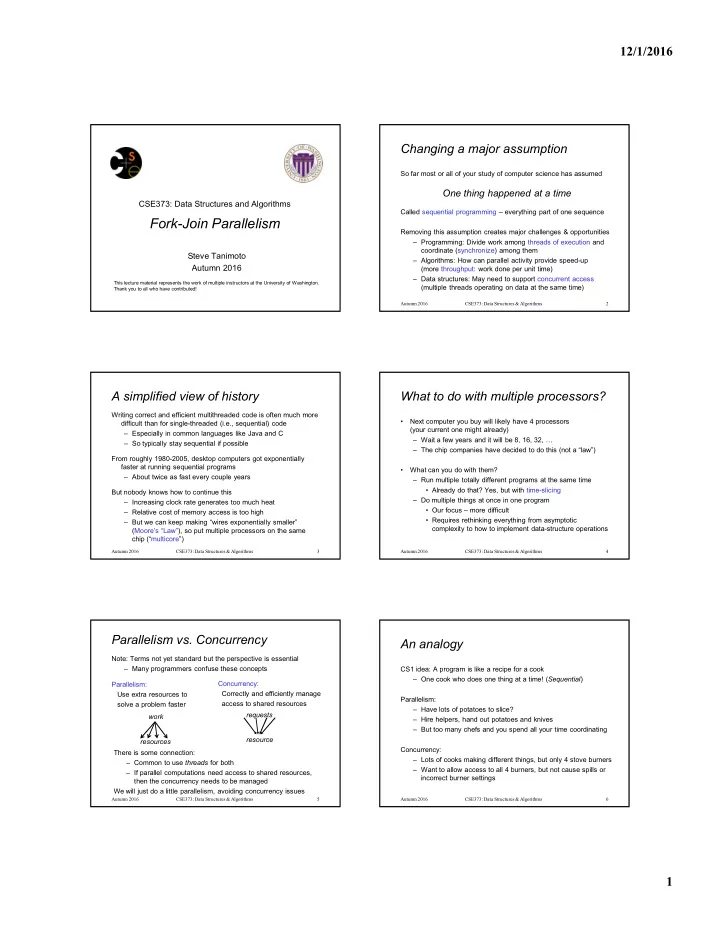
Fork-Join Parallelism Removing this assumption creates major - - PDF document

fork join parallelism
SMART_READER_LITE
LIVE PREVIEW

Fork-Join Parallelism Removing this assumption creates major - - PDF document

12/1/2016 Changing a major assumption So far most or all of your study of computer science has assumed One thing happened at a time CSE373: Data Structures and Algorithms Called sequential programming everything part of one sequence


slide-1
SLIDE 1

12/1/2016 1

CSE373: Data Structures and Algorithms

Fork-Join Parallelism

Steve Tanimoto Autumn 2016

This lecture material represents the work of multiple instructors at the University of Washington. Thank you to all who have contributed!

Changing a major assumption

So far most or all of your study of computer science has assumed

One thing happened at a time

Called sequential programming – everything part of one sequence Removing this assumption creates major challenges & opportunities – Programming: Divide work among threads of execution and coordinate (synchronize) among them – Algorithms: How can parallel activity provide speed-up (more throughput: work done per unit time) – Data structures: May need to support concurrent access (multiple threads operating on data at the same time)

2 CSE373: Data Structures & Algorithms Autumn 2016

A simplified view of history

Writing correct and efficient multithreaded code is often much more difficult than for single-threaded (i.e., sequential) code – Especially in common languages like Java and C – So typically stay sequential if possible From roughly 1980-2005, desktop computers got exponentially faster at running sequential programs – About twice as fast every couple years But nobody knows how to continue this – Increasing clock rate generates too much heat – Relative cost of memory access is too high – But we can keep making “wires exponentially smaller” (Moore’s “Law”), so put multiple processors on the same chip (“multicore”)

3 CSE373: Data Structures & Algorithms Autumn 2016

What to do with multiple processors?

  • Next computer you buy will likely have 4 processors

(your current one might already) – Wait a few years and it will be 8, 16, 32, … – The chip companies have decided to do this (not a “law”)

  • What can you do with them?

– Run multiple totally different programs at the same time

  • Already do that? Yes, but with time-slicing

– Do multiple things at once in one program

  • Our focus – more difficult
  • Requires rethinking everything from asymptotic

complexity to how to implement data-structure operations

4 CSE373: Data Structures & Algorithms Autumn 2016

Parallelism vs. Concurrency

Note: Terms not yet standard but the perspective is essential – Many programmers confuse these concepts

5 CSE373: Data Structures & Algorithms

There is some connection: – Common to use threads for both – If parallel computations need access to shared resources, then the concurrency needs to be managed We will just do a little parallelism, avoiding concurrency issues Parallelism: Use extra resources to solve a problem faster resources Concurrency: Correctly and efficiently manage access to shared resources requests work resource

Autumn 2016

An analogy

CS1 idea: A program is like a recipe for a cook – One cook who does one thing at a time! (Sequential) Parallelism: – Have lots of potatoes to slice? – Hire helpers, hand out potatoes and knives – But too many chefs and you spend all your time coordinating Concurrency: – Lots of cooks making different things, but only 4 stove burners – Want to allow access to all 4 burners, but not cause spills or incorrect burner settings

6 CSE373: Data Structures & Algorithms Autumn 2016

slide-2
SLIDE 2

12/1/2016 2 Shared memory

The model we will assume is shared memory with explicit threads – Not the only approach, may not be best, but time for only one Old story: A running program has – One program counter (current statement executing) – One call stack (with each stack frame holding local variables) – Objects in the heap created by memory allocation (i.e., new)

  • (nothing to do with data structure called a heap)

– Static fields - belong to the class and not an instance (or object)

  • f the class. Only one for all instances of a class.

New story: – A set of threads, each with its own program counter & call stack

  • No access to another thread’s local variables

– Threads can (implicitly) share static fields / objects

  • To communicate, write somewhere another thread reads

7 CSE373: Data Structures & Algorithms Autumn 2016

Shared memory

8 CSE373: Data Structures & Algorithms

pc=…

pc=…

pc=…

… Unshared: locals and control Shared:

  • bjects and

static fields Threads each have own unshared call stack and current statement – (pc for “program counter”) – local variables are numbers, null, or heap references Any objects can be shared, but most are not

Autumn 2016

Our Needs

To write a shared-memory parallel program, need new primitives from a programming language or library

  • Ways to create and run multiple things at once

– Let’s call these things threads

  • Ways for threads to share memory

– Often just have threads with references to the same objects

  • Ways for threads to coordinate (a.k.a. synchronize)

– A way for one thread to wait for another to finish – [Other features needed in practice for concurrency]

9 CSE373: Data Structures & Algorithms Autumn 2016

Java basics

Learn a couple basics built into Java via java.lang.Thread – But for style of parallel programming we’ll advocate, do not use these threads; use Java 7’s ForkJoin Framework instead To get a new thread running: 1. Define a subclass C of java.lang.Thread, overriding run 2. Create an object of class C 3. Call that object’s start method

  • start sets off a new thread, using run as its “main”

What if we instead called the run method of C? – This would just be a normal method call, in the current thread Let’s see how to share memory and coordinate via an example…

10 CSE373: Data Structures & Algorithms Autumn 2016

Parallelism idea

  • Example: Sum elements of a large array
  • Idea: Have 4 threads simultaneously sum 1/4 of the array

– Warning: This is an inferior first approach, but it’s usually good to start with something naïve works ans0 ans1 ans2 ans3 + ans – Create 4 thread objects, each given a portion of the work – Call start() on each thread object to actually run it in parallel – Wait for threads to finish using join() – Add together their 4 answers for the final result

11 CSE373: Data Structures & Algorithms Autumn 2016

First attempt, part 1

12 CSE373: Data Structures & Algorithms

class SumThread extends java.lang.Thread { int lo; // arguments int hi; int[] arr; int ans = 0; // result SumThread(int[] a, int l, int h) { lo=l; hi=h; arr=a; } public void run() { //override must have this type for(int i=lo; i < hi; i++) ans += arr[i]; } } Because we must override a no-arguments/no-result run, we use fields to communicate across threads

Autumn 2016

slide-3
SLIDE 3

12/1/2016 3 First attempt, continued (wrong)

13 CSE373: Data Structures & Algorithms

class SumThread extends java.lang.Thread { int lo, int hi, int[] arr; // arguments int ans = 0; // result SumThread(int[] a, int l, int h) { … } public void run(){ … } // override } int sum(int[] arr){ // can be a static method int len = arr.length; int ans = 0; SumThread[] ts = new SumThread[4]; for(int i=0; i < 4; i++) // do parallel computations ts[i] = new SumThread(arr,i*len/4,(i+1)*len/4); for(int i=0; i < 4; i++) // combine results ans += ts[i].ans; return ans; }

Autumn 2016

Second attempt (still wrong)

14 CSE373: Data Structures & Algorithms

int sum(int[] arr){ // can be a static method int len = arr.length; int ans = 0; SumThread[] ts = new SumThread[4]; for(int i=0; i < 4; i++){// do parallel computations ts[i] = new SumThread(arr,i*len/4,(i+1)*len/4); ts[i].start(); // start not run } for(int i=0; i < 4; i++) // combine results ans += ts[i].ans; return ans; } class SumThread extends java.lang.Thread { int lo, int hi, int[] arr; // arguments int ans = 0; // result SumThread(int[] a, int l, int h) { … } public void run(){ … } // override }

Autumn 2016

Third attempt (correct in spirit)

15 CSE373: Data Structures & Algorithms

int sum(int[] arr){// can be a static method int len = arr.length; int ans = 0; SumThread[] ts = new SumThread[4]; for(int i=0; i < 4; i++){// do parallel computations ts[i] = new SumThread(arr,i*len/4,(i+1)*len/4); ts[i].start(); } for(int i=0; i < 4; i++) { // combine results ts[i].join(); // wait for helper to finish! ans += ts[i].ans; } return ans; } class SumThread extends java.lang.Thread { int lo, int hi, int[] arr; // arguments int ans = 0; // result SumThread(int[] a, int l, int h) { … } public void run(){ … } // override }

Autumn 2016

Join (not the most descriptive word)

  • The Thread class defines various methods you could not

implement on your own – For example: start, which calls run in a new thread

  • The join method is valuable for coordinating this kind of

computation – Caller blocks until/unless the receiver is done executing (meaning the call to run returns) – Else we would have a race condition on ts[i].ans (answer would depend on what finishes first)

  • This style of parallel programming is called “fork/join”
  • Java detail: code has 1 compile error because join may throw

java.lang.InterruptedException – In basic parallel code, should be fine to catch-and-exit

16 CSE373: Data Structures & Algorithms Autumn 2016

Shared memory?

  • Fork-join programs (thankfully) do not require much focus on

sharing memory among threads

  • But in languages like Java, there is memory being shared.

In our example: – lo, hi, arr fields written by “main” thread, read by helper thread – ans field written by helper thread, read by “main” thread

  • When using shared memory, you must avoid race conditions

– We will stick with join to do so

17 CSE373: Data Structures & Algorithms Autumn 2016

A better approach

Several reasons why this is a poor parallel algorithm 1. Want code to be reusable and efficient across platforms – “Forward-portable” as core count grows – So at the very least, parameterize by the number of threads

18 CSE373: Data Structures & Algorithms

int sum(int[] arr, int numTs){ int ans = 0; SumThread[] ts = new SumThread[numTs]; for(int i=0; i < numTs; i++){ ts[i] = new SumThread(arr,(i*arr.length)/numTs, ((i+1)*arr.length)/numTs); ts[i].start(); } for(int i=0; i < numTs; i++) { ts[i].join(); ans += ts[i].ans; } return ans; }

Autumn 2016

slide-4
SLIDE 4

12/1/2016 4 A Better Approach

2. Want to use (only) processors “available to you now” – Not used by other programs or threads in your program

  • Maybe caller is also using parallelism
  • Available cores can change even while your threads run

19 CSE373: Data Structures & Algorithms

// numThreads == numProcessors is bad // if some are needed for other things int sum(int[] arr, int numTs){ … }

Autumn 2016

A Better Approach

3. Though unlikely for sum, in general subproblems may take significantly different amounts of time – Example: Apply method f to every array element, but maybe f is much slower for some data items

  • Example: Is a large integer prime?

– If we create 4 threads and all the slow data is processed by 1

  • f them, we won’t get nearly a 4x speedup
  • Example of a load imbalance

20 CSE373: Data Structures & Algorithms Autumn 2016

A Better Approach

The counterintuitive (?) solution to all these problems is to use lots of threads, far more than the number of processors – But this will require changing our algorithm – [And using a different Java library]

21 CSE373: Data Structures & Algorithms

ans0 ans1 … ansN ans 1. Forward-portable: Lots of helpers each doing a small piece 2. Processors available: Hand out “work chunks” as you go 3. Load imbalance: No problem if slow thread scheduled early enough

  • Variation probably small anyway if pieces of work are small

Autumn 2016

Naïve algorithm is poor

Suppose we create 1 thread to process every 1000 elements

22 CSE373: Data Structures & Algorithms

int sum(int[] arr){ … int numThreads = arr.length / 1000; SumThread[] ts = new SumThread[numThreads]; … } Then combining results will have arr.length / 1000 additions

  • Linear in size of array (with constant factor 1/1000)
  • Previously we had only 4 pieces (constant in size of array)

In the extreme, if we create 1 thread for every 1 element, the loop to combine results has length-of-array iterations

  • Just like the original sequential algorithm

Autumn 2016

A better idea

This is straightforward to implement using divide-and-conquer – Parallelism for the recursive calls

23 CSE373: Data Structures & Algorithms

+ + + + + + + + + + + + + + +

Autumn 2016

Divide-and-conquer to the rescue!

The key is to do the result-combining in parallel as well – And using recursive divide-and-conquer makes this natural – Easier to write and more efficient asymptotically!

24 CSE373: Data Structures & Algorithms Autumn 2016

class SumThread extends java.lang.Thread { int lo; int hi; int[] arr; // arguments int ans = 0; // result SumThread(int[] a, int l, int h) { … } public void run(){ // override if(hi – lo < SEQUENTIAL_CUTOFF) for(int i=lo; i < hi; i++) ans += arr[i]; else { SumThread left = new SumThread(arr,lo,(hi+lo)/2); SumThread right= new SumThread(arr,(hi+lo)/2,hi); left.start(); right.start(); left.join(); // don’t move this up a line – why? right.join(); ans = left.ans + right.ans; } } } int sum(int[] arr){ SumThread t = new SumThread(arr,0,arr.length); t.run(); return t.ans; }

slide-5
SLIDE 5

12/1/2016 5 Divide-and-conquer really works

  • The key is divide-and-conquer parallelizes the result-combining

– If you have enough processors, total time is height of the tree: O(log n) (optimal, exponentially faster than sequential O(n))

25 CSE373: Data Structures & Algorithms

+ + + + + + + + + + + + + + +

Autumn 2016

Being realistic

  • In theory, you can divide down to single elements, do all your

result-combining in parallel and get optimal speedup – Total time O(n/numProcessors + log n)

  • In practice, creating all those threads and communicating

swamps the savings, so: – Use a sequential cutoff, typically around 500-1000

  • Eliminates almost all the recursive thread creation

(bottom levels of tree)

  • Exactly like quicksort switching to insertion sort for small

subproblems, but more important here – Do not create two recursive threads; create one and do the

  • ther “yourself”
  • Cuts the number of threads created by another 2x

26 CSE373: Data Structures & Algorithms Autumn 2016

Being realistic, part 2

  • Even with all this care, Java’s threads are too “heavyweight”

– Constant factors, especially space overhead – Creating 20,000 Java threads is just a bad idea 

  • The ForkJoin Framework is designed to meet the needs of divide-

and-conquer fork-join parallelism – In the Java 7 (and 8) standard libraries – Library’s implementation is a fascinating but advanced topic – Names of methods and how to use them slightly different

27 CSE373: Data Structures & Algorithms Autumn 2016