
C Tombeur Page 1 December 2011
Juggling Slide Rules
By Colin Tombeur December 2011
INTRODUCTION
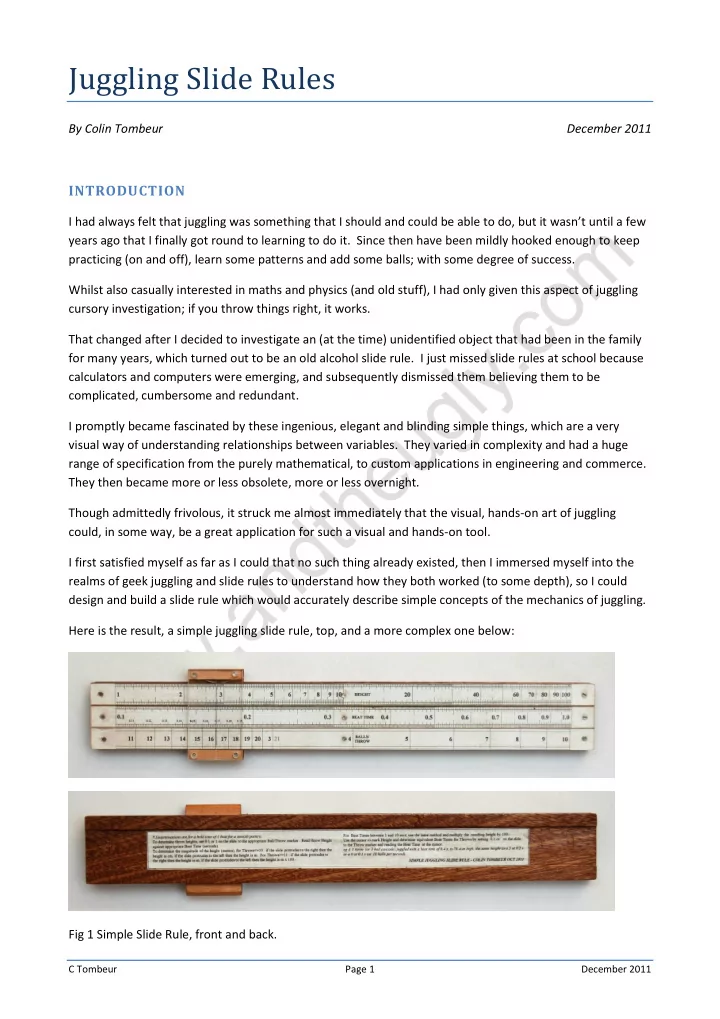
I had always felt that juggling was something that I should and could be able to do, but it wasn’t until a few years ago that I finally got round to learning to do it. Since then have been mildly hooked enough to keep practicing (on and off), learn some patterns and add some balls; with some degree of success. Whilst also casually interested in maths and physics (and old stuff), I had only given this aspect of juggling cursory investigation; if you throw things right, it works. That changed after I decided to investigate an (at the time) unidentified object that had been in the family for many years, which turned out to be an old alcohol slide rule. I just missed slide rules at school because calculators and computers were emerging, and subsequently dismissed them believing them to be complicated, cumbersome and redundant. I promptly became fascinated by these ingenious, elegant and blinding simple things, which are a very visual way of understanding relationships between variables. They varied in complexity and had a huge range of specification from the purely mathematical, to custom applications in engineering and commerce. They then became more or less obsolete, more or less overnight. Though admittedly frivolous, it struck me almost immediately that the visual, hands-on art of juggling could, in some way, be a great application for such a visual and hands-on tool. I first satisfied myself as far as I could that no such thing already existed, then I immersed myself into the realms of geek juggling and slide rules to understand how they both worked (to some depth), so I could design and build a slide rule which would accurately describe simple concepts of the mechanics of juggling. Here is the result, a simple juggling slide rule, top, and a more complex one below: Fig 1 Simple Slide Rule, front and back.