Foundations of pred(n) = set of all immediate predecessors of n p - - PowerPoint PPT Presentation

foundations of
SMART_READER_LITE
LIVE PREVIEW

Foundations of pred(n) = set of all immediate predecessors of n p - - PowerPoint PPT Presentation

Terminology: Program Representation e o ogy: og a ep ese tat o Control Flow Graph: Control Flow Graph: Nodes N statements of program Edges E flow of control Foundations of pred(n) = set of all immediate predecessors of


slide-1
SLIDE 1

Foundations of Dataflow Analysis

Terminology: Program Representation e

  • ogy:
  • g a

ep ese tat o

Control Flow Graph: Control Flow Graph:

– Nodes N – statements of program – Edges E – flow of control

  • pred(n) = set of all immediate predecessors of n

p ( ) p

  • succ(n) = set of all immediate successors of n

– Start node n0 Start node n0 – Set of final nodes Nfinal

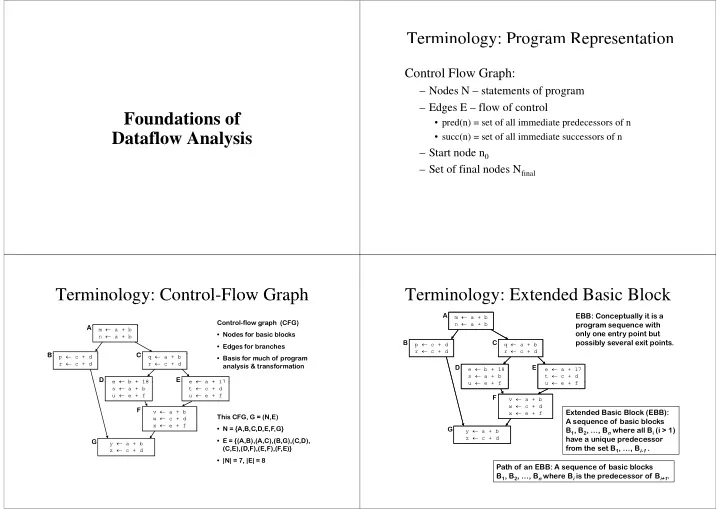
Terminology: Control-Flow Graph Terminology: Control Flow Graph

A Control-flow graph (CFG)

m ← a + b n ← a + b

A B C g p ( )

  • Nodes for basic blocks
  • Edges for branches

p ← c + d r ← c + d

B

q ← a + b r ← c + d

C

e ← b + 18

D

e ← a + 17

E

  • Basis for much of program

analysis & transformation

e ← b + 18 s ← a + b u ← e + f

D

e ← a + 17 t ← c + d u ← e + f

E F

v ← a + b w ← c + d x ← e + f

F This CFG, G = (N,E)

  • N = {A,B,C,D,E,F,G}

y ← a + b z ← c + d

G

  • E = {(A,B),(A,C),(B,G),(C,D),

(C,E),(D,F),(E,F),(F,E)}

  • |N| = 7, |E| = 8

Terminology: Extended Basic Block Terminology: Extended Basic Block

m ← a + b n ← a + b

A

EBB: Conceptually it is a program sequence with

n ← a b p ← c + d r ← c + d

B

q ← a + b r ← c + d

C

program sequence with

  • nly one entry point but

possibly several exit points.

e ← b + 18 s ← a + b f

D

e ← a + 17 t ← c + d f

E

u ← e + f u ← e + f v ← a + b w ← c + d

F

Extended Basic Block (EBB): A sequence of basic blocks B1, B2, …, Bn where all Bi (i > 1) h i d

y ← a + b ← + d

G

x ← e + f

have a unique predecessor from the set B1, …, Bi-1 .

z ← c + d

P th f EBB A f b i bl k Path of an EBB: A sequence of basic blocks B1, B2, …, Bn where Bi is the predecessor of Bi+1.

slide-2
SLIDE 2

Terminology: Program Points

  • One program point before each node

Terminology: Program Points

  • One program point before each node
  • One program point after each node
  • Join point – program point with multiple

predecessors predecessors

  • Split point – program point with multiple

successors

Dataflow Analysis Dataflow Analysis

Compile Time Reasoning About Compile-Time Reasoning About Run-Time Values of Variables or Expressions at Different Program Points

– Which assignment statements produced the value of Which assignment statements produced the value of the variables at this point? Which variables contain values that are no longer – Which variables contain values that are no longer used after this program point? Wh i h f ibl l f i bl – What is the range of possible values of a variable at this program point?

Dataflow Analysis: Basic Idea Dataflow Analysis: Basic Idea

  • Information about a program represented using
  • Information about a program represented using

values from an algebraic structure called lattice

  • Analysis produces a lattice value for each

program point program point

  • Two flavors of analyses

– Forward dataflow analyses – Backward dataflow analyses f y

Forward Dataflow Analysis Forward Dataflow Analysis

  • Analysis propagates values forward through
  • Analysis propagates values forward through

control flow graph with flow of control

E h d h t f f ti f – Each node has a transfer function f

  • Input – value at program point before node

O t t l t i t ft d

  • Output – new value at program point after node

– Values flow from program points after predecessor nodes to program points before successor nodes nodes to program points before successor nodes – At join points, values are combined using a merge function function

  • Canonical Example: Reaching Definitions
slide-3
SLIDE 3

Backward Dataflow Analysis Backward Dataflow Analysis

  • Analysis propagates values backward through
  • Analysis propagates values backward through

control flow graph against flow of control

– Each node has a transfer function f

  • Input – value at program point after node
  • Output – new value at program point before node

– Values flow from program points before successor Values flow from program points before successor nodes to program points after predecessor nodes – At split points values are combined using a merge – At split points, values are combined using a merge function

C i l E l Li V i bl – Canonical Example: Live Variables

Partial Orders Partial Orders

  • Set P
  • Set P
  • Partial order ≤ such that ∀x,y,z∈P

– x ≤ x (reflexive) – x ≤ y and y ≤ x implies x = y (asymmetric) – x ≤ y and y ≤ x implies x = y (asymmetric) – x ≤ y and y ≤ z implies x ≤ z (transitive)

Upper Bounds Upper Bounds

  • If S ⊆ P then
  • If S ⊆ P then

– x∈P is an upper bound of S if ∀y∈S, y ≤ x – x∈P is the least upper bound of S if

  • x is an upper bound of S, and

pp

  • x ≤ y for all upper bounds y of S

– ∨ - join, least upper bound (lub), supremum (sup) ∨ join, least upper bound (lub), supremum (sup)

  • ∨ S is the least upper bound of S
  • x ∨ y is the least upper bound of {x y}

x ∨ y is the least upper bound of {x,y}

Lower Bounds Lower Bounds

  • If S ⊆ P then
  • If S ⊆ P then

– x∈P is a lower bound of S if ∀y∈S, x ≤ y – x∈P is the greatest lower bound of S if

  • x is a lower bound of S, and
  • y ≤ x for all lower bounds y of S

– ∧

meet greatest lower bound (glb) infimum (inf)

– ∧ - meet, greatest lower bound (glb), infimum (inf)

  • ∧ S is the greatest lower bound of S
  • x ∧ y is the greatest lower bound of {x y}
  • x ∧ y is the greatest lower bound of {x,y}
slide-4
SLIDE 4

Coverings Coverings

  • Notation: x< y if x ≤ y and x≠y
  • Notation: x< y if x ≤ y and x≠y
  • x is covered by y (y covers x) if

x < y and – x < y, and – x ≤ z < y implies x = z

  • Conceptually y covers x if there are no
  • Conceptually, y covers x if there are no

elements between x and y

Example Example

  • P = {000 001 010 011 100 101 110 111}
  • P {000, 001, 010, 011, 100, 101, 110, 111}

(standard boolean lattice, also called hypercube)

  • x ≤ y if (x bitwise and y) = x
  • x ≤ y if (x bitwise_and y) = x

We can visualize a partial

111

We can visualize a partial

  • rder with a Hasse Diagram

f

011 101 110

  • If y covers x
  • Line from y to x

010 001 100

Line from y to x

  • y is above x in diagram

000

Lattices Lattices

  • If x ∧ y and x ∨ y exist (i e are in P) for all x y∈P
  • If x ∧ y and x ∨ y exist (i.e., are in P) for all x,y∈P,

then P is a lattice. If S d S i t f ll S P

  • If ∧S and ∨S exist for all S ⊆ P,

then P is a complete lattice.

  • Theorem: All finite lattices are complete
  • Example of a lattice that is not complete

p p

– Integers Z – For any x, y∈Z, x ∨ y = max(x,y), x ∧ y = min(x,y) y , y , y ( ,y), y ( ,y) – But ∨ Z and ∧ Z do not exist – Z ∪ {+∞,−∞ } is a complete lattice { , } p

Top and Bottom Top and Bottom

  • Greatest element of P (if it exists) is top (T)
  • Greatest element of P (if it exists) is top (T)
  • Least element of P (if it exists) is bottom (⊥)
slide-5
SLIDE 5

Connection between ≤ ∧ and ∨ Connection between ≤, ∧, and ∨

The following 3 properties are equivalent:

– x ≤ y – x ∨ y = y – x ∧ y = x

  • Will prove:

Will prove:

– x ≤ y implies x ∨ y = y and x ∧ y = x – x ∨ y = y implies x ≤ y x ∨ y y implies x ≤ y – x ∧ y = x implies x ≤ y

  • By Transitivity
  • By Transitivity,

– x ∨ y = y implies x ∧ y = x i li – x ∧ y = x implies x ∨ y = y

Connecting Lemma Proofs (1) Connecting Lemma Proofs (1)

  • Proof of x ≤ y implies x ∨ y

y

  • Proof of x ≤ y implies x ∨ y = y

– x ≤ y implies y is an upper bound of {x,y}. – Any upper bound z of {x,y} must satisfy y ≤ z. – So y is least upper bound of {x,y} and x ∨ y = y So y is least upper bound of {x,y} and x ∨ y y

  • Proof of x ≤ y implies x ∧ y = x

i li i l b d f { } – x ≤ y implies x is a lower bound of {x,y}. – Any lower bound z of {x,y} must satisfy z ≤ x. – So x is greatest lower bound of {x,y} and x ∧ y = x

Connecting Lemma Proofs (2) Connecting Lemma Proofs (2)

  • Proof of x ∨ y

y implies x ≤ y

  • Proof of x ∨ y = y implies x ≤ y

– y is an upper bound of {x,y} implies x ≤ y

  • Proof of x ∧ y = x implies x ≤ y

– x is a lower bound of {x y} implies x ≤ y – x is a lower bound of {x,y} implies x ≤ y

Lattices as Algebraic Structures Lattices as Algebraic Structures

  • Have defined ∨ and ∧ in terms of ≤
  • Have defined ∨ and ∧ in terms of ≤
  • Will now define ≤ in terms of ∨ and ∧

– Start with ∨ and ∧ as arbitrary algebraic operations that satisfy associative, commutative, idempotence, y , , p , and absorption laws – Will define ≤ using ∨ and ∧ Will define ≤ using ∨ and ∧ – Will show that ≤ is a partial order

slide-6
SLIDE 6

Algebraic Properties of Lattices Algebraic Properties of Lattices

Assume arbitrary operations ∨ and ∧ such that Assume arbitrary operations ∨ and ∧ such that

– (x ∨ y) ∨ z = x ∨ (y ∨ z) (associativity of ∨) – (x ∧ y) ∧ z = x ∧ (y ∧ z) (associativity of ∧) – x ∨ y = y ∨ x (commutativity of ∨) x ∨ y y ∨ x (commutativity of ∨) – x ∧ y = y ∧ x (commutativity of ∧) (id t f ) – x ∨ x = x (idempotence of ∨) – x ∧ x = x (idempotence of ∧) – x ∨ (x ∧ y) = x (absorption of ∨ over ∧) – x ∧ (x ∨ y) = x (absorption of ∧ over ∨) ( y) ( p )

Connection Between ∧ and ∨ Connection Between ∧ and ∨

Theorem: x ∨ y y if and only if x ∧ y x Theorem: x ∨ y = y if and only if x ∧ y = x

  • Proof of x ∨ y = y implies x = x ∧ y

x = x ∧ (x ∨ y) (by absorption) = x ∧ y (by assumption) x ∧ y (by assumption)

  • Proof of x ∧ y = x implies y = x ∨ y

y = y ∨ (y ∧ x) (by absorption) = y ∨ (x ∧ y) (by commutativity) y ( y) ( y y) = y ∨ x (by assumption) = x ∨ y (by commutativity) = x ∨ y (by commutativity)

Properties of ≤ Properties of ≤

  • Define x ≤ y if x ∨ y

y

  • Define x ≤ y if x ∨ y = y
  • Proof of transitive property. Must show that

x ∨ y = y and y ∨ z = z implies x ∨ z = z

x ∨ z = x ∨ (y ∨ z) (by assumption) x ∨ z = x ∨ (y ∨ z) (by assumption) = (x ∨ y) ∨ z (by associativity) = y ∨ z (by assumption) = z (by assumption) ( y p )

Properties of ≤ Properties of ≤

  • Proof of asymmetry property Must show that
  • Proof of asymmetry property. Must show that

x ∨ y = y and y ∨ x = x implies x = y

x = y ∨ x (by assumption) = x ∨ y (by commutativity) x ∨ y (by commutativity) = y (by assumption)

  • Proof of reflexivity property. Must show that

x ∨ x = x x ∨ x x

x ∨ x = x (by idempotence)

slide-7
SLIDE 7

Properties of ≤ Properties of ≤

  • Induced operation ≤ agrees with original
  • Induced operation ≤ agrees with original

definitions of ∨ and ∧, i.e.,

– x ∨ y = sup {x, y} – x ∧ y = inf {x, y} y { , y}

Proof of x ∨ y = sup {x y} Proof of x ∨ y sup {x, y}

  • Consider any upper bound u for x and y
  • Consider any upper bound u for x and y.
  • Given x ∨ u = u and y ∨ u = u, must show

x ∨ y ≤ u, i.e., (x ∨ y) ∨ u = u

u = x ∨ u (by assumption) u x ∨ u (by assumption) = x ∨ (y ∨ u) (by assumption) ( ) (b i i i ) = (x ∨ y) ∨ u (by associativity)

Proof of x ∧ y = inf {x y} Proof of x ∧ y inf {x, y}

  • Consider any lower bound l for x and y
  • Consider any lower bound l for x and y.
  • Given x ∧ l = l and y ∧ l = l, must show

l ≤ x ∧ y, i.e., (x ∧ y) ∧ l = l

l = x ∧ l (by assumption) l x ∧ l (by assumption) = x ∧ (y ∧ l) (by assumption) ( ) l (b i i i ) = (x ∧ y) ∧ l (by associativity)

Chains Chains

  • A set S is a chain if ∀x y∈S y ≤ x or x ≤ y
  • A set S is a chain if ∀x,y∈S. y ≤ x or x ≤ y
  • P has no infinite chains if every chain in P is

finite

  • P satisfies the ascending chain condition if
  • P satisfies the ascending chain condition if

for all sequences x1 ≤ x2 ≤ …there exists n h th t such that xn = xn+1 = …

slide-8
SLIDE 8

Transfer Functions Transfer Functions

  • Assume a lattice of abstract values P
  • Assume a lattice of abstract values P
  • Transfer function f: P→P for each node in

control flow graph

  • f models effect of the node on the program
  • f models effect of the node on the program

information

Properties of Transfer Functions Properties of Transfer Functions

Each dataflow analysis problem has a set F of y p transfer functions f: P→P

Identity function i∈F – Identity function i∈F – F must be closed under composition: ∀f F th f ti h λ f( ( )) F ∀f,g∈F, the function h = λx.f(g(x)) ∈F – Each f ∈F must be monotone: x ≤ y implies f(x) ≤ f(y) – Sometimes all f ∈F are distributive: f(x ∨ y) = f(x) ∨ f(y) – Distributivity implies monotonicity s bu v y p es

  • o o c y

Distributivity Implies Monotonicity Distributivity Implies Monotonicity

Proof: Proof:

  • Assume f(x ∨ y) = f(x) ∨ f(y)
  • Must show: x ∨ y = y implies f(x) ∨ f(y) = f(y)

f(y) = f(x ∨ y) (by assumption) f(y) = f(x ∨ y) (by assumption) = f(x) ∨ f(y) (by distributivity)

Forward Dataflow Analysis Forward Dataflow Analysis

  • Simulates execution of program forward with
  • Simulates execution of program forward with

flow of control F h d h

  • For each node n, have

– inn – value at program point before n – outn – value at program point after n – fn – transfer function for n (given inn, computes outn)

n

(g

n,

p

n)

  • Require that solutions satisfy

∀n out = f (in ) – ∀n, outn = fn(inn) – ∀n ≠ n0, inn = ∨ { outm | m in pred(n) } i ⊥ – inn0 = ⊥

slide-9
SLIDE 9

Dataflow Equations Dataflow Equations

  • Result is a set of dataflow equations
  • Result is a set of dataflow equations
  • utn := fn(inn)

inn := ∨ { outm | m in pred(n) } C t ll t l i bl f

  • Conceptually separates analysis problem from

program

Worklist Algorithm for Solving Forward Dataflow Equations

for each n do outn := fn(⊥) worklist := N worklist := N while worklist ≠ ∅ do remove a node n from worklist inn := ∨ { outm | m in pred(n) } inn : ∨ { outm | m in pred(n) }

  • utn := fn(inn)

if t h d th if outn changed then worklist := worklist ∪ succ(n)

Correctness Argument Correctness Argument

Why result satisfies dataflow equations? Why result satisfies dataflow equations?

  • Whenever we process a node n, set outn := fn(inn)

Algorithm ensures that outn = fn(inn)

  • Whenever outm changes, put succ(m) on worklist.

m

g , p ( ) Consider any node n ∈ succ(m). It will eventually come off the worklist and the y algorithm will set in := ∨ { out | m in pred(n) } inn : ∨ { outm | m in pred(n) } to ensure that inn = ∨ { outm | m in pred(n) }

Termination Argument Termination Argument

Why does the algorithm terminate? Why does the algorithm terminate?

  • Sequence of values taken on by inn or outn is a

n n

  • chain. If values stop increasing, the worklist

empties and the algorithm terminates. empties and the algorithm terminates.

  • If the lattice has the ascending chain property,

th l ith t i t the algorithm terminates

– Algorithm terminates for finite lattices – For lattices without the ascending chain property, we must use a widening operator g p

slide-10
SLIDE 10

Widening Operators Widening Operators

  • Detect lattice values that may be part of an
  • Detect lattice values that may be part of an

infinitely ascending chain A tifi i ll i l t l t b d f

  • Artificially raise value to least upper bound of

the chain

  • Example:

– Lattice is set of all subsets of integers g – Widening operator might raise all sets of size n or greater to TOP g – Could be used to collect possible values taken on by a variable during execution of the program g p g

Reaching Definitions Reaching Definitions

  • Concept of definition and use
  • Concept of definition and use

– z = x+y – is a definition of z – is a use of x and y is a use of x and y

  • A definition reaches a use if

h l i b d fi i i – the value written by definition – may be read by the use.

Reaching Definitions Reaching Definitions

s = 0; s = 0; a = 4; i = 0; k == 0 b = 1; b = 2; i < n s = s + a*b; i = i + 1; return s

Reaching Definitions Framework Reaching Definitions Framework

  • P = powerset of set of all definitions in program
  • P = powerset of set of all definitions in program

(all subsets of set of definitions in program) ( d i )

  • ∨ = ∪ (order is ⊆)
  • ⊥ = ∅
  • F = all functions f of the form f(x) = a ∪ (x-b)

– b is set of definitions that node kills – b is set of definitions that node kills – a is set of definitions that node generates

G l tt f t f f ti General pattern for many transfer functions

– f(x) = GEN ∪ (x-KILL)

slide-11
SLIDE 11

Does Reaching Definitions Framework Satisfy Properties?

  • ⊆ satisfies conditions for ≤
  • ⊆ satisfies conditions for ≤

– x ⊆ y and y ⊆ z implies x ⊆ z (transitivity) d i li ( ) – x ⊆ y and y ⊆ x implies y = x (asymmetry) – x ⊆ x (reflexivity)

  • F satisfies transfer function conditions

– λx.∅ ∪ (x- ∅) = λx.x∈F (identity) ( ) ( y) – Will show f(x ∪ y) = f(x) ∪ f(y) (distributivity)

f(x) ∪ f(y) = (a ∪ (x – b)) ∪ (a ∪ (y – b)) f(x) ∪ f(y) (a ∪ (x b)) ∪ (a ∪ (y b)) = a ∪ (x – b) ∪ (y – b) = a ∪ ((x ∪ y) – b) (( y) ) = f(x ∪ y)

Does Reaching Definitions Framework Satisfy Properties?

What about composition? What about composition?

– Given f1(x) = a1 ∪ (x-b1) and f2(x) = a2 ∪ (x-b2) – Must show f1(f2(x)) can be expressed as a ∪ (x - b)

f1(f2(x)) = a1 ∪ ((a2 ∪ (x-b2)) - b1)

1( 2( )) 1

(( 2 (

2)) 1)

= a1 ∪ ((a2 - b1) ∪ ((x-b2) - b1)) = (a1 ∪ (a2 - b1)) ∪ ((x-b2) - b1)) ( 1 ( 2

1))

((

2) 1))

= (a1 ∪ (a2 - b1)) ∪ (x-(b2 ∪ b1))

– Let a = (a1 ∪ (a2 - b1)) and b = b2 ∪ b1 Let a (a1 ∪ (a2 b1)) and b b2 ∪ b1 – Then f1(f2(x)) = a ∪ (x – b)

General Result General Result

All GEN/KILL transfer function frameworks All GEN/KILL transfer function frameworks satisfy the properties:

– Identity – Distributivity – Compositionality

Available Expressions Framework Available Expressions Framework

  • P = powerset of set of all expressions in
  • P = powerset of set of all expressions in

program (all subsets of set of expressions)

  • ∨ = ∩ (order is ⊇)
  • ⊥ = P (but in

= ∅)

  • ⊥ = P (but inn0 = ∅)
  • F = all functions f of the form f(x) = a ∪ (x-b)

– b is set of expressions that node kills – a is set of expressions that node generates a is set of expressions that node generates

  • Another GEN/KILL analysis
slide-12
SLIDE 12

Concept of Conservatism Concept of Conservatism

  • Reaching definitions use ∪ as join
  • Reaching definitions use ∪ as join

– Optimizations must take into account all definitions that reach along ANY path

  • Available expressions use ∩ as join

p j

– Optimization requires expression to reach along ALL paths ALL paths

  • Optimizations must conservatively take all

possible executions into account possible executions into account.

  • Structure of analysis varies according to the

way the results of the analysis are to be used.

Backward Dataflow Analysis Backward Dataflow Analysis

  • Simulates execution of program backward
  • Simulates execution of program backward

against the flow of control F h d h

  • For each node n, we have

– inn – value at program point before n – outn – value at program point after n – fn – transfer function for n (given outn, computes inn)

n

(g

n,

p

n)

  • Require that solutions satisfy

∀n in = f (out ) – ∀n. inn = fn(outn) – ∀n ∉ Nfinal. outn = ∨ { inm | m in succ(n) } ∀ N t ⊥ – ∀n ∈ Nfinal = outn = ⊥

Worklist Algorithm for Solving Backward Dataflow Equations

for each n do inn := fn(⊥) worklist := N worklist := N while worklist ≠ ∅ do remove a node n from worklist

  • utn := ∨ { inm | m in succ(n) }
  • utn : ∨ { inm | m in succ(n) }

inn := fn(outn) if i h d th if inn changed then worklist := worklist ∪ pred(n)

Live Variables Analysis Framework Live Variables Analysis Framework

  • P = powerset of set of all variables in program
  • P = powerset of set of all variables in program

(all subsets of set of variables in program)

  • ∨ = ∪ (order is ⊆)
  • ⊥ = ∅
  • ⊥ = ∅
  • F = all functions f of the form f(x) = a ∪ (x-b)

– b is set of variables that the node kills – a is set of variables that the node reads a is set of variables that the node reads

slide-13
SLIDE 13

Meaning of Dataflow Results Meaning of Dataflow Results

  • Connection between executions of program and
  • Connection between executions of program and

dataflow analysis results

  • Each execution generates a trajectory of states:

– s0;s1; ;sk where each si∈ST s0;s1;…;sk,where each si∈ST

  • Map current state sk to

– Program point n where execution located – Value x in dataflow lattice

  • Require x ≤ inn

Abstraction Function for Forward Dataflow Analysis

  • Meaning of analysis results is given by an

abstraction function AF:ST→P

  • Require that for all states s
  • Require that for all states s

AF(s) ≤ inn h i i t h th ti i where n is program point where the execution is located in state s, and inn is the abstract value before that point.

Sign Analysis Example Sign Analysis Example

Sign analysis compute sign of each variable v Sign analysis - compute sign of each variable v

  • Base Lattice: flat lattice on {-,zero,+}

TOP

  • zero

+

A l l i d l f h i bl

BOT

  • Actual lattice records a value for each variable

– Example element: [a→+, b→zero, c→-]

Interpretation of Lattice Values Interpretation of Lattice Values

If value of v in lattice is: If value of v in lattice is:

– BOT: no information about the sign of v – -: variable v is negative – zero: variable v is 0 zero: variable v is 0 – +: variable v is positive TOP b iti ti – TOP: v may be positive or negative or 0

slide-14
SLIDE 14

Operation ⊗ on Lattice Operation ⊗ on Lattice

⊗ BOT + TOP ⊗ BOT

  • zero

+ TOP BOT BOT

  • zero

+ TOP BOT BOT zero TOP

  • +

zero

  • TOP

zero zero zero zero zero zero + +

  • zero

+ TOP TOP TOP TOP zero TOP TOP TOP TOP TOP zero TOP TOP

Transfer Functions Transfer Functions

Defined by structural induction on the shape of Defined by structural induction on the shape of nodes:

– If n of the form v = c

  • fn(x) = x[v→ +] if c is positive

n( )

[ ] p

  • fn(x) = x[v→zero] if c is 0
  • f (x) = x[v→ ] if c is negative
  • fn(x) = x[v→ -] if c is negative

– If n of the form v1 = v2*v3

  • fn(x) = x[v1→x[v2] ⊗ x[v3]]

Abstraction Function Abstraction Function

  • AF(s)[v] = sign of v
  • AF(s)[v] = sign of v

– AF([a→5, b→0, c→-2]) = [a→+, b→zero, c→-]

bli h i f h l i l

  • Establishes meaning of the analysis results

– If analysis says a variable v has a given sign – then v always has that sign in actual execution.

  • Two sources of imprecision

Two sources of imprecision

– Abstraction Imprecision – concrete values (integers) abstracted as lattice values (- zero and +) abstracted as lattice values ( ,zero, and +) – Control Flow Imprecision – one lattice value for all different possible flow of control possibilities different possible flow of control possibilities

Imprecision Example Imprecision Example

a = 1

Abstraction Imprecision:

a = 1

[a→+] [a→+] [a→1] abstracted as [a→+]

b = -1 b = 1

[ ] [ ] [a→+, b→+] [a→+, b→-] [a→+, b→TOP]

*b c = a*b

Control Flow Imprecision: [b→TOP] summarizes results of all executions [b→TOP] summarizes results of all executions. In any execution state s, AF(s)[b]≠TOP

slide-15
SLIDE 15

General Sources of Imprecision General Sources of Imprecision

  • Abstraction Imprecision
  • Abstraction Imprecision

– Lattice values less precise than execution values – Abstraction function throws away information

  • Control Flow Imprecision

Control Flow Imprecision

– Analysis result has a single lattice value to s mmari e res lts of m ltiple concrete e ec tions summarize results of multiple concrete executions – Join operation ∨ moves up in lattice to combine l f diff i h values from different execution paths – Typically if x ≤ y, then x is more precise than y

Why Have Imprecision? Why Have Imprecision?

ANSWER: To make analysis tractable ANSWER: To make analysis tractable

  • Conceptually infinite sets of values in execution

– Typically abstracted by finite set of lattice values

  • Execution may visit infinite set of states
  • Execution may visit infinite set of states

– Abstracted by computing joins of different paths

Augmented Execution States Augmented Execution States

  • Abstraction functions for some analyses require
  • Abstraction functions for some analyses require

augmented execution states

– Reaching definitions: states are augmented with the definition that created each value – Available expressions: states are augmented with expression for each value p

Meet Over All Paths Solution Meet Over All Paths Solution

  • What solution would be ideal for a forward dataflow
  • What solution would be ideal for a forward dataflow

analysis problem? C id th t d

  • Consider a path p = n0, n1, …, nk, n to a node n

(note that for all i, ni ∈ pred(ni+1))

  • The solution must take this path into account:

fp (⊥) = (fnk(fnk-1(…fn1(fn0(⊥)) …)) ≤ inn

  • So the solution must have the property that

∨{fp (⊥) | p is a path to n} ≤ inn { p ( ) | p p }

n

and ideally ∨{f (⊥) | p is a path to n} = in ∨{fp (⊥) | p is a path to n} = inn

slide-16
SLIDE 16

Soundness Proof of Analysis Algorithm

Property to prove: Property to prove:

For all paths p to n, fp (⊥) ≤ inn

  • Proof is by induction on the length of p

– Uses monotonicity of transfer functions Uses monotonicity of transfer functions – Uses following lemma

Lemma:

The worklist algorithm produces a solution such that g p if n ∈ pred(m) then outn ≤ inm

Proof Proof

  • Base case: p is of length 0
  • Base case: p is of length 0

– Then p = n0 and fp(⊥) = ⊥ = inn0

  • Induction step:

– Assume theorem for all paths of length k Assume theorem for all paths of length k – Show for an arbitrary path p of length k+1.

Induction Step Proof Induction Step Proof

  • p = n

n n

  • p = n0, …, nk, n
  • Must show (fk(fk-1(…fn1(fn0(⊥)) …)) ≤ inn

– By induction, (fk-1(…fn1(fn0(⊥)) …)) ≤ innk – Apply fk to both sides. pp y

k

By monotonicity, we get: (fk(fk-1(…fn1(fn0(⊥)) …)) ≤ fk(innk) = outnk ( k( k 1(

n1( n0( ))

))

k( nk) nk

– By lemma, outnk ≤ inn By transitivity (f (f ( f (f (⊥)) )) ≤ in – By transitivity, (fk(fk-1(…fn1(fn0(⊥)) …)) ≤ inn

Distributivity Distributivity

  • Distributivity preserves precision
  • Distributivity preserves precision
  • If framework is distributive, then the worklist

algorithm produces the meet over paths solution

– For all n: For all n:

∨{fp (⊥) | p is a path to n} = inn

slide-17
SLIDE 17

Lack of Distributivity Example Lack of Distributivity Example

Integer Constant Propagation (ICP) Integer Constant Propagation (ICP)

  • Flat lattice on integers

TOP

  • 1

1

  • 2

2 … … BOT

  • Actual lattice records a value for each variable

– Example element: [a→3 b→2 c→5] Example element: [a→3, b→2, c→5]

Transfer Functions Transfer Functions

  • If n of the form v = c
  • If n of the form v = c

– fn(x) = x[v→c]

  • If n of the form v1 = v2+v3

– f (x) = x[v →x[v ] + x[v ]] – fn(x) x[v1→x[v2] + x[v3]]

  • Lack of distributivity of ICP

– Consider transfer function f for c = a + b

– f([a→3, b→2]) ∨ f([a→2, b→3]) = [a→TOP, b→TOP, c→5] – f([a→3, b→2]∨[a→2, b→3]) = f([a→TOP, b→TOP]) = [a→TOP, b→TOP, c→TOP]

Lack of Distributivity Anomaly Lack of Distributivity Anomaly

a = 2 b 3 a = 3 b 2 b = 3 b = 2

[a→3, b→2] [a→2, b→3] [ , ] [ , ] [ TOP b TOP] [a→TOP, b→TOP]

c = a+b

Lack of Distributivity Imprecision: [a→TOP, b→TOP, c→5] more precise [a→TOP, b→TOP, c →TOP]

Summary Summary

  • Formal dataflow analysis framework
  • Formal dataflow analysis framework

– Lattices, partial orders – Transfer functions, joins and splits – Dataflow equations and fixed point solutions Dataflow equations and fixed point solutions

  • Connection with program

b i f i – Abstraction function AF: S → P – For any state s and program point n, AF(s) ≤ inn – Meet over paths solutions, distributivity