From Selection to Repetition Semantics of while loop The if - - PowerPoint PPT Presentation

from selection to repetition semantics of while loop
SMART_READER_LITE
LIVE PREVIEW

From Selection to Repetition Semantics of while loop The if - - PowerPoint PPT Presentation

From Selection to Repetition Semantics of while loop The if statement and if/else statement allow a block of if (test) while (test) { { statements to be executed selectively: based on a guard/test


slide-1
SLIDE 1

A Computer Science Tapestry 5.1

From Selection to Repetition

  • The if statement and if/else statement allow a block of

statements to be executed selectively: based on a guard/test

if (area > 20.0) { cout << area << " is large" << endl; }

  • The while statement repeatedly executes a block of

statements while the guard/test is true

int month = 0; while (month < 12) { PrintCalendar(month, 1999); month += 1; // month = month + 1; }

A Computer Science Tapestry 5.2

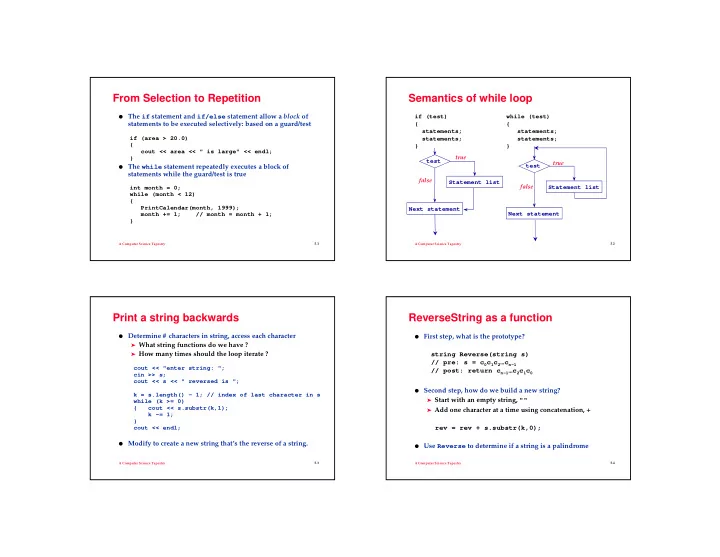
Semantics of while loop

if (test) while (test) { { statements; statements; statements; statements; } } test Statement list Next statement true false test Statement list Next statement true false

A Computer Science Tapestry 5.3

Print a string backwards

  • Determine # characters in string, access each character

➤ What string functions do we have ? ➤ How many times should the loop iterate ?

cout << "enter string: "; cin >> s; cout << s << " reversed is "; k = s.length() - 1; // index of last character in s while (k >= 0) { cout << s.substr(k,1); k -= 1; } cout << endl;

  • Modify to create a new string that’s the reverse of a string.

A Computer Science Tapestry 5.4

ReverseString as a function

  • First step, what is the prototype?

string Reverse(string s) // pre: s = c0c1c2…cn-1 // post: return cn-1…c2c1c0

  • Second step, how do we build a new string?

➤ Start with an empty string, "" ➤ Add one character at a time using concatenation, +

rev = rev + s.substr(k,0);

  • Use Reverse to determine if a string is a palindrome
slide-2
SLIDE 2

A Computer Science Tapestry 5.5

Anatomy of a loop

  • Initialize variables used in loop/loop test (before loop)

➤ Loop test affected by initial values of variables

  • The loop test or guard is evaluated before each loop iteration

➤ NOT evaluated after each statement in loop

  • The loop body must update some variable/expression used in

the loop test so that the loop eventually terminates

➤ If loop test is always true, loop is infinite

k = s.length() - 1; string rev = ""; while (k >= 0) { rev = rev + s.substr(k,1); k -= 1; } return rev;

A Computer Science Tapestry 5.6

Infinite loops

  • Sometimes your program will be “stuck”, control-C to stop

➤ What’s the problem in the loop below? Fixable?

cin >> num; int start = 0; while (start != 0) { start += 2; cout << start << endl; }

  • It’s impossible to write one program that detects all infinite

loops (the compiler doesn’t do the job, for example)

➤ This can be proven mathematically, Halting Problem ➤ Some detection possible, but not universally

A Computer Science Tapestry 5.7

Developing Loops

  • Some loops are easy to develop code for, others are not

➤ Sometimes the proper loop test/body are hard to design ➤ Techniques from formal reasoning/logic can help

  • Practice helps, but remember

➤ Good design comes from experience, experience comes

from bad design

  • There are other looping statements in addition to while, but

they don’t offer anything more powerful, just some syntactic convenience

➤ for loop ➤ do-while loop

A Computer Science Tapestry 5.8

Factorial

  • N! = 1x2x…xN is “N factorial”, used in math, statistics

int factorial(int n) // pre: 0 <= n // post: returns n! (1 x 2 x … x n)

  • We’ll return the value of a variable product, we’ll need to

accumulate the answer in product

➤ The loop will iterate n times, mutiplying by 1, 2, …, n ➤ Alternatives: how many multiplications are needed? ➤ If product holds the answer, then product == n! when

the loop terminates

  • Use this to help develop the loop
slide-3
SLIDE 3

A Computer Science Tapestry 5.9

Factorial continued

  • If product holds the answer, then product == n! when the

loop terminates, replace n with count, the looping variable

➤ Invariant: product == count!

long Factorial(int num) // precondition: num >= 0 // postcondition returns num! { long product = 1; int count = 0; while (count < num) { count += 1; product *= count; } return product; }

A Computer Science Tapestry 5.10

Long, int, and BigInt

  • On some systems the type long int (long) provides a

greater range than int

➤ With 32-bit (modern) compilers/operating systems int is

roughly –2 billion to 2 billion, but on 16-bit machines the range is usually –32,768 to 32,767 [how many values?]

➤ 13! Is 1,932,053,504, so what happens with 14!

  • The type BigInt, accessible via #include "bigint.h" can

be used like an int, but gets as big as you want it to be

➤ Really arbitrarily large? ➤ Disadvantages of using BigInt compared to int?

A Computer Science Tapestry 5.11

Determining if a number is prime

  • Cryptographic protocols depend on prime numbers

➤ Determining if a number is prime must be “easy” ➤ Actually factoring a number must be “hard” ➤ What does hard mean? What factors affect difficulty?

  • PGP (pretty good privacy) and e-commerce depend on

secure/encrypted transactions

➤ What are government restrictions on exporting PGP? ➤ Different versions of Netscape in US and other countries?

  • Sophisticated mathematics used for easy prime-testing, we’ll

do basic prime testing that’s reasonably fast, but not good enough for encryption (why not?)

A Computer Science Tapestry 5.12

Determining Primality (continued)

  • 2 is prime, 3 is prime, 5 is prime, 17 is prime, … 137, 193?

➤ To check 137, divide it by 3, 5, 7, 9, 11, 13 ➤ To check 193, divide it by 3 ,5, 7, 9, 11, 13

  • Note that 14x14 = 196, why is 13 largest potential factor?
  • How do we determine if a number is divisible by another?
  • We’ll check odd numbers as potential divisors

➤ Treat even numbers as special case, avoid lengthy testing ➤ Watch out for 2, special case of even number ➤ Instead of odd numbers, what would be better as tests? ➤ How many times will our testing loop iterate to determine

if n is prime?

➤ See primes.cpp for code

slide-4
SLIDE 4

A Computer Science Tapestry 5.13

Details of IsPrime in primes.cpp

  • Several different return statements are written, only one is

executed when function executes

➤ The return statement immediately tops, return to call ➤ Some people think functions should have one return

  • Potentially easier to debug and reason about,
  • Often introduces extraneous variables/tests
  • To assign a double value to an int, a typecast is used, tell

the compiler that the loss of precision is ok

➤ Fix all compiler warnings whenever possible ➤ Make casts explicit, tell the compiler you know what you

are doing

  • What about complexity/efficiency of IsPrime?

A Computer Science Tapestry 5.14

C++ details: syntax and shorthand

  • With while loops and variables we can write a program to do

anything a program can be written for

➤ Other language features make programs easier to develop

and maintain: functions, if statements, other statements

➤ Yet, we want to avoid needing to understand many, many

language features if we don’t have to

➤ You’ll read code written by others who may use features

  • Loops are statements, can be combined with other loops, with

if statements, in functions, etc.

  • Other kinds of looping statements can make programming

simpler to develop and maintain

  • Similar shorthand for other language features: x = x + 1;

A Computer Science Tapestry 5.15

The for loop

  • In many coding problems a definite loop is needed

➤ Number of iterations known before loop begins and

simple to calculate and use in loop (counting loop)

  • Example: length of string: print a string vertically

void Vertical(string s) // post: chars of s printed vertically int len = s.length(); // for loop alternative int k = 0; for(k=0; k < len; k+= 1) while (k < len) { cout << s.substr(k,0); { cout << s.substr(k,0); } k += 1; }

  • Initialization, test, update are localized into one place, harder

to leave update out, for example

A Computer Science Tapestry 5.16

Example: add up digits of a number

  • If we have a number like 27 or 1,618 what expression yields

the number of digits in the number (hint, think log)

➤ Which digit is easiest to get, how can we access it? ➤ How can we chop off one digit at-a-time?

int digitSum(int n) // post: returns sum of digits in n { // what’s needed here? while (n > 0) // for loop alternative? { sum += n % 10; // what’s needed here? } return sum; }

slide-5
SLIDE 5

A Computer Science Tapestry 5.17

Shorthand for increment/decrement

  • Lots of code requires incrementing a variable by one

➤ Three methods, using +, using +=, and using ++

num = num + 1; num += 1; num++;

  • We use postincrement ++, also possible to write ++num

➤ These differ on when the increment is performed, but this

difference doesn’t matter when used as abbreviation for the statement n += 1; in a single statement

  • Similarly there are postdecrement (and predecrement)

num = num - 1; num -= 1; num--;

A Computer Science Tapestry 5.18

The do-while loop

  • The while loop may never execute, some loops should execute

at least once

➤ Prompt for a number between 0 and 100, loop until entered

do { cout << "num in range [0..100] "; cin >> num; } while (num < 0 || 100 < num);

➤ Execute while the test/guard is true, in example above

what must be true when loop terminates (de Morgan) ?

A Computer Science Tapestry 5.19

Priming, loop-and-half problems

  • Problem: enter numbers, add them up, stop when 0 entered

➤ What should loop test be?

int sum = 0; int num; cin >> num; // prime the loop while (num != 0) { sum += num; cin >> num; } cout << "total = " << sum << end;

➤ Code duplication problem: input (and perhaps prompt)

code is repeated before loop and in loop

  • Why is duplicated code a bad thing? Alternatives?

A Computer Science Tapestry 5.20

Loop and a half: quasi infinite solution

  • To avoid repeating code, include it in the body of the loop
  • nly, use a test to break out of the loop

➤ break statement exits (inner-most) loop

int sum = 0; int num; while (true) { cin >> num; if (num == 0) // get out of loop { break; } sum += num; } cout << "total = " << sum << end;

slide-6
SLIDE 6

A Computer Science Tapestry 5.21

Alternative priming solution

  • Force loop to execute once by giving tested variable a value

➤ What’s wrong with the solution below?

int sum = 0; int num=-1; while (num != 0) { cin >> num; if (num != 0) { sum += num; } } cout << "total = " << sum << end;

A Computer Science Tapestry 5.22

Nested loops

  • Sometimes one loop occurs in another

➤ Generating tabular data ➤ Sorting vectors (which is studied much later)

  • Often code is simpler to reason about if inner loop is moved to

another function int j,k; for(j=1; j <= 6; j++) { cout << j; for(k=0; k < j; k++) { cout << "\t" << j*k; } cout << endl; }

  • What’s printed? What’s the purpose of the inner loop?

A Computer Science Tapestry 5.23

Using classes

  • Using only strings, ints, and doubles limits the kinds of

programs we can write

➤ What about graphics? ➤ What about calendars, address books? ➤ What about web-servers, games, …?

  • Using object-oriented techniques means we develop new

types that correspond to the real-world artifact we’re writing code for

➤ What about an online roulette game? ➤ What about appointment book that synchs with PalmV?

  • New types are called classes, variables are called objects and
  • bjects are instances of a class, e.g., 3 for int, “hello” for string

A Computer Science Tapestry 5.24

The class Date

  • The class Date is accessible to client programmers by

➤ #include "date.h" to get access to the class

  • The compiler needs this information, it may contain

documentation for the programmer

➤ Link the implementation in date.cpp, which has been

compiled to date.o (and maybe stored in a library)

  • The class Date models a calendar date:

➤ Month, day, and year make up the state of a Date object ➤ Dates can be printed, compared to each other, day-of-week

determined, # days in month determined, many other behaviors

  • Behaviors are called methods or member functions
slide-7
SLIDE 7

A Computer Science Tapestry 5.25

Constructing Date objects

  • See usedate.cpp

int main() { Date today; Date birthDay(7,4,1776); Date million(1000000L); Date badDate(3,38,1999); Date y2k(1,1,2000); cout << "today \t: " << today << endl; cout << "US bday \t: " << birthDay << endl; cout << "million \t: " << million << endl; cout << "bad date \t: " << badDate << endl; cout << y2k << " is a " << y2k.DayName() << endl;

A Computer Science Tapestry 5.26

Constructing/defining an object

  • Date objects (like string objects) are constructed when

they’re first defined

➤ Three ways to construct a Date, what are they? ➤ How have we constructed string objects?

  • Constructors for Date objects look like function calls

➤ We’ll see that constructor is special member function ➤ Different parameter lists means different constructors

  • Once constructed many ways to manipulate a Date

➤ Increment it, subtract an int from it, print it, … ➤ MonthName(), DayName(), DaysIn(), …

A Computer Science Tapestry 5.27

Finding Thanksgiving in the US

  • Thanksgiving occurs on fourth Thursday in November

Date Thanksgiving(int year) // post: return date for Thanksgiving in year cout << "what year "; cin >> year; cout << "bird day is " << Thanksgiving(year) << endl;

  • How do we write the function?

➤ How is it similar to Labor Day, Mother’s Day, Flag Day? ➤ Can we generalize the function?

A Computer Science Tapestry 5.28

The class Dice

  • Accessible to client programmers using #include "dice.h"

➤ How do clients get access to implementation? ➤ Why are quotes used instead of angle brackets < .. > ?

  • What do we do with Dice outside of programs (real world)

➤ What would be nice to model with the class Dice? ➤ What would be hard?

  • Dice objects will work as pseudo-random number generators

➤ Not truly random in a strict mathematical sense ➤ Still useful to introduce randomness into programs ➤ Some random numbers are more random than others

slide-8
SLIDE 8

A Computer Science Tapestry 5.29

Using the class Dice

int main() { Dice cube(6); // six-sided die Dice dodeca(12); // twelve-sided die cout << "rolling " << cube.NumSides() << " sided die" << endl; cout << cube.Roll() << endl; cout << cube.Roll() << endl; cout << "rolled " << cube.NumRolls() << " times" << endl; // more here

  • See roll.cpp, how is a Dice object constructed?

A Computer Science Tapestry 5.30

What you can and cannot do with Dice

  • Cannot define a Dice object without specifying # sides

Dice d(1); // ok, but what is it? Dice cube; // NOT ok, won’t compile

  • How random is a Dice object – how can we test this?

➤ Roll two Dice 10,000 times, count how many 2’s and 12’s ➤ How can we test every valid roll? For n-sided Dice? ➤ How many rolls needed to get a “pure Yahtzee”? (five six-

sided Dice rolled, all yield the same value)

  • What techniques help in developing this loop/program?
  • What about two Dice, three Dice

A Computer Science Tapestry 5.31

Grace Murray Hopper (1906-1992)

  • One of the first programmers
  • n one of the first computers in

the US

➤ “third programmer on

world’s first large-scale digital computer”

➤ US Navy, later Admiral

“It’s better to show that something can be done and apologize for not asking permission, than to try to persuade the powers that be at the beginning”

  • ACM Hopper award given for

contributions before 30 1994, Bjarne Stroustrup/C++

A Computer Science Tapestry 5.32

Loop development case study

  • To calculate an what are the options?

➤ Use pow in <cmath>, when can’t pow be used? ➤ Multiply a x a x … x a, n times?

  • Using 1,024 multiplications to calculate 61024 probably ok, but

what about BigInt values raised to powers?

3x3=9 9x9=81 81x81=6561 6561x6561=43,046,721

➤ Number of multiplications needed for 316? ➤ Does this matter?

  • How do we calculate 4125 or 1767?

➤ Divide exponent in half

slide-9
SLIDE 9

A Computer Science Tapestry 5.33

Efficient Exponentiation (continued)

double Power(double base, int expo) // precondition: expo >= 0 // postcondition: returns base^expo (base to the power expo) { double result = 1.0; // invariant: result * (base^expo) = answer

  • Is invariant true initially? Why?
  • If we use return result; then what should loop test be?

➤ How will we make progress towards loop termination? ➤ What values will change in body of loop?

A Computer Science Tapestry 5.34

Exponentiation loop development

double Power(double base, int expo) // precondition: expo >= 0 // postcondition: returns base^expo (base to the power expo) { double result = 1.0; // invariant: result * (base^expo) = answer while (expo > 0) { if (expo % 2 == 0) { expo /= 2; // divide by 2 how many times? // how does base change? } // more here for odd exponent } return result; }

  • When exponent is even we divide it by two, what about when

exponent is odd?

A Computer Science Tapestry 5.35

Code for odd exponents

double Power(double base, int expo) // precondition: expo >= 0 // postcondition: returns base^expo (base to the power expo) { double result = 1.0; // invariant: result * (base^expo) = answer while (expo > 0) { if (expo % 2 == 0) // code here from before else { } } return result; }

  • Use: result x baseexpo = (result x base) x baseexpo/2 x baseexpo/2

A Computer Science Tapestry 5.36

Factor out common code

double Power(double base, int expo) // precondition: expo >= 0 // postcondition: returns base^expo (base to the power expo) { double result = 1.0; // invariant: result * (base^expo) = answer while (expo > 0) { if (expo % 2 != 0) // exponent is odd { result *= base; } expo /= 2; // 4/2 == 2, 5/2 == 2 base *= base; // (a*a)^(b/2) == a^b } return result; }

  • Will this function work if base is a BigInt value? What must

change?