Frontiers in Quantum Matter Symmetry, Topology & Strong - - PowerPoint PPT Presentation

frontiers in quantum matter symmetry topology strong
SMART_READER_LITE
LIVE PREVIEW

Frontiers in Quantum Matter Symmetry, Topology & Strong - - PowerPoint PPT Presentation

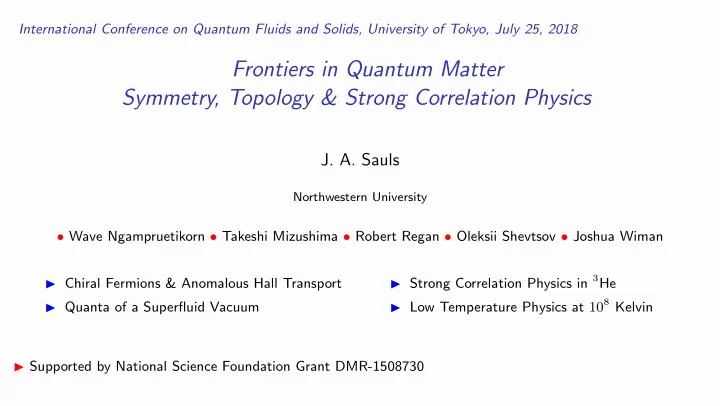
International Conference on Quantum Fluids and Solids, University of Tokyo, July 25, 2018 Frontiers in Quantum Matter Symmetry, Topology & Strong Correlation Physics J. A. Sauls Northwestern University Wave Ngampruetikorn Takeshi


slide-1
SLIDE 1

International Conference on Quantum Fluids and Solids, University of Tokyo, July 25, 2018

Frontiers in Quantum Matter Symmetry, Topology & Strong Correlation Physics

  • J. A. Sauls

Northwestern University

  • Wave Ngampruetikorn • Takeshi Mizushima • Robert Regan • Oleksii Shevtsov • Joshua Wiman

◮ Chiral Fermions & Anomalous Hall Transport ◮ Quanta of a Superfluid Vacuum ◮ Strong Correlation Physics in 3He ◮ Low Temperature Physics at 108 Kelvin ◮ Supported by National Science Foundation Grant DMR-1508730

slide-2
SLIDE 2

Chiral Quantum Matter

Molecular Chiral Enantiomers Handedness: Broken Mirror Symmetry

slide-3
SLIDE 3

Chiral Quantum Matter

Molecular Chiral Enantiomers Handedness: Broken Mirror Symmetry Chiral Diatomic Molecules Ψ(r) = f(r) (x + iy)

Mirror

Broken Mirror Symmetries Πzx Ψ(r) = f(r) (x − iy)

slide-4
SLIDE 4

Chiral Quantum Matter

Molecular Chiral Enantiomers Handedness: Broken Mirror Symmetry Chiral Diatomic Molecules Ψ(r) = f(r) (x + iy)

Mirror

Broken Mirror Symmetries Πzx Ψ(r) = f(r) (x − iy) Broken Time-Reversal Symmetry T Ψ(r) = f(r) (x − iy)

slide-5
SLIDE 5

Chiral Quantum Matter

Molecular Chiral Enantiomers Handedness: Broken Mirror Symmetry Chiral Diatomic Molecules Ψ(r) = f(r) (x + iy)

Mirror

Broken Mirror Symmetries Πzx Ψ(r) = f(r) (x − iy) Broken Time-Reversal Symmetry T Ψ(r) = f(r) (x − iy) Realized in Superfluid 3He-A & possibly the ground states in unconventional superconductors

slide-6
SLIDE 6

Chiral Quantum Matter

Molecular Chiral Enantiomers Handedness: Broken Mirror Symmetry Chiral Diatomic Molecules Ψ(r) = f(r) (x + iy)

Mirror

Broken Mirror Symmetries Πzx Ψ(r) = f(r) (x − iy) Broken Time-Reversal Symmetry T Ψ(r) = f(r) (x − iy) Realized in Superfluid 3He-A & possibly the ground states in unconventional superconductors Signatures: Chiral, Edge Fermions Anomalous Hall Transport

slide-7
SLIDE 7

Chiral Superconductors Ground states exhibiting:

◮ Emergent Topology of a Broken-Symmetry Vacuum of Cooper Pairs ◮ Weyl-Majorana excitations of the Vacuum ◮ Ground-State Edge Currents and Angular Momemtum ◮ Broken P and T Anomalous Hall-Type Transport

slide-8
SLIDE 8

Chiral Superconductors Ground states exhibiting:

◮ Emergent Topology of a Broken-Symmetry Vacuum of Cooper Pairs ◮ Weyl-Majorana excitations of the Vacuum ◮ Ground-State Edge Currents and Angular Momemtum ◮ Broken P and T Anomalous Hall-Type Transport

Where are They?

◮ 3He-A: definitive chiral p-wave condensate; quantitative theory-experimental confirmation ◮ Sr2RuO4: proposed as the electronic analog of 3He-A; evidence of chirality ◮ UPt3: electronic analog to 3He: Multiple Superconducting Phases; evidence of chirality ◮ Other candidates: URu2Si2; SrPtAs, doped graphene ...

slide-9
SLIDE 9

The Pressure-Temperature Phase Diagram for Liquid 3He Maximal Symmetry: G = SO(3)S × SO(3)L × U(1)N × P × T → Superfluid Phases of 3He

0.0 0.5 1.0 1.5 2.0 2.5

T/mK

6 12 18 24 30 34

p/bar

A B

pPCP TAB Tc

◮ J. Wiman & J. A. Sauls, PRB 92, 144515 (2015)

slide-10
SLIDE 10

Realization of Broken Time-Reversal and Mirror Symmetry by the Vacuum State of 3He Films ◮ Length Scale for Strong Confinement: ξ0 = vf/2πkBTc ≈ 20 − 80 nm

◮ L. Levitov et al., Science 340, 6134 (2013) ◮ A. Vorontsov & J. A. Sauls, PRL 98, 045301 (2007)

10 20 0.2 0.4 0.6 0.8 1

B A

Stripe Pha se Ψ↑↑ Ψ↑↓ Ψ↑↓ Ψ↓↓

  • ABM

=

  • px + ipy ∼ e+iφ

px + ipy ∼ e+iφ

  • SO(3)S × SO(3)L × U(1)N × T × P

⇓ SO(2)S × U(1)N-Lz × Z2 Chiral ABM State l = ˆ z

slide-11
SLIDE 11

Realization of Broken Time-Reversal and Mirror Symmetry by the Vacuum State of 3He Films ◮ Length Scale for Strong Confinement: ξ0 = vf/2πkBTc ≈ 20 − 80 nm

◮ L. Levitov et al., Science 340, 6134 (2013) ◮ A. Vorontsov & J. A. Sauls, PRL 98, 045301 (2007)

10 20 0.2 0.4 0.6 0.8 1

B A

Stripe Pha se Ψ↑↑ Ψ↑↓ Ψ↑↓ Ψ↓↓

  • ABM

=

  • px + ipy ∼ e+iφ

px + ipy ∼ e+iφ

  • SO(3)S × SO(3)L × U(1)N × T × P

⇓ SO(2)S × U(1)N-Lz × Z2 Chiral ABM State l = ˆ z Lz = 1, Sz = 0 Ground-State Angular Momentum

  • Lz = N

2 ? Open Question

slide-12
SLIDE 12

Momentum-Space Topology

Topology in Momentum Space Ψ(p) = ∆(px ± ipy) ∼ e±iϕp Winding Number of the Phase: Lz = ±1 N2D = 1 2π

  • dp·

1 |Ψ(p)|Im[∇pΨ(p)] = Lz ◮ Massless Chiral Fermions ◮ Nodal Fermions in 3D ◮ Edge Fermions in 2D

slide-13
SLIDE 13

Massless Chiral Fermions in the 2D 3He-A Films

Edge Fermions: GR

edge(p, ε; x) =

π∆|px| ε + iγ − εbs(p||) e−x/ξ∆ ξ∆ = vf/2∆ ≈ 102 ˚ A ≫ /pf

◮ εbs = −c p|| with c = ∆/pf ≪ vf ◮ Broken P & T Edge Current

Vacuum

Unoccupied Occupied

◮ M. Stone, R. Roy, PRB 69, 184511 (2004) ◮ J. A. Sauls, Phys. Rev. B 84, 214509 (2011)

slide-14
SLIDE 14

Chiral Edge Current Circulating a Hole or Defect in a Chiral Superfluid

y z J x

l

^

~ (p + i p ) R ∆

x y

◮ R ≫ ξ0 ≈ 100 nm ◮

Sheet Current : J ≡

  • dx Jϕ(x)
slide-15
SLIDE 15

Chiral Edge Current Circulating a Hole or Defect in a Chiral Superfluid

y z J x

l

^

~ (p + i p ) R ∆

x y

◮ R ≫ ξ0 ≈ 100 nm ◮

Sheet Current : J ≡

  • dx Jϕ(x)

◮ Quantized Sheet Current:

1 4 n (n = N/V = 3He density)

◮ Edge Current Counter-Circulates:

J = −1 4 n w.r.t. Chirality: ˆ l = +z

slide-16
SLIDE 16

Chiral Edge Current Circulating a Hole or Defect in a Chiral Superfluid

y z J x

l

^

~ (p + i p ) R ∆

x y

◮ R ≫ ξ0 ≈ 100 nm ◮

Sheet Current : J ≡

  • dx Jϕ(x)

◮ Quantized Sheet Current:

1 4 n (n = N/V = 3He density)

◮ Edge Current Counter-Circulates:

J = −1 4 n w.r.t. Chirality: ˆ l = +z

◮ Angular Momentum: Lz = 2π h R2 × (−1

4 n ) = −(Nhole/2) Nhole/2 = Number of 3He Cooper Pairs excluded from the Hole ∴ An object in 3He-A inherits angular momentum from the Condensate of Chiral Pairs!

slide-17
SLIDE 17

Electron bubbles in the Normal Fermi liquid phase of 3He

◮ Bubble with R ≃ 1.5 nm,

0.1 nm ≃ λf ≪ R ≪ ξ0 ≃ 80 nm

◮ Effective mass M ≃ 100m3

(m3 – atomic mass of 3He)

◮ QPs mean free path l ≫ R ◮ Mobility of 3He is independent of T for

Tc < T < 50 mK

  • B. Josephson and J. Leckner, PRL 23, 111 (1969)
slide-18
SLIDE 18

Current bound to an electron bubble (kfR = 11.17)

y z J x

l

^

~ (p + i p ) R ∆

x y

= ⇒ L(T → 0) ≈ −Nbubble/2ˆ l ≈ −100 ˆ l

slide-19
SLIDE 19

Electron bubbles in chiral superfluid 3He-A ∆(ˆ k) = ∆(ˆ kx + iˆ ky) = ∆ eiφk

quasiparticle ◮ Current: v =

vE

  • µ⊥E +

vAH

  • µAHE ׈

l

  • R. Salmelin, M. Salomaa & V. Mineev, PRL 63, 868 (1989)

◮ Hall ratio:

tan α = vAH/vE = |µAH/µ⊥|

slide-20
SLIDE 20

Mobility of e-bubbles in 3He-A (Ikegami, et al., RIKEN)

Science 341, 59 (2013); JPSJ 82, 124607 (2013); JPSJ 84, 044602 (2015)

Electric current: v =

vE

  • µ⊥E +

vAH

  • µAHE ׈

l Hall ratio: tan α = vAH/vE = |µAH/µ⊥|

slide-21
SLIDE 21

Mobility of e-bubbles in 3He-A (Ikegami, et al., RIKEN)

Science 341, 59 (2013); JPSJ 82, 124607 (2013); JPSJ 84, 044602 (2015)

Electric current: v =

vE

  • µ⊥E +

vAH

  • µAHE ׈

l Hall ratio: tan α = vAH/vE = |µAH/µ⊥|

slide-22
SLIDE 22

Mobility of e-bubbles in 3He-A (Ikegami, et al., RIKEN)

Science 341, 59 (2013); JPSJ 82, 124607 (2013); JPSJ 84, 044602 (2015)

Electric current: v =

vE

  • µ⊥E +

vAH

  • µAHE ׈

l Hall ratio: tan α = vAH/vE = |µAH/µ⊥|

slide-23
SLIDE 23

Mobility of e-bubbles in 3He-A (Ikegami, et al., RIKEN)

Science 341, 59 (2013); JPSJ 82, 124607 (2013); JPSJ 84, 044602 (2015)

Electric current: v =

vE

  • µ⊥E +

vAH

  • µAHE ׈

l Hall ratio: tan α = vAH/vE = |µAH/µ⊥|

tanα

slide-24
SLIDE 24

Forces on the Electron bubble in 3He-A:

◮ M dv

dt = eE + FQP, FQP – force from quasiparticle collisions

slide-25
SLIDE 25

Forces on the Electron bubble in 3He-A:

◮ M dv

dt = eE + FQP, FQP – force from quasiparticle collisions

◮ FQP = − ↔

η · v,

η – generalized Stokes tensor

◮ ↔

η =   η⊥ ηAH − ηAH η⊥ η   for broken PT symmetry with ˆ l ez

slide-26
SLIDE 26

Forces on the Electron bubble in 3He-A:

◮ M dv

dt = eE + FQP, FQP – force from quasiparticle collisions

◮ FQP = − ↔

η · v,

η – generalized Stokes tensor

◮ ↔

η =   η⊥ ηAH − ηAH η⊥ η   for broken PT symmetry with ˆ l ez

M dv dt = eE − η⊥v + e cv × Beff , for E ⊥ ˆ l

Beff = −c eηAHˆ l Beff ≃ 103 − 104 T !!!

slide-27
SLIDE 27

Forces on the Electron bubble in 3He-A:

◮ M dv

dt = eE + FQP, FQP – force from quasiparticle collisions

◮ FQP = − ↔

η · v,

η – generalized Stokes tensor

◮ ↔

η =   η⊥ ηAH − ηAH η⊥ η   for broken PT symmetry with ˆ l ez

M dv dt = eE − η⊥v + e cv × Beff , for E ⊥ ˆ l

Beff = −c eηAHˆ l Beff ≃ 103 − 104 T !!!

◮ Mobility: dv

dt = 0

  • v =

µE, where

µ = e

η

−1

◮ O. Shevtsov and JAS, Phys. Rev. B 96, 064511 (2016)

slide-28
SLIDE 28

T-matrix description of Quasiparticle-Ion scattering ◮ Lippmann-Schwinger equation for the T-matrix (ε = E + iη ; η → 0+): ˆ T R

S (k′, k, E)= ˆ

T R

N (k′, k) +

d3k′′ (2π)3 ˆ T R

N (k′, k′′)

  • ˆ

GR

S (k′′, E) − ˆ

GR

N(k′′, E)

  • ˆ

T R

S (k′′, k, E)

ˆ GR

S (k, E) =

1 ε2 − E2

k

  ε + ξk −∆(ˆ k) −∆†(ˆ k) ε − ξk  , Ek =

  • ξ2

k + |∆(ˆ

k)|2, ξk = 2k2 2m∗ − µ ◮ Normal-state T-matrix: ˆ T R

N (ˆ

k′, ˆ k) = tR

N(ˆ

k′, ˆ k) −[tR

N(−ˆ

k′, −ˆ k)]†

  • in p-h (Nambu) space
slide-29
SLIDE 29

T-matrix description of Quasiparticle-Ion scattering ◮ Lippmann-Schwinger equation for the T-matrix (ε = E + iη ; η → 0+): ˆ T R

S (k′, k, E)= ˆ

T R

N (k′, k) +

d3k′′ (2π)3 ˆ T R

N (k′, k′′)

  • ˆ

GR

S (k′′, E) − ˆ

GR

N(k′′, E)

  • ˆ

T R

S (k′′, k, E)

ˆ GR

S (k, E) =

1 ε2 − E2

k

  ε + ξk −∆(ˆ k) −∆†(ˆ k) ε − ξk  , Ek =

  • ξ2

k + |∆(ˆ

k)|2, ξk = 2k2 2m∗ − µ ◮ Normal-state T-matrix: ˆ T R

N (ˆ

k′, ˆ k) = tR

N(ˆ

k′, ˆ k) −[tR

N(−ˆ

k′, −ˆ k)]†

  • in p-h (Nambu) space, where

tR

N(ˆ

k′, ˆ k) = − 1 πNf

  • l=0

(2l + 1)eiδl sin δlPl(ˆ k′ · ˆ k), Pl(x) – Legendre function ◮ Hard-sphere potential tan δl = jl(kfR)/nl(kfR) – spherical Bessel functions ◮ kfR – determined by the Normal-State Mobility kfR = 11.17 (R = 1.42 nm)

slide-30
SLIDE 30

Differential cross section for Bogoliubov QP-Ion Scattering kfR = 11.17

◮ O. Shevtsov and JAS, Phys. Rev. B 96, 064511 (2016)

slide-31
SLIDE 31

Theoretical Results for the Drag and Transverse Forces

0.0 0.2 0.4 0.6 0.8 1.0

T/Tc

0.0 0.5 1.0

η⊥/ηN

◮ ∆px ≈ pf

σtr

xx ≈ σtr N ≈ πR2

◮ Fx ≈ n vx ∆px σtr

xx

≈ n vx pf σtr

N

◮ ∆py ≈ /R σtr

xy ≈ (∆(T)/kBTc)2σtr N

◮ Fy ≈ n vx ∆py σtr

xy

≈ n vx (/R) σtr

N(∆(T)/kBTc)2

|Fy/Fx| ≈

  • pfR (∆(T)/kBTc)2

kfR = 11.17 Branch Conversion Scattering in a Chiral Condensate

◮ O. Shevtsov and JAS, Phys. Rev. B 96, 064511 (2016)

slide-32
SLIDE 32

Comparison between Theory and Experiment for the Drag and Transverse Forces

0.0 0.2 0.4 0.6 0.8 1.0

T/Tc

100 101 102 103 104 105 106

µ⊥/µN

theory experiment 5 10 15 20

l

  • 0.5

0.0 0.5

δl[π]

◮ µ⊥ = e

η⊥ η2

⊥ + η2 AH

◮ µAH = −e

ηAH η2

⊥ + η2 AH

◮ tan α =

  • µAH

µ⊥

  • = ηAH

η⊥

◮ Hard-Sphere Model:

kfR = 11.17

◮ O. Shevtsov and JAS, Phys. Rev. B 96, 064511 (2016) ◮ O. Shevtsov and JAS, JLTP 187, 340353 (2017)

slide-33
SLIDE 33

Summary

◮ Electrons in 3He-A are “dressed” by a spectrum of Chiral Fermions ◮ Electrons are “Left handed” in a Right-handed Chiral Vacuum Lz ≈ −100

slide-34
SLIDE 34

Summary

◮ Electrons in 3He-A are “dressed” by a spectrum of Chiral Fermions ◮ Electrons are “Left handed” in a Right-handed Chiral Vacuum Lz ≈ −100 ◮ Experiment: RIKEN mobility experiments Observation an AHE in 3He-A ◮ Origin: Broken Mirror & Time-Reversal Symmetry

slide-35
SLIDE 35

Summary

◮ Electrons in 3He-A are “dressed” by a spectrum of Chiral Fermions ◮ Electrons are “Left handed” in a Right-handed Chiral Vacuum Lz ≈ −100 ◮ Experiment: RIKEN mobility experiments Observation an AHE in 3He-A ◮ Origin: Broken Mirror & Time-Reversal Symmetry ◮ Theory: Scattering of Bogoliubov QPs by the dressed Ion

  • Drag Force (−η⊥v) • Transverse Force (e

cv × Beff)

◮ Anomalous Hall Field: Beff ≈ Φ0

3π2 k2

f (kfR)2

ηAH ηN

  • l ≃ 103 − 104 T l
slide-36
SLIDE 36

Summary

◮ Electrons in 3He-A are “dressed” by a spectrum of Chiral Fermions ◮ Electrons are “Left handed” in a Right-handed Chiral Vacuum Lz ≈ −100 ◮ Experiment: RIKEN mobility experiments Observation an AHE in 3He-A ◮ Origin: Broken Mirror & Time-Reversal Symmetry ◮ Theory: Scattering of Bogoliubov QPs by the dressed Ion

  • Drag Force (−η⊥v) • Transverse Force (e

cv × Beff)

◮ Anomalous Hall Field: Beff ≈ Φ0

3π2 k2

f (kfR)2

ηAH ηN

  • l ≃ 103 − 104 T l

This theory fails as T → 0

slide-37
SLIDE 37

Frontier Topic at Low Temperatures Transport Radiation Dominated Motion of Electrons in a Chiral Vacuum

slide-38
SLIDE 38

Vanishing of the Effective Magnetic Field for T → 0 Breakdown of Laminar Flow BW = 5.9 × 10⁵ T ηxy ηN

  • 0.0

0.2 0.4 0.6 0.8 1.0 T/Tc 0.0 0.2 0.4 0.6 0.8 1.0 1.2 BW [T] ×104 ∼ T 4 ∼ Tc − T →

ηxy/ηN|T =0.8 Tc ≈

  • pfR
slide-39
SLIDE 39

Vanishing of the Effective Magnetic Field for T → 0 Breakdown of Laminar Flow BW = 5.9 × 10⁵ T ηxy ηN

  • 0.0

0.2 0.4 0.6 0.8 1.0 T/Tc 0.0 0.2 0.4 0.6 0.8 1.0 1.2 BW [T] ×104 ∼ T 4 ∼ Tc − T →

ηxy/ηN|T =0.8 Tc ≈

  • pfR

Re = ReN ηN η 3/2 − − − →

T →0 ∼

Tc T 9/2 ReN = 6.7 × 10⁻⁶

slide-40
SLIDE 40

Breakdown of Scattering Theory for T → 0 Electron Bubble Velocity

◮ VN = µNEN = 1.01 × 10⁻⁴m/s ◮ V = µNEN

ηN η Maximum Landau critical velocity

◮ V max

c

≈ 155 × 10−4m/s ∆A(T) kbTc Nodal Superfluids: ◮ Vc = ∆(p)/pf → 0 for p → pnode ◮ Radiation Dominated Damping for T 0.1Tc

slide-41
SLIDE 41

Radiation Damping - Pair-Breaking at T → 0

Is their a transverse component of the radiation backaction? Stochastic Radiative Dynamics Quasiparticle Radiation Fluctuations of the Chiral Vacuum ◮ Mesoscopic Ion coupled and driven through a Chiral “Bath”

slide-42
SLIDE 42

Frontier Topic: Low Temperature Transport in Chiral Superconductors

slide-43
SLIDE 43

Frontier Topic: Low Temperature Transport in Chiral Superconductors

◮ Anomalous Thermal Hall Conductivity (κxy) could provide detection of Broken Time-Reversal and Mirror Symmetries in the Bulk ⇓ Introduce non-magnetic impurity disorder into a Chiral Superconductor ∆(p) = ∆ (px ± ipy) ν JQ

i = −κij∇jT κxy = 0

slide-44
SLIDE 44

Anomalous Hall Response of Chiral SCs - Wave Ngampruetikorn, S12-2

slide-45
SLIDE 45

Strong Correlation Physics and the Low-Temperature Phases of 3He

◮ Strong Interactions in 3He

◮ Spin-Fluctuation-Mediated Pairing in 3He ◮ Nearly Ferromagnetic or Nearly Localized?

◮ Strong-Coupling Theory of Superfluid 3He

◮ Beyond Weak-coupling BCS pairing ◮ The Stabilization of the A phase - circa 2018

slide-46
SLIDE 46

Paramagnon Exchange: Ferromagnetic Spin Fluctuations Odd-Parity, Spin-Triplet Pairing for 3He

  • A. Layzer and D. Fay, Int. J. Magn. 1, 135 (1971)

p ↑ p′ ↑ −p′ ↑ −p ↑

Vsf(q) = = − I 1−I χ(q)

−gl = (2l + 1) dΩˆ

p

4π dΩˆ

p′

4π Vsf(p − p′) Pl(ˆ p · ˆ p′)

0.0 0.2 0.4 0.6 0.8 1.0 0.0 0.5 1.0 1.5 2.0 2.5 3.0 q ≈ ¯ h/ξsf Vsf = −I 1 − I χ(q) q/pf

−gl is a function of I ≈ 0.75 & ξsf ≈ 5 /pf

◮ S = 1, Sz = 0 , ±1 Cooper Pairs:

| ↑↓ + ↓↑ , | ↑↑ , | ↓↓

◮ l = 1 (p-wave) is dominant pairing channel

◮ ˆ px + iˆ py ∼ sin θˆ

p e+iφˆ p

lz = +1 ◮ ˆ pz ∼ cos θˆ

p

lz = 0 ◮ ˆ px − iˆ py ∼ sin θˆ

p e−iφˆ p

lz = −1

slide-47
SLIDE 47

Paramagnon Exchange: Ferromagnetic Spin Fluctuations Odd-Parity, Spin-Triplet Pairing for 3He

  • A. Layzer and D. Fay, Int. J. Magn. 1, 135 (1971)

p ↑ p′ ↑ −p′ ↑ −p ↑

Vsf(q) = = − I 1−I χ(q)

−gl = (2l + 1) dΩˆ

p

4π dΩˆ

p′

4π Vsf(p − p′) Pl(ˆ p · ˆ p′)

0.0 0.2 0.4 0.6 0.8 1.0 0.0 0.5 1.0 1.5 2.0 2.5 3.0 q ≈ ¯ h/ξsf Vsf = −I 1 − I χ(q) q/pf

−gl is a function of I ≈ 0.75 & ξsf ≈ 5 /pf

◮ S = 1, Sz = 0 , ±1 Cooper Pairs:

| ↑↓ + ↓↑ , | ↑↑ , | ↓↓

◮ l = 1 (p-wave) is dominant pairing channel

◮ ˆ px + iˆ py ∼ sin θˆ

p e+iφˆ p

lz = +1 ◮ ˆ pz ∼ cos θˆ

p

lz = 0 ◮ ˆ px − iˆ py ∼ sin θˆ

p e−iφˆ p

lz = −1

◮ l = 3 (f-wave) is attractive, but

sub-dominant to the p-wave channel

slide-48
SLIDE 48

Paramagnon Exchange: Ferromagnetic Spin Fluctuations Odd-Parity, Spin-Triplet Pairing for 3He

  • A. Layzer and D. Fay, Int. J. Magn. 1, 135 (1971)

p ↑ p′ ↑ −p′ ↑ −p ↑

Vsf(q) = = − I 1−I χ(q)

−gl = (2l + 1) dΩˆ

p

4π dΩˆ

p′

4π Vsf(p − p′) Pl(ˆ p · ˆ p′)

0.0 0.2 0.4 0.6 0.8 1.0 0.0 0.5 1.0 1.5 2.0 2.5 3.0 q ≈ ¯ h/ξsf Vsf = −I 1 − I χ(q) q/pf

−gl is a function of I ≈ 0.75 & ξsf ≈ 5 /pf

◮ S = 1, Sz = 0 , ±1 Cooper Pairs:

| ↑↓ + ↓↑ , | ↑↑ , | ↓↓

◮ l = 1 (p-wave) is dominant pairing channel

◮ ˆ px + iˆ py ∼ sin θˆ

p e+iφˆ p

lz = +1 ◮ ˆ pz ∼ cos θˆ

p

lz = 0 ◮ ˆ px − iˆ py ∼ sin θˆ

p e−iφˆ p

lz = −1

◮ l = 3 (f-wave) is attractive, but

sub-dominant to the p-wave channel

◮ Weak-Coupling BCS Theory based on Vsf:

◮ a unique ground state: ˆ ∆(p) = (i σσy) · d(p) with d(p) = ∆ ˆ p L = 1, S = 1 and J = 0. ◮ Fully gapped excitations: Ep =

  • ξ2

p + ∆2

◮ BW order parameter for all p, T.

  • R. Balian and N. Werthamer, PR 131, 1553 (1963)
slide-49
SLIDE 49

Paramagnon Exchange: Ferromagnetic Spin Fluctuations Odd-Parity, Spin-Triplet Pairing for 3He

  • A. Layzer and D. Fay, Int. J. Magn. 1, 135 (1971)

p ↑ p′ ↑ −p′ ↑ −p ↑

Vsf(q) = = − I 1−I χ(q)

−gl = (2l + 1) dΩˆ

p

4π dΩˆ

p′

4π Vsf(p − p′) Pl(ˆ p · ˆ p′)

0.0 0.2 0.4 0.6 0.8 1.0 0.0 0.5 1.0 1.5 2.0 2.5 3.0 q ≈ ¯ h/ξsf Vsf = −I 1 − I χ(q) q/pf

−gl is a function of I ≈ 0.75 & ξsf ≈ 5 /pf

◮ S = 1, Sz = 0 , ±1 Cooper Pairs:

| ↑↓ + ↓↑ , | ↑↑ , | ↓↓

◮ l = 1 (p-wave) is dominant pairing channel

◮ ˆ px + iˆ py ∼ sin θˆ

p e+iφˆ p

lz = +1 ◮ ˆ pz ∼ cos θˆ

p

lz = 0 ◮ ˆ px − iˆ py ∼ sin θˆ

p e−iφˆ p

lz = −1

◮ l = 3 (f-wave) is attractive, but

sub-dominant to the p-wave channel

◮ Weak-Coupling BCS Theory based on Vsf:

◮ a unique ground state: ˆ ∆(p) = (i σσy) · d(p) with d(p) = ∆ ˆ p L = 1, S = 1 and J = 0. ◮ Fully gapped excitations: Ep =

  • ξ2

p + ∆2

◮ BW order parameter for all p, T.

  • R. Balian and N. Werthamer, PR 131, 1553 (1963)

Not the Whole Story

slide-50
SLIDE 50

The Pressure-Temperature Phase Diagram for Liquid 3He Maximal Symmetry: G = SO(3)S × SO(3)L × U(1)N × P × T → Superfluid Phases of 3He

0.0 0.5 1.0 1.5 2.0 2.5

T/mK

6 12 18 24 30 34

p/bar

A B

pPCP TAB Tc

◮ J. Wiman & J. A. Sauls, PRB 92, 144515 (2015)

slide-51
SLIDE 51

Spin Fluctuation Exchange: Feedback Effect Stabilization of 3He-A

Spin-Triplet Pairing Fluctuations modify the Spin-Fluctuation Pairing Interaction

p ↑ p′ ↑ −p′ ↑ −p ↑

Vsf(q) = +

p ↑ p′ ↑ −p′ ↑ −p ↑

δ χpair

∆⋆ ∆

◮ S = 1 pairing fluctuations modify Vsf:

δVsf ∝ δχpair ∝ −χN (∆∆†) | A ∼ (ˆ px + iˆ py)(| ↑↑ + | ↓↓ ) δχA

pair = 0

| B ∼ (ˆ px + iˆ py)| ↓↓ + (ˆ px + iˆ py)| ↑↑ + ˆ pz | ↑↓ + ↓↑ ) δχB

pair ∼ −χN (|∆|/πTc)2

“Feedback” Stabilization of 3He-A

  • P. W. Anderson and W. Brinkman, PRL 30, 1108 (1973)

  • W. Brinkman, J. Serene, and P. Anderson, PRA 10, 2386 (1974)
slide-52
SLIDE 52

3He: Nearly Ferromagnetic vs. Almost Localized

Paramagnon Theory (Levin and Valls, Phys. Rep. 1 1983):

◮ Spin Susceptibility in Paramagnon Theory: χ/χP =

1 1 − I ≫ 1 ⇓

3He is near to a ferromagnetic instability

⇓ finite, but long-lived FM spin fluctuations.

◮ Effective Mass: m∗/m − 1 = ln(1/(1 − I))

◮ Fermi Liquid Theory: χ/χP = m∗/m 1 + F a ≫ 1 ◮ Exchange Interaction: F a

0 = −0.70 to −0.75 is nearly constant ◮ ∴ χ/χP increases with pressure mainly due m∗/m

3He is nearly localized (`

a la Mott) due to short-range repulsive interactions

  • P. W. Anderson, W. Brinkman, Scottish Summer School, St. Andrews (1975).

◮ 3He is very incompressible: F s

0 ≈ 10 to 100 at p = 34 bar

◮ D. Vollhardt, RMP 56, 101 (1984)

slide-53
SLIDE 53

The Pressure-Temperature Phase Diagram for Liquid 3He Maximal Symmetry: G = SO(3)S × SO(3)L × U(1)N × P × T → Superfluid Phases of 3He

0.0 0.5 1.0 1.5 2.0 2.5

T/mK

6 12 18 24 30 34

p/bar

A B

pPCP TAB Tc

◮ J. Wiman & J. A. Sauls, PRB 92, 144515 (2015)

slide-54
SLIDE 54

Tri-Critical Points in Landau Theory: → Ferro-electric Transition in BaTiO3

Ba O

2+ 2− Ti4+

◮ Electric Polarization: P = Pxˆ

x + Py ˆ y + Pzˆ z

◮ Landau Free Energy Functional:

Ω[P] = a(p, T)(P 2

x + P 2 y + P 2 z )

+ b1(p, T)(P 4

x + P 4 y + P 4 z )

+ b2(p, T)(P 2

xP 2 y + P 2 y P 2 z + P 2 z P 2 x)

Phase Diagram for Ferro-Electric Transitions

T p

tetrag rhomb cubic

b2(p, T∗) = 0 a(p, Tc) = 0

◮ a(p, Tc) = 0 Ferro-electric transition ◮ b1(p, Tc) > 0, b2(p, Tc) > 0 Tetragonal FE ◮ b1(p, Tc) > 0, b2(p, Tc) < 0 Rhombohedaral FE

◮ b2(p, T∗) = 0 1st Order Transition Line ◮ T∗(pc) = Tc(pc) tri-critical point

slide-55
SLIDE 55

Maximal Symmetry: G = SO(3)S × SO(3)L × U(1)N × P × T → Superfluid Phases of 3He

  • J. Wiman & J. A. Sauls, PRB 92, 144515 (2015)

0.0 0.5 1.0 1.5 2.0 2.5

T/mK

6 12 18 24 30 34

p/bar

A B

pPCP TAB Tc “Isotropic” BW State AB

αi = ∆

√ 3 δαi Chiral AM State AA

αi = ∆

√ 2 ˆ dα ( ˆ mi + iˆ ni) ◮ Ginzburg-Landau Free Energy Functional: Ω[A] = α(p, T)Tr

  • AA†

+

5

  • i=1

βi(p, T) I(4)

i

[A]

◮ α(Tc, p) = 0 Tc(p) ◮ ΩA,B(p, T) = −

α(p, T)2 4βA,B(p, T)

◮ βA = β245 and βB = β12 + 1

3β345

∆β(p, TAB) = 0 TAB(p) ◮ Microscopic Theory:

◮ α(p, T) = 1

3Nf(T − Tc)

◮ Weak-Coupling:

2βwc

1 = −βwc 2 = −βwc 3 = −βwc 4 = βwc 5 = −

7ζ(3)Nf 240(πkBTc)2

◮ Leading Order Strong-Coupling: ◮ βsc

i (p, T) ≈ βwc(p) × wi|T|2FS ×

T Ef

  • βi(p, T) = βwc

i (p) +

T Tc

  • βsc

i (p, Tc(p))

slide-56
SLIDE 56

Strong-Coupling GL Theory: Inhomogeneous Phases of Superfluid 3He in Confined Geometries

◮ R. Regan et al., QFS 2018 (Poster P28.3) 1.2 1.4 1.6 1.8 2.0 2.2 2.4 T (mK) 5 10 15 20 25 30 p (bar)

B D-Core A-Core A N PCP Pcv

TAB(p) - Expt, H = 0 G TAB(p) - Theory, H = 0 G TAB(p) - Theory, H = 300 G Tv(p) - Expt - Warming Tv(p) - Expt - Cooling Tv(p) - Theory, H = 0 G Tv(p) - Theory, H = 300 G

◮ Rotating 3He-B - P. Hakonen et al. 1983

slide-57
SLIDE 57

Strong-Coupling GL Theory: Inhomogeneous Phases of Superfluid 3He in Confined Geometries

◮ R. Regan et al., QFS 2018 (Poster P28.3) 1.2 1.4 1.6 1.8 2.0 2.2 2.4 T (mK) 5 10 15 20 25 30 p (bar)

B D-Core A-Core A N PCP Pcv

TAB(p) - Expt, H = 0 G TAB(p) - Theory, H = 0 G TAB(p) - Theory, H = 300 G Tv(p) - Expt - Warming Tv(p) - Expt - Cooling Tv(p) - Theory, H = 0 G Tv(p) - Theory, H = 300 G

◮ Rotating 3He-B - P. Hakonen et al. 1983 ◮ V. Dmitriev et al.,PRL 115, 165304 (2015) ◮ 3He Confined in Nematic Aerogel ◮ J.Wiman, S. Laine, E. Thuneberg & JAS, (2018).

0.70 0.75 0.80 0.85 0.90 0.95 1.00

T/Tc

5 10 15 20 25 30

P (bar)

P A B ◮ Discovery:

1 2 Quantum Vortices - S. Autti et al. PRL (2016)

slide-58
SLIDE 58

Strong-Coupling GL Theory: Inhomogeneous Phases of Superfluid 3He in Confined Geometries

◮ R. Regan et al., QFS 2018 (Poster P28.3) 1.2 1.4 1.6 1.8 2.0 2.2 2.4 T (mK) 5 10 15 20 25 30 p (bar)

B D-Core A-Core A N PCP Pcv

TAB(p) - Expt, H = 0 G TAB(p) - Theory, H = 0 G TAB(p) - Theory, H = 300 G Tv(p) - Expt - Warming Tv(p) - Expt - Cooling Tv(p) - Theory, H = 0 G Tv(p) - Theory, H = 300 G

◮ Rotating 3He-B - P. Hakonen et al. 1983 ◮ V. Dmitriev et al.,PRL 115, 165304 (2015) ◮ 3He Confined in Nematic Aerogel ◮ J.Wiman, S. Laine, E. Thuneberg & JAS, (2018).

0.70 0.75 0.80 0.85 0.90 0.95 1.00

T/Tc

5 10 15 20 25 30

P (bar)

P A B ◮ Discovery:

1 2 Quantum Vortices - S. Autti et al. PRL (2016)

100nm Pores ◮ A. Zimmerman (NU ULT) ◮ Six new phases of 3He ◮ Nematic Pz Phase ◮ Helical Phase ◮ J.J. Wiman & JAS, PRL (2018)

(2) SO

B

(2) SO

A

z

P N

A

S

B

S

1 . = 0

T ′

b

0.0 0.5 1.0 1.5 2.0 2.5 5 10 15 20 25 30

p (bar) T (mK)
slide-59
SLIDE 59

Strong-Coupling GL Theory: Inhomogeneous Phases of Superfluid 3He in Confined Geometries

◮ R. Regan et al., QFS 2018 (Poster P28.3) 1.2 1.4 1.6 1.8 2.0 2.2 2.4 T (mK) 5 10 15 20 25 30 p (bar)

B D-Core A-Core A N PCP Pcv

TAB(p) - Expt, H = 0 G TAB(p) - Theory, H = 0 G TAB(p) - Theory, H = 300 G Tv(p) - Expt - Warming Tv(p) - Expt - Cooling Tv(p) - Theory, H = 0 G Tv(p) - Theory, H = 300 G

◮ Rotating 3He-B - P. Hakonen et al. 1983 ◮ V. Dmitriev et al.,PRL 115, 165304 (2015) ◮ 3He Confined in Nematic Aerogel ◮ J.Wiman, S. Laine, E. Thuneberg & JAS, (2018).

0.70 0.75 0.80 0.85 0.90 0.95 1.00

T/Tc

5 10 15 20 25 30

P (bar)

P A B ◮ Discovery:

1 2 Quantum Vortices - S. Autti et al. PRL (2016)

100nm Pores ◮ A. Zimmerman (NU ULT) ◮ Six new phases of 3He ◮ Nematic Pz Phase ◮ Helical Phase ◮ J.J. Wiman & JAS, PRL (2018)

(2) SO

B

(2) SO

A

z

P N

A

S

B

S

1 . = 0

T ′

b

0.0 0.5 1.0 1.5 2.0 2.5 5 10 15 20 25 30

p (bar) T (mK)

SA - Double Helix Phase

A

S

2

C

A

slide-60
SLIDE 60

The 3He Paradigm: Strongly Correlated Fermi-Liquid Superconductors

◮ Microscopic extension of strong-coupling GL theory to all T

slide-61
SLIDE 61

The 3He Paradigm: Strongly Correlated Fermi-Liquid Superconductors

◮ Microscopic extension of strong-coupling GL theory to all T Quasiclassical reduction of the Luttinger-Ward functional Ω = −T 2

  • ǫn
  • d3p

(2π)3 Tr4

Σ G +ln[− G−1

N + ∆

Σ] − ln[− G−1

N )]

  • + ∆Φ[∆

G]

  • G(

p, ǫn) =

  • ˆ

G( p, ǫn) ˆ F( p, ǫn) ˆ F †( p, −ǫn) − ˆ Gtr(− p, −ǫn)

  • Σ(

p, ǫn) = ˆ Σ( p, ǫn) ˆ ∆( p, ǫn) ˆ ∆†( p, −ǫn) −ˆ Σtr(− p, −ǫn)

slide-62
SLIDE 62

The 3He Paradigm: Strongly Correlated Fermi-Liquid Superconductors

◮ Microscopic extension of strong-coupling GL theory to all T Quasiclassical reduction of the Luttinger-Ward functional Ω = −T 2

  • ǫn
  • d3p

(2π)3 Tr4

Σ G +ln[− G−1

N + ∆

Σ] − ln[− G−1

N )]

  • + ∆Φ[∆

G]

  • G(

p, ǫn) =

  • ˆ

G( p, ǫn) ˆ F( p, ǫn) ˆ F †( p, −ǫn) − ˆ Gtr(− p, −ǫn)

  • Σ(

p, ǫn) = ˆ Σ( p, ǫn) ˆ ∆( p, ǫn) ˆ ∆†( p, −ǫn) −ˆ Σtr(− p, −ǫn)

  • δΩ[

Σ]/δ Σtr( p, ǫn) = 0 and δΩ[ Σ]/δ Gtr( p, ǫn) = 0

  • Σ =

Σskel = 2 δΦ[ G]/δ Gtr Expansion in T Ef ,

  • pfξ0 , . . .
slide-63
SLIDE 63

The 3He Paradigm: Strongly Correlated Fermi-Liquid Superconductors

◮ Microscopic extension of strong-coupling GL theory to all T Quasiclassical reduction of the Luttinger-Ward functional Ω = −T 2

  • ǫn
  • d3p

(2π)3 Tr4

Σ G +ln[− G−1

N + ∆

Σ] − ln[− G−1

N )]

  • + ∆Φ[∆

G]

  • G(

p, ǫn) =

  • ˆ

G( p, ǫn) ˆ F( p, ǫn) ˆ F †( p, −ǫn) − ˆ Gtr(− p, −ǫn)

  • Σ(

p, ǫn) = ˆ Σ( p, ǫn) ˆ ∆( p, ǫn) ˆ ∆†( p, −ǫn) −ˆ Σtr(− p, −ǫn)

  • δΩ[

Σ]/δ Σtr( p, ǫn) = 0 and δΩ[ Σ]/δ Gtr( p, ǫn) = 0

  • Σ =

Σskel = 2 δΦ[ G]/δ Gtr Expansion in T Ef ,

  • pfξ0 , . . .

(a) +1 2 (b) −1 4 (c) −1 4 (d) + (e) −1 2 T T (f) −1 8 (g) +1 2 (h) −1 8

  • D. Rainer & J. Serene, Phys. Rev. B 13, 4745 (1976)

JAS & J. Serene, Phys. Rev. B 24, 181 (1981) ◮

  • J. Wiman & JAS, (2018) [QFS: P26.16]
slide-64
SLIDE 64

Strong-Correlations in 3He: Effective Interactions J. Wiman, (2018) [QFS: P26.16]

T p1, α p2, β p3, γ p4, ρ = δαγδβρ v(q1) + σαγ · σβρ j(q1) − δαρδβγ v(q2) − σαρ · σβγ j(q2)

◮ v(q) - spin-independent potential ◮ j(q) - exchange interaction

− −

− −

slide-65
SLIDE 65

Strong-Correlations in 3He: Effective Interactions J. Wiman, (2018) [QFS: P26.16]

T p1, α p2, β p3, γ p4, ρ = δαγδβρ v(q1) + σαγ · σβρ j(q1) − δαρδβγ v(q2) − σαρ · σβγ j(q2)

◮ v(q) - spin-independent potential ◮ j(q) - exchange interaction

◮ To leading order in ε/Ef:

◮ pi = pf ˆ

pi and ǫi = 0

◮ q1 = p3 − p1 and q2 = p4 − p1

0.0 0.2 0.4 0.6 0.8 1.0 −4 −2 2

−j(q)

34 bar

q 2kF /

AFM FM

0.0 0.2 0.4 0.6 0.8 1.0 −4 −2 2 4

v(q)

34 bar

q 2kF /

Mott

slide-66
SLIDE 66

Strong-Correlations in 3He: Effective Interactions J. Wiman, (2018) [QFS: P26.16]

T p1, α p2, β p3, γ p4, ρ = δαγδβρ v(q1) + σαγ · σβρ j(q1) − δαρδβγ v(q2) − σαρ · σβγ j(q2)

◮ v(q) - spin-independent potential ◮ j(q) - exchange interaction

◮ To leading order in ε/Ef:

◮ pi = pf ˆ

pi and ǫi = 0

◮ q1 = p3 − p1 and q2 = p4 − p1

0.0 0.2 0.4 0.6 0.8 1.0 −4 −2 2

−j(q)

34 bar

q 2kF /

AFM FM

0.0 0.2 0.4 0.6 0.8 1.0 −4 −2 2 4

v(q)

34 bar

q 2kF /

Mott

◮ v(q) and j(q) determine:

◮ Landau Interactions: Forward scattering (p3 = p1) ◮ Thermodynamics: Cv/T, m∗/m, χ/χPauli, c1, c0, . . . ◮ Transport: κ, DS, η, α0, . . .

slide-67
SLIDE 67

Strong-Correlations in 3He: Effective Interactions J. Wiman, (2018) [QFS: P26.16]

T p1, α p2, β p3, γ p4, ρ = δαγδβρ v(q1) + σαγ · σβρ j(q1) − δαρδβγ v(q2) − σαρ · σβγ j(q2)

◮ v(q) - spin-independent potential ◮ j(q) - exchange interaction

◮ To leading order in ε/Ef:

◮ pi = pf ˆ

pi and ǫi = 0

◮ q1 = p3 − p1 and q2 = p4 − p1

0.0 0.2 0.4 0.6 0.8 1.0 −4 −2 2

−j(q)

34 bar

q 2kF /

AFM FM

0.0 0.2 0.4 0.6 0.8 1.0 −4 −2 2 4

v(q)

34 bar

q 2kF /

Mott

◮ v(q) and j(q) determine:

◮ Landau Interactions: Forward scattering (p3 = p1) ◮ Thermodynamics: Cv/T, m∗/m, χ/χPauli, c1, c0, . . . ◮ Transport: κ, DS, η, α0, . . .

◮ Strong-Coupling Free Energy: ∆Ω[A]; ∆CB/Tc, ∆CA/Tc

  • D. S. Greywall, Phys. Rev. B 33, 7520 (1986)
slide-68
SLIDE 68

Strong-Correlations in 3He: Effective Interactions J. Wiman, (2018) [QFS: P26.16]

T p1, α p2, β p3, γ p4, ρ = δαγδβρ v(q1) + σαγ · σβρ j(q1) − δαρδβγ v(q2) − σαρ · σβγ j(q2)

◮ v(q) - spin-independent potential ◮ j(q) - exchange interaction

◮ To leading order in ε/Ef:

◮ pi = pf ˆ

pi and ǫi = 0

◮ q1 = p3 − p1 and q2 = p4 − p1

0.0 0.2 0.4 0.6 0.8 1.0 −4 −2 2

−j(q)

34 bar

q 2kF /

AFM FM

0.0 0.2 0.4 0.6 0.8 1.0 −4 −2 2 4

v(q)

34 bar

q 2kF /

Mott

◮ v(q) and j(q) determine:

◮ Landau Interactions: Forward scattering (p3 = p1) ◮ Thermodynamics: Cv/T, m∗/m, χ/χPauli, c1, c0, . . . ◮ Transport: κ, DS, η, α0, . . .

◮ Strong-Coupling Free Energy: ∆Ω[A]; ∆CB/Tc, ∆CA/Tc

  • D. S. Greywall, Phys. Rev. B 33, 7520 (1986)

0.2 0.4 0.6 0.8 1.0

T/Tc

1 2 3 4

(C/C>)/(T/Tc)3

  • Exp. A
  • Exp. B

Theory A Theory B

slide-69
SLIDE 69

Summary

◮ GL theory combined with (i) the presence of a tri-critical point and (ii) the known (p, T)

strong-coupling β parameters can be extended to all p > pc, and to temperatures below Tc to investigate effects of confinement, disorder and relative stability of new phases.

slide-70
SLIDE 70

Summary

◮ GL theory combined with (i) the presence of a tri-critical point and (ii) the known (p, T)

strong-coupling β parameters can be extended to all p > pc, and to temperatures below Tc to investigate effects of confinement, disorder and relative stability of new phases.

◮ Quasiclassical reduction of the Luttinger-Ward Functional - with effective interactions

  • btained from the normal Fermi liquid - provides a quantitative account of the

thermodynamics of the superfluid 3He-A and 3He-B at all T, p.

slide-71
SLIDE 71

Summary

◮ GL theory combined with (i) the presence of a tri-critical point and (ii) the known (p, T)

strong-coupling β parameters can be extended to all p > pc, and to temperatures below Tc to investigate effects of confinement, disorder and relative stability of new phases.

◮ Quasiclassical reduction of the Luttinger-Ward Functional - with effective interactions

  • btained from the normal Fermi liquid - provides a quantitative account of the

thermodynamics of the superfluid 3He-A and 3He-B at all T, p.

◮ The stability of 3He-A at high pressure (beyond weak-coupling BCS) is derived from

effective interactions for a nearly localized Fermi liquid with both FM and AFM correlations.

slide-72
SLIDE 72

Summary

◮ GL theory combined with (i) the presence of a tri-critical point and (ii) the known (p, T)

strong-coupling β parameters can be extended to all p > pc, and to temperatures below Tc to investigate effects of confinement, disorder and relative stability of new phases.

◮ Quasiclassical reduction of the Luttinger-Ward Functional - with effective interactions

  • btained from the normal Fermi liquid - provides a quantitative account of the

thermodynamics of the superfluid 3He-A and 3He-B at all T, p.

◮ The stability of 3He-A at high pressure (beyond weak-coupling BCS) is derived from

effective interactions for a nearly localized Fermi liquid with both FM and AFM correlations. ◮ Challange: Gutzwiller-Rice generalization of the BCS ground state

slide-73
SLIDE 73

Summary

◮ GL theory combined with (i) the presence of a tri-critical point and (ii) the known (p, T)

strong-coupling β parameters can be extended to all p > pc, and to temperatures below Tc to investigate effects of confinement, disorder and relative stability of new phases.

◮ Quasiclassical reduction of the Luttinger-Ward Functional - with effective interactions

  • btained from the normal Fermi liquid - provides a quantitative account of the

thermodynamics of the superfluid 3He-A and 3He-B at all T, p.

◮ The stability of 3He-A at high pressure (beyond weak-coupling BCS) is derived from

effective interactions for a nearly localized Fermi liquid with both FM and AFM correlations. ◮ Challange: Gutzwiller-Rice generalization of the BCS ground state ◮ Frontier Topic: Inhomogeneous and non-equilibrium dynamics of Strong-Coupling 3He

slide-74
SLIDE 74

Thank You! The End